
admin
August 22, 2014
Sapna Agarwal, Mihir Dalal, Mint
Mumbai/Bangalore, 22 August 2014

Gap Inc., which sells brands such as Banana Republic, Old Navy and Piperlime, has signed a franchise agreement with Arvind Lifestyle Brands Ltd, a unit of Arvind Ltd to enter India.
The agreement will be formally announced on Friday.
After the Indian government allowed 100% foreign direct investment (FDI) in single-brand retail in September 2012, a handful of companies including H&M Hennes and Mauritz AB and Swedish furniture retailer Ikea announced that they would enter the Indian market on their own.
However, a majority of global retailers prefer the joint venture and franchise route to launch operations in India.
In 2013, eight of the 10 new international fashion brands that launched operations in India entered the country through franchise or distribution partnerships, according to research by Third Eyesight, a consulting firm.
“Franchising is seen as a lower-risk, arms-length model that allows brands to maintain control on products and the supply chain, which are important to maintain consistency, while keeping minimal involvement and investment in the market itself. On the downside are added costs due to low margins and potentially different operating philosophies between the franchiser and franchisee,” said Devangshu Dutta, chief executive officer (CEO), Third Eyesight.
Gap operates both company-owned stores and franchise stores around the world. The retailer has company-operated stores in the US, Europe, Hong Kong, China, Japan and Taiwan. Gap ended fiscal 2013 with 3,164 company-operated and 375 franchise stores around the world, it said in its annual report.
The decision to enter India through the franchise routes comes after almost a year of discussions. In November, Mint reported that the two companies were in discussions for a possible joint venture agreement for the Indian market. Arvind is also a supplier of denim to Gap.
“When you come to a new country with a credible partner, it does not matter what kind of an agreement it is,” said Arvind Singhal, managing director, Technopak Advisors Pvt. Ltd, a retail consulting company.
It is often seen that brands that view India as a strategic
market have been moving towards equity investments through joint
ventures or subsidiaries, which allows the brand more control
or influence on the business, and also reap the returns, Dutta
said.
For instance, clothing brand Ed Hardy made its first entry in 2007 with a franchise agreement with Mumbai-based Wadhawan Lifestyle Retail Pvt. Ltd.
In 2011, the brand was acquired by Iconix Group, which is a partner to over 20 brands. In 2013, the group formed a joint venture with Reliance Brands Ltd to launch and manage its fashion and lifestyle brands in India.
On Thursday, Arvind Lifestyle Brands also announced a franchise agreement with The Children’s Place, the largest children’s speciality apparel retailer in North America. Arvind aims to become the country’s largest kids wear retailer.
“In the next five years we will invest Rs.150 crore to scale The Children’s Place to 50 stores,” said J. Suresh, managing director and CEO, Arvind Lifestyle Brands. He is optimistic that the company will become a dominant kids wear retailer.
With The Children’s Place label, Arvind will directly compete with higher-priced kids wear brands Mothercare and Benetton Kids.
The company, which also sells other kids wear brands including US Polo Assn. Kids and Elle, plans to increase its kids wear sales to more than Rs.700 crore from Rs.150 crore over the next three years, said Suresh of Arvind Lifestyle Brands.
“Kidswear is a very large market but very fragmented and
dominated by local (companies). We hope that with this format
we should be able to get a good chunk of the local market,”
Suresh said.
(Published in MINT.)
admin
August 20, 2014
Reghu Balakrishnan, Business Standard
Mumbai, 20 August 2014
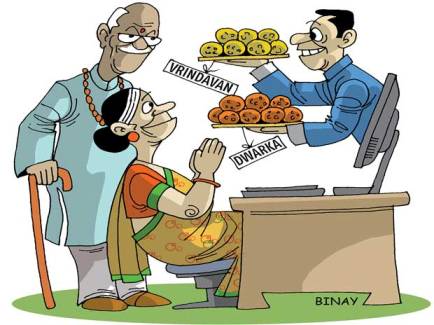 Online
prasad and virtual aarti are passe. To secure a bigger chunk of
the spiritually-oriented, e-commerce sites in the religious segment
are now going beyond commoditised services.
Online
prasad and virtual aarti are passe. To secure a bigger chunk of
the spiritually-oriented, e-commerce sites in the religious segment
are now going beyond commoditised services.
So, ready yourselves for combo offers tailor-made for your kind
of devotion. OnlinePrasad, the largest player in this sector,
has launched a combo offer for devotees of Lord Krishna. Goonjan
Mall, founder, OnlinePrasad, says the site has increased its catchment
area from four temples to 50, as devotees are no longer happy
with prasad from the Mathura temple alone and want prasad from
all leading Krishna temples in India.
During Janmashtami, OnlinePrasad launched a ‘two-plus-one’ scheme,
which provided prasad from the Vrindavan, Dwarka, Srinathji, Puri
Jagannath, Pandharpur Vitthala and Goverdhan Giriraj Dharan temples.
The company’s Zevotion brand accounts for about a third of the e-commerce site’s revenue. Launched six months ago, it offers rudrakshas and idols. Mall says Zevotion is India’s first devotional brand.
Another popular site, Saranam.com, offer services that combine astrology and pujas. It offers analysis of horoscopes, as well as pujas, depending on various planetary positions, on an annual subscription basis. It has a monthly customer base of about 4,000 to 5,000. Such devotion has a material aspect, too. The site charges $2,750 (Rs 1.6 lakh) a year for this service, Talisman, which includes pujas, homams, consultation and shipping charges.
"In the recent past, we have seen a lot of interest from non-resident Indians who are unable to do pujas every month at their favourite temples in India. The ‘Talisman’ package will help them with pujas according to their planetary positions through the year, with delivery of prasad to their doorsteps," says Mahesh Mohanan, founder of Saranam.com.
The site also sells rudrakshas, and claims these are value-added through pujas. Launched in Chennai in 1999, Saranam.com plans to launch travel services to various temples across the country soon. When money comes in, can private equities be far behind? OnlinePrasad plans to raise a second round of PE funding and is engaged in talks with various firms. Expansion plans include those for product launches under Zevotion, scaling up temple reach, logistics, and promotion & marketing. A year ago, OnlinePrasad raised angel funding from GrowthStory (an investment company founded by Krishnan Ganesh and Meena Ganesh) by divesting 35 per cent stake.
Devangshu Dutta, chief executive of Third Eyesight, a retail consultancy, said, "The market related to religion and spirituality will always see growth, as customers are unlikely to cut expenditure, even in a downturn." He added these sites could gain significant margins by selling products and services, as these weren’t standard and varies from sites to sites. In India, temples have seen good growth in annual revenue.
Last year, Tirupati Devasthanam in Andhra Pradesh earned revenue of Rs 2,260 crore. Annual revenue of other religious sites such as the ShirdiSaibaba and Siddhivinayak and Puri Jagannath temples, as well as the Vaishnodevi shrine, stands at Rs 100-1,500 crore each.
(Published in Business Standard.)
admin
August 19, 2014
Mihir Dalal, Mint
Bangalore, 19 August 2014

Retailer Arvind Ltd will start an e-commerce website that will sell personalized or customized shirts, trousers and suits under the Creyate brand, in a move that illustrates the growing popularity of online shopping.
Arvind will also launch a fully-fledged e-commerce site that will sell all its owned and licensed brands, including Flying Machine, Arrow and Tommy Hilfiger, next year, executive director Kulin Lalbhai said. The company hopes to generate sales of Rs.1,000 crore over the next three years from its e-commerce business, he said.
“As physical (organized) retail was in the nineties, we see e-commerce as the next big thing. We are convinced that a large part of the consumption will move toward e-commerce. As a company which wants to be the largest player in brands and fashion, we feel e-commerce should be central to our vision,” Lalbhai said.
Arvind has formed a separate unit called Arvind Internet Ltd, headed by Tejinder Singh, a former executive at Times Internet. Arvind Internet has hired more than 40 executives, mostly from e-commerce firms such as Flipkart and Times Internet.
Arvind was planning to launch an online personalized apparel retail business within the next three months, Mint reported on 10 June.
Retailers such as Shoppers Stop, MobileStore, Croma and Spencer’s Retail have been talking up their strategy of integrating their stores with their websites and trying to make e-commerce a crucial medium of sales. Online retail is worth $3.1 billion, or 10% of the organized retail market, and is estimated to grow to $22 billion, or over 15% of the organized retail market, in five years, according to a November 2013 report by brokerage CLSA.
The growth of online retailers such as Flipkart and Snapdeal has hurt offline retailers, as customers have been lured by attractive discounts and the convenience of home delivery. Many retailers had asked brand manufacturers, who are also suppliers to online firms, to persuade e-commerce sites to reduce their discounts.
These steps are unlikely to work as analysts say e-commerce has become too large a medium for brands to ignore and the best approach for offline retailers would be to make a serious attempt at having some kind of an online business.
"The biggest difference between running a traditional retail business versus an e-commerce site is the pace at which you have to make decisions," said Devangshu Dutta, chief executive of retail consultancy Third Eyesight. "In e-commerce, things such as inventory management, merchandising, pricing, promotions, etc., have a much shorter life span and a company has to be very fast on its feet to manage these things. Even customer acquisition costs are significantly higher in e-commerce, and logistics management is a complex problem. All this shows that it not easy for a traditional retail business to make a transition into e-commerce."
On its part, Arvind is launching Creyate in international markets, such as the US, as well as in India. The brand will also launch stores in 15 cities within the next year. These will be equipped with state-of-the-art technology to allow shoppers to customize all aspects of shirts, trousers and suits, such as material, sizes and features, Arvind’s Lalbhai said.
The website, which will be called Creyate.com, and the stores will take about 12 days to deliver products initially. Arvind has set up a separate factory for the Creyate business.
(Published in MINT.)
admin
August 10, 2014
 G Seetharaman,
The Economic Times
G Seetharaman,
The Economic Times
New
Delhi, 10 August 2014
 It
turns my stomach. It’s a bad customer experience," says Michael
Adnani, vice-president of retail at Flipkart, about its website
crashing on August 5.
It
turns my stomach. It’s a bad customer experience," says Michael
Adnani, vice-president of retail at Flipkart, about its website
crashing on August 5.
The third batch of 15,000 Xiaomi Mi3 phones, of which Flipkart is an exclusive seller, had been lapped up in all of two seconds. The site had also gone down on July 22, when the first bunch of Xiaomi Mi3 phones were sold in under 40 minutes, and on May 14 when Moto E went on sale on the site. Flipkart has sold over a million units of Moto G, Moto E and Moto X, all available only on its portal, since February, and 35,000 units of Xiaomi Mi3 which saw ten times as many people pre-registering for the first two flash sales (the figure for August 5 is not public yet).
Partnering with brands to be their exclusive sales partner seems to be the flavour of the season for e-commerce companies. Amazon, the world’s largest online retailer, earlier this week announced that it would be the sole seller of Microsoft’s interactive entertainment products in India, including the latest version of its gaming console, Xbox One, which will be available on September 23, and for which Amazon has started taking pre-orders.
Amazon had in July inked a similar agreement with Samsung for its Galaxy K Zoom phone, and with low-cost Indian mobile handset maker Karbonn a month earlier for its Titanium Hexa. But given the might of brick-and-mortar stores, most of these brands might find it difficult to completely ignore them in the long run. Organized retail, after all, is 20 times as big as online retail, and even with the rapid growth of the latter, will be nearly five times as large in 2020.
Turning Point
While brand exclusivity is not new to e-commerce firms — and certainly not to retailers — the trend has snowballed since the success of Motorola’s partnership with Flipkart to make a reentry into India. Motorola, which Google bought for $12.5 billion in 2011 and sold to Chinese computer-maker Lenovo for $2.91 billion in January this year, while retaining most of its patents, has since edged past Nokia to become the fourth largest smartphone maker in India. According to Counterpoint Technology Market Research, in the April-June period, Motorola’s market share was 4.3%, behind Samsung’s 25.3%, Micromax’s 19.1% and Karbonn’s 5.9%.
Adnani says while Flipkart had exclusive tie-ups with companies before, the Motorola partnership was the first one where the exclusivity applied to the brand’s entire portfolio, including accessories like phone covers. "Discussions with Motorola started about 90 days before the launch of Moto G on February 6," he says. He adds that higher margins are not the reason for these exclusive partnerships."We are able to plan the products as we see fit for the Indian consumer."
Saloni Nangia, president of Technopak, a consultancy, says it would have been difficult for Motorola to create a conventional distribution network for Moto G. Exclusive partnerships may entail promotion by the e-tailer.
"From the brands’ point of view, the big win [of an exclusive partnership] is the huge amount of visibility they get because it is in the interest of the ecommerce partner to provide that extra push," observes Devangshu Dutta, chief executive of Third Eyesight, a retail consultancy.
Tony Navin, senior V-P of electronics at Snapdeal, says a brand could save 8-20% by taking the online-only route.
For e-tailers, Dutta adds, exclusive partnerships are a way to create differentiation. "In the past 2-3 years, their growth has come from discounting which is not sustainable." If a portal is the only seller of a product, consumers cannot compare prices on different websites and even at retail stores.
Having said that, Indian e-tailers would do well to learn from some unsavoury fallout of exclusive partnerships abroad.
The Flip Side
When American singer Beyonce launched her selftitled album only on iTunes late last year, Amazon and supermarket chain Target refused to stock CDs of the album.
Back home Nilesh Gupta, managing partner of Vijay Sales, an electronics store chain, says he has no option but to play hardball with companies sometimes. "If two out of a company’s 10 products are doing very well, and they are both exclusive to an online retailer, I will tell the company to take the other eight online too." When renowned literary agent Andrew Wylie, who represents Philip Roth and Salman Rushdie, in 2010 announced that e-books of classics like John Updike’s Rabbit series and Vladimir Nabokov’s Lolita would be available only on Amazon, publishers protested saying they owned the electronic rights to those books.
Talking of books and exclusive deals, Rupa Publications has signed an exclusive agreement with Flipkart to take pre-orders and sell bestselling author Chetan Bhagat’s upcoming book, Half Girlfriend, available from now to a month after its October release. Kapish Mehra, MD of Rupa, says Flipkart is only the exclusive online partner and that the book would be available at physical bookstores from the day of its release. "Everytime you do something innovative and different, it gets people talking. We saw it with the announcement itself, which generated a lot of buzz," says Bhagat.
Riding the Boom
The online retail market in India is expected to grow from just $2.3 billion, or 0.4% of the country’s overall retail market in 2014, to $32 billion, or 3% of the retail market in 2020. In the same period, the share of organized brick-and-mortar stores is set to rise from 8.4% to 14% (unorganized retail will still dominate).
While Motorola is used to selling at physical stores, four-year-old Xiaomi sells only online and did not want to alter its strategy in India. "We save a huge amount of margin by selling online which we then pass on to customers. Also, we don’t do promotions because the customer ends up paying for it," says Manu Jain, head of Xiaomi India. Xiaomi Mi3 is priced at Rs 13,999. "We chose Flipkart as an exclusive partner because of their technology and their track record in delivery and solving customer problems," says Jain. Flipkart was recently valued at $7 billion in a $1-billion fund-raising round.
Exclusive partnerships have now gone beyond mobile phones, with Myntra, which Flipkart bought in May, bagging the exclusive rights to SuperDry footwear and accessories collection, and Amazon being the sole launch partner for Whirlpool’s KitchenAid appliance range. Among the most prominent brands, Amazon now has Xbox One in its ‘exclusive’ portfolio.
Anshu Mor, director, interactive entertainment business of Microsoft
India, said unlike mobile phones the market for gaming consoles
in India is underdeveloped: "There is not enough awareness
on what all you can do with a console. We have not been able to
address that offline, and the youth audience we are targeting
is natively digital." He adds that Microsoft chose Amazon
as it was still in "market creation mode" and hence
wanted to have just one partner to drive a concentrated effort
in creating awareness about the product. Kumar says Microsoft
and Amazon look to tap 6 million potential users of high-end console
gaming. 
Xbox One retails for Rs 39,990. While the Indian gaming industry is set to double in size to Rs 4,200 crore by 2017, the share of consoles will likely slip from 50% to 45%, thanks to the increasing popularity of mobile gaming. Globally, investors have been calling for Microsoft to junk Xbox, owing to its struggle against market leader Sony PlayStation.
The Online Advantage
Among the aces up the e-tailers’ sleeve is the data they have on purchase patterns by demography and geography. "If an exclusive launch is doing well in the north and not in the south, you can devise deals and promotions accordingly. In offline sales, that data will take a few days to come while here it is immediate," says Navin. What is common to brands like Motorola and Xbox is that they are trying to establish or restablish their presence in the market.
"Any e-tailer who is pragmatic would not expect long-term exclusivity. As a brand scales up and becomes more desirable, it has no option but to be available across multiple channels," says Dutta.
Exceptions to this could be brands like Xiaomi which are resolutely web-only. "If someone doesn’t have access to the internet today, they can just use their smartphone," says Amit Boni, general manager for India at Motorola Mobility.
However, Gupta of Vijay Sales feels Motorola’s smartphones should also be available at retail outlets soon, to which Boni says, "As of now this is an exclusive partnership. We would continue to sell our products through Flipkart in the foreseeable future." But, he also says that Motorola expects to have its products "widely available".
Even as more and more people, even in smaller cities, get comfortable with buying online, brick-and-mortar stores continue to grow and wield no small influence.
While several luxury brands have spurned online platforms in
favour of the actual store experience, brands whose USP is their
attractive pricing and who rely on volumes may have to reach customers
through as many avenues as possible.
(Published in The Economic Times.)
admin
July 25, 2014
Nikita
Garia, Mint
Bangalore,
25 July 2014
 Meru
Cabs, India’s largest taxi fleet operator, plans to start
services outside India by the next financial year and is evaluating
entering countries such as Malaysia, Vietnam, Myanmar, Nepal,
Bangladesh and Sri Lanka.
Meru
Cabs, India’s largest taxi fleet operator, plans to start
services outside India by the next financial year and is evaluating
entering countries such as Malaysia, Vietnam, Myanmar, Nepal,
Bangladesh and Sri Lanka.
“There are many countries around India which face similar
problems related to taxi service—a huge consumer need and
gaps in services,” chief executive officer Siddhartha Pahwa
said on Thursday. “We have the capability to address these.”
Meru Cabs is not the only one planning an overseas foray. Rival
TaxiForSure is also firming up plans to start operations abroad.
“We are looking at launching overseas early next year,”
said Raghunandan G., founder and director at TaxiForSure. He declined
to elaborate as the plans are in a preliminary stage.
However, Raghunandan said it makes more sense for TaxiForSure
to go abroad as the company works on a so-called asset-light model
and does not own cars, unlike Meru Cabs. “With our existing
model, we would be better positioned to tackle the international
market,” he said.
Companies such as Olacabs and TaxiForSure do not own vehicles
but work as aggregators.
Meru Cabs, which started operations in 2006 by creating its own
fleet of cars, has been trying to move to an aggregator model
since 2012.
Currently, Meru Cabs is evaluating the kind of model it would
follow abroad and the capital investment that would be required
to operate internationally.
“It will be a significant investment,” said Pahwa,
without disclosing the amount as the company is still working
on details such as whether it would have to open call centres
abroad or operate completely via a mobile app, acquire taxis in
those countries or aggregate those already run by other operators.
The move to go international comes at a time when competition
in the Indian taxi industry is intensifying, with local firms
attracting investor interest on one hand, and international companies
eyeing the Indian market on the other.
In recent months, Olacabs and TaxiForSure have raised funds.
In contrast, Meru’s growth has been almost entirely been
funded by equity capital. Private equity firm India Value Fund
owns 85% in Meru. San Francisco-based Uber had launched its India
operations in August last year with its luxury car service UberBLACK
and introduced the lower-priced service UberX last month.
Meru’s plans to launch elsewhere are afoot even as it looks
to expand in more cities across India. It is present in eight
cities including Hyderabad, Bangalore, Mumbai and Delhi and is
planning to expand operations to 20 cities within the next 12-18
months. It had recorded a positive profit after tax for 2013-14
and expects to post Rs. 650 crore revenue this fiscal year compared
to Rs. 395 crore a year ago.
TaxiForSure is also looking to expand its footprint in India
as it looks to enter 22 cities by end of this year, said Raghunandan.
It now operates in Ahmedabad, Bangalore, Chennai, Delhi and Hyderabad.
Olacabs is not looking to expand outside India as it deems India
to be a large enough market at this point. “India is a sizeable
market and there is a genuine taxi problem to be solved here before
we can think of moving elsewhere,” said Anand Subramanian,
director of corporate communications at Olacabs. Olacabs has so
far covered nine cities with the launch of its operations in Chandigarh
on Thursday.
Analysts say establishing a successful operation outside India
won’t be easy as taxi is a very local business.
“The companies will have to deal with the complexities of managing new markets and invest on marketing and technology,” said Devangshu Dutta, chief executive of retail consultant Third Eyesight.
(Published in Mint.)
