
admin
March 29, 2022
Writankar Mukherjee & Sagar Malviya, Economic Times
Kolkata / Mumbai, March 28, 2022
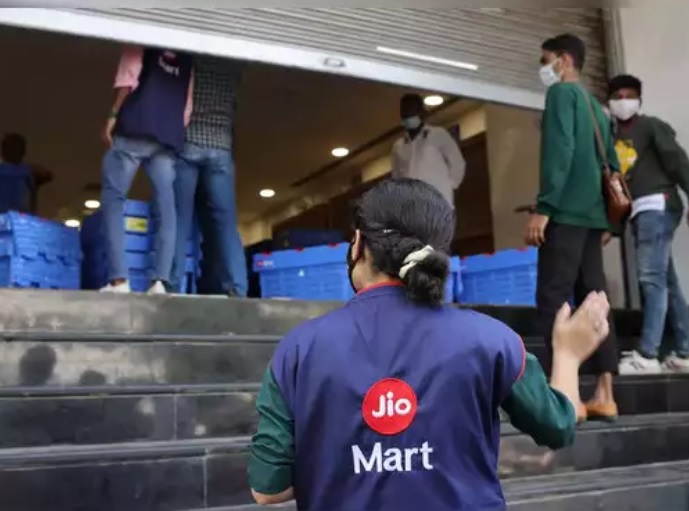
The war for instant grocery delivery is going to intensify with Reliance Retail entering the segment with its JioMart platform. The company will start the trial in next 2-4 days in Navi Mumbai for ‘JioMart Express’ which will sell and deliver around 2,000 stock keeping units (SKUs) in a few hours, two senior industry executives aware of the plans said.
Reliance has plans to take instant grocery sales to over 200 cities and towns where JioMart is currently operational by end of next quarter and double the reach in next few months to make it India’s largest instant grocer. The company will also tap its network of kirana stores for such fulfillment, apart from its own chain of grocery stores, the executives said. It is testing a separate app for express grocery deliveries as well as integrating it into the JioMart platform.
The plans of India’s largest brick-and-mortar retailer to enter quick commerce is to further grow its e-grocery business and Reliance will compete against Tata-owned Big Basket which will launch it in April, Zomato-funded Blinkit, Swiggy’s Instamart, Walmart-owned Flipkart Quick and Zepto. Earlier this year, Reliance had led a $240 million funding round in quick commerce hyperlocal firm Dunzo owning the largest 26% stake.
“JioMart Express will utilize Dunzo in the markets where it is strong like the metros as well as its own delivery fleet. JioMart Express can be quickly scaled up since Reliance has onboarded lakhs of kiranas under its B2B programme ‘JioMart Partner’ who buys the merchandise from Reliance and sells through the JioMart platform,” an executive said.
An email sent to Reliance Retail remained unanswered till Sunday press time.
Devangshu Dutta, chief executive of consulting firm Third Eyesight, said Reliance needs to ensure that it is in the right catchment which has a high concentration of demand, low competition and keep supply centres close to it to make instant grocery service profitable. “Margin contribution is low in grocery and hence apart from these there could be a higher focus on high margin products in the assortment,” he said.

To be sure, quick commerce is not new for Reliance Retail. It has been delivering orders in less than three hours placed through Reliance Digital online or app for smaller consumer electronics such as mobile phones and laptops. “However, order volumes are going to be much more frequent in grocery, and hence it would need a robust backend and delivery fleet,” an executive said.
While the pilot in Navi Mumbai will start with 1-3 hours delivery time, Reliance will progressively reduce the delivery time to match the industry standard of 45 minutes to an hour and will also expand the range. According to researcher RedSeer, India’s quick commerce market is all set to grow 15 times by 2025 reaching a market size of close to $5.5 billion. Online shoppers in the metros have been using quick commerce for their unplanned and top-up purchases.
(Published in Economic Times)
admin
September 8, 2015
 Devina
Joshi, Financial Express
Devina
Joshi, Financial Express
Mumbai,
8 September 2015
 E-commerce,
as we know it, is old news. Hyperlocal is the hot new buzzword
in retail hallways, going by the recent spate of well-funded launches
in this space. There is already a wide range of services on offer,
from grocery delivery to home, office and personal care services.
Hyperlocals, services-based or inventory-based, are largely an
urban India phenomenon. Services are hyperlocal by their very
nature, driven by locality or communities. When moving into a
new city, for example, people would like to stabilise as quickly
as possible and here, such services step in.
E-commerce,
as we know it, is old news. Hyperlocal is the hot new buzzword
in retail hallways, going by the recent spate of well-funded launches
in this space. There is already a wide range of services on offer,
from grocery delivery to home, office and personal care services.
Hyperlocals, services-based or inventory-based, are largely an
urban India phenomenon. Services are hyperlocal by their very
nature, driven by locality or communities. When moving into a
new city, for example, people would like to stabilise as quickly
as possible and here, such services step in.
To put the whole picture in context, the Indian retail industry
is worth $500-600 billion. Of this, grocery items account for
about 67% of the revenue. However, in case of fast moving consume
goods (FMCG) and grocery, modern retail formats account for less
than 10% of the total sale. E-commerce or hyperlocals are obviously
a tiny part of the pie just yet. Most companies, therefore, are
still at a stage where they have to prove their business models
and change consumer behaviour.
While on-demand grocery delivery—the model that players
such as Grofers ride on—has immense potential in this space,
other high potential categories include delivery of services (such
as supplying peons/delivery boys, specialised laundry services,
plumbers or electricians), price comparisons, food ordering apps,
etc.
Hyperlocal startups in India
It is a no-brainer that an aggregation model, since it is asset-light,
is less capital-intensive than the inventory-led one. Moreover,
it is easier to scale up such a model. The new generation of hyperlocal
start-ups is coupling aggregation with logistics/delivery, thus
controlling even the last mile.
Take Zopper, a product-based hyperlocal which started off as
a price comparison website for electronics but now is a platform
for purchasing products from offline stores. It counts on faster
delivery through tie-ups with local shops near a buyer. “City
by city, we need to bring more merchants on board, and all they
have to do is download an app and their product can be listed
on Zopper,” says Neeraj Jain, CEO, Zopper. The company’s
margins vary from 2-8%.
Home services start-up Taskbob, founded by Aseem Khare, charges
a 20% commission from its servicemen. Product price comparison
website MySmartPrice works on commission too, while providing
a free six-month on-board period to offline sellers, where they
can use the platform for gaining traction. The revenue model of
BookMeIn, another home services company, includes a monthly subscription
fee for a SaaS-backed system given to service providers to manage
their business. Further, it gets revenues on leads/bookings done
by customers on the website, along with revenues through ads of
service providers. So what’s working in their favour?
A fertile environment
Indian retail is still dominated by brick-and-mortar stores, which,
oddly, is an opportunity in disguise for hyperlocal players. Unlike
non-hyperlocal e-commerce, these start-ups are not really competing
with offline retailers, but are partnering them instead.
Hyperlocal business models spell instant, on-demand delivery as
they cater to needs of a more immediate nature. The gratification
is far more accelerated – the entire transaction can be completed
in an hour sometimes. Customers also tend to trust hyperlocals
more than non-hyperlocal e-commerce websites, as the stores they
buy from through online platforms have a physical presence, making
it possible to attend to any grievances quickly. Further, the
start-up can tap into existing infrastructure, acting as a bridge
between existing retailers and the consumer.
“Due to the convenience factor, by being able to tap
into consumption opportunities that might have otherwise been
missed, the aggregator can actually drive new demand to the retailer
in the short term,” says retail consultant Devangshu Dutta,
chief executive, Third Eyesight.
Within hyperlocals, services have higher margins of around 20%
as opposed to product based models which earn 2-10% margins or
even non-hyperlocal e-commerce companies, which operate on 3-7%
margins, depending on the category.
This is because there is virtually no warehousing, inventory management or logistics involved in a services hyperlocal. Within services, food-ordering apps have an added advantage of the frequency of purchase as opposed to, say, e-commerce products. “The category is a high-repeat one as opposed to home repair for example,” says Saurabh Kochhar, co-founder and CEO, India, and chief business officer, global, Foodpanda.

A word of caution
While it ensures higher margins, replication of a services model
is much more difficult. Training of people in services is very
difficult as each individual has to be available wherever the
customer is located. “Second, when a product delivery happens,
I need local people to deliver it but if a person is coming to
give a service, he represents your brand and should know how to
handle a customer,” says Alagu Balaraman, partner and MD,
Indian operations, CGN Global India, a supply chain management
consulting firm.
Third, as the services industry is rather fragmented, it is difficult
to form partnerships with associations or groups of such service
providers, as specialists are spread out across the country. Fourth,
creating a need for services might be difficult as people may
already have their own local set-up in place. “But that mindset
is changing, with a large group of urban people who don’t
have the time or patience and need professional services,”
he says.
The biggest learning will be the capability to scale. A hyperlocal that focuses on a single ‘locality’ will find it difficult to get the scale needed to create an economically viable model. Being able to identify a widespread but local need, and having a model that adapts to each new market will be crucial.
(Published in Financial Express.)
