
admin
November 4, 2022
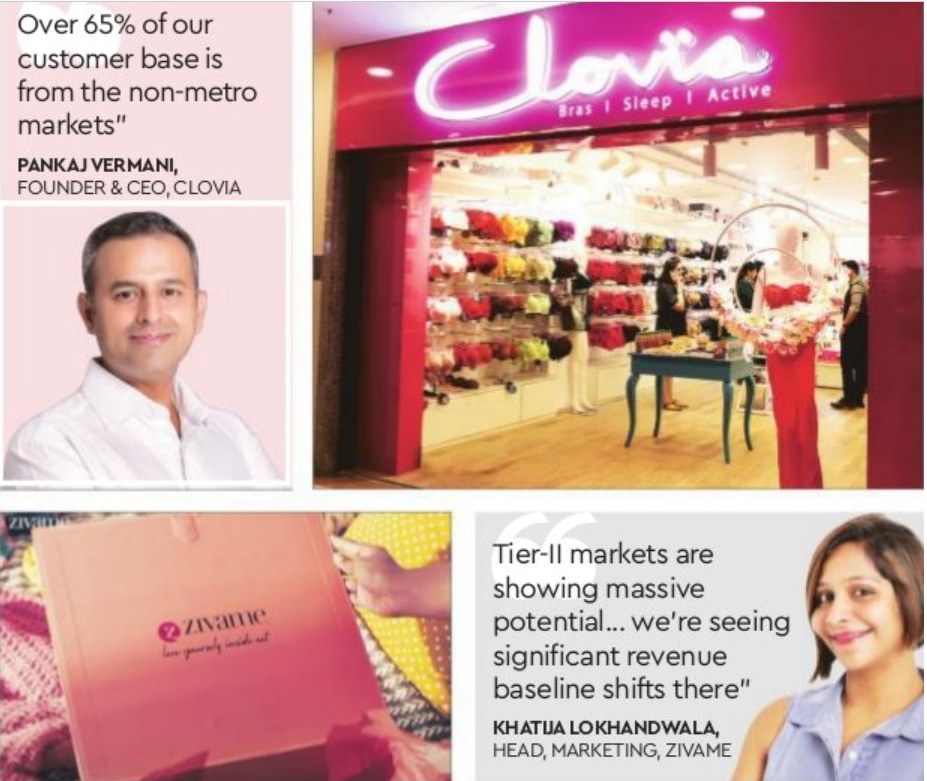
Christina Moniz, Financial Express / BrandWagon
November 4, 2022
Direct-to-consumer (D2C) lingerie brands, often credited with transforming the category and the way women shop for innerwear, are expanding their offline footprint in response to growing demand from tier-II markets and beyond. Zivame, whose journey began online just over a decade ago in 2011, has grown its offline presence to over 120 stores and also sells through over 4,000 partner outlets. In its recently concluded Grand Lingerie Festival, Zivame saw its sales grow three times,with a 120% increase in new customer acquisition. “Tier-II markets are showing massive potential and though tier-1 remains our highest revenue contributor, we are seeing significant revenue baseline shifts in tier-II locations,” says Khatija Lokhandwala, head of marketing at Zivame. The company has announced that its focus will be retail expansion in the second half of this fiscal, going beyond metros and tier-I markets.
Another decade-old D2C player in the innerwear segment, Cloviais eyeing the immense opportunity presented by smaller markets with aggressive expansion plans in place. “Clovia currently has 45 exclusive brand outlets in the country and has been diversifying its product range, with plans to open 130 outlets by the end of this fiscal. Ours has always been a mass- market brand, and most of the repeat customers come from tier-II and tier-III markets,” explains Pankaj Vermani, founder and CEO, Clovia. He notes that over 65% of its customer base is from the non- metro markets, and average order values are 20% higher in these cities compared to the metros. Earlier this year, Reliance Retail Ventures acquired an 89% stake in Clovia’s parent company (Purple Panda Fashions) for Rs. 950 crore. Vermani adds that Clovia will ben- efit from the conglomerate’s scale and retail expertise, driving up growth and love for the brand. Reliance Retail had picked up 15% stake in Zivame back in 2020.
Shaping the market
The women’s innerwear market in India is set to double to reach $11-12 billion by 2025, according to a report by RedSeer. Aside from the key segments of bras and panties, ancillary products like athleisure, sleepwear, swimwear and lounge wear are also boosting the lingerie category’s growth in the country, as is evident from the widening portfolios of leading brands. The online segment for women’s innerwear is expected to become a $1 billion market by 2025.
Experts believe there is a large opportunity for companies to grow since 60% of the $6-billion women’s intimate wear market in India is unorganised, and the category is still largely underserved.
“The lingerie market is an example of improving supply feeding into a growing demand, and the increasing demand expanding the opportunity for more brands to step in. Larger cities, with their higher income profiles and demand concentration, are the logical first-choice market for companies such as Zivame,” points out Devangshu Dutta, CEO, Third Eyesight.
The competition in the large cities is greater, with a plethora of Indian and global brands, which is why Dutta recommends that e-commerce led companies should push aggressively in smaller markets to drive sustained growth.
The fact that D2C brands have better data sets at their disposal to glean insights about Indian women and their concerns when buying innerwear has also worked in their favour.
“Intimate wear shopping can be overwhelming for a lot of women. Finding the right size and choosing styles for their specific needs requires an environment free of embarrassment and judgement. At Zivame, we help women choose the right size and perfect fit, ensuring a private, comfortable and discreet shopping experience,” says Lokhandwala.
While lingerie can sometimes be prohibitively expensive, Vermani points out that Clovia’s feedback-led design approach helps it keep pricing competitive.
The brand creates each product in small quantities, and uses technology to predict future sales based on customer feedback, thereby determining the right quantities for production. He states, “With this approach, we have created a fashion brand that is low on cost, high on consumer appeal and efficient in inventory, leading to better margins and cash flows.”
(Published in Brandwagon, Financial Express)
admin
November 3, 2022
The organised traditional snacks market in India is expected to double to Rs 20,400 crore by fiscal 2026, according to Bikaji Foods, aided by rapid urbanisation, a shift towards branded products and export demand.
Written By Devika Singh

Bikaji Foods is the largest manufacturer of Bikaneri bhujia with an annual production of 29,380 tonnes. (Image credit: www.bikaji.com)
A few years back, chips and kurkure packets would mostly adorn aisles in grocery shops across the country but now they jostle with enticingly packed bhujia, sev and other local savouries.
The upcoming initial public offering (IPO) of Bikaji Foods has put the spotlight on the huge inroads made by traditional snacks in the organised packaged snacks segment.
Till a few years ago, the traditional segment was mostly unorganised but bhujia, chana chor garam, ganthia, bhel puri, among others, have made their place in the organised packaged snacks market. Though western snacks like chips still dominate packaged snacks, with a 57.2 percent market share, traditional Indian sweets now command a 42.8 percent share. Of this, the traditional savoury bhujia has a 15.9 percent share.
A few years ago, these snacks were sold by small regional players, often loose, while organised players like Haldiram’s, Bikaji Foods, Bikano had a small share in the packaged snacks market.
“The traditional Indian snacks segment had been a fragmented market mostly sold by individual retailers and the brands in it were small,” said Devangshu Dutta, chief executive at retail-focused consultancy Third Eyesight.
However, with the introduction of packaging and processing along with the consumer preference for local taste, Indian brands have significantly picked up the pace.
According to the draft red herring prospectus (DRHP) filed by Bikaji Foods, the overall market for savoury snacks was valued at Rs 75,100 crore in FY22, in which the organised segment had a 56.3 percent share at Rs 42,300 crore. Of this, the organised ethnic or traditional snacks market was Rs 11,400 crore and expected to grow at a compounded annual growth rate (CAGR) of 16 percent to reach Rs 20,400 crore by FY26, said DRHP. This sub-segment was valued at Rs 5,700 crore in FY15.

Haldiram’s (Delhi and Nagpur), as per an IPO note issued by Axis Capital, have the largest share of the traditional savoury snacks market in India at 38.5 percent, followed by Balaji at 9.6 percent, Bikaji at 9 percent, Bikanervala (Bikano) at 6 percent and PepsiCo at 3 percent. Haldiram – Prabhuji (Kolkata), Prataap Snacks, DFM Foods and other organised players have the rest of this market.
Here are a few factors that have led to the growth of traditional savoury snacks in India.
The Covid factor
The entire market for savoury snacks, Western and traditional, has been rapidly growing, triggered by Covid-19-led restrictions in 2020 and 2021. “Snacking in between meals has always been traditional in Indian culture and Covid-19 forced lockdown has increased this habit of snacking multi-fold and is driving the growth of this industry,” said Bikaji Foods’ DRHP. The document projects the overall market for savoury snacks, which stood at Rs 75,100 crore in FY22, to reach Rs 1,22,700 crore by FY26. The DRHP added that increased concerns over health and hygiene are also pushing consumers towards the organised market and branded products will be a major beneficiary of this growth.
Rapid urbanisation
According to the DRHP, while traditional savoury snacks were consumed in specific regions earlier, with urbanisation and working population migration to different regions the demand for regional snacks is increasing pan-India. This has led to the domestic expansion of many regional players like Bikaji and Chitale, it added.
Packaging and processing
As stressed by Dutta of Third Eyesight, several traditional snacks were not sold in packaged form earlier but brands are launching more and more products from Indian cuisine in the packaged form now. Bikaji’s DRHP says this trend is expected to continue as companies discover processes to increase the shelf life while retaining the authentic taste of traditional food.
The shift towards branded products
Consumers who earlier used to buy traditional snacks in loose and unbranded forms are switching to branded, packaged products now. “The boom in branded or organised namkeen is driven by consumers who are upgrading from unbranded segment rather than consumers of western snacks shifting to ethnic segment,” said the DRHP.
The rise in exports
Home-grown companies such as Bikaji, Haldiram’s, Bikano have also cracked the export market over the years and their products can be found in several countries abroad. “Earlier, these products were found in stores catering to the Indian diaspora in the US, the UK, or Canada but now they have even made their way to large chains,” said Dutta. Bikaji, for instance, drew about 5 percent of its revenue from exports in FY21. The company currently exports to 35 countries.
Source: moneycontrol
admin
October 31, 2022
Written By Faizan Haidar, ET Bureau
Synopsis
“Physical spaces are built to encourage lifestyle-oriented consumption, moving away from hard sales push. Hence, given the current retail real estate supply, there is a strong likelihood that retail spaces where experiences can be curated will be in short supply even in large cities,” said Anshul Jain, managing director, India and Southeast Asia.

India’s top three cities will need 9 million square feet of retail space every year till 2027 to reach the level of organised retail area available in a country to match cities of a small country like Vietnam’s retail space per capita (RSPC), according to an analysis by Cushman & Wakefield. Currently India adds about 3.8 million sq ft of retail area every year with developers mostly focusing on office and residential assets.
Source: economictimes
admin
October 29, 2022
By Pranav Balakrishnan & Writankar Mukherjee

“Walmart and Ikea are currently in a market acquisition mode in India to establish a dominant position and may sacrifice profit in the short term,” said Devangshu Dutta, chief executive of consulting firm Third Eyesight. “But in the long term, these companies will definitely chase profit in India. Also, the market environment has been tough last fiscal due to increased competition despite a bounceback post-Covid,” he said.
Walmart is yet to publish the FY22 results of Flipkart India Private Ltd, which is a business-to-business entity which supplies goods to online sellers and also Flipkart’s online B2B business. The entity posted a revenue of Rs 7,840 crore in FY21.
Furniture and home décor store Ikea India reported revenue from operations at Rs 1,076 crore in 2021-22, while the net loss was Rs 902 crore.
In the filings, the company said it continued to work on its plans towards positioning, growth and profitability of the omni-channel business in India. It said expansion plans and operations were impacted due to Covid-19 in FY22, but the management is optimistic about future prospects.
Of the Walmart arms in India,
Flipkart Internet, posted a 33% rise in operating revenue of Rs 10,476 crore in the year ended March 31, 2022, while its loss widened to Rs 4,361 crore from Rs 2881 crore in FY21. The filings showed the company spent Rs 5,045 crore in delivering orders, which was 46% higher compared with the year before, while advertisement and promotional expenses almost doubled to Rs 1,945 crore from Rs 1,073 crore.
The company’s revenue comes from multiple sources, including platform fees collected from sellers, and services such as shipping and carrying advertisements. Revenue from marketplace services remained largely flat at Rs 2,823 crore while that from advertisements increased 50% to Rs 2,083 crore. The Indian company is the top contributor to parent Walmart’s ad revenue globally. Revenue from logistics services grew 57% to Rs 3,848 crore.
Meanwhile, Walmart India – which owns and operates 28 cash and carry wholesale stores – posted 6% jump in revenue at Rs 5362 crore in FY22, while net loss went up by 49% at Rs 299 crore as compared to the year ago.
Myntra Design, the Walmart entity which owns the fashion marketplace Myntra,
reported a 45% jump in revenue from operations to Rs 3,501 crore while losses widened 40% to Rs 597 crore in FY22. Revenues of Myntra Design come from commission and service charge collected from brands and sellers on the platform.
Revenue from marketplace service increased 18% to Rs 1,610 crore, while income from logistics services almost doubled to Rs 1,498 crore and revenue from advertisement jumped 76% to Rs 344 crore.
ET reported on September 13 that Amazon Seller Services, which runs the Amazon India marketplace, reported a 32% jump in overall revenue to Rs 21,633 crore on a standalone basis in FY22.The local unit of Seattle-based Amazon had also cut losses by almost 23% to Rs 3,649 crore in FY22.
Source : economictimes
admin
October 28, 2022
Christina Moniz
Mumbai, October 28, 2022
Earlier this week, global soft drinks major Coca-Cola Company announced that its Iemon and lime flavoured carbonated drink, Sprite, had become a billion-dollar brand in the Indian market. While Chairman and CEO James Quincey attributed much of Sprite’s India success to “locally adapted, occasion-based global marketing campaigns and screen time,” industry experts outline a few other factors such as consumer preferences that have also worked in the brand’s favour.
Lemon and lime drinks are not new to the Indian consumer’s palate, which provides a large baseline demand for brands such as Sprite, remarks Devangshu Dutta, CEO, Third Eyesight. “Some consumers also perceive clear lemon-based and non-caffeinated drinks to be more natural and healthier than colas, even if the actual ingredients may be far from healthy,” he says.
This set of consumers is seemingly quite large as according to a syndicated study by Kantar, Sprite has a household penetration of 11%, which is the highest for a beverage brand.
What have helped are the lingering doubts over cola beverages after the pesticide controversy in the early 2000s, giving brands like Sprite a leg up. While the pesticide allegations are no longer a talking point, Naresh Gupta, cofounder and chief strategy officer, Bang In The Middle, points out that social media and unsubstantiated Whatsapp forwards continue to create concern around the consumption of colas.
“Although cola brands dominate the aerated drinks market, brands like Sprite carry the imagery of being a safer drink and so a large section of consumers see it as an alternative. Credit also goes to Sprite’s communication, which has made it a cooler, friendlier brand. Contrast this with the colas, which have a more hard-core imagery attached to them,” explains Gupta.
Keeping It Clear
In 1999, Sprite was launched in India with the tagline, ‘Sprite bujhaye only pyaas, baki all bakwaas, positioning itself as a basic thirst quencher. Since then, it has continued with the same positioning although its taglines changed regularly- from ‘seedhi baat, no bakwaas, clear hai!’ in 2008 to its current tagline ‘thandrakh’.
Ajay Gahlaut, group chief creative officer, Dentsu Creative, who worked on Sprite’s advertising between 2007 and 2018, takes great pride in its billion dollar success in the country. Gahlaut, who was at Ogilvy India when working on the brand, explains that the ‘clear hai’ message was a key part of the brand’s communication, one that also cleverly played on the drink’s clear appearance. “Sprite was always a counter-culture brand, went against the grain and for the most part, stayed away from celebrity endorsements. Working on the brand was sometimes a challenge because we had to think of taglines that were slightly provocative, but which still resonate with the younger consumers,” he explains. With each tagline, the focus was on keeping the communication no-nonsense and upfront, and the brand’s consistent tone of voice paid off well, Gahlaut points out.
Over the years, Sprite has been able to create a distinct brand persona that sets it apart from other beverage brands in the market, notes Nisha Sampath, managing partner, Bright Angles Consulting. She states, “Taglines, endorsers and stories may change with time and generations, but the brand’s persona has not changed, nor has its connect with the youth. The ‘clear hai’ line encapsulates Sprite’s marketing and communication strategy, and it is a classic example of how strong positioning is timeless.”

Other Trends At Play
The non-alcoholic beverages category in India is expected to reach Rs. 1.47 trillion by 2030, with a CAGR of 8.7% according to an ICRIER report. While colas continue to dominate the market, lemon and other flavoured drinks are not far behind. Ankur Bisen, senior partner and head, retail, consumer products and food, Technopak Advisors believes there are multiple niche trends that are supporting the growth of the non-cola aerated beverage category. One such trend is that clear carbonated drinks like Sprite are popular alcohol mixers, making them a natural extension to alcohol as a market.
He observes, “The brand has also got the right SKU (stock keeping unit) sizes – from small 250ml bottles to the big packs. Beyond its advertising, the brand has got its retail placement absolutely right, and that is where half the battle is won. Additionally, both 7UP and Limca are also seeing muted growth, and that has helped Sprite become the leader in this category.”
Gupta too notes that Pepsi could have done more to build the 7UP brand, but its lost opportunity has allowed Sprite to gain ground. He adds that Sprite continues to stay relevant and visible, through its advertising and distribution, which is why it has captured the lemon based drinks segment.
(With inputs from Akanksha Nagar)
