
admin
October 12, 2022
Spearheaded by Isha Ambani, the venture seems to be an attempt to consolidate the brand’s consumer retail offering.
Reliance Retail has launched a premium fashion and lifestyle brand, called ‘Azorte’. It is a consolidation of brands from Reliance’s stables, and has both an offline store at Bengaluru as well as an online presence on azorte.ajio.com. The store stocks products such as clothing, personal care products, home decor, jewellery, and footwear. Most of the brands stocked at Azorte are Reliance’s in-house brands.
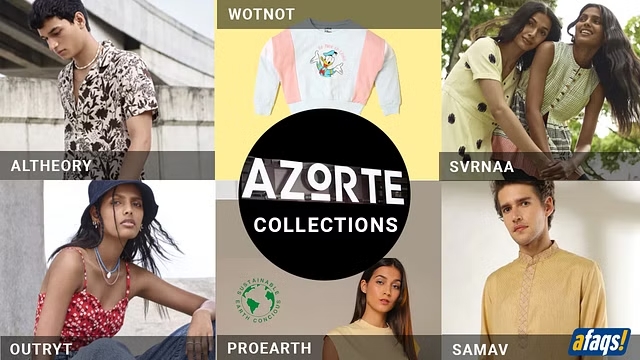
Brands part of Azorte’s collection
Reliance Retail also caters to consumers online through its website, ajio.com. With JioMart, it offers a hyperlocal retail solution that makes full use of Reliance Retail’s wide range of grocery stores and supply chain infrastructure.
According to a CNBC-TV18 report, the company is just getting started with Azorte. The report quotes Akhilesh Prasad, CEO, fashion and lifestyle – Reliance Retail, as saying that the next store is all set to open in Hyderabad.
Prasad adds that within the next nine months, the company is looking at opening 35-40 new stores in 16 different locations – metro cities, mini metro cities and state capitals – across the country.
A press release quotes Prasad as saying that the mid-premium fashion segment is one of the fastest-growing consumer segments, as millennials and Gen Z are increasingly demanding the latest international and contemporary styles.
A mid-premium fashion brand is one that still has aspirational value, while continuing to be affordable. Other examples of mid-premium fashion brands include H&M, Mango, Vero Moda, etc.
This is not Reliance Retail’s first foray into different value sets of products. According to its website, Reliance has a portfolio of fashion and lifestyle brands that spans across value, mid, premium and luxury segments. The company operates brands such as Trends, Trends Footwear, Avantra by Trends, Reliance Jewels, and more.

What kind of products does Azorte stock?
In addition to this, Reliance also operates a portfolio of international brands, such as Armani, Diesel, Burberry, Marks & Spencer, Superdry, and others in India. The website also mentions that Reliance Retail reported a turnover of close to Rs 2 lakh crore for the financial year 2020-21. Reliance Retail operates 15,196 stores across 7,000 cities.
Devangshu Dutta, chief executive at Third Eyesight, points out that a part of Reliance’s strategy is to be larger than life – to be as big as possible and present in as many segments as possible.
He points out that Reliance already has a presence in the high-end retail brand market, with its international brands portfolio. Now, it is targeting the segment below that; which is growing, as the segment of people with disposable incomes increases.
“If you look at the brands that take up space on the ground floor of shopping malls – they are mostly international and luxury brands. India should have more homegrown luxury brands to compete with. We have a large young population and a strong manufacturing base. The number of brands we have, in comparison to these two factors, is actually minuscule,” Dutta adds.
Samit Sinha, founder and managing partner, Alchemist Brand Consulting, explains that one of the frontiers that Reliance has been unable to conquer, is retail. That is why it is looking to aggressively expand.
“Reliance Retail wants to have a comprehensive presence across categories and segments – both online and offline, with Azorte. It makes sense that Reliance Retail is creating a space for its brand, since e-commerce retailers, like Amazon, have their own brands,” says Sinha.

What sets Azorte apart from other retailers?
Dutta says that another aspect of competition that exists between international brands and homegrown brands – like the ones Reliance is stocking at Azorte – is aspiration.
“Brands like Zara have been around since 1975. Even before its India launch, Zara used to have many visitors from India on its online website. The aspirational aspect certainly exists.”
Reliance Retail has aggressive expansion plans for Azorte. Dutta says that a mix of both online and offline is important for brand building. “Reliance has the resources to create a footprint for the brand, and that’s half of the battle won.”
Sinha agrees that offline presence for the brand – especially in the mid-premium luxury segment, is important in building up ‘brand Azorte’ in the minds of consumers, since brand building is not as strong when the brand just has an online presence.
Dutta argues that an offline presence is as important as an online one, since most consumers may experience the brand offline, even though they may browse its products online or on various apps.
admin
October 11, 2022
SHARLEEN D’SOUZA, Business Standard
Mumbai, 10 October 2022
In early 1994, Titan started selling watches with precious stones in them and called this new line, Tanishq. It went on to become a separate division of Titan Company and grew into the country’s largest branded jewellery outfit, helping raise Titan’s sales to ~28,799 crore last financial year.
Thirteen years later, in 2007, Titan Eye+ set out to shake up the eyewear market. Though it also sells sunglasses of other brands, it is the prescription segment that Titan redefined and now, according to its website, has 550 Eye+ exclusive stores in 229 cities.
In 2017, Titan sought to do an encore in yet another large market in which the demand, as in jewellery and eyewear, was almost recession-proof and largely commoditised, leaving ample space for a pan-Indian branded chain. Thus was born Taneira, with an avowed intent to become the country’s largest organised saree retailer.
“Titan had earlier tried to organise the jewellery market through Tanishq, which is successful, and this is an attempt by Titan to organise the saree market,” Ambuj Narayan, chief executive officer (CEO) of Taneira, told Business Standard.
What is unsaid is that jewellery to sarees can also be seen as a horizontal brand extension, the two do go together on occasion.
Natural extension
The Indian wear market is a 5,000-year old segment estimated to be worth ₹50,000 crore a year and growing at a compound annual growth rate of 6 to 8 per cent. Sarees account for 80 to 85 per cent of its sales, with kurta sets, blouses, and lehengas comprising the rest. Yet, despite the size and growth, there is hardly any nationally known brand in this segment, with Nalli Silks being one of the notable exceptions.
Titan insiders say the company believed sarees to be a natural extension for it, given its past success with design-led lifestyle brands. They say the company organised an internal competition to see who came up with the best expansion strategy.
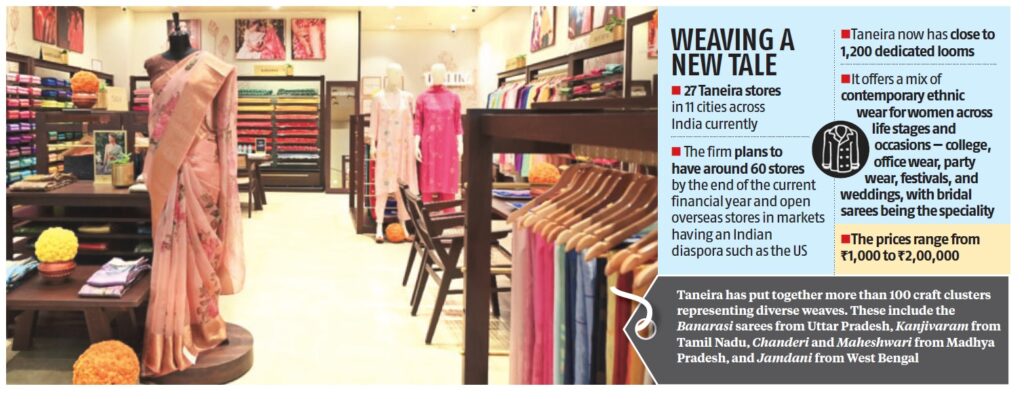
The result is a bouquet of design-differentiated products — primarily sarees and kurta sets — made from pure natural fabrics sourced from all over India. The company put together more than 100 craft clusters representing the diverse weaves. These include the Banarasi sarees from Uttar Pradesh, Kanjivaram from Tamil Nadu, Chanderi and Maheshwari from Madhya Pradesh, and Jamdani from West Bengal. The output is a mix of contemporary ethnic wear for women across life stages and occasions — college, office wear, party wear, festivals, and weddings, with bridal sarees being the speciality. The prices range from ₹1,000 to ₹2,00,000.
“The Tata group’s ventures have always been consistent with their approach — they stay the course beyond initial hiccups and eventually scale up the business. This is very much how Titan and Tanishq worked their way from initial struggles to eventually scale and become nationwide brands,” said retail expert Devangshu Dutta, CEO at Third Eyesight.
To say that Taneira has had initial hiccups would be an understatement. Three years after its launch, the Covid-induced lockdowns and restrictions brought the entire retail sector down to its knees.
Baptism by Covid
“Pandemic restrictions and high Covid-19 anxiety among the people kept socialising and weddings at a very low level of activity over the past couple of years. For Taneira, being a nascent brand with a yet-to-be-established customer base, the operating environment has been particularly tough,” Titan Company said in its FY22 annual report.
Taneira used this time to realign its strategy of connecting with customers. Thus, during 2021-22, which braved the second Covid wave in its first quarter — the dreadful Delta — and saw the third wave creep into its fourth quarter, sales at Titan’s Indian dress wear division grew by 55 per cent.
Narayan, the CEO, attributes this growth to initiatives that included staying close to the customer through e-commerce. “We really drove e-commerce out and reached out to our customers through video calling and try-at-home activities,” he said.
As consumer sentiment started to improve, Taneira already had two collections ready — wedding weave and the summer collection — which boosted sales. During 2021-22, it also increased its store count to 20 by adding six more. During the fourth quarter, Taneira sales rose 4 per cent.
Today, there are 27 Taneira stores in 11 cities across India. It plans to expand to Tier 1 and Tier 2 cities in the first phase and then to Tier 3 in the second phase of its store expansion.
However, Vishal Gutka, vice-president of research (consumer and retail sector) at Phillip Capital, said: “Taneira follows the same principle Titan used for Tanishq, where it entered an unorganised category and expanded it. But it is still early days to gauge how Taneira will pan out. Also, the company needs to give more clarity on the unit economics of each store.”
Weaving an expansion plan Titan’s annual report talks of a robust expansion plan for Taneira this financial year: “We plan to grow at an exponential rate and make our store count around 60 by the end of the current fiscal year and open overseas stores in markets having an Indian diaspora such as the US.” It adds that Taneira will become a more significant contributor to the overall revenue of Titan in the medium term.
At the heart of this grand ambition lies the humble weaver. Taneira now has close to 1,200 dedicated looms and has a programme called Weaver Shala to support them with technical expertise and in modernising their facilities. It has introduced frame looms along with basic workspace facilities for the weavers in collaboration with the localised weaver-led organisations.
The brand has closely worked with the weavers in Varanasi, Uttar Pradesh, and Champa, Chhattisgarh, and aims to take Weaver Shala to other parts of the country.
Taneira leverages Tanishq’s brand strength; mannequins at Tanishq stores, for instance, are dressed in Taneira sarees.
However, Narayan said Taneira and Tanishq will not be sold under the same roof because Titan wants to establish Taneira as a distinct brand in its own right.
(Published in the Business Standard)
admin
September 26, 2022

The Indian smart wearables market is expected to register a CAGR of 23.91% over the 2022-27 period.
There is no stopping Fastrack —the Titan Company brand wants to be the one-stop shop for all the cool Gen Z accessories.
Last month, the brand launched Reflex Play+, its first ever Bluetooth-calling smartwatch, priced at an affordable Rs 6,995. Earlier this year, Fastrack extended the Reflex portfolio to Reflex Vox, a smartwatch, at just under Rs 7,000. Last year, Fastrack added activity trackers and wireless earbuds to its portfolio.
Says Ajay Maurya, marketing head, Fastrack, “Anything new which happens in the space of fashion or technology, the first group to get really impacted is the Gen Z and they are the first adopters. Tapping on to this target group (TG) is extremely important because these are the trend catchers, and some of them are even the opinion leaders in the market to influence purchases.”
In line with its strategy to be known as a fashion tech (‘fash-tech’) brand, Fastrack in 2021 changed its positioning statement from Move On to You Do You to fuel the fearless expression of Gen Z’s (18-26 years) fluid identity. It also onboarded Sanya Malhotra as ambassador.
Says Ajay Maurya, marketing head, Fastrack, “Anything new which happens in the space of fashion or technology, the first group to get really impacted is the Gen Z and they are the first adopters. Tapping on to this target group (TG) is extremely important because these are the trend catchers, and some of them are even the opinion leaders in the market to influence purchases.”
In line with its strategy to be known as a fashion tech (‘fash-tech’) brand, Fastrack in 2021 changed its positioning statement from Move On to You Do You to fuel the fearless expression of Gen Z’s (18-26 years) fluid identity. It also onboarded Sanya Malhotra as ambassador.
Staying relevant
But why Gen Z? India’s Gen Z population of 375 million has already exceeded China’s 250 million. This cohort possesses massive purchasing power and is therefore the target of a range of brands. Maurya says Fastrack has a “hand-in-glove association” with the group. Out of its total business, close to 60% of this comes from GenZ customers.
Maurya adds that the Reflex brand is likely to grow at the rate of 200% this year, over the last. The strategy, he says, is to place an assortment of smartwatches across the price spectrum to appeal to a wide group of consumers. Most of its smartwatches are in the Rs 4,000 – 7,000 bracket, so it plans to enter the economy segment, with wearables starting at `3,000.
The Indian smart wearables market is expected to register a CAGR of 23.91% over the 2022-27 period, as per Mordor Intelligence with the market seeing double-digit growth in the first quarter of 2022 as shipments crossed 13.9 million units. While incumbents Samsung and Xiaomi have had a strong presence in the space for some years now, new-age D2C brands are giving them a run for their money.
Speaking on the growing competition, Maurya says the brand hopes to introduce differentiated products that stay relevant for a long period of time, are difficult for the competition to imitate, and which will give Fastrack an edge in the market. “We are very strong with our design capabilities, which will be one of the biggest differentiators compared to any of the D2C brands that are available in the market,” he says.
Consumer response to the brand’s foray into audio accessories last year, however, has been lukewarm, says Maurya, adding that it is working to get the proposition right.
Looking ahead
Recent research from Counterpoint’s IoT service shows India’s smartwatch market grew 173% YoY in Q1 2022 (January-March). The report said Noise has 23% of market share, Fire-Boltt has 21% and boAt 18%. More than 10 brands entered this booming market in Q1 2022.
Staying relevant and in-sync with the cultural mood and fashion choices of Gen Z has been a challenge for the brand, says Devangshu Dutta, chief executive, Third Eyesight. He adds that Gen Z consumers are more fickle than loyal—they are spoilt for choices, have short attention spans, and are even more demanding than the older generations.
Fastrack currently retails through multi-brand outlets and 175-odd exclusive brand outlets. The offline retail outlets contribute around 65% to its total revenue, and the rest comes via the online channels. The company plans to double the network in a year’s time — with a special focus on tier-II, III cities. Third Eyesight’s Dutta says ensuring price-accessibility will be key to success here.
“While being digital first is the mantra for the brand and the pandemic has accelerated the shift towards online purchasing habits, the need to look and feel a product is coming back,” Maurya says. While digital takes up 50% of its ad spends, the rest is allocated to on-ground activities.
admin
September 22, 2022

Reliance Retail is planning to launch a new clothing and accessories brand store chain to compete directly with fast fashion brands Zara and H&M in India. “The new format, internally called Regalia, will be spread across 20,000-30,000 square feet, and the company could open six stores initially. They have finalised their store locations in Mumbai and Gurgaon (Gurugram) and have also signed properties in Hyderabad and Bangalore,” said two people privy to the launch.
admin
September 20, 2022

New Delhi: The launch of online shopping experience by WhatsApp, along with Jio platforms, the holding company for the digital services businesses of Reliance Industries (RIL), will help these companies to take on e-commerce behemoths such as Jeff Bezos-controlled Amazon and Walmart-owned Flipkart.
Experts are of the view that the partnership will give JioMart, the e-commerce platform of RIL, around 48.7 crore WhatsApp users in India. At present, the total annualised active e-commerce users in the country are only 20 crore.
Rohan Agarwal, partner at research firm Redseer, told Business Standard: “WhatsApp is the primary messaging app for most Indians and the partnership shows the level of access JioMart would have to reach out to them.”
He went on add that it would help in expanding the reach of the e-commerce to users who might not be accessing online retail platforms.
To recap, speaking at the 45th AGM of RIL on Monday (August 29), Isha Ambani, director, Reliance Retail Ventures Ltd (RRVL), gave a presentation on placing online grocery orders using Meta-owned WhatsApp and making payments.
In a global first, JioMart on WhatsApp will aid users in India, including first-time online shoppers, to have a new shopping experience in ordering a wide range of groceries on WhatsApp. They will be able to shop via JioMart’s entire grocery catalogue by easily selecting their favourite items. Also, they will be able to add these products to the cart and pay without leaving the WhatsApp chat.
Mark Zuckerberg, founder and chief executive officer (CEO), Meta, said the association with JioMart would enable people to buy groceries from JioMart in a single chat.
Agarwal highlighted that most of the online grocery businesses generate from big cities and this alliance will be an opportunity for small cities and towns.
The financial daily quoted Devangshu Dutta, CEO, Third Eyesight, as saying that the partnership will have a big impact on the entire e-commerce industry.
He told the publication: “Reliance is the largest retailer in the country and with deep pockets. It wants to (tap) not just the big cities but small cities and towns as well. Given the fact that WhatApp is something consumers are comfortable with, and grocery is related to high-frequency purchases, they are firing on all cylinders.”
Dutta added that the crucial thing for both companies to be successful is to create a delivery process that is quick and cost-effective.
Source: timesnownews
