
admin
February 29, 2024
Sagar Malviya & Faizan Haidar, Economic Times
New Delhi, 28 February 2024
Reliance is in exploratory talks with British fashion retailer Primark to bring the label to India, a move that will pit it against Tata’s Zudio, Landmark Group-owned Max and Shoppers Stop’s new value format InTune.
The 55-year-old brand, popular for its moderately priced clothing and shoes, has been evaluating the Indian market for the past few years and may partner Reliance through the joint venture or licensing route, said two people aware of the development.
Most of their stores will be on the high street due to its big box format, unlike other global retailers, which prioritise malls, the executives added.
Primark has been a successful value-priced retailer and its global revenue has exploded in the last few years, aside from two Covid-hit years. Average prices are even cheaper than retailers such as H&M and Uniqlo. While China is the largest source country for Primark, India is second in the number of small to large factories that supply the company. Nearshoring is already embedded in Primark’s supply chain strategy, and it can deliver goods from Indian suppliers directly to a local retail unit for cost control and flexibility while being responsive to local market needs.
As the largest retailer in India and with its portfolio of multiple international brand partnerships, Reliance can provide a significant edge with real estate and operational synergies, said Devangshu Dutta, founder of retail consulting firm Third Eyesight.
“India is an obvious growth market choice for large brands and retailers such as Primark,” he said. “In the end, though, it will come down to how effective the merchandise and the marketing is in connecting with the diverse needs of Indian consumers across the country.”
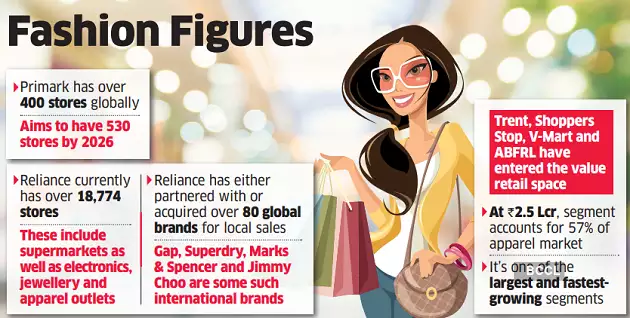
Primark is owned by London-listed Associated British Foods and has over 400 stores globally with a stated ambition to expand across new and existing markets to reach 530 outlets by the end of 2026. In the lower-priced segment, Reliance has Trends and recently launched fashion and lifestyle store Yousta, which competes directly with fast-fashion brands Zara and H&M in India. Reliance currently has over 18,774 stores-these include supermarkets as well as electronics, jewellery and apparel outlets. It has also either partnered with or acquired over 80 global brands for local sales.
Reliance didn’t respond to queries. A Primark spokesperson said, “As a growing international business, we’re always open to new opportunities. However, we don’t comment on speculation about where we might expand to next.”
Experts said India’s consumption structure has been skewed in the past over a narrow base of richer consumers accounting for a large chunk of market. However, now the opportunity for value-brands is expanding.
(Published in Economic Times)
admin
August 26, 2023
Reliance Retail has established a dominant position and the growth trajectory remains robust – Devangshu Dutta of Third Eyesight tells Prashant Nair, Nigel D’Souza and Sonia Shenoy
admin
August 24, 2023
admin
December 20, 2022
Metro AG global chief executive officer Steffen Greubel said the company is at a “very advanced” level of discussions on its India business, suggesting for the first time that it could be looking at an exit from the country soon.
“We are very advanced in the process regarding India and are at a certain maturity level in the process. It’s too early to share any information, but we have discussed it greatly,” Greubel told analysts when asked if he is looking at a possible withdrawal from India and the status of talks. “We are very deep in the (sale) process in India,” he said last week while announcing annual earnings.
The German wholesaler grew its Indian business by 21% to $982 million during the year ended September, as per its latest annual report.
Last month, ET reported that Reliance had agreed in principle to buy Metro AG’s cash-and-carry wholesale India business for ₹4,000-4,500 crore.
Its unit Reliance Retail is already the biggest grocery retailer in the country with over 2,400 stores across formats while Metro operates 31 wholesale stores in India with seven of them on company owned land in prime locations. The company hasn’t publicly stated that it’s looking to leave India. Metro would be the second big international wholesaler retailer to exit India, if this happens. French retailer Carrefour wound up its India business in 2014 after struggling with sales for four years.
Globally, Metro is the world’s fourth-largest retailer by revenue. In India, it doesn’t sell directly to consumers and is an organised wholesaler or cash-and-carry operator that sells merchandise to local kirana stores, hotels and catering firms.
It decided to put the India business on the block as part of a global decision to exit the country due to heightened competition, a tougher regulatory environment and the lack of a level playing field between local and foreign retail companies, industry executives said.
Experts said the difficult European and global economic environment, regulatory restrictions in India, tough competition from domestic Indian groups and thin margins in the B2B business in India may have led Metro to focus on growing its core markets in Europe.
“Though India is, indeed, a long-term strategic market for companies looking at global growth, whether retail or B2B, not every business model from other geographies can be successfully transplanted or rapidly scaled in India, and Metro’s business footprint in India may be far smaller than they may have expected in the two decades of presence here,” said Devangshu Dutta, founder of retail consulting firm Third Eyesight. The choice to be present in different countries is always a dynamic one for global retailers and entry or withdrawal is driven by individual strategies, rather than solely on the merit of the market itself, he said.
“In September, the management board reported on the current status of the audit of strategic options for Metro India,” according to the annual report.
Overseas investment in offline trade has been a tricky issue, despite India allowing 100% foreign direct investment (FDI) in wholesale trade on a cash-and-carry basis. Metro was one of the first companies to enter the segment in India in 2003. Lobby groups representing small Indian retailers have accused overseas retailers of violating FDI rules, which the foreign companies have consistently denied. Some trade lobbies have complained to the government that a few global wholesalers have been flouting FDI rules by selling to consumers directly, which is not allowed as per current regulations.
(Published in The Economic Times)
admin
March 24, 2022
Written By Aditya Kalra & Abhirup Roy

MUMBAI, March 6 (Reuters) – At a large Future Retail (FRTL.NS) supermarket in Mumbai last week, workers were unloading hundreds of bright blue grocery crates belonging to India’s biggest retailer Reliance.
Prospective customers were turned back by security, disappointed at the closed state of the store that still carries the signage of Future’s biggest brand, Big Bazaar, but which will likely soon be rebranded as a Reliance outlet.
Across India, similar scenes are being played out as Reliance Industries (RELI.NS), India’s biggest conglomerate run by Mukesh Ambani, the country’s richest man, presses ahead with a shock de facto takeover of prized retail real estate that Amazon.com Inc has been keen to take part-ownership of.
The high-profile bitter dispute between corporate titans in which Amazon has sought to block Reliance’s planned $3.4 billion purchase of Future Group’s retail assets is currently before India’s Supreme Court.
Reliance’s takeover began with utmost stealth on the night of Feb. 25 when its staff began arriving at Future stores. Many in Future’s management were in the dark about the plans as store employees from all over the country frantically began to call, according to people with direct knowledge of the matter.
“It was tense, everybody was panicking. We didn’t know who they were. They wanted access and seniors didn’t know about it,” a New Delhi Big Bazaar store employee said, describing what happened around 8 p.m. that day.
At a Future store in Sonipat town in northern Haryana state, announcements were made asking customers to leave as Reliance seized control, one source said. In Vadodara in western Gujarat, Future employees arriving for work the next morning were asked to go back home with no explanation, said another source.
Citing unpaid payments by Future, Reliance has taken control of operations of some 200 Big Bazaar stores and has plans to seize another 250 of Future’s retail outlets. Combined, they represent the crown jewels of Future’s retail network and around a third of all Future outlets. read more
Although Reliance had not played a large public role in the legal dispute, it had, according to sources, for some months assumed many of the leases held by cash-strapped Future, India’s No. 2 retailer and Amazon’s estranged business partner.
Reliance’s sudden possession of the stores appears to have landed what some analysts are calling a coup de grace that spoils Amazon’s chances of untangling the transfer of Future’s assets to Reliance. That’s despite a series of legal battles won by the U.S. e-commerce giant to date blocking the 2020 deal announced between the two Indian companies.
“What will Amazon fight for now?” said a source close to the U.S. company with knowledge of the legal dispute. “The shops are gone.”
Representatives for Reliance, Amazon and Future did not respond to Reuters queries for this article. Sources asked not to be identified due to the sensitive nature of the dispute.
AFTER THE TAKEOVER, TALKS
Future Retail said on Feb. 26 it was “scaling down its operations” to cut losses although it made no mention of Reliance in its statement. Future Group as a whole has more than $4 billion in debt.
Reliance plans to retain Future’s employees at the stores it takes over, sources have said.
Amazon, which has a stake in a separate Future Group unit that it argues prevents Future from selling retail assets without its permission, has called the supermarkets and other stores an “irreplaceable” network in a sector worth $900 billion in revenues annually.
The legal wrangles had over time become increasingly high-stakes and marked by ugly rhetoric. At one point, Amazon sought for Future Chief Executive Kishore Biyani to be detained in prison for disobeying a legal order. And Future once likened Amazon to Alexander the Great and his “ruthless ambition to scorch the earth”.
But on Thursday, six days after Reliance’s move, Amazon at a Supreme Court hearing unexpectedly called for cordial talks to end the dispute – a proposal Future agreed to.
“People have taken over shops … let’s at least have a conversation,” Amazon’s lawyer Gopal Subramanium said.
Discussions are expected to begin soon. read more
Whatever the outcome of the talks, analysts say Amazon had gravely underestimated Reliance.
“If anybody should have seen this coming, it should have been Amazon and they should have prepared against it,” said Devangshu Dutta of retail consultancy Third Eyesight.
“Clearly, they didn’t.”
Source: reuters
