
admin
May 26, 2023

Chloe Cornish in Mumbai and Eleanor Olcott in Hong Kong, Financial Times
May 26 2023
India’s biggest company Reliance Industries is seeking to dominate the country’s $10bn online domestic fashion market, striking a deal with Shein that will allow the rapidly growing Chinese retailer to return to the world’s most populous nation.
The retail unit of billionaire Mukesh Ambani’s petrol-to-telecoms conglomerate will tie up with Shein three years after India banned the online retailer’s app in its attempt to freeze Chinese companies out of the local market in retaliation for border clashes that had left at least 20 Indian soldiers dead.
“We can confirm Shein’s partnership with Reliance Retail and have no additional comment at this time,” said Shein, declining to answer questions about the structure of the deal. Reliance did not respond to queries about the partnership, which was first reported by the Wall Street Journal.
The addition of a low-priced offering gives India’s biggest listed company by market capitalisation an important boost in its battle to dominate the country’s growing online fashion retail market, which was worth $10bn in 2022, according to analyst estimates.
As part of the licence agreement, which was recently approved by the government, Shein will receive a percentage of profits generated from its fast fashion sales in India, people familiar with the deal said, while Reliance will help Shein build a supply chain with India’s garment industry for global exports.
The move into Indian sourcing comes as Shein diversifies its supply chain outside the coastal province of Guangdong in southern China, where it has 8,000 suppliers, mostly located in the garment hub of Panyu. Pandemic-era supply chain bottlenecks, rising labour costs in China and geopolitical tensions between Beijing and Washington have propelled multinational companies, including Apple and clothing retailer Mango, to migrate parts of their supply chains out of the country.
Shein, which does not sell in China, has been seeking to distance itself from its home country. Last year, it made its Singapore arm the de facto holding company, rapidly expanding its workforce there and shifting some of its operations from its China headquarters in Nanjing.
Shein will seek to minimise delivery times by having more manufacturing centres around the world. India, meanwhile, hopes to benefit from multinationals’ “China plus one” movement, a strategy that seeks to avoid investing only in China and aims to diversify supply chains to other countries.
Reliance has signed agreements with international luxury brands ranging from Balenciaga to Burberry, catering to India’s small but growing demographic of super-rich consumers. In addition, it has nearly 13,000 bricks-and-mortar stores across the country selling affordable apparel.
“Reliance’s other international brand partnerships are more premium, being luxury or designer brands,” said Devangshu Dutta, chief executive of consultant Third Eyesight. “India is still a relatively low per capita income economy. The bigger opportunity is in brands which are euphemistically called value brands, and that’s where Shein is positioned.”
For Shein, access to the Indian market will allow the company to boost sales as the pace of its expansion in Europe and the US begins to lose steam, according to people briefed on its growth figures.
The Financial Times reported that in a recent presentation to investors, Shein forecast that gross merchandise value — the total value of merchandise sold on its platform — will almost triple by 2025 to $80.6bn compared with the figure last year.
The lofty revenue projections come ahead of a much anticipated initial public offering, which promises to be one of the largest listings of a Chinese-founded company in years.
In fashion ecommerce, Reliance lags behind Myntra, one of India’s oldest ecommerce players, which merged with Walmart-backed Flipkart in 2014. Myntra accounts for around half of the online fashion market in India, according to Satish Meena, an independent ecommerce analyst based in Gurgaon.
“Myntra is the nucleus” for online fashion, said Ankur Bisen, senior partner at retail consultancy Technopak Advisors, adding that its “cohort” of shoppers is primarily young and urban. “With the Reliance and Shein partnership, they would like to get into this cohort and break the monopoly of Myntra,” Bisen said.
Meena estimates that Reliance’s ecommerce fashion business Ajio has about 4 per cent of market share, while Bisen put Ajio among the “long tail” of ecommerce fashion ventures behind Myntra. Reliance’s JioMart online shop also sells clothes, alongside groceries and electronics.
“If you look at Reliance as a company, it’s about dominance and it’s about long term,” Dutta said.
(Published in the Financial Times)
admin
May 24, 2023

Shambhavi Anand, Economic Times
New Delhi, May 24, 2023
Retailers and shopkeepers will soon not be allowed to seek phone numbers of their customers while generating bills, according to a diktat by the department of consumer affairs, a senior government official said.
Taking the numbers of customers without their “express consent” is a breach and encroachment of privacy, said the official, without wanting to be identified.
The official added that such a move will be classified as an unfair trading practice defined as any business practice or act that is deceptive, fraudulent, or causes injury to a consumer.
Most large retailers mandatorily take down buyers’ phone numbers while generating the bill for their purchases and use them for loyalty programmes or sending push messages.
The move has come after the department received several complaints from consumers about retailers insisting on getting their phone numbers. This will be communicated to all retailers through industry bodies representing retailers soon, the official added.
While the implementation of these new rules may require some adjustments and initial costs for retailers, it is seen as a necessary step towards protecting consumer privacy and ensuring fair business practices in the retail sector, said experts.
While retailers will have to rework their systems in case this becomes a regulation, this won’t stop them from asking for phone numbers of consumers as their loyalty programmes run on these numbers, said Devangshu Dutta, founder of Third Eyesight, a retail consultancy firm.
He added that retailers also use numbers for sending e-invoices and so this could have a cost impact and environmental impact.
(Published in Economic Times)
admin
May 16, 2023

Viveat Susan Pinto, Financial Express
May 16, 2023
The country’s top two organised retailers, Reliance Retail and DMart, are shifting focus to the large but fragmented pharma retail market in India in their quest for growth. The Rs 2-trillion domestic pharma retail industry is largely dominated by mom-and-pop stores, much like the fast-moving consumer goods market and kiranas.
On Saturday, Avenue Supermarts, which runs the DMart chain of stores, said it had set up a new subsidiary called Reflect Healthcare and Retail to launch pharmacy shop-in-shops. Reliance Retail, on the other hand, proposes to step up the launch of offline pharmacy stores under Netmeds, the e-pharmacy company it acquired in August 2020. Netmeds is now a subsidiary of Reliance Retail.
The plan with Netmeds, according to persons in the know, is to open around 2,000 standalone pharmacy stores in the next few years. Reliance Retail already has around 1,000 shop-in-shop pharma stores across Reliance Smart Bazaar and Smart Point outlets.
During Reliance Industries’ fourth quarter earnings call last month, Dinesh Taluja, chief financial officer of Reliance Retail, said standalone pharmacy stores by the company would be positioned as destinations for pharma and wellness products. The aim, Taluja said, was to leverage omni-channel capabilities to serve customers better.
DMart, on the other hand, has launched one pharmacy shop-in-shop in the Mumbai Metropolitan Region (MMR) for now. But the future plan, according to industry sources, includes rolling out at least four to five more of such outlets in the MMR region in the next few months.
“While e-pharmacies are a growing concept, there is a large population out there that still prefers to go to a nearby pharmacy or medical store to purchase drugs or medicines prescribed or buy over-the-counter products,” said Devangshu Dutta, founder and chief executive of retail consultancy Third Eyesight.
“The number of organised retail chains in the pharma space in the country are limited. This presents an opportunity for organised players like DMart and Reliance Retail to expand their presence in the market,” Dutta said.
Apart from Apollo Pharmacy, which is India’s largest omnichannel pharmacy chain with over 5,000 outlets, the organised pharma retail space in India largely has regional chains or popular standalone outlets within cities catering to a captive market, say experts. So, organised retailers such as Reliance Retail and DMart can disrupt the market if they begin growing their presence.
Analysts at brokerage firm Kotak Securities, however, see DMart’s foray into pharma retail as a pilot programme, which could be scaled up in the future. “This is another pilot that is expected to boost footfalls in DMart’s brick and mortar business using existing store infrastructure,” they said.
(Published in Financial Express)
admin
May 6, 2023
Gargi Sarkar, Inc42
6 May 2023
With one of the largest consumer bases in the world, the Indian retail industry is on a constant upward spiral, thanks to the increase in the purchasing power of Indian consumers and the ever-increasing ecommerce adoption.
Notably, this has helped segments like online beauty and personal care (BPC) sustain and grow faster than the players in the offline space.
According to industry experts, the online BPC market has been growing in the range of 20% to 25% annually, compared to the offline segment at around 8% to 10% a year. According to a IMARC Group report, India’s BPC market size reached $26.3 Bn in 2022 and is expected to reach $38 Bn by 2028, growing at a CAGR of 6.45% between 2023 and 2028.
Notably, in their endeavour to capture this opportunity, new players are entering the BPC space, and the existing ones have started to scale their omnichannel presence.
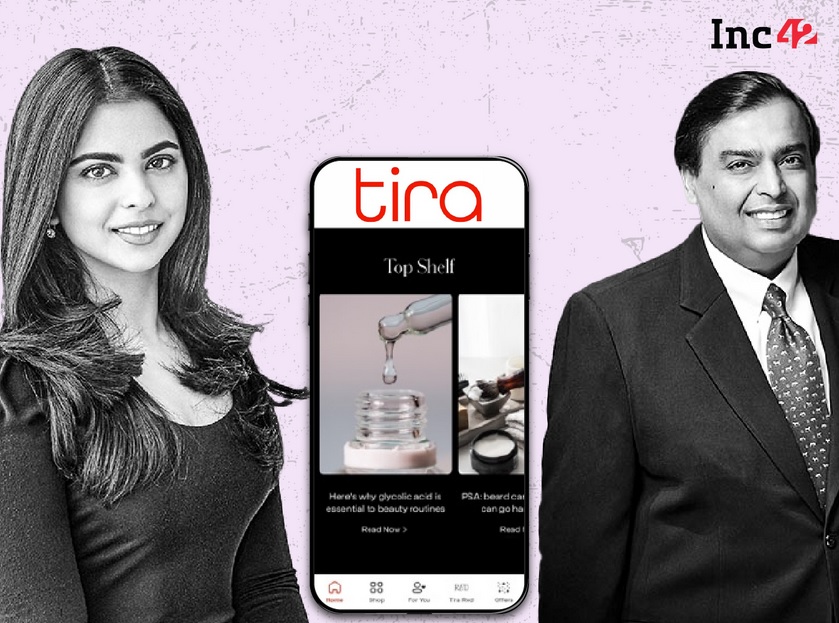
The newest entrant in the space is Reliance Retail. The retail major forayed into the BPC market with its omnichannel platform, Tira, earlier last month. Along with launching its app, Reliance Retail also opened its flagship Tira store in Mumbai.
It is crucial to note that existing marketplaces like Nykaa and Purplle, and D2C brands such as SUGAR Cosmetics and Mamaearth, too, have started expanding their offline footprint, after scaling up their online presence.
Similarly, offline retailers such as Loreal India, Sephora, and Hindustan Unilever’s Lakme have increased their focus on expanding their online presence via direct-to-consumer websites.

Given that Reliance’s Tira has entered the market with an omnichannel playbook, piggybacking on its parent’s cash reserves, it becomes all the more important to understand what impact it will have in the long run on the existing players and industry dynamics.
According to the industry experts that Inc42 spoke with, the beauty and personal care market offers more than enough opportunities for multiple players to grow, due to multiple favourable factors.
“The BPC segment remains one of the fastest growing categories in consumer retail because the penetration of beauty products has remained relatively low. With increasing awareness, and more disposable income, the BPC segment has witnessed decent growth. Now, since the segment is growing, there is a scope for multiple players to grow. That is why some of the big players have entered into the market,” Ashish Dhir, EVP (consumer and retail), 1Lattice said.
Despite Dhir’s optimism, it is pertinent to note that Nykaa saw some initial pressure on its share prices and overall stock performance with the launch of Tira. Brokerage firm Macquarie said that the entry of new players such as Tira could exacerbate the problems for Nykaa at a time when the competition in the segment is already tough.
In the past, Reliance’s entry into the fashion ecommerce space with Ajio impacted leading existing players like Myntra. Now that we already have an example from the past, coupled with a falling will to spend due to factors like rising unemployment and inflation, it will be interesting to see how Nykaa performs under such pressure.
How Tira Could Threaten Nykaa & Ilks Dominance In The Beauty & Personal Care Space
It is no wonder that Reliance Retail will look at disrupting the market to emerge as a market leader as it has done in every segment.
Compared to sectors such as apparel and telecom, the BPC segment is different, and it is not very easy to scale here the way Nykaa has done over the years, according to Karan Taurani, SVP Research, Elara Capital. He noted that many other players in the past tried to scale but failed.
“Nykaa has emerged as a winner due to several factors such as a superior consumer experience on the app, trustworthiness, and product variety. Currently, the product delivery time is also lesser on Nykaa compared to Tira, although the latter could improve it. Moreover, Nykaa has created a network of influencers over the years, and its approach on social media is very different,” Taurani added.
He, however, highlighted that there will be an initial consumer churn as some customers will try Tira as well, and whether the new venture, Tira, can retain all these customers will depend on the consumer experience it provides.
As per Taurani, marketplaces like Nykaa will see some sort of pinch in terms of demand but will not have a significant impact until Tira offers a differentiated experience. Right now, Tira has very few differentiating factors.
However, we should not forget that Reliance Retail is experienced in building brands and has the heavy financial backing to scale in the offline segment.
Given that many players do not have much experience in the offline segment, they may see a visible impact facing the retail giant in the offline BPC space.
It is important to note that Nykaa’s consolidated net profit fell 70.7% year-on-year (YoY) to INR 8.5 Cr in the December quarter of the financial year 2022-23 (FY23), despite the festive season.
In addition, Mumbai-based beauty ecommerce startup Purplle’s net loss almost quadrupled to INR 203.6 Cr in the financial year 2021-22 (FY22) from INR 52 Cr in FY21.
An optimistic Dhir, however, likes to believe that Tira would only increase the competition in the segment and would not impact the profitability of its rivals, at least in the near term.

Will D2C Beauty & Personal Care Brands Face The Heat?
Along with conglomerate-backed large players such as Tata Cliq and online marketplaces, there are several Indian startups and brands such as mCaffeine, Mamaearth, Sugar and Minimalist, which are looking to capture a big chunk of the ever-increasing BPC market pie.
According to an Inc42 report, BPC will remain one of the fastest-growing D2C segments between 2022 and 2030, growing at a CAGR of 27%.
Talking about Tira’s impact, experts said these (aforementioned) D2C brands will not see any major impact due to two factors.
“Firstly, these brands will have similar arrangements with Tira as they have with Nykaa. Secondly, these brands have created a loyal customer base for the products they offer and they have their recall,” Taurani said.
“While deep-pocketed companies can spend their way into buying the market share, all brands need to be prepared for the long term. Also, for these brands a clear positioning be crucial to stand out, not just in their product and service mix but also the overall customer experience specific to their target audience. This would also give opportunities to several beauty and personal care brands to profitably serve niches that may be too small for the larger companies driving for the market, “Devangshu Dutta, the founder of Third Eyesight, said.
Also, Nykaa and Purplle have a portfolio of private labels, which includes skincare brands such as Dot & Key, Earth Rhythm, and Good Vibes, among others. Hence, it will not be surprising if Tira launches its private labels or acquires small brands to grow its portfolio.
As brands like Dot & Key, and Good Vibes are already direct competitors to these D2C beauty brands, a new player can pose more challenges for them.
What Else Could Work In Tira’s Favour
“Our vision for Tira is to be the leading beauty destination for accessible yet aspirational beauty, one that is inclusive and one that harbours the mission of becoming the most loved beauty retailer in India,” Reliance Retail’s executive director Isha Ambani said at the time of launch in April 2023.
When Reliance entered new segments like telecom and fashion ecommerce with Jio and Ajio, respectively, many of the existing players struggled to sustain in the segment as the Mukesh Ambani-led conglomerate scaled up quickly, thanks to its strong financial position. Hence, it will work as the biggest favourable factor in the beauty and personal care space as well, industry experts believe.
Tira is also expected to lure customers with big discounts. “For Tira, a big chunk of revenue will initially go towards marketing and customer acquisition, at least for the first couple of years, as it is a new brand. More than marketing, Reliance will look at discounting more prominently. Reliance will try to give higher discounts compared to other players,” Taurani said.
He added that Reliance has some expertise in building new platforms, such as Ajio, and a rich talent pool and strong brand exposure.

While players like Tata Cliq, Purplle, and Myntra’s beauty segment have tried to scale up in BPC, none of these players has seen significant growth. Hence, the market consists of one large player, making it easier for a deep-pocket player like Tira to carve its positioning quickly and create a duopoly with Nykaa.
At the time of Tira’s launch, the company said that the brand would offer a curated assortment of the best global and home-grown beauty brands. In terms of its offline play, Reliance Retail can leverage partnerships with global beauty brands and suppliers to get better deals. As it is looking at an omnichannel play at an entry stage itself, it may be able to gain market share from smaller beauty retailers, especially in bigger cities.
The Tira offline store will have the latest beauty tech tools such as virtual try-on to create customised looks and a skin analyser that will personalise and assist consumers in making purchasing decisions based on their needs, the company said.
On the luxury side, Reliance Retail is also directly targeting the market which has higher margins and could eat into the margins of Nykaa easily. It must be noted that Nykaa’s Luxe is still in its infancy.
While it is true that Tira will increase the competition in the BPC segment, it is not likely to rewrite the industry’s future over the next couple of years. Tira currently has very few differentiating factors in both the online and offline segments. Additionally, in the offline segment, Tira has opened only one store while Nykaa already has 141 physical stores across 56 Indian cities, as shared in its Q3 earnings report.
Even though there are glaring differences, some industry experts see Tira’s journey to be the same as that of Nykaa, going ahead.
(Published in Inc42)
admin
April 21, 2023

Viveat Susan Pinto, Financial Express
April 21, 2023
Retailers of Apple products in Mumbai and Delhi, which account for around 20-21% of the brand’s annual sales in the country, fear the launch of stores by the US giant within these cities may dent their business.
In particular, retailers in the vicinity of these outlets, at Bandra-Kurla Complex (BKC) in Mumbai and Saket in Delhi, say consumers will prefer to go to these company-owned stores rather than make it to their outlets to purchase Apple products.
“That is a visible danger for those Apple retailers who are located near these outlets,” a senior executive at Unicorn Infosolutions, an Apple premium reseller in Delhi and Mumbai, said. Unicorn has 37 outlets in the west and north of India and is looking to its increase its footprint to 75 stores in the next three years.
“You have to keep in mind that the base of consumers for Apple is growing, both in Mumbai and Delhi as well as other cities. It will not be feasible for all the consumers to make it to these outlets. Yes, some high-end consumers may choose to shop at these Apple stores in the two cities, but for those staying away from these stores, it will be difficult to make it to these outlets,” the Unicorn executive said, declining to be quoted.
Nilesh Gupta, managing director of Vijay Sales, an electronics retailer, which has stores in the west and north of India, had reiterated a similar point on Tuesday (April 18), the day the Apple BKC store was launched in Mumbai. He said that he saw the store launches in Mumbai and Delhi as an opportunity for brand-building and further growth in sales.
“Apple is launching just two stores in India, one in Mumbai and the other in Delhi, for now. Even if they launch more outlets, not everyone will be able to make it to these stores, given the size of India and the aspirations of people wanting to own an Apple. The word-of-mouth and excitement going around following the launch will positively impact all of us who stock and sell Apple products in the country. I see more consumers wanting to buy Apple products in the future,” Gupta said.
While Apple has been in India for more than 25 years, it has had no direct retail presence in the country until now. An Apple online store in India was launched around three years ago. In other words, say experts, the Cupertino-based tech giant has depended largely on a network of online and offline retailers, including premium resellers, multi-brand operators and e-commerce channels, for sales in India.
“And Apple will want to ensure that its retail partners are not impacted because of its direct retail foray into India,” says Devangshu Dutta, founder and chief executive officer, Third Eyesight, a Gurugram-based retail consultancy.
“The Apple premium resellers, for instance, may choose to upgrade their retail experience at their outlets to ensure that there is no loss of business, especially in Mumbai and Delhi,” Dutta said.
Apart from Unicorn, some of the other Apple premium resellers in India include Maple in Mumbai and Ample Technologies, which runs the Imagine brand of stores in cities such as Bengaluru and Chennai.
Both the Apple stores in Mumbai and Delhi are high on experience, visitors to these outlets have said, coming at a time when the brand, amongst the most valuable in the world, has clocked a record revenue in India.
A Bloomberg report this week said that Apple had reported a turnover of $6 billion in India in FY23, up from $4.1 billion in FY22.
The Apple craze has drawn huge crowds both to the Mumbai and Delhi stores this week. The retail push will come as the company looks to expand manufacturing in India, experts said.
While Apple has been manufacturing older iPhone models in India since 2017, it began assembling the most recent smartphone models in 2022, with the iPhone 14.
According to the International Data Corporation (IDC), Apple’s iPhone shipments in India stood at 6.7 million units in 2022 against 4.8 million in 2021 and 2.7 million in 2020.
Apple also captured 25% of the ‘Made in India’ smartphone shipments in terms of value in 2022, compared to 12% in 2021, according to Counterpoint Research.
Among cities, Mumbai accounted for 10% of iPhone sales in India, trailing only Delhi, which accounted for 11% of sales, Counterpoint Research said.
(Published in Financial Express)
