
admin
September 1, 2026
Pritha Pahari, The Core
1 September 2026
Reliance has spent more than a decade bringing together a long list of names such as Burberry and Tiffany & Co. to India. Its latest focus seems to be luxury celebrity brands, adding global pop star Rihanna’s Fenty Beauty and now media personality Kim Kardashian’s shapewear label SKIMS to its luxury brands portfolio.
Isha Ambani, executive director of Reliance Retail, has fronted most of these announcements herself.
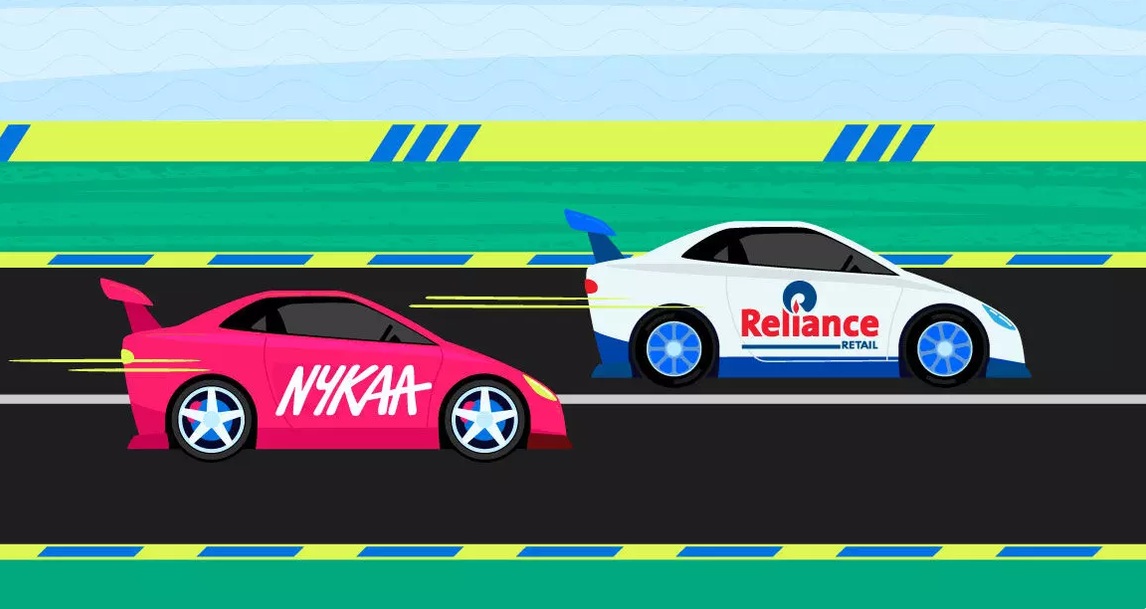
Meanwhile, Nykaa, the beauty platform Reliance Retail keeps getting compared to, spent the last year going after some of the same celebrity founders.
In August 2025, Fenty Beauty moved from Nykaa’s platform to an exclusive deal with Reliance’s Sephora India and Tira. In June 2026, Nykaa answered by signing pop star Selena Gomez’s Rare Beauty. A month later, Reliance landed SKIMS.
India’s luxury and celebrity-brand market is split between Reliance’s scale and Nykaa’s beauty expertise, with Fenty, Rare Beauty and SKIMS showing how ownership, reach and brand fit are shaping who gets the biggest names.
Big Brands, Different Bets
Reliance wins brands through scale (20,169 stores, 396 million customers) and ownership ties; Fenty’s move to Sephora India is less a market choice than an internal LVMH routing decision, given LVMH’s stakes in both Fenty and Sephora.
But Nykaa is holding its own by competing on specialism, not size; its beauty-literate audience and curated community pulled in Rare Beauty and Chanel.
The brand fit, not just distribution muscle, still decides who signs where, and some brands (like Birkenstock) skip both platforms entirely.
The economics behind these deals are harder to pin down than the headlines suggest. None of the three — Fenty, Rare Beauty, or SKIMS — have disclosed minimum guarantees, royalty rates, or sales targets for their India entries; these are announced as partnerships, not filed joint ventures.
SKIMS raised $225 million in November 2025 at a $5 billion valuation, nearing $1 billion in annual net sales.
Fenty tells a different story: $450 million in 2024 sales, now valued at $1-2 billion, down sharply from a $2.8 billion estimate in 2021, with Jay-Z’s MarcyPen Capital Partners in talks to buy LVMH’s stake.
Rare Beauty’s India entry rides on Nykaa’s own momentum; the company’s revenue from operations rose 29% year on year (YoY) to Rs 2,782 crore in Q1 FY27, up from Rs 2,154.9 crore a year earlier. In the last quarter of FY26, revenue stood at Rs 2,648.1 crore.
The Core has reached out to Reliance and Nykaa for their response, and will update this report if and when they respond.
Why Fenty Chose Reliance
Fenty’s move looks more like an internal one, according to Suumit Kapoor, a brand growth consultant.
LVMH owns 50% of Fenty Beauty through its beauty incubator Kendo Brands, a stake it has held since co-founding the brand with Rihanna in 2017. LVMH also owns Sephora globally, and Sephora in India is run by Reliance.
“When Fenty enters a new market through Sephora, LVMH is effectively distributing its own equity stake through its own global retail infrastructure,” Kapoor said. For a brand with that kind of ownership overlap, he added, the choice of partner is “close to an internal routing decision” and not a genuine trade-off.
That ownership overlap is itself now in a pickle.
LVMH has been exploring a sale of its 50% Fenty stake since October 2025, working with investment bank Evercore, according to Reuters. As of June 2026, American rapper and businessman, Jay-Z’s investment firm MarcyPen Capital Partners was reported to be among the parties in talks to buy it.
No sale has closed yet, so the Reliance-Sephora-LVMH alignment still holds for now, but it isn’t guaranteed to outlast the current ownership structure.
Fenty’s India journey backs this up. The brand’s first India listing wasn’t through Reliance at all.
It ran on Nykaa’s Cross Border Store, a low-commitment digital shelf that was discontinued before Fenty’s August 2025 relaunch, an exclusive omnichannel deal with Reliance spanning more than 50 stores across 16 cities on day one.
Kapoor doesn’t think of the switch as a deliberate strategic upgrade.
“The Cross Border Store listing may simply have underperformed on its own terms, without much marketing support behind it,” he said, adding that there is no clear evidence that Reliance stole the brand away.
Devangshu Dutta, founder of the research firm Third Eyesight, said celebrity backing only buys a brand little room.
“When a company or an investor buys into an early-stage celebrity brand, they are acquiring instant brand equity which acts as a top-of-the-funnel magnet and potentially lower CAC,” he said. “However, the ‘fame premium’ runs out if product and service execution isn’t compelling enough to drive repeat business and customer retention.”
Ownership decides the biggest deals before “competition” even enters the picture, Fenty landed at Reliance’s Sephora because LVMH owns half of each, though that alignment is shakier than it looks, with Jay-Z’s MarcyPen Capital Partners now the leading bidder for LVMH’s Fenty stake.
Beyond ownership, it’s a straight trade-off.
For brands chasing scale, Reliance’s tens of thousands of stores will get you reach. If brands want to chase community, Rare Beauty did by picking Nykaa specifically to tap its affluent, digitally engaged beauty shoppers and build loyalty. Some brands skip the fight altogether, like Birkenstock, which walked into India solo.
The Distribution Gap
Where Reliance doesn’t need an ownership story to make its case is scale. Reliance Retail closed the quarter ended June 2026 with 20,169 stores across 78.4 million square feet, 396 million registered customers, and 568 million transactions in that single quarter, up 46% year on year, according to the company’s Q1 FY27 earnings release. JioMart alone served 5,500 pincodes through its rapid delivery network in the same period.
Nykaa, by comparison, operated 324 physical stores across 105 cities as of its FY26 numbers, with a cumulative customer base of around 42 million, per its own disclosures and Business Standard’s reporting on the company’s results.
“That gap generally buys a brand not just bigger numbers, but reaches into places where a beauty specialist has no reason to be,” Kapoor said. For brands thinking beyond beauty into wellness, gifting, or lifestyle crossovers, he said that scale “is not a nice-to-have. It is the entire argument for choosing Reliance over a beauty-only platform.”
Satish Meena, founder of Datum Intelligence, a research firm, made a similar point on Reliance’s pull with brands weighing an India entry.
“With the kind of strength they have, they can always give a better deal,” he said, referring to Reliance’s ability to commit capital and guarantee scale that a newer entrant typically cannot promise on its own. He pointed to Reliance’s existing retail relationships, including Marks & Spencer, as part of the track record that makes brands comfortable signing with the group.
Experts say over the past two to three years, Nykaa has been the more prolific launch platform for major international beauty brands, while Reliance has had greater strength in international luxury and fashion.
According to experts, Nykaa reported more than 70 luxury-brand additions over the last three years, including names such as NARS, Prada Beauty, La Prairie, Chanel Beauty, Armani Beauty and Maison Margiela. Reliance, meanwhile, has built a luxury portfolio spanning Valentino, Balenciaga, Bottega Veneta, Tiffany & Co., Burberry and others, and most recently brought SKIMS to India. Reliance’s public disclosures do not provide a comparable 2–3-year count of new international brand entries.
Reliance is arguably a major gateway for international luxury/fashion, but calling it the default gateway for international brands overall is too broad.
Where Nykaa Still Wins
Reliance’s advantage on raw numbers doesn’t fully explain why Nykaa keeps landing brands too.
Nykaa built its beauty audience before it built its stores, using tutorials and curated storytelling to create what Kapoor called “a beauty-literate customer base that arrives already primed to trust the platform’s recommendations.”
That specialism is what pulled in Rare Beauty. Nykaa’s June 2026 launch made the brand available through its website, app, and 30 stores nationwide, and came from a company reporting its highest quarterly profit since listing at the time, per its own disclosures.
In a company statement announcing the launch, Anchit Nayar, Nykaa Beauty’s executive director and CEO, said the brand fit a “new generation of highly informed and globally engaged consumers seeking elevated brand experiences.” Rare Beauty’s chief executive, Scott Friedman, said in the same announcement that India was “a very important market” for the brand, citing Nykaa’s beauty community in the country as the reason to partner with it specifically.
Nykaa has run a similar playbook before. Chanel strengthened its India fragrance and beauty presence on Nykaa in 2025, Obagi Medical entered India through the platform specifically for its clinically driven skincare positioning, and Estee Lauder’s incubation arm has run its India beauty programme, Beauty and You, with Nykaa as lead partner every year since 2022.
Dutta pointed to Kay Beauty, Nykaa’s own celebrity line with actor Katrina Kaif, as an example of why platform fit matters as much as platform size. Contrasting it with 82°E, actor Deepika Padukone’s skincare brand on Tira, he said Kay Beauty had two advantages: it was priced for a much larger audience, and it had “Nykaa’s active participation across channels for merchandising and visibility.”
Not The Only Door
Reliance’s pull is real, but it isn’t the only route into India.
Reliance benefits from international-brand partnerships through retail economics, distribution and, in some cases, ownership or joint-venture economics. The potential conflict emerges because Reliance can simultaneously act as a brand’s market-entry partner and control substantial retail and digital routes to consumers. Public filings, however, do not establish that Reliance uses this position to disadvantage partner brands or competing retailers.
Meena pointed to Birkenstock, which entered by opening its own stores rather than partnering with either platform. Birkenstock and similar labels operate as single-brand retail; they can use India’s foreign direct investment rules to set up shop directly, bypassing the need for a local partner altogether.
“If the brands think that they have enough pull in the market and they can bring customers, they are opening these stores without any partnership,” Meena said. He added that most global brands take the partner route anyway because India, for many of them, is still a small share of global sales, and testing the market with an established partner for a few years is lower risk than building from scratch.
Kapoor flagged one risk worth watching no matter which partner a brand picks. Exclusive deals give a retailer more control. But Tira has also started building its own private-label products, including a colour cosmetics line, and sells them in the same stores as the global brands it distributes.
“A retailer can be a brand’s distribution partner and, on an adjacent shelf, its competitor, at the same time,” he said, a tension he noted that Nykaa’s marketplace model, without a comparable private label push against premium brands, does not carry in the same way.
For brands already tied to Reliance through ownership, like Fenty, there isn’t much of a decision to make. For everyone else, Nykaa signing Rare Beauty and Reliance signing SKIMS within weeks of each other shows this fight for celebrity founders in India is far from over.
(Published in The Core)
admin
June 12, 2026
Christina Moniz, Financial Express/Brand Wagon
12 June 2026
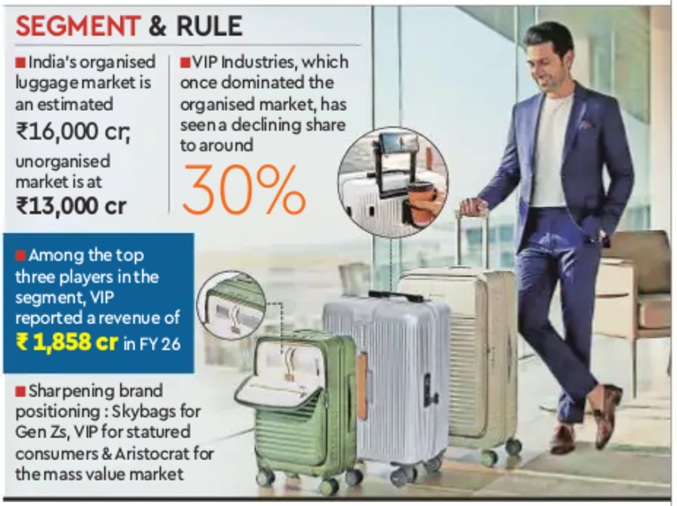
Legacy luggage brand VIP Industries is shedding some of its old baggage. The company, which manufactures Skybags and Aristocrat along with its flagship VIP range, has gone beyond cringey makeovers solely to attract Gen Z, and has embarked on a transformation journey that leverages its legacy to purvey a fresh range of offerings.
The company is modernising its digital presence and supply chain to catch up with competitors.
Managing director Atul Jain admits that the company has been a bit slow on the e-commerce front. It is reinventing its online store, while also making its products available across other e-commerce channels. “Quick commerce is becoming an important channel since there are several use occasions and segments within the luggage market. For instance, consumers often make last-minute purchases for a weekend trip via quick commerce. School bags and backpacks for kids, also great gifting options, are seeing good demand on these platforms,” he says
The company, which once dominated the ₹16,000 crore organised luggage market in India, saw a bit of a shakeup last year when the Piramal family sold 32% of its stake to a private equity firm. But it continues to be among the top three players in the category with a 29-30% market share. “Luggage plays the role of a traveller’s companion. We are creating designs to fit that role,” says Jain. “For example, our new VIP suitcases have a coffee cup holder and our cabin trolley bag has an easy access compartment for devices like laptops and iPads.”
The transformation goes beyond the product. VIP’s 350 exclusive physical retail touchpoints in the country are being revamped to offer a new customer experience.
Unpacking opportunities
Overits 55 years, VIP has grown from a briefcase brand into Asia’s largest luggage maker, housing labels like Skybags, Aristocrat, and Carlton (premium segment). While VIP is a premium offering targeted at business and travellers, its Aristocrat brand operates in the mass market and the budget-friendly Alfa targets consumers who typically shop in the unbranded segment. Aristocrat and Alfa together contributed upwards of 40% to the company’s revenue in FY25, followed by Skybags (28%) and VIP (20%).
Like many legacy brands, the VIP Industries’ faces the challenge to ia, stay relevant among Gen Z buyers as a plethora of digital-first brands swamp the market. “VIP has lost ground on relevance and desirability to a generation for whom luggage, like sneakers, is an expression of identity. To them, VIP feels like their parents’ brand,” says Nisha Sampath, managing partner, Bright Angles Consulting. D2C players in the category operate in the business of “lifestyle accessories” and not for “luggage” per se, she points out.
With a design-forward approach, incorporating features like compression systems, silent wheels and charging ports, these new-age brands have embedded themselves in travel “culture”, while also being Instagram worthy, say experts.
Jain says Skybags is VIP’s Gen Z focussed brand, which has over 8,20,000 Instagram followers. “We are sharpening our positioning for Skybags in our design, advertising and marketing outreach, especially on social platforms. The brand has a clear differentiation with youthful colours and prints to attract younger consumers,” he adds.
While D2C players have seen notable growth in recent years, they don’t have the kind of trust and brand equity that VIP has cultivated across its brands, nor do they have the scale or revenue that legacy brands have, he says.
Experts believe there is a significant growth opportunity for legacy players given that the unbranded market still accounts for ₹13,000-14,000 crore. The important lever for legacy brands is to clearly demonstrate value beyond price. “The unorganised market competes heavily on affordability, so organised players need to communicate durability, warranty, after-sales service, and consistent quality – areas where they have a strong inherent advantage over unorganised alternatives,” says Praveen Govindu, partner at Deloitte India. He adds that these brands should also invest in advertising and communicate this value to the end consumer.
Not only are the needs different among different consumer groups, competitive pressures are also diverse. “VIP can segment the market more cleanly with its portfolio of brands if it maintains absolute distinction to ensure clear consumer targeting across not just product attributes and pricing, but also communication and channels,” says Devangshu Dutta, CEO, Third Eyesight.
(Published in Financial Express)
admin
May 27, 2026
Kartikey Kashyap, Financial Express
27 May 2026
Three campaigns took home the Grand Prix awards from Goafest this year: Kansai Nerolac Paints”The Barefoot Journey” by Tribes Commu-nication in the Media category; Mountain Dew’s “Darescore” by Leo in Digital & Technology; and Center fruit (Perfetti Van Melle India)” Kaisi Jeebh Laplapayee”” by Perfetti’s in-house team in the Best Use of Voice/Technology category.
All three were exceptionally creative and scored high on likeability and novelty. There was another common element that tied the three together: How they used creativity to solve real brand problems.
Take PepsiCo’s Mountain Dew Darescore campaign. Nepal’s tourism economy relies heavily on mountaineering, but over 90% of global tourist revenue flows into Mount Everest. As a result, there is overcrowding on Everest, starving the country’s other formidable peaks of income and attention.
Enter Mountain Dew. In partner-ships with the Nepal Tourism Board and the Discovery Channel, the brand built the world’s first algorithmic mountain grading system. Leo aggregated decades of expedition records, terrain complexity maps, seasonal weather hazards, rescue failure rates, and first-hand Sherpa wisdom. They funneled these metrics into an engine and assigned a quantifiable “Dare Score” to individual peaks. This data visually demonstrated that height does not equal danger, giving climbers an scale to gauge terrain toughness.
The genius of the campaign was its consumer utility. Mountain Dew printed smart QR codes on millions of its beverage bottles. When a user scanned the bottle, it unlocked an immersive digital hub, where users could simulate climbs, map out route plans, read real-time weather conditions, and submit expedition inquiries. The campaign took Mountain Dew’s slogan, “Darr Ke Aage Jeet Hai” and algorithmically decoded it for real-world application.
The result: It Swept Goafest 2026 and collected medals across vastly different categories including Integrated, Brand Experience, Social Content, and Video Craft, besides the Grand Prix. “Darescore is a powerful example of how brands are moving from storytelling to measurable participation. For decades, adventure culture celebrated only the final summit. This campaign changed the lens, it quantified courage itself,” says Prabhakar Mundkur, director, advertising & media, Percept. “What made this Grand Prix-worthy was the fusion of technology, gaming logic, data and brand philosophy into one seamless experience.”
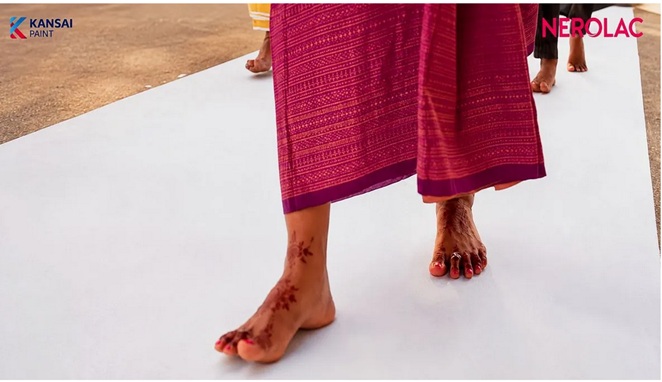
If the Darescore campaign embedded data into storytelling, Nerolac chose to stay away from the beaten path. Its “Barefoot Journey” was a hyper-local activation designed by Tribes Communication for Nerolac Perma NoHeat, an acrylic-based, heat-reflective exterior coating. The campaign focused entirely on real-world product performance.
Every summer devotees visit various religious sites and walk barefoot along sweltering walkways or wait in queues on hot concrete floors.
Along with local authorities, the teams coated thewalkways of several high-footfall temples across south-ern India with Nerolac Perma NoHeat paint. The paint reduced the surface temperature of the pathways by up to 15°C offering relief to devotees.
This campaign won the jury over with its simplicity. According to Devangshu Dutta, founder & CEO, Third Eyesight, “Though the campaign might target a small audience, it made an impact by shifting the frame,” Dutta points out. “The campaign turned advertising into lived experience,” Mundkur says. “People didn’t just hear a claim, they felt it. This is media not as interruption, but as empathy.”
For its part, Centre fruit brought back its hoary “Kaisi Jeebh Lapla-payee” tagline using generative AI. Teaming up with WPP, BharatGPT.ai and Google Cloud, Perfetti created voice-based GenAl interactions in local dialects that turned feature phones smart. “What made the experience special was that it felt less like advertising and more like a conversation,” says Gunjan Khetan, director marketing, Perfetti Van Melle. Al was an enabler of accessibility and a tool to build cultural relevance, Khetan adds. “The brilliance lay in how it con-verted a simple sensory reaction -the uncontrollable craving triggered by taste – into a scalable interactive idea. It was playful, memorable and unmistakably Indian. More importantly, it proved that consistency in -brand codes, when combined with fresh execution, can become a formidable creative asset,” Mundkur says.
There you have it. Winning creative awards is validating, but solving the client’s problems through that creativity remains the bellringer.
(Published in Financial Express)
admin
May 9, 2026
Writankar Mukherjee, Economic Times
Kolkata, 9 May 2026
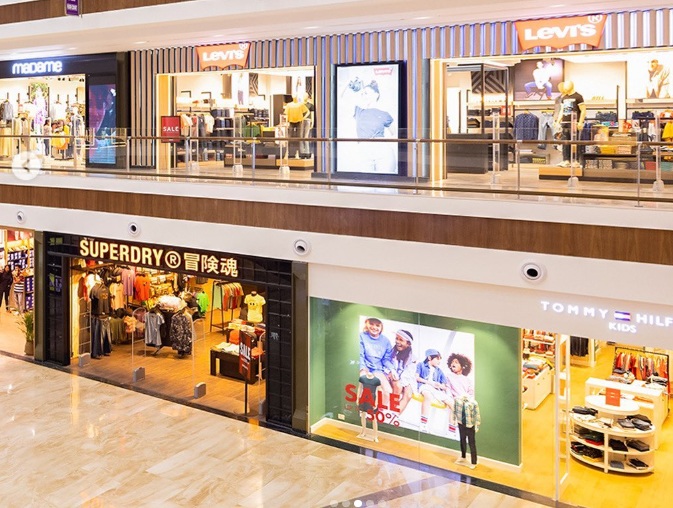
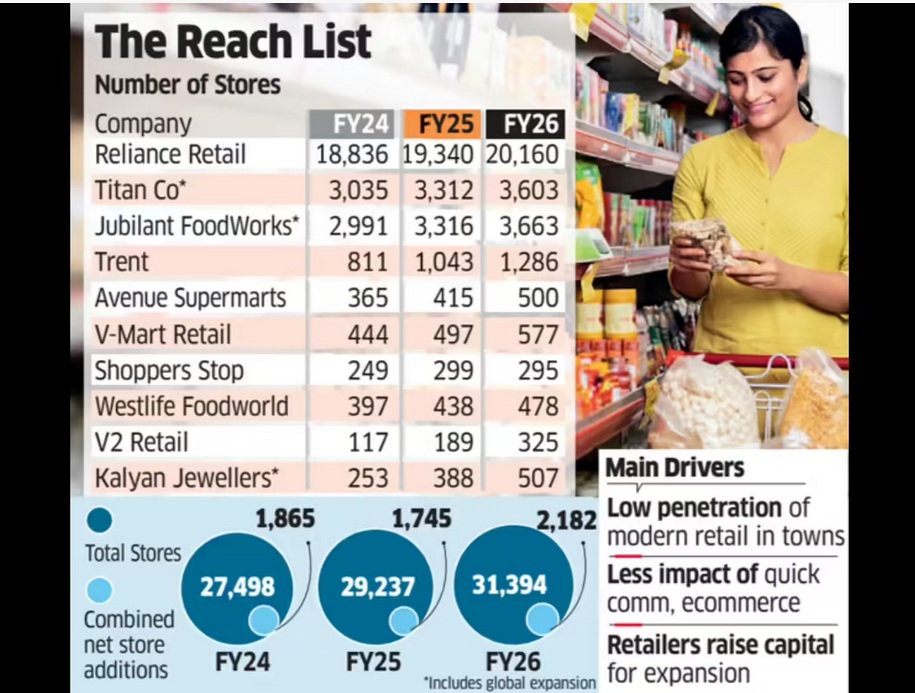
India’s top retail chains including Reliance Retail, DMart, Trent, Titan Company, Jubilant FoodWorks, and V-Mart Retail opened the highest number of stores in three years in FY26, seeking to capitalise on a demand recovery and a clean-up of unviable outlets added during the post-Covid revenge-spending period.
Entry into smaller towns and cities where many consumers continue to prefer shopping at physical stores over online is also influencing the expansion plans.
An ET study of the 10 largest listed retailers showed they added 25% more stores in the last fiscal year compared to FY25. Additions are on a net basis after accounting for loss-making outlet closures.
Collectively, the retailers added 2,182 stores in FY26, equivalent to six new stores a day on a net basis. In comparison, they added 1,745 stores in FY25 and 1,865 in FY24.
Retailers attributed the store expansion spree to improving consumer sentiment, helped further by cuts in income tax and goods and services tax (GST) rates last fiscal, along with low penetration of organised retail in smaller towns and cities. Together, the ten retailers had 31,394 stores operational as of March 2026.
Expansion Set to Continue
V-Mart Retail chief executive officer Lalit Agarwal said the ongoing shift from unorganised to organised retail is fuelling this expansion as several companies are meeting their sales growth expectations. “Many retailers have also raised capital, which they are deploying to grow topline,” he said, adding that the “growth phase will continue in the current fiscal as well.”
Companies surveyed by ET also include Shoppers Stop, Westlife Foodworld, V2 Retail and Kalyan Jewellers. Together, the ten retailers had 31,394 stores operational as of March 2026. Their combined store count grew 7% in FY26, ahead of a 6% expansion in the year before.
Reliance Retail alone added 820 net stores last fiscal, rebounding from a slowdown in FY25 when it shut several unviable outlets that were opened immediately post Covid, impacting overall industry growth rates. The country’s largest retailer had added 504 net stores in FY25, 796 in FY24, and 2,844 in FY23.
Similarly, Tata-owned Titan added 532 stores in FY23, but expansion moderated to 280-290 stores annually in FY25 and FY26.
India’s retail industry saw hyper expansion in late FY22 and FY23 as retailers sought to tap a boom in post-pandemic revenge shopping.
“Retail expansion now is more organic and measured as compared to the post Covid phase when there was a huge backlog of demand and over expansion,” said Devangshu Dutta, founder and CEO at Third Eyesight, a consultancy in consumer space.
(Published in Economic Times)
admin
February 27, 2026

Samar Srivastava, Forbes India
Feb 27, 2026
India’s young consumers are discovering the next big beauty serum, protein bar or sneaker brand not in a mall, but on Instagram reels, YouTube shorts and quick-commerce apps that promise 10-minute delivery. What began as a trickle of digital-first labels a decade ago has now become a full-blown wave. Direct-to-consumer (D2C) brands—built online, fuelled by social media and venture capital—have reshaped India’s consumer landscape and forced legacy companies to rethink everything from marketing to distribution.
India today has more than 800 active D2C brands across beauty, personal care, fashion, food, home and electronics, according to industry estimates and consulting reports. The Indian D2C market is estimated at $12–15 billion in 2025, up from under $5 billion in 2020, and growing at 25–30 percent annually. The pandemic accelerated online adoption, but the structural drivers—cheap data, digital payments and over 750 million internet users—were already in place.
Unlike traditional FMCG brands that relied on distributors and kirana stores, D2C brands such as Mamaearth, boAt, Licious and Sugar Cosmetics built their early traction online. Customer acquisition happened through performance marketing; feedback loops were immediate; product iterations were rapid.
Importantly, these brands are discovered online—but as they scale, consumers buy them both online and offline, increasingly through quick-commerce platforms such as Blinkit, Zepto and Swiggy Instamart, as well as modern trade and general trade stores. The omnichannel play is now central to their growth strategy.
According to Anil Kumar, founder and chief executive of Redseer Strategy Consultants, the ecosystem is maturing in measurable ways. Brands are taking lesser time to reach ₹100 crore or ₹500 crore revenue benchmarks and, once there, mortality rates are coming down. There is also an acceptance that if a brand is not profitable in a 3–5 year timeframe, that needs to be corrected. “There is a lot of emphasis on growing profitably and not just through GMV,” he says.
Big Cheques, Bigger Exits
The D2C boom would not have been possible without capital. Between 2014 and 2022, Indian D2C startups raised over $5 billion in venture and growth funding. Peak years like 2021 alone saw more than $1.2 billion invested in the segment. Beauty, personal care and fashion accounted for nearly 50 percent of total inflows, followed by food and beverages.
Some brands scaled independently; others found strategic buyers. Among the most prominent exits:
> Hindustan Unilever acquired a majority stake in Minimalist, reportedly valuing the actives-led skincare brand at over ₹3,000 crore. For Hindustan Unilever, the annual run rate from sales of its D2C portfolio is estimated at around ₹1,000 crore, underscoring how material digital-first brands have become to its growth strategy.
> ITC Limited bought Yoga Bar for about ₹175 crore in 2023 to strengthen its health foods portfolio.
> Emami acquired a majority stake in The Man Company, expanding its digital-first play.
> Tata Consumer Products acquired Soulfull as part of its health and wellness strategy.
> Marico invested in brands such as Beardo and True Elements.
Private equity has also entered aggressively at the growth stage. ChrysCapital invested in The Man Company; L Catterton backed Sugar Cosmetics; General Atlantic invested in boAt; and Sequoia Capital India (now Peak XV Partners) was an early backer of multiple consumer brands.
Valuations were often steep. boAt was valued at over $1.2 billion at its peak. Mamaearth’s parent, Honasa Consumer, listed in 2023 at a valuation of around ₹10,000 crore. Across categories, brands crossing ₹500 crore in annual revenue began attracting buyout interest, with deal sizes ranging from ₹150 crore to over ₹3,000 crore depending on scale and profitability.
Yet exits have not always been smooth. “While it takes 7-8 years to build a brand most funds that invest in them have a timeline of 3-5 years before they need an exit,” says Devangshu Dutta, founder of Third Eyesight, a retail consultancy. This timing mismatch can create pressure—pushing brands to scale aggressively, sometimes at the cost of margins.
Integration Pains and the Profitability Pivot
For large FMCG companies, buying D2C brands offers speed: Access to younger consumers, premium positioning and digital marketing expertise. But integration brings challenges.
Founder-led organisations operate with rapid decision cycles, test-and-learn marketing and flat hierarchies. Large corporations often work with layered approvals, structured brand calendars and rigid cost controls. Cultural friction can lead to talent exits if autonomy is curtailed too quickly.
Margins are another sticking point. In the early growth phase, many D2C brands spent 30–40 percent of revenue on digital advertising. Rising customer acquisition costs post-2021, combined with higher logistics expenses, squeezed contribution margins. As brands entered offline retail, distributor and retailer margins of 20–35 percent further compressed profitability.
Large acquirers, used to EBITDA margins of 18–25 percent in mature FMCG portfolios, often discovered that digital-first brands operated at low single-digit margins—or were loss-making at scale. Rationalising ad spends, optimising supply chains and pruning SKUs became essential.
The funding slowdown between 2022 and 2024 triggered a reset. Marketing spends were cut by as much as 25–40 percent across several startups. Growth moderated from 80–100 percent annually during peak years to 25–40 percent for more mature brands—but unit economics improved.
Quick-commerce has emerged as a structural growth lever. For categories such as personal care, snacking and health foods, these platforms now account for 10–25 percent of urban revenues for scaled brands, improving inventory turns and reducing dependence on paid digital acquisition.
The next phase of India’s D2C journey will be less about blitz scaling and more about disciplined brand building—balancing growth, profitability and exit timelines. What began as a disruption is now part of the mainstream consumer playbook. And as capital becomes more selective, only brands that combine strong gross margins, repeat purchase rates above 35–40 percent and sustainable EBITDA pathways will endure.
(Published in Forbes India)
