
admin
July 25, 2023
Suprita Anupam, Inc42
Jul 25, 2023
– Following a stock downgrade, Nykaa might lose some visibility among public market investors at a time when competition in the beauty ecommerce space is intensifying
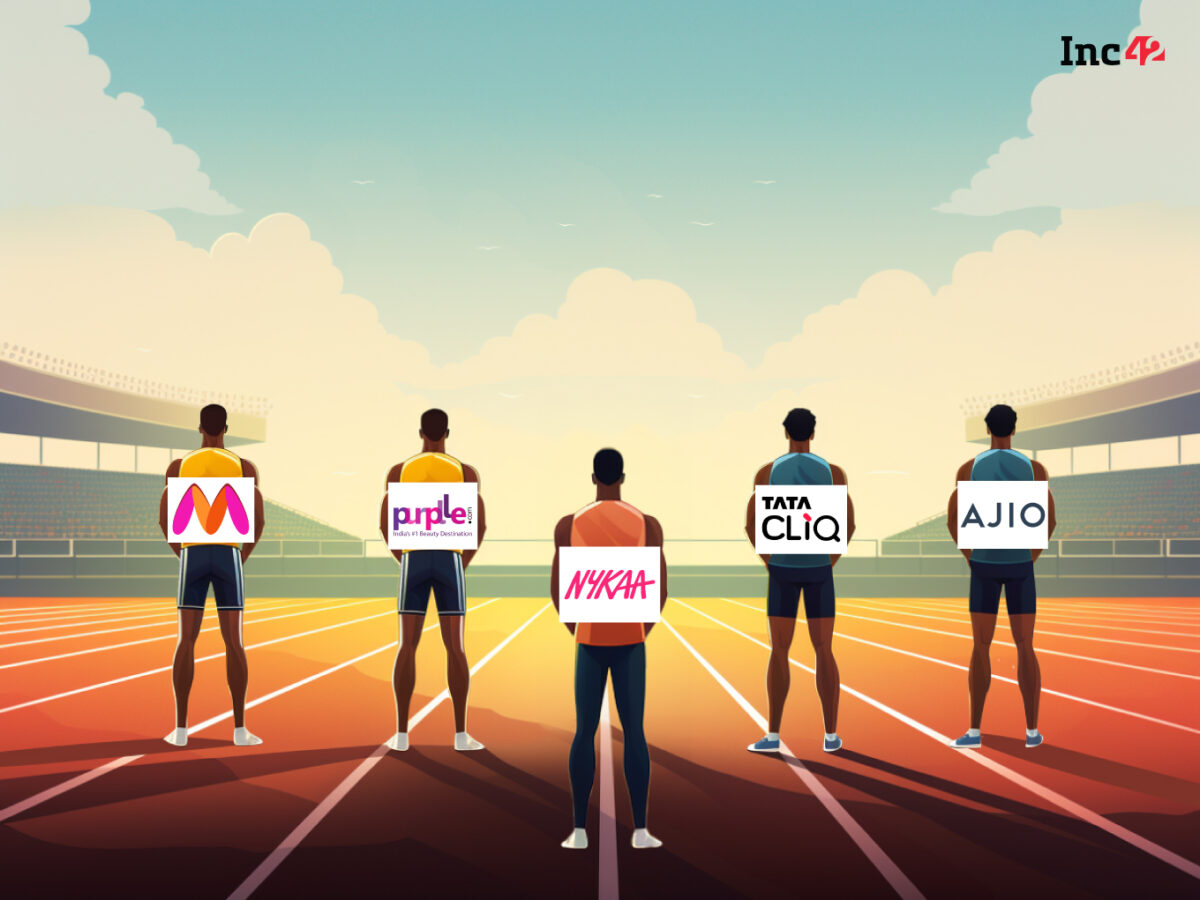
– Nykaa, which has been the most popular beauty marketplace, has had to fight off Reliance Tira, Flipkart-owned Myntra, Tata CLiQ and others but has to invest heavily in omnichannel and private label expansion
– As its profitability and traction have declined, Nykaa needs to fix things for the long run without losing too much money as it does not have the capital reserves similar to its rivals
In the first week of July, the Nykaa stock took a significant hit, falling 42% from its 52-week high. Further, the Association of Mutual Funds in India (AMFI) downgraded the stock, dropping it from the top 100 listed companies in the country. As of now, the company is ranked somewhere between 101 and 250 on the market capitalisation threshold.
From a near monopoly in the beauty ecommerce space, Nykaa has lost its top spot. Not to mention, new competition, in the form of D2C brands and behemoths such as Tata and Reliance, has complicated the situation even more.
The downgrade by the AMFI means that Nykaa is no longer an attractive largecap stock in India, and this could have an impact on the company’s visibility in the near future.
So, what exactly triggered this collapse?
It was only in November 2021 that Nykaa’s INR 5,352 Cr IPO saw 82x subscription, the highest among large startup IPOs in India. Having withstood competition from marketplaces such as Amazon India and Walmart-backed Flipkart and Myntra, Nykaa seemingly set a new benchmark for Indian ecommerce startups with its blockbuster IPO.
But the last 20 months have been nothing short of disruptive. Reliance-backed AJIO has grown in stature, and the Indian conglomerate has also launched Tira in the beauty ecommerce space.
Meanwhile, Tata has also bolstered its beauty and personal care product assortment on its platform Tata CLiQ. Furthermore, the Tatas have added 20 beauty tech stores across the country, aligned with its ecommerce operations, while Myntra Beauty has registered 2X-3X growth in recent months and expanded its brand collection. Therefore, Nykaa needs to come up with something exceptional to compete with the aforementioned well-funded BPC contenders.
Adding to the company’s woes was the announcement of the issue of bonus shares in a 5:1 ratio and changes in key management personnel after a successful IPO. This did not go down well with investors. Bonus shares announcement was largely perceived as a way to keep the company’s anchor investors from offloading shares at the end of their IPO lock-in period.
Experts believe that amid declining year-on-year profitability, Nykaa could see a cash crunch as it prepares to combat with deep-pocketed corporations. For now, it will be interesting to see if Nykaa can hold onto its market share?
Nykaa’s Losing Its Footfall To AJIO & Myntra
First, let’s look at the bread-and-butter for ecommerce platforms such as Nykaa — that is visits, page views, engagement and repeat orders.
It must be noted that Nykaa has separate properties for fashion (Nykaafashion.com) and beauty (nykaa.com). If we look at the performance over the last 3-4 months, the fashion vertical has definitely seen some gains, but Nykaa.com itself has experienced negative growth in total visits.
The flagship property is bleeding users due to an ever-intensifying competition, which is quite clear in the graph given below.

Further, Nykaa, Nykaa Man and Nykaa Fashion have the lowest numbers when it comes to average visit durations.
On the ecommerce front, Nykaa has a lot of catching up to do against its competitors. Some of Nykaa’s private labels — take Dot&Key for instance — have become popular discounted items on Myntra, AJIO, Amazon India and other marketplaces, which shows that the company is forced to use its competition to sell its products.
In contrast, Myntra, AJIO, Tira and Amazon’s private labels are largely walled inside their respective marketplaces. To beat the competition and stay in the public spotlight, Nykaa has opted for the omnichannel strategy, and it is looking to add brand-owned stores on the retail front. But here too, the competition is stiff.

Nykaa Faces Challenges With Its Online-To-Offline Strategy
When we look at the omnichannel operations, Nykaa has 145 physical stores, 38 fulfilment centres, and 2,749 stores of its owned brands. The company plans to open more physical stores this year, according the announcements made in its last earnings call.
Nykaa’s founder and CEO Falguni Nayar had earlier said, “Physical retail is a necessary investment that we need to make, even if it adversely affects overall profitability. So, we are aiming for the optimal mix of online, offline, and duty.”
This is where the situation becomes more complicated. Being primarily an online platform, Nykaa has managed to stay lean and achieve profits thus far. However, opening more stores means more investments and a significant increase in operational expenditure, including higher employee expenses.
Plus, this entails entering into fierce competition with Tata and Reliance.
Reliance Retail alone has launched over 3,300 new stores in FY23 under its various brands, including Tira Beauty, Trends, and others.
Similarly, Tata has been a well-known name in the BPC and fashion industry. It introduced the first-ever cosmetics brand, Lakme Cosmetics, to India (later sold to Unilever). Tata has over 22 in-house labels for its Westside brand, which operates over 200 stores across the country.
While Tata plans to open 20 beauty tech stores, equipped with AI and VR, it already has 391 Zudio stores nationwide.
For Tata and Reliance, it is relatively easier to build an online business backed by their offline stores compared to Nykaa’s strategy of building an offline presence backed by online operations. These large conglomerates have years of experience in building retail brands in the offline space.
So, essentially, Nykaa seems to have lost ground in its strength areas of ecommerce and offline retail, as it is not as experienced as its rivals.
Speaking to Inc42, Devangshu Dutta, the founder and CEO of Third Eyesight, a boutique management consulting firm explained, “Apart from the impact of Covid, in the last 3-4 years, many brands have started moving offline because that’s where the bulk of the business happens. But moving offline means entering a completely different business. You’re not able to centralise inventory as much, and you may not be able to respond to market-specific segments as quickly.”
He also believes, like any other offline retail business, Nykaa will face high operational costs, but it has an advantage in the fact that it may be able to use data more effectively from its online operations. Nevertheless, this is a minor advantage.
“Your store locations have to be correct, and self-sustaining quickly, at least on a cash operating basis. At the business level you may look at profitability in a longer term,” Dutta added.
Profits Plummet: Nykaa’s Other Big Worry
India’s beauty and personal care market, presently valued at $16.8 Bn, is poised to grow at a compound annual rate of 11%, with cosmetics and perfumes categories growing at a faster clip.
According to a joint report by international beauty brand Estée Lauder and Gurugram-based business insights firm 1Lattice, a substantial portion of sales worth about $1.3 Bn are through ecommerce channels. This is expected to grow at a CAGR of 30% during FY22-27, followed by companies that retail beauty products in health and beauty stores and modern retail shops.
With 30% of India’s BPC market share, Nykaa has so far managed to stay ahead in the race. Nykaa’s beauty category (55% of the broad BPC category) saw 33% full-year growth with a GMV of INR 6,649 Cr. On the fashion side, the GMV grew 47% for the full year at INR 2,570 Cr.
BPC and fashion are the two mainstays of Nykaa’s business, even though fashion is a relatively new vertical for the Mumbai-based company. The company had earlier launched Nykaa Man, a separate platform for men’s grooming, beauty and fashion, but with less than 1 Mn visits, it has failed to grow over the last few years while AJIO has grown from 0-37 Mn users, as per analysts.
“At one end, Nykaa’s online PAT has been going down for the last two years, while Nykaa Fashion’s loss for the year has grown consecutively, putting Nykaa business in a fix,” said an analyst from PwC.
Nykaa needs to bring a balance between short-term losses and long-term profits. However, the company’s current strategy fails to show a way out, the analyst added.

The Balancing Act For Nykaa
As per the analyst quoted above, the company’s BPC products have so far had lower prices than Myntra and AJIO, where discounts are typically lower.
However, when compared to Amazon India and its long list of D2C brands and private labels, Nykaa products were slightly more expensive. Amazon also scored over Nykaa with its better supply chain and distribution.
Nykaa banked on product assortment, the assurance of quality and authenticity of products, but as more and more brands join Tira, AJIO and Tata CLiQ, this is also fast eroding.
Access to international brands is no longer exclusive to Nykaa, so it needs to tackle distribution and supply chain, where its rivals score heavily.
Giving Nykaa the benefit of the doubt, a consultant from brokerage firm Motilal Oswal recently said, “There is no clear playbook for these businesses. When Nykaa entered the segment, it was pioneering many aspects in India.”
However, now the company needs to exercise extreme caution regarding expenses and investments because of heavyweight competition with deeper pockets.
P Ganesh, chief financial officer at Nykaa, highlighted that the company still has funds remaining from the IPO, which will be utilised to secure future capital needs.
Ganesh added, “It’s worth noting that while we have observed a considerable increase in working capital as the company scales up, the number of working capital days is expected to stabilise. This means that the amount of funding allocated to working capital should moderate in the future.”
But analysts also believed that Nykaa cannot afford to sacrifice its market share in India’s rapidly growing beauty, personal care, and wellness segment. One thing that is advantageous for Nykaa is that Reliance-owned Tira is still new in the market and will take some time to get to critical mass adoption.
This is a window of opportunity for Nykaa to stretch its lead and fight off its rivals. Nykaa’s brand value primarily comes from its online business, so it must not let offline expenses hinder its online growth plans. However, given the competition, Nykaa is in a Catch-22 situation.
In the BPC segment, owned and private label brands play a vital role in increasing long-term profitability and repeat purchases. All of this will require extensive investment from Nykaa’s leadership — there are segments in BPC where Nykaa has no private label or owned brands.
As of now, the question remains: Can Nykaa maintain its dominance in the online market while facing fierce competition on multiple fronts?
(Published on Inc42)
admin
June 16, 2023
Sharleen D’Souza & Shivani Shinde, Business Standard
June 8, 2023
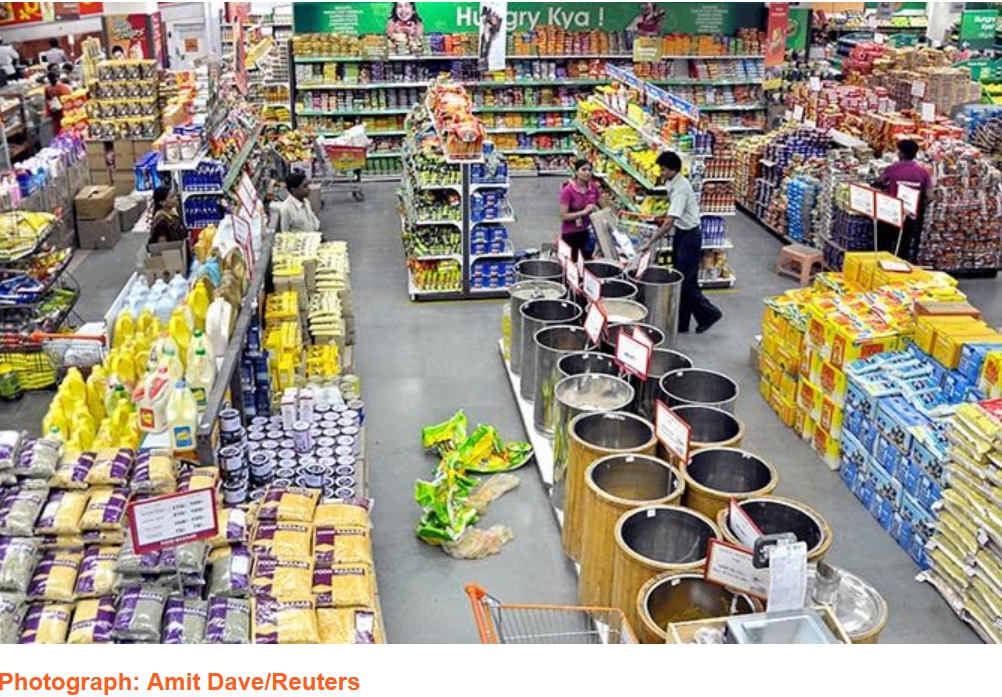
Why are companies finding it difficult to sustain the supply-chain business?
Experts point out that gross margins in supplying fast-moving consumer goods (FMCGs) are very low.
While it does look attractive because it is the largest part of the consumption market, the last-mile supply chain and retailer are not making money.
“FMCG brands have ensured high margins for their businesses by streamlining and smoothing their supply chains over decades and making them cost-efficient,” said Anshuman Singh, founder and managing director, Stellar Value Chain Solutions.
Singh said in rural markets, the costs of supply chains were proportionately high due to lower volumes.
He added: “The low margins in the last leg of the FMCG rural supply chain make it difficult for new-age rural distribution players to offset the high costs.”
Devangshu Dutta, chief executive officer, Third Eyesight, a consultancy firm, said modern B2B (business-to-business) players had tried to step in to replace the traditional links in supply chains with price incentives and a large selection of products.
“Traditional distributors and wholesalers don’t just add costs but also add value, including aggregating demand for brands, disaggregating supplies for small retailers, providing market intelligence to both ends of the chain, and giving credit to retailers and a sort of financial guarantee for manufacturers,” Dutta said.
He said for their business models to work — online or offline — B2B businesses needed a significant concentration of demand, which had been tough to get in many locations.
On July 6, 2022, the Competition Commission of India (CCI), in the dispute between biscuit manufacturer Parle and B2B player Udaan, upheld the plea of the former, saying it did not violate competition laws. Parle had refused to sell its products directly to Udaan.
Udaan was the first B2B start-up to have a run-in with a well established brand, which was not interested in moving away from the traditional distribution model.
What has that meant for Udaan? It has meant tweaks to its business.
It further diversified its product portfolio so that its access to the market was not impacted.
It forayed into the mobile accessories segment as local brands tapped into its network of over 3 million retailers.
Earlier, this year it expanded its reach in the miller segment, which supplies staples like pulses, grains, wheat, rice, and oil.
Udaan aims to take on board about 100 miller partners per quarter.
It works with over 500 miller partners, supplying over 10,000 SKUs (stock-keeping units) to retailers and kirana owners, according to the company in an interaction with Business Standard.
The other company that recently had to tweak its business or go back to its focus on rural India is Pune-based ElasticRun.
B2B start-up ElasticRun has decided to focus on the core business and wind up its new expansion plans.
Backed by SoftBank and Prosus Venture, ElasticRun, which typically runs distribution for FMCGs in rural areas, decided to expand and also cater to retailers within city limits, i.e. tier 1 and tier 2 markets that had a strong distribution owing to companies having direct distribution in those areas.
“We initiated a pilot for urban markets. But through the year, as the macro changed, we decided not to pursue the urban pilot and focus on our core of rural business … we have to part ways with almost 2 per cent of our employees,” said Sandeep Deshmukh, co-founder and chief executive officer, ElasticRun, in an earlier interaction with Business Standard.
ElasticRun extends the reach of the brands’ direct distribution networks to deep rural markets. It enables access to a set of net new stores and customers, who were not accessible through traditional distribution networks.
The need to spend in order to get market share has caused well-entrenched players like Amazon to pull out of some of its distribution business.
Amazon India has decided to shut down Amazon Distribution, according to sources. This follows its recent decision to close down its food delivery and edtech offers. The moves are part of the annual operating planning review process amid global macroeconomic uncertainties. The e-commerce giant is looking to focus on its core businesses, sources said.
Amazon Distribution operates a platform where sellers sell FMCGs and apparel products from companies and distribute them among kiranas and small neighbourhood stores.
However, this unit operated in only three cities of Karnataka — Bengaluru, Mysuru, and Hubbali.
(Published in Business Standard)
admin
April 24, 2022
Written By Suvashree Ghosh, Bijou George, and Sankalp Phartiyal

It was a contentious plan to repay overseas bondholders in full that brought what would have been India’s biggest retail deal to a grinding halt.
Debt-laden Future Retail Ltd.’s offshore bondholders — a relatively smaller part of the creditor pool — were promised 100% payment in the rescue offer from billionaire Mukesh Ambani, according to people with knowledge of the matter. Indian lenders were asked to take a haircut of as much as 66%, the people added, asking not to be identified discussing confidential information.
The unequal treatment led to the move last week, when the local banks rebuffed the $3.2 billion offer from Ambani’s conglomerate. Reliance Industries Ltd. announced the purchase plan in August 2020 but struggled to complete the transaction in the face of legal challenges mounted by Amazon.com Inc., which argued it had the first right of refusal contractually.
Bank of India and State Bank of India, the main bankers to Future Retail, didn’t immediately respond to emails seeking comment on reasons for voting down the deal. Representatives for Future Group and Reliance also didn’t immediately comment.
State-run lenders risked probes from federal agencies if they accepted these discriminatory terms, they said, explaining their preference now for a court-mediated insolvency process where bids are called in and there’s no risk of them being accused of cutting a bad deal. Bank of India has already requested an Indian court to initiate the process.
Hard-Nosed Decision
The hard-nosed decision by Indian banks has pushed the teetering Future Retail, which ran one of the nation’s largest retail grocery chains before the pandemic struck, one step closer to bankruptcy. Future Retail is almost certain to default on its $500 million bond coupon payment due July 22, S&P Global Ratings said Tuesday, while downgrading the company’s ratings deeper into junk territory.
The lenders’ action has also taken the wind out of a tortuous two-year-old litigation between Reliance and Jeff Bezos-owned Amazon — the e-tailer had started arbitration proceedings in Singapore to block the deal — but left the door open for Ambani to snag these retail assets, possibly at an even cheaper price, under the bankruptcy process.
“Reliance and other parties could be eligible to bid for its assets by submitting their resolution plans” even if Future Retail ends up in bankruptcy, according to Satwinder Singh, New Delhi-based partner at law firm Vaish Associates Advocates. “This would also lead to moratorium on any or all ongoing arbitration proceedings against Future.”
While the local lenders were agreeable to the deal when it was first announced, a lot changed in the past year or so, the people said. While the Amazon lawsuit dragged on, the asset value eroded and the pandemic worsened the cash crunch at Future Retail that began defaulting on its debt repayments.
Secured Indian lenders were promised recoveries ranging between 34% to 88% of the total $4 billion in dues and even those payouts were staggered over seven years, the people said.
Bloodless Coup
Reliance dealt a body blow to the Kishore Biyani-led Future Group in February when it quietly began poaching employees and taking over rental leases of hundreds of stores earlier run by Future Retail and Future Lifestyle Fashions Ltd. Ambani’s bloodless coup prompted Amazon to suggest settlement talks on the bitter dispute and alarmed Future’s investors and lenders who worried about asset-stripping.
Reliance’s unexpected takeover of Future’s stores eroded bankers’ confidence in the deal as it stripped off value from the chain and potentially could erode Reliance’s offer terms.
The out-of-court truce talks between Amazon, Future and Reliance collapsed soon after the store-purchases were initiated, the companies informed India’s top court on March 15. Amazon will continue with its arbitration proceedings against Future Group in Singapore, according to a person familiar with the matter, who asked not to be identified as the deliberations are private.
“A major turning point was when Reliance physically took over Future’s stores, which turned it into a no-holds barred situation,” said Devangshu Dutta, head of New Delhi-based retail consultancy Third Eyesight. “Before this the battle was being fought in courts and across the negotiating table. But at this point it moved over to the real business.”
Source: bloomberg
admin
March 24, 2022
Written By Aditya Kalra & Abhirup Roy

MUMBAI, March 6 (Reuters) – At a large Future Retail (FRTL.NS) supermarket in Mumbai last week, workers were unloading hundreds of bright blue grocery crates belonging to India’s biggest retailer Reliance.
Prospective customers were turned back by security, disappointed at the closed state of the store that still carries the signage of Future’s biggest brand, Big Bazaar, but which will likely soon be rebranded as a Reliance outlet.
Across India, similar scenes are being played out as Reliance Industries (RELI.NS), India’s biggest conglomerate run by Mukesh Ambani, the country’s richest man, presses ahead with a shock de facto takeover of prized retail real estate that Amazon.com Inc has been keen to take part-ownership of.
The high-profile bitter dispute between corporate titans in which Amazon has sought to block Reliance’s planned $3.4 billion purchase of Future Group’s retail assets is currently before India’s Supreme Court.
Reliance’s takeover began with utmost stealth on the night of Feb. 25 when its staff began arriving at Future stores. Many in Future’s management were in the dark about the plans as store employees from all over the country frantically began to call, according to people with direct knowledge of the matter.
“It was tense, everybody was panicking. We didn’t know who they were. They wanted access and seniors didn’t know about it,” a New Delhi Big Bazaar store employee said, describing what happened around 8 p.m. that day.
At a Future store in Sonipat town in northern Haryana state, announcements were made asking customers to leave as Reliance seized control, one source said. In Vadodara in western Gujarat, Future employees arriving for work the next morning were asked to go back home with no explanation, said another source.
Citing unpaid payments by Future, Reliance has taken control of operations of some 200 Big Bazaar stores and has plans to seize another 250 of Future’s retail outlets. Combined, they represent the crown jewels of Future’s retail network and around a third of all Future outlets. read more
Although Reliance had not played a large public role in the legal dispute, it had, according to sources, for some months assumed many of the leases held by cash-strapped Future, India’s No. 2 retailer and Amazon’s estranged business partner.
Reliance’s sudden possession of the stores appears to have landed what some analysts are calling a coup de grace that spoils Amazon’s chances of untangling the transfer of Future’s assets to Reliance. That’s despite a series of legal battles won by the U.S. e-commerce giant to date blocking the 2020 deal announced between the two Indian companies.
“What will Amazon fight for now?” said a source close to the U.S. company with knowledge of the legal dispute. “The shops are gone.”
Representatives for Reliance, Amazon and Future did not respond to Reuters queries for this article. Sources asked not to be identified due to the sensitive nature of the dispute.
AFTER THE TAKEOVER, TALKS
Future Retail said on Feb. 26 it was “scaling down its operations” to cut losses although it made no mention of Reliance in its statement. Future Group as a whole has more than $4 billion in debt.
Reliance plans to retain Future’s employees at the stores it takes over, sources have said.
Amazon, which has a stake in a separate Future Group unit that it argues prevents Future from selling retail assets without its permission, has called the supermarkets and other stores an “irreplaceable” network in a sector worth $900 billion in revenues annually.
The legal wrangles had over time become increasingly high-stakes and marked by ugly rhetoric. At one point, Amazon sought for Future Chief Executive Kishore Biyani to be detained in prison for disobeying a legal order. And Future once likened Amazon to Alexander the Great and his “ruthless ambition to scorch the earth”.
But on Thursday, six days after Reliance’s move, Amazon at a Supreme Court hearing unexpectedly called for cordial talks to end the dispute – a proposal Future agreed to.
“People have taken over shops … let’s at least have a conversation,” Amazon’s lawyer Gopal Subramanium said.
Discussions are expected to begin soon. read more
Whatever the outcome of the talks, analysts say Amazon had gravely underestimated Reliance.
“If anybody should have seen this coming, it should have been Amazon and they should have prepared against it,” said Devangshu Dutta of retail consultancy Third Eyesight.
“Clearly, they didn’t.”
Source: reuters
admin
September 28, 2020
Written By Mihir Dalal

(From left to right) Doug McMillon, CEO of Walmart, which owns Flipkart; Mukesh Ambani, chairman and MD of RIL; Jeff Bezos, CEO of Amazon
BENGALURU : Last month, Nimit Jain, an entrepreneur, ordered biscuits, shampoo, toothpaste and other items for his family in Kota. He used JioMart—the new online shopping app by Mukesh Ambani’s Reliance Industries Limited—lured by its low prices and freebies.
JioMart was to deliver the order within two days, but Jain’s family didn’t receive the items on time and JioMart didn’t inform Jain about the delay. The delivery was done four days after he had placed the order, a few hours after Jain had complained to the firm via email and Twitter.
A few products were missing, Jain’s parents informed him. It took time to figure out the missing items because the details of the order weren’t available on the app. Jain had paid online and asked JioMart for a partial refund. Instead of receiving an acknowledgement for his refund request, he received a response for his previous email about the delay in delivery. Five days later, Jain got a refund.
Mumbai-based Jain, a computer science graduate from the Indian Institute of Technology, Madras, usually orders groceries from BigBasket and sometimes from Dunzo. He said that he doesn’t plan to use JioMart again.
“A couple of my friends and relatives (in Mumbai and Kota) have also had similarly bad experiences. It doesn’t look like JioMart is ready for online groceries. Their operations and customer care teams weren’t in sync,” Jain said.
Since JioMart expanded to more than 200 cities this summer, scores of customers like Jain have complained about missing products, delayed deliveries and generally poor service. Still, industry executives say that while its service levels have been inconsistent, JioMart is registering similar order volumes to BigBasket, the largest e-grocer, on the back of aggressive marketing and discounts.
These volumes still comprise a small fraction of the overall business of Amazon India and Walmart-owned Flipkart, the two dominant online retailers. But that’s because JioMart is only selling groceries now; it plans to sell other products like fashion and electronics soon. It’s clear that after many years of talk and hype, Reliance, which owns India’s largest offline retail chain, is finally becoming a serious challenger to Amazon and Flipkart, as well as BigBasket and Grofers.
Still, industry executives, logistics firms, consultants and analysts that Mint spoke with said that Reliance will find it tough to break the dominance of Amazon-Flipkart in e-commerce, similar to how Walmart is struggling to challenge Amazon in digital sales in the US even as its stores continue to prosper. Amazon and Flipkart both have deep pockets, proven expertise in e-commerce, popular brands and good knowledge of the Indian market.
“Reliance has the financial muscle, but Walmart (Flipkart) and Amazon are no pushovers,” said Harminder Sahni, managing director, Wazir Advisors, a consultancy. “Today, most people who want to shop online are happy with Flipkart and Amazon. These companies have achieved significant scale and have very few weaknesses. As a latecomer, it will be very difficult for Reliance to make a big dent in the market.”
Reliance did not respond to an emailed questionnaire seeking comment.
Local internet powerhouse
During the pandemic, Reliance has not only moved fast to make inroads into the e-commerce market, it has also consolidated its leadership in organized offline retail. Last month, Reliance bought most of the businesses of Future Group for about $3.4 billion in a deal that will take its retail footprint to nearly 14,000 stores—by far, the largest in India.
In the past six months, Reliance has raised more than $21 billion for its digital unit Jio Platforms. This month, Reliance kickstarted a separate fund-raising spree for its retail unit, Reliance Retail, bagging about $1.8 billion from private equity firms Silver Lake and KKR, two of the investors in Jio. Several more investment firms, including other shareholders in Jio, are expected to join them.
These moves are part of Reliance’s efforts to transform itself into a 21stcentury digital behemoth. It is positioning itself as India’s answer to Amazon, Facebook, Google, Alibaba and other world-class digital giants, and unlike local startups like Flipkart, Ola and Paytm that have or had similar ambitions, Reliance enjoys some unparalleled advantages.
It is now accepted wisdom among politicians and regulators that India needs a ‘local’ internet powerhouse to counter the dominance of America’s Big Tech and the growing influence of Chinese firms, partly because of sovereignty concerns. Reliance’s mastery in lobbying and its political clout makes the firm best-placed to exploit this urgent establishment need to find a domestic internet powerhouse.
Amazon, Flipkart, Facebook and others face many policy-related restrictions that not only serve as obstacles to them but pave the way for domestic firms led by Reliance to enter the fray. For instance, foreign investment rules prevent Amazon and Flipkart from owning inventory or selling private labels (though critics say that these firms do it anyway using clever legal workarounds), while Reliance has no such constraints. Apart from a supportive policy environment and huge capital resources, on the business front, too, Reliance has an enviable digital distribution network and reservoir of customer data on account of Jio.
But despite these formidable advantages, Reliance has yet to prove that it has the chops to realise its ambitious vision.
The war among Reliance and Flipkart and Amazon and other internet firms is also not restricted to retail, but will extend to other sectors like financial services, content and business-to-business commerce. The technology-centric nature of the battle is more suited to the internet companies than to Reliance. There’s little doubt that Reliance will be a major player in the digital business, but the jury’s out on how much value the firm can corner. Its foray in e-commerce and B2B will provide early answers to this question.
Retail battle
After JioMart began testing its service late last year, media reports said that the company would deliver products to customers from local kirana stores. After Facebook invested in Jio in April in a deal that included a business partnership between JioMart and WhatsApp, Ambani said that JioMart would soon connect some 3 crore kirana stores with their neighbourhood customers.
Many analysts, too, expect the partnership with WhatsApp, the most popular app in India, to be a game-changer. In July, Goldman Sachs estimated that Reliance’s entry will help expand the online grocery market by 20 times to about $29 billion by 2024. Reliance’s partnership with Facebook could help the firm become the leader in e-grocery and garner a market share of more than 50% by 2024, Goldman said.
But Mint learns that Reliance is sourcing a majority of orders on JioMart in many cities through Reliance Retail’s supply chain; only a small number of orders are served through kirana stores. JioMart is signing up a few thousand kirana stores every month, but its expansion is happening at a slower rate than many analysts expect. Two industry executives said that JioMart’s average order value is lower than that of other e-grocers, which means that Reliance is losing larger amounts of money on every order.
According to one e-commerce executive, for BigBasket and Grofers, the delivery cost is about 3-4% of the average order value, which exceeds ₹1000. For Reliance, the delivery cost is presently much higher because its order value is below ₹800. The lower order value is partly because most of JioMart’s 200 city-markets are non-metros. BigBasket and others generate an overwhelming majority of their business from the metros. Reliance is betting on expanding the e-grocery market rather, than taking market share from incumbents, which generate an overwhelming majority of their sales from 10-15 cities. But while Reliance may be able to attract customers in smaller cities initially with discounts, profitability will be tough.
“The economics of serving metros are very different from the rest of India. In the mass market, bill values are much, much lower. Right now, Reliance’s main focus is to scale JioMart, so they aren’t worried about the delivery cost,” the executive cited above said. “But eventually, reality will catch up, and they will have to increase basket sizes because this model isn’t sustainable. Grocery has very thin margins to start with. “
Private label push
One obvious way for Reliance to boost margins is by selling more private label products. In the grocery category, Reliance Retail already generates 14% of its revenues from private labels. People familiar with Reliance’s plans said that the company wants to push its private label products to kirana stores. While there are hundreds of well-known brands in FMCG, the grocery category (products like rice, pulses and flour) is largely unstructured. Reliance plans to sell its private label products both in grocery and FMCG.
Apart from retail, Reliance is also rapidly expanding its B2B business. Its private label products form a key component of its retail and wholesale business plans, the people cited above said.
The private label push, however, is making large FMCG companies like Hindustan Unilever, Marico and Dabur, which sell competing products, wary of working with Reliance’s B2B arm.
Like Flipkart and Amazon, which are also expanding their B2B businesses, Reliance’s grand vision over time is to have an integrated ecosystem of wholesale and retail in which it connects consumer goods makers with kirana stores and retailers, supplies a large number of private label products across many categories to retailers and end-customers, and becomes the biggest omnichannel retail firm in the country. But realising this vision will require Reliance to work seamlessly with millions of kirana stores, thousands of brands, modern retailers (all of which will see the firm as a rival to an extent)—and provide exceptional service in a profitable manner to retail customers.
Analysts and industry executives said that Reliance has a higher probability of finding success in categories like fashion (in which it already runs a portal called Ajio) and grocery that are mostly unorganised and have a shortage of established brands. In these categories, Reliance faces fewer barriers from existing players and has a better chance of pushing its private labels in both the wholesale and retail markets. But in categories like electronics and FMCG, which are dominated by entrenched brands, kirana stores and e-commerce firms, Reliance may struggle to scale as fast.
For instance, Flipkart and Amazon dominate online sales of electronics and fashion, which together comprise more than 75% of all e-commerce. To win significant share in electronics, Reliance will have to spend enormous amounts on discounts, marketing and offering favourable terms to brands . But, in fashion, Reliance can tap its low-priced private labels to lure customers without resorting to value destruction.
“The market is too varied for one player to be big in all categories,” an investment banker said. “Reliance will have to carefully choose its battles. There’s a risk that it may spread itself too thin, so it’s wise for them to have started with grocery.”
Meanwhile, while Google and Facebook have together invested more than $10 billion in Reliance, both companies are continuing to expand their own businesses in India. Google and Facebook have ambitions to enter e-commerce and expand in other sectors like payments and content. What this means is that while Google and Facebook will end up collaborating with Reliance in some areas, they will also compete with the firm in others, joining Flipkart and Amazon in the war of the digital conglomerates.
Flipkart and Amazon have already stepped up their lobbying efforts with the emergence of Reliance as a threat. Because of the pandemic that has made e-commerce indispensable, there has been a thaw in the government’s attitude towards the US e-commerce firms. A more antagonistic attitude may return when the pandemic passes.
Eventually, though, the war will be decided by customers. Here, experts are divided on whether Reliance will emerge as the winner. “Reliance still has to do a lot more on getting the customer experience in place, but given the strides they’ve made, it is well-placed to compete in the digital space,” said Devangshu Dutta, head of retail consultancy firm Third Eyesight.
Source: livemint
