
admin
September 1, 2026
Vikash Tripathi, Outlook Business
1 September 2026
Eight decades ago, the ‘nationalist businessman’ GD Birla helped prepare the ‘Bombay Plan’, which asked the state to pro-vide for the bare minimum needs of its people. His plan asked for 2,800 calories of well-balanced food per day, 30 yards of clothing per year and 100sq ft of housing per person.
Today, seventh-generation Aryaman Vikram Birla is betting on an entirely different opportunity: premium dining. “We continue to believe in the remarkable potential of the premium casual dining space, spurred by rising disposable income and evolving lifestyles,” the 29-year-old said after Aditya Birla New Age Hospitality acquired KA Hospitality in 2023.
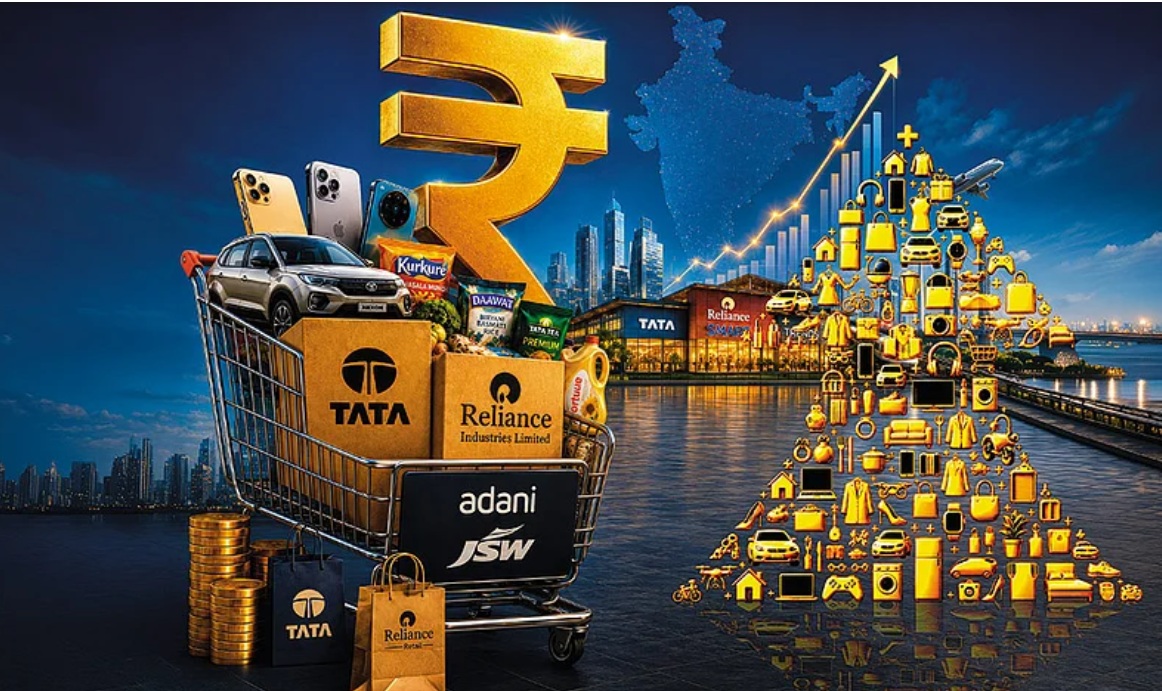
The Birlas are not alone in trying to cash-in on rising prosperity in India. In the past five years alone, India’s top 10 industrial groups have announced new ventures in consumer-facing sectors or doubled down on existing ones. A rough tally of these investments crosses ₹4.8 lakh crore.
For decades, these same business houses built their dominance in core sectors like steel, power, aluminium, cement and chemicals, laying the industrial backbone of the economy. This helped the nation become a large producer of such goods and, in some cases, an exporter as well.
But as India’s economic conditions changed, so has the focus of its largest conglomerates.
For the likes of Tata, Aditya Birla, Bajaj and Bharti, that journey started way back. “What has changed in recent years is the speed and openness of the amount of capital being invested,” says Jitender Kumar, associate professor and programme chairperson, retail management programme at Birla Institute of Management Technology.
“It is not ‘opportunistic’ reasons, it’s structural reasons.”
Two factors seem to be driving the shift: the first is the arrival of an affluent consuming class that can buy branded and premium goods, and the second is the attraction of consumer businesses as a way to diversify revenue and, in some cases, improve the quality of earnings.
The Rise of Affluence
A couple of decades ago, if an Indian household had some extra cash, it often meant buying more of the same. Today, it increasingly means buying better. Even salt is being upgraded, from iodised to Himalayan pink or rock salt. The same shift is visible in bigger purchases: sports utility vehicles (SUVs) over hatchbacks, and ₹1cr-plus homes over budget flats.
But India isn’t simply consuming more. It is moving from basic consumption towards discretionary, branded and premium consumption. This boom is most clearly seen in the rapid expansion of the financial infrastructure that enables consumption. Formal retail credit penetration has more than doubled over the past decade, according to a TransUnion Cibil report, driven largely by personal loans, credit cards and consumer durable loans. Meanwhile, the government-backed Unified Payments Interface has untethered spending from the cash in a buyer’s wallet.
The signs show up across the broader consumption economy. Homes priced above ₹1cr accounted for 54% of total sales in 2025, up from just 30% in 2023—the market that decorative paints and home solutions are chasing.
Out of 4.7mn cars sold in the financial year 2025–26, SUVs accounted for more than half.
“The consumer market has grown substantially—not only through rising incomes but also the dramatic expansion of branded consumption across product verticals,” says Devangshu Dutta, founder of management-consulting firm Third Eyesight.
The bets are also getting more varied, from Reliance Retail tying up with global brands like Fenty and Skims to the Bharti Group bringing Olive Garden to India.
The Lure of Returns
For a passenger walking through an airport, the flight is only one part of the journey. There is coffee before boarding, food between flights, a lounge, retail outlets, parking and a host of other things to spend money on. For Adani Airports, those non-aero businesses are increasingly becoming the more lucrative part.
Its non-aero operations already generate about ₹2,500cr, with returns in the high-20% range, against roughly 12% from regulated aeronautical operations.
Jeet Adani, director of Adani Airport Holdings, expects the share of aeronautical revenue to fall to around 10% of total revenue, with non-aero becoming the bigger growth driver. The motivation can be seen as an escape from a return ceiling as much as a bet on rising affluence.
As Kumar puts it, consumer businesses help the conglomerates in two major ways. First, they help insulate them from volatile and often punishing commodity cycles, and second, they often offer far better returns with lower capital intensity and faster cash conversion.
Reliance Industries (RIL) shows how significant that shift can become. By 2025–26, its consumer-facing arms, Jio Platforms, Reliance Retail Ventures and Reliance Consumer Products, together contributed over 40% of group revenue and nearly 60% of operating profit.
And there is another advantage. “A small business, when it wants to build a new venture, faces constant margin pressure and often has to build its supply chain from scratch. A large conglomerate can leverage its existing scale, infrastructure and supply chain to enter a new business far more efficiently,” explains Kranthi Bathini, equity strategist at WealthMills Securities.
Different Strokes
In chasing consumers, some conglomerates are following the fastest-growing categories, while others are using their existing industrial capabilities to enter consumer-facing businesses. One is trying to build an entire ecosystem around it. But the lines between these approaches are not always clean.
Tatas is doing both: building entirely new consumer brands while also using the industrial ecosystem it has built over decades.
For Tatas, the consumer opportunity has largely been about following where spending is moving. Their consumer ventures have followed this arc longest. It began decades ago with Lakmé (1952), Tata Tea (1962) and Titan (1984). Tanishq and the expansion of Trent under brands such as Zudio are only the latest examples.
At Tata Consumer Products, once largely a staples business built around salt, tea and pulses, the focus has been shifting towards value-added foods and beverages, with ₹7,000cr spent on the acquisitions of Capital Foods and Organic India in 2024. Across companies such as Tata Digital, Indian Hotels, Air India and Tata Motors Passenger Vehicles, the group has announced close to ₹93,180cr in investment over the past five years.
Aditya Birla’s jewellery chain Indriya and its move into premium hospitality belong to the same category of ‘pull-based’ diversification.
JSW is taking a different route. It is taking its existing industrial strengths one step closer to the buyer. The group, which has traditionally been focused on areas such as steel, energy and cement, has expanded into consumer-facing areas such as auto, paints and home solutions.
It launched JSW Paints in 2019, and acquired a controlling stake in paintmaker AkzoNobel India for ₹8,986cr last year. Its strategy is to leverage an established network of contractors, dealers, architects and builders to reach consumers.
The same strategy can be seen in its push into autos, acquiring a 35% stake in the Indian unit of China’s MG Motor in 2024, leveraging synergies with its established steel business.
At Tatas, too, group companies like Tata Steel, Tata Power, Tata AutoComp, Tata Technologies and TCS are doing significant businesses with Tata Motors.
Adani is also using an asset it already controls to move further into the consumer’s wallet. Adani Airports announced a ₹20,000cr investment in June to develop hotels, retail, entertainment and commercial infrastructure around its eight airports, and has signed hotel management agreements with IHG Hotels & Resorts for five hotels. City-side developments could contribute 30–40% of Adani Airport Holdings’ non-aero revenue.
Yet another example of the extension strategy is Aditya Birla Group’s attempt to diversify from cement, metals and textiles into decorative paints with Birla Opus.
RIL took a different approach: trying to connect multiple consumer businesses into one ecosystem. It expanded its retail network through new formats and acquisitions, added brands and partnerships, and then built a consumer-goods business around acquisitions such as Campa Cola and Lotus Chocolate.
That expansion was helped by billions of dollars raised by both Jio Infocomm and Retail Ventures from foreign investors in 2020. The group now plans to spend another ₹8,000cr expanding consumer goods manufacturing. The advantage of having that kind of scale is clear. If RIL has Ajio at a mall and, next to it, GAP and Herschel, it can negotiate better rental terms.
For conglomerates, Kumar points out, the next level of competition will not be based on investment, “but on the ability to create different consumer experiences, foster innovation and create lasting brand loyalty through the integration of these capabilities”.
Can Scale Win?
When Reliance Fresh opened its first stores in 2006, it was part of a rush by some of India’s biggest business groups to crack organised retail. Aditya Birla Group, RP-Sanjiv Goenka Group’s Spencer’s and Kishore Biyani’s Future Group were all betting that organised retail could transform the way Indians shopped. What followed was years of experimentation, losses and, for some, eventual retreat.
Birlas essentially gave up on grocery retail after a decade of heavy losses and exited entirely.
Future was pushed into insolvency after a controversial ₹24,713cr deal with RIL. Spencer’s is still trying to find its footing, with ₹249.33cr in net losses in 2025–26.
Conglomerates may have deeper pockets, but that does not automatically make them better at selling to consumers. India has seen some of those bets fail or take years to work. And even among today’s biggest players, the results are still mixed.
Tata Sons has been in this segment longer than the Ambanis, yet its consumer businesses still make up less than 40% of its total revenue —a share that has not changed since 2020.
These groups have what most standalone consumer companies don’t: capital, distribution, infrastructure, brands, scale.
But winning consumers takes something else entirely—reading what people want, building brands, innovating fast and earning loyalty.
“In B2B [business to business], it’s about manufacturing at scale, getting your costs down. Then you can compete. In B2C [business to consumer], it’s all about the product. With the right product at the right price, you have a chance to win in the market,” Parth Jindal, managing director of JSW Cement and JSW Paints, told Outlook Business in 2025.
Tata Sons’ chairman N Chandrasekaran hit the same wall while revamping the group’s consumer unit. “I have the money. But I don’t have the team to run it,” he had told Sunil D’Souza while hiring him to lead Tata Consumer Products in 2020.
Reliance and Tatas have had the longest head start, but even their journeys show how difficult it is to turn scale and capital into consumer businesses. Birla, JSW and Adani are now trying to make that transition in their own ways.
A longer tail—Bajaj in hospitals, L&T in retail finance and education, Mahindra in insurance and hospitality, Murugappa in electric mobility—is playing it safer, going deeper into what it already owns rather than chasing new categories.
What ties them together is a bet on consumers buying not just more but better, and on those consumers being worth more per rupee of capital than the industrial customers who built these houses.
The prize is growing, but so is the competition. Capital and scale may get these conglomerates through the door. They won’t guarantee a seat at the table.
(Published in Outlook Business)
admin
August 18, 2025
Hiral Goyal, The Morning Context
18 August 2025
A trend that has been playing out through big and small changes over the last two decades is that in urban India the kirana store is easily replaceable.
When it comes to buying groceries, urban Indians have a number of options. They can visit a fancy supermarket run by a conglomerate or order online through a number of e-commerce and instant-delivery companies. And if the above doesn’t seem easy enough, they can hop over to a nearby mom-and-pop store.
It would appear it is now the turn of smaller towns in the country to witness the kirana disruption. Even though 99% of grocery shopping in these tier-3 cities is done through neighborhood general stores, there are startups that believe this is an outdated and inefficient form of retail and a change is in order.
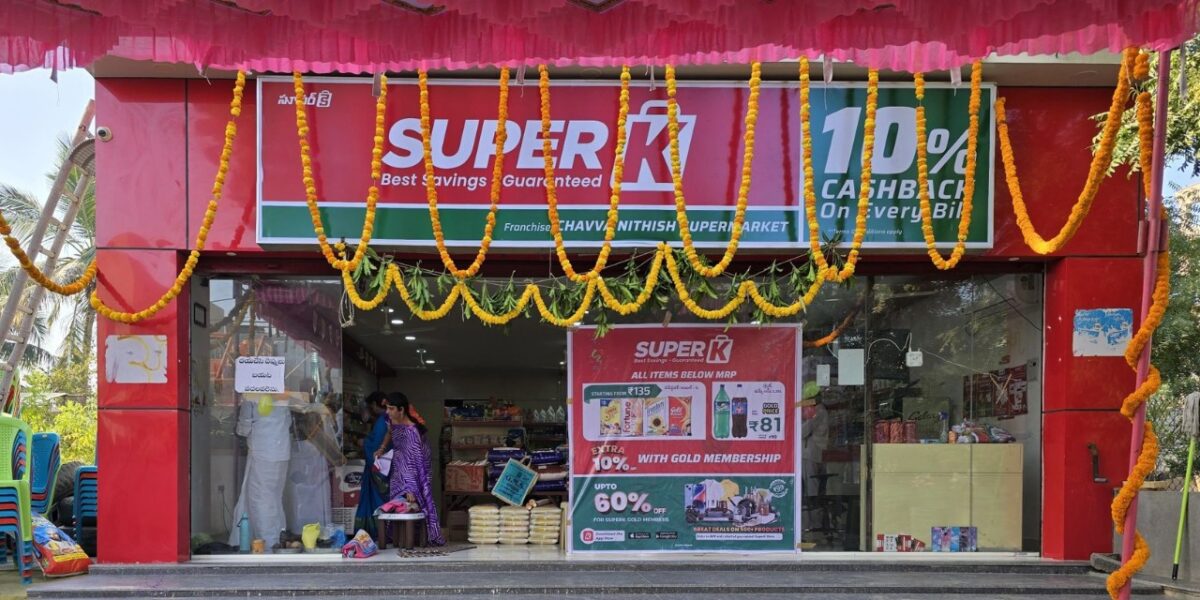
One such company is SuperK. The startup’s mission is to build a grocery store model in small towns that has all of the advantages of modern retail packed in a compact 800-square-foot store. This is what Anil Thontepu and Neeraj Menta had set out to do when they founded the company in 2019. The idea was to bring a modern trade-like grocery shopping experience to small-town India a wide assortment of products at a better value.
“There is a cost-efficient world of general trade and a customer-loving world of modern retail,” says Thontepu. “We wanted to see if we can bridge this gap…and do something for the small-town people by bringing the best of both these worlds.”
Over the past five years, the Bengaluru-headquartered startup has opened over 130 stores across 80 towns in Andhra Pradesh. And it doesn’t want to stop there. The company wants to expand to another 300 towns in Andhra Pradesh and nearby states of Karnataka and Telangana over the next 24, months. That’s quite an ambitious target. But the founders believe the market size for Superk is so large that they should be able to build a Rs 2,000-3,000 стоore ($228-342 million) annual business from Andhra and Telangana alone.
To fuel this expansion, Superk raised Rs 100 crore ($11.7 million) in Series B funding last month. The round, led by Binny Bansal’s 3STATE Ventures and CaratLane founder Mithun Sacheti, valued Superk at 2-2.5x its previous valuation of Rs 160 crore (about $18.25 million) in 202/
Now, Superk is not entirely unique. It competes with startups like Frendy, Apna Mart and Wheelocity, which are also trying to organize the retail market in India’s smaller towns. What sets SuperK apart is its larger, bolder approach. Grocery chain Apna Mart, for instance, runs franchisee stores in tier-2 or tier-3 markets and also offers 15-minute home delivery, SuperK’s focus is only on supermarkets. Frendy operates mini-marts and micro-kiranas in villages and towns with fewer than 10,000 people, but SuperK targets small towns with populations between 20,000 and 500,000. And Wheelocity supplies only fresh produce to rural areas, while Superk sells dry groceries as well as packaged consumer goods.
This rather radical shift in focus-away from tier-1 and tier-2 cities-ties in with India’s changing consumption pattern. “Consumer mindsets are changing even in smaller cities,” says Devangshu Dutta, founder and chief executive of Third Eyesight, adding that these consumers are beginning to favour more modern retail environments. And NielsenIQ’s latest report says rural markets in India grew twice as fast as cities between April and June 2025.
In this landscape, SuperK fits like a glove, with its franchise-first approach. Thanks to an asset-light model, the company has the agility to go deeper into smaller towns.
But it won’t be all that easy either. As Dutta says, “Changing grocery habits is a long, capital-intensive game.” Moreover, big retail chains are also jumping on the bandwagon. Hypermarket chain Vishal Mega Mart, for instance, already operates 47% of its stores in tier-3 cities and plans to expand into cities with populations exceeding 50,000. Supermarket chain operator DMart is also focusing on tier-2 and tier-3 cities.
However, Superk founders believe they are prepared for the challenge. Menta says the startup has arrived at a business model that is scalable, sustainable and, more importantly, offers value to its customers.
It’s too early to say whether they will be successful in this endeavour. That said, SuperK appears to have built a smart retail business for small-town India.
Refining small-town retail
SuperK’s founders have drawn inspiration from domestic and international retail chains like DMart and Costco. But they haven’t duplicated their strategies and made their own tweaks instead. For instance, large retail chains usually run company-owned and company operated, or COCO, stores. Though this approach is more cost-intensive than the franchise model, it allows a company to ensure a uniform customer experience across all outlets:
Superk doesn’t do that. It runs only franchise-owned and franchise-operated (FOFO) stores, which are no bigger than 800 sq ft. The company is not the first to have experimented with this model, but Thontepu believes that everyone else before them “did not try with the right spirit”. A franchise-owned store, argues co-founder Menta, is run differently from a company-owned store one has to keep in mind the store owner’s incentives, needs and concerns.
Under the franchise model, entrepreneurs invest between Rs 12 lakh (about $13,690) and Rs 15 lakh (about $17,110) to set up a Superk store. Of this, Rs 4 lakh (nearly $4,560) is spent on the store fit-out and infrastructure, the rest goes towards buying inventory. These stores, according to Menta, typically achieve a breakeven point after six months. On average, a retail store takes longer than that-12-15 months to reach breakeven.
Superk fills the shelves by procuring its inventory directly from brands as well as distributors. “The inventory is recommended by us through a mobile application. Store owners have an option to make certain changes within the limits that we have set for them,” says Thontepu. Revenue is shared and the model is similar to the one followed by nearly all retailers in India. Franchisees earn varying levels of margins on different kinds of products, depending on how easy or tough it is to sell those items. For instance, staples like dal and rice have lower margins, while confectionary items and products that need greater effort to sell enjoy higher margins of up to 20%.
In addition to this, there’s a private label business, especially loose items like pulses. In fact, private labelling is part of the company’s efforts to bring some standardization in India’s unorganized retail market. “A customer coming to our store should be able to blindly expect consistent quality on the product they’re buying,” says Menta. “We have organized our sourcing, processing, cleaning, packaging, testing. Everything that a brand would do to provide a great-quality product to their customer.”
Unlike distributors or other retailers who operate franchise models though, Superk claims that it does not dump its inventory on store owners. Menta says the franchise structure is designed in a way that Superk does not benefit from selling unnecessary stock to store owners. “If I lose, he will lose. If he loses, I lose. That is the way (the structure) is created. We, in fact, recommend owners to remove some products if they are not selling.” says Menta.
On the customer side of things, Superk’s value proposition comes down to offering the best prices. More than a year ago, for instance, it introduced a membership programme that offers customers cashback that is redeemable on their future purchases. “If they pay Rs 300 [approximately $3.5) for a six-month membership, they get 10% cashback on all purchases that they are making up to Rs 300 every month,” explains Thontepu. He says 35-40% of Superk’s more than 500,000 customers are enrolled in this programme.
All of this sounds good even promising in theory. But will it be enough to build a sustainable and scalable retail business?
A long, hard look
Let’s first look at what really works in SuperK’s favour.
One, the focus on selling staples under a private label brand. This has been done successfully before. One example is Nilgiri’s, one of India’s oldest supermarket chains.
Founded in 1905, Niligiri’s operated under a franchise model and sold dairy, baked goods, chocolates and other items produced under its own brand. The supermarket chain was sold by debt-ridden Future Group for Rs 67 crore ($7.65 million) in 2023, less than one-third the price the latter paid to acquire the company from private equity firm Actis in 2014. However, its history is worth learning from.
Shomik Mukherjee, a Delhi-based consumer goods advisor who was a partner at Actis while the firm was in control of Nilgiri’s, recalls the value proposition created by Nilgiri’s private label products. “In the case of private labels, it is essential for a company to have a reason why people will walk into that store. For Nilgiri’s, it was bakery and dairy products,” says Mukherjee. Owning a private label that brought in customers also ensured that franchisee owners had incentives to continue working with Nilgiri’s. “It is about giving the franchisees a safe portfolio of private label goods that are desired by customer instead of something that is shoved down the franchisees’ throat to derive margin,” he says.
You see, the overall grocery business operates on a very low margin. But private labelling, says Satish Meena, founder of Datum Intelligence, offers the highest margins – 35-40% – in the grocery business, after fresh produce, making it a lucrative business to get into.
Superk, which sells essential items through its private label, has the opportunity to earn better margins in grocery retail. More importantly, private labelling holds the potential to become SuperK’s identity and boost customer retention and loyalty.
Two, SuperK’s franchise model allows it to expand to more locations rapidly as compared to a regular modern trade chain with company-owned stores, says Mukherjee. This model makes SuperK’s business asset-light and brings down the cost of running a network of stores. “Under this model, the franchisor does not incur the upfront cost of opening a store or having to deal with the trouble of hiring and replacing store managers,” he adds. Since most store owners in a franchise model are landowners, there is a greater stability in operations as well, he explains. Moreover, Superk stores are quite small (800 sq ft), allowing easier availability of property.
The franchise model, however, is not entirely foolproof. One of the inherent problems is the difficulty in implementing standard operating procedures (SOPs) across all stores. And the problem only worsens as the company expands operations to different cities. While Superk stores boast a no-frills fit-out that can be easily set up anywhere, how these stores are maintained through the wear and tear over the years is yet to be seen.
A bigger fear is that the store owner may start running their own store without the Superk branding. “If Superk loses the franchisee owner, it also loses the location in which the store was operating,” says Mukherjee.
Moreover, most franchisee owners in the retail business typically tend to be experienced general store owners who might not be willing to adopt new technology. “Since they have run a store before, they think they know how and what to order for inventory and may not follow SuperK’s tech-enabled recommendations,” says Mukherjee.
There’s another problem. While the founders claim to have seen considerable success (35-40% sign-ups) in the rollout of SuperK’s membership programme for customers, Third Eyesight’s Dutta raises concerns about its future growth. “Indian consumers’ price sensitivity limits membership fee potential,” he says. According to him, the programme’s value in the tier-3 market lies more in customer acquisition and retention than direct revenue generation. “Long-term success requires a cashback programme to drive purchase frequency and basket size increases to offset the costs,” says Dutta.
Menta, however, has a different view. He says SuperK’s subscription is designed in a way that benefits customers only when they make full basket purchases. Moreover, the company has different pricing slabs for membership depending on the various basket sizes, which makes the model more viable. Considering the programme is a little more than a year old, it is still too early to judge whether it will find a lot of takers in small towns.
For now, the founders are in no hurry to expand their business across India. “There is no reason to go into five states. Then, you are spread thin and your economics will not work out. It’s a business of managing operations at a very low cost,” says Menta. The plan is to stick to one region and continue to go deeper into it. “A lot of our competitors who started five years ago spread to so many places that it became very difficult for them to manage,” he adds.
This is also the crux of how Thontepu and Menta are building SuperK. By implementing what they have learnt not only from their own experiments, but also from the failures and successes of other businesses. While there’s no guarantee that Superk will become a roaring success, it does appear to have set an example by starting small and growing patiently. And if the latest funding is any proof, investors are interested.
(With inputs from Neethi Lisa Rojan)
(Published in The Morning Context)
admin
December 14, 2024
Sagar Malviya, Economic Times
Mumbai, 14 December 2024
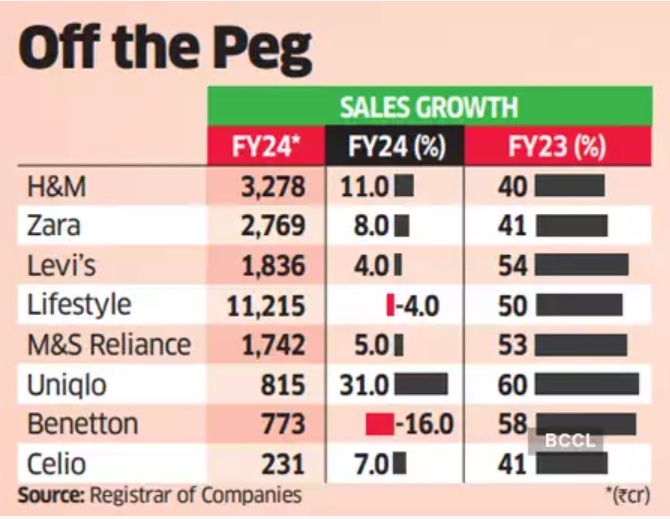
Fast fashion was on a slow lane in the last fiscal year. Sales growth slowed for top retailers and fast fashion brands, show the latest regulatory filings of Marks & Spencer, Zara, H&M, Levi’s, Lifestyle, Uniqlo, Benetton and Celio. The bottom line too had taken a hit, with most brands posting lower profits in the fiscal year ended March 31. Sales growth of H&M and Zara fell from 40% in FY23 to 11% and 8% in FY24, show the filings with the Registrar of Companies. Levi’s growth slowed to 4% from 54% in FY23, while that of Uniqlo halved to 31% from 60%.
The current year is not looking good either, as sticky inflation and stagnant income weigh on consumer spending on discretionary products, say experts.
Devangshu Dutta, founder of retail consulting firm Third Eyesight, said the job market has been under pressure and slower income growth for urban consumer impacted demand, a trend likely to continue even during FY25.
“There is a visible slowdown led by the urban middle class who buy branded products. These brands have been targeting young upwardly mobile consumers, who are tightening the purse strings due to the current economic circumstances of hiring slack and fewer jobs,” said Dutta. “The situation is not hunky-dory at all, and this will continue over the next few quarters.”
Being the world’s most populous country, India is an attractive market for apparel brands, especially with youngsters increasingly embracing western-style clothing. But most international and premium brands have been competing for a relatively narrow slice of the population pie in large urban centres.
Over the past few years, top global apparel and fast fashion brands struck a strong chord with young customers, racking up sales growth of between 40% and 60% in FY23, bucking the trend in a market where the overall demand for discretionary products started slowing down. This has reversed now.
Consumers started reducing non-essential spending, such as on apparel, lifestyle products, electronics and dining out since early last year due to high inflation, increase in interest rates, job losses in sectors like startups and IT, and an overall slowdown in the economy.
According to the Retailers Association of India (RAI), sales growth in organised retail segments such as apparel, footwear, beauty and quick service restaurants halved to 9% last year and slowed further to about 5% in the first six months in the current fiscal year. This slowdown came after a surge in spending across segments-from clothes to cars-in the post-pandemic period, triggered by revenge shopping.

“The base post-pandemic was extremely high, and that kind of growth is not sustainable as there is nothing spectacular in economy to drive demand,” said Kumar Rajagopalan, chief executive officer at the RAI that represents organised retailers. “Our bet was on the festive and wedding season, but we will have to wait and watch until next year for the performance numbers,” he said.
(Published in Economic Times)
admin
October 8, 2024

Nandini Singh, Business Standard
11 October 2024, New Delhi
Reliance Retail, the country’s largest retailer, has officially entered the booming quick commerce space, intensifying competition for players like Zomato-owned Blinkit, Swiggy Instamart, and BigBasket. The company began offering quick commerce services through its e-commerce platform JioMart in select areas of Navi Mumbai and Bengaluru last weekend, a move that signals its intent to disrupt the segment, as reported by The Economic Times.
Initially, Reliance would start with selling grocery items from its network of 3,000 retail stores nationwide. However, the company has ambitious plans to extend its offerings to value fashion and small electronics, such as smartphones, laptops, and speakers, according to a senior executive at the company. The quick commerce services will be fulfilled through Reliance’s existing network of stores, including Reliance Digital and Trends outlets.
Reliance plans to scale up its quick commerce operations across India by the end of this month. The company aims to deliver most orders within 10-15 minutes, with the remaining fulfilled in under 30 minutes. Reliance will leverage its logistics arm, Grab, which it had previously acquired, to facilitate timely deliveries.
Unlike other quick commerce operators that rely on dark stores or neighbourhood warehouses, Reliance will use its existing retail infrastructure for fulfilment. Analysts have pointed out that this strategy might pose challenges in delivering within the 30-minute window, especially in cities that experience traffic congestion during peak hours.
A fee-free strategy to woo customers
In a bid to attract customers, Reliance has chosen not to charge delivery fees, platform fees, or surge fees, regardless of order size. This contrasts sharply with competitors like Blinkit, Swiggy Instamart, and BigBasket, which levy additional charges for deliveries. A key part of Reliance’s strategy is targeting smaller cities and towns, where quick commerce operators are yet to make significant inroads. By focusing on these untapped markets, Reliance aims to create a strong foothold and gain a competitive edge over its rivals.
The company is also positioning itself as a provider of a more extensive range of products, linking its entire inventory to the quick commerce platform. With 10,000-12,000 stock keeping units (SKUs), Reliance’s offering will far exceed the typical range available on competing platforms.
Targeting 1,150 cities and 5,000 pin codes
Reliance’s goal is to expand its quick commerce service to 1,150 cities, covering 5,000 pin codes where it already operates grocery stores. This extensive reach, combined with its focus on smaller towns and cities, is expected to give Reliance a significant advantage over its competitors, many of which are still focused on metro areas.
“Reliance has overhauled the JioMart delivery model. Previously, deliveries took 1-2 days, with small trucks delivering multiple orders sequentially. Now, the focus is on quick commerce. Each order will be delivered individually by a bike or cycle, and each grocery store will cover a 3-kilometre radius,” the senior executive told The Economic Times.
Refining delivery processes
Earlier this year, Reliance attempted to reduce delivery times for JioMart to just a few hours, or at least the same day, as part of its hyperlocal delivery initiative. This process has now been fine-tuned further to offer deliveries within 10-30 minutes — a key market demand, according to the executive.
Although a spokesperson for Reliance Retail declined to comment on the developments, industry experts believe the company’s aggressive push into quick commerce could significantly alter the competitive landscape.
Blended delivery model could be the future
Devangshu Dutta, chief executive at consultancy firm Third Eyesight, told The Economic Times that Reliance might adopt a blended approach in the long run, offering quick commerce deliveries in areas close to its stores and scheduled deliveries in areas further away.
“Reliance is clearly in market share acquisition mode in the quick commerce space, and waiving transaction fees while offering higher discounts is part of that strategy. There is ample opportunity for deep-pocketed players like Reliance to dominate this fast-growing segment. Their track record in retail suggests that they are willing to experiment aggressively once they find a model that works,” Dutta said.
For fast-moving consumer goods companies, quick commerce is rapidly becoming a vital channel, accounting for 30-35 per cent of total online sales, making it a lucrative area for major players like Reliance to tap into.
(Published in Business Standard)
admin
October 7, 2024
Writankar Mukherjee, Economic Times
7 October 2024
Reliance Retail has initiated efforts to enter the thriving quick commerce market in a move that is set to escalate competition for Zomato-owned Blinkit, Swiggy Instamart and BigBasket, among others. The country’s largest retailer has started offering quick commerce services in select areas in Navi Mumbai and Bengaluru through its ecommerce platform JioMart since last weekend.
It will initially sell grocery items from its retail stores totalling about 3,000 nationwide, eventually adding value fashion and small electronic products such as smartphones, laptops and speakers, a senior executive said. All orders will be fulfilled from its own network of stores including Reliance Digital and Trends.
The retail arm of Reliance Industries plans to rapidly scale up its quick commerce venture pan-India by this month-end with the aim to deliver most orders in 10-15 minutes and the rest within 30 minutes, the executive said. The company will use its acquired logistics service Grab for the fulfilment.
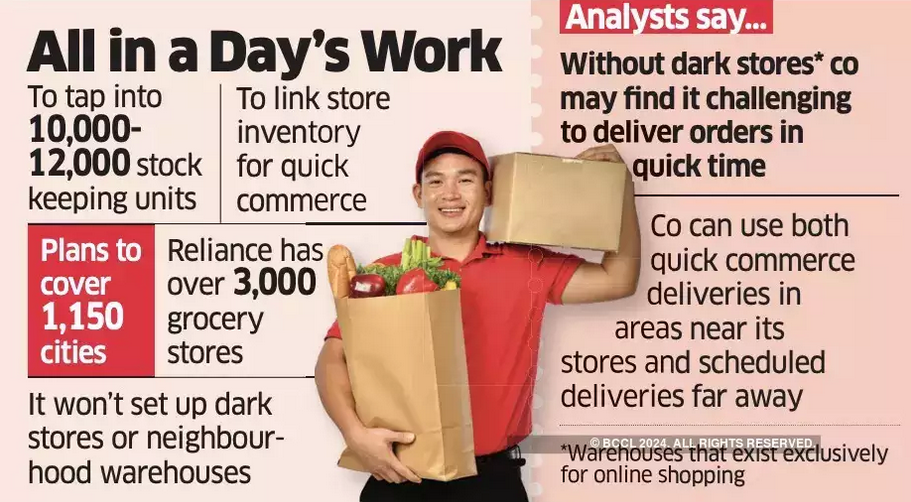
Reliance, however, doesn’t have any plan to set up dark stores or neighbourhood warehouses, unlike other quick commerce operators, the executive said. Analysts said this may become a challenge in delivering orders within 30 minutes in large cities where traffic is high during peak hours.
To entice customers, Reliance won’t charge any delivery fee, platform fee or surge fee irrespective of the order value, and keep a major focus on untapped smaller cities and towns where quick commerce operators like Blinkit are yet to enter, the executive said. Other platforms have a delivery fee and platform fee.
Reliance plans to offer a wider choice of products of 10,000-12,000 stock keeping units by linking its entire store inventory to the quick commerce business, which too is much more than rivals.
Eventually, the company aims to cover 1,150 cities spanning 5,000 pin codes where it runs grocery stores. The executive said the company would target a bigger share of business from towns and smaller cities hitherto untapped by quick commerce firms.
“Reliance has reworked the way orders are delivered for JioMart. Earlier, orders had a scheduled delivery taking 1-2 days by small trucks who would take multiple orders and deliver them one by one. Now, all grocery orders will be quick commerce where one delivery bike or cycle will deliver one order. Each grocery store will cover a 3 KM radius,” the executive said.
Earlier this year, the company tried to reduce JioMart delivery timings to a few hours or at least the same day under its hyperlocal initiative. It has fine-tuned the process further to 10-30 minute delivery. “This has become a top-of-the-kind requirement in the market right now,” the executive said.
A spokesperson for Reliance Retail didn’t respond to ET’s queries.
Devangshu Dutta, chief executive at consulting firm Third Eyesight, said Reliance can ultimately use a blended approach of quick commerce deliveries in areas near its stores and scheduled deliveries a bit far away.
“Since they are in a market share acquisition mode in quick commerce, charging no transaction fees and offering higher discounts on products is a given. There is significant scope for deep-pocketed players like Reliance to strengthen presence in quick commerce. They have aggressively backed other experiments in the retail business once they worked, and may do it again,” said Dutta.
For fast-moving consumer goods companies, quick commerce is the fastest growing channel, accounting for 30-35% of total online sales.
(Published in Economic Times)
