
admin
February 23, 2025
Chitra Narayanan, BusinessLine
New Delhi, 23 February 2025
India’s formidable array of craft traditions got full play at the just concluded Bharat Tex 2025, the mega textile trade show in New Delhi that showcased the best of Indian weaves to the world. But if there was one theme that dominated this year’s textile extravaganza, aimed at generating more exports, it was the focus on zero-waste fashions and upcycling. Everywhere the eye could see were standees and gigantic posters pushing the message of conscious consumption and sustainability — be it regenerative cotton, innovative models of textile waste collection, or eco-friendly fibres.
Taking centre stage at one of the halls at Bharat Mandapam, the venue, was a section that showcased age-old traditional arts like rafugari (creative darning or artistic mending), patchwork quilts and toys, and chindi durries (the art of weaving rugs and carpets with waste).
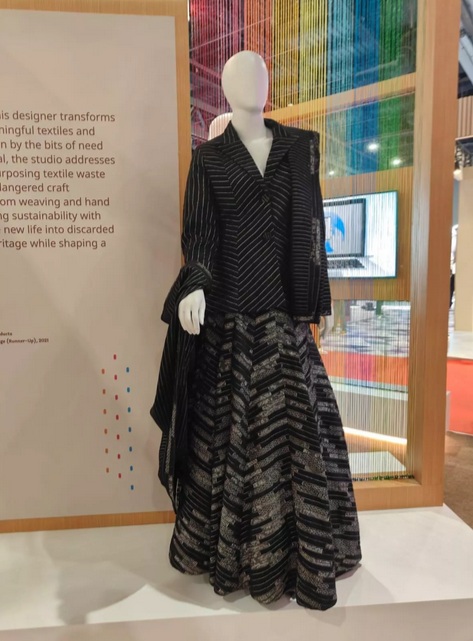
Juxtaposed against these ethnic ways of upcycling waste were the modern works of startups that rose to the textile ministry’s grand innovation challenge to work with discarded materials. From microbial dyes that are non-polluting to flowing fashionable lehengas created out of textile waste, the startups showed that a lot can be done in this area. The ministry had challenges in three more segments — jute, silk and wool.
Some takeaways from a walk-through of the textile trade show:
Closing the loop
The fashion and textile industry generates enormous waste. How to cut down on this was a subject of much deliberation and showcases. There were a lot of good ideas on display, showing that a fair amount of work has been done with fibres (bamboo, banana, flax), as well as creativity and ingenuity in weaves and finished garments.
As Devangshu Dutta, Chief Executive of the consultancy Third Eyesight, points out, due credit must be given for the good work going into generating solutions that will reduce waste, be it textiles that are reprocessed and reused as yarn, or refashioned garments or reloved apparel. But, as he adds, on the other hand we have brands that are constantly looking to grow their business and there is a race to the bottom in terms of price. The relaunch of fast fashion retailer Shein in India is sending conflicting signals. “The basic engine is pumping out more and more products, and that has to be tackled,” he says, pointing to the competing forces at work.
The source of hope, he says, is the fact that the young are a bit more conservative about how they consume and what they consume.
Sandip Ghose, CEO of MP Birla Group, which has one of the oldest jute companies in India, was among the visitors at Bharat Tex. “As an industry insider, what I found good at Bharat Tex was that quite a bit of research seems to be on, both for finished fabric and for weaving. There was a lot of work on making jute look aesthetic. There were some vanity projects like tea leaves packed in jute bags. But the challenge is in two areas — commercialisation, and scaling up of these ideas,” he says.
He rues that the jute sector has not taken advantage of the production-linked incentive scheme at a time when the world is looking for eco-friendly and biodegradable textiles. “A tripartite partnership between the Centre (Niti Aayog and textile ministry), State government, and industry would address the issue of industry’s dependence on subsidies, labour issues and exports,” he says, adding that if India is looking at textiles as a major export area, jute is an option that has been missed.
Spinning into luxury
A clear trend evident from a tour of some of the apparel and home textile pavilions is the move towards premiumisation, similar to what is visible in other sectors, noticeably FMCG.
Talking to the manufacturers, especially those focused on the domestic market, the story one heard was that consumption had slowed in the mass segment, but was reassuringly strong in the premium segment.
Several players were also moving into the luxury and uber luxury segments. Both myTrident and Welspun had striking luxury collections.
Another trend visible in the home textiles section was the use of celebrity designers — myTrident’s eye-catching collection by resort-wear designers Shivan-Narresh; and Welspun’s beautiful sets from Kate Shand and Payal Singhal.
“When the economy suffers, it is the poor and middle class who cut down. There is no pressure to reduce consumption at the upper levels, and companies will try to tap into demand that is recession-proof,” says Dutta, explaining the push towards luxury by textile manufacturers.
New trade routes?
Export houses seemed reasonably happy with the buyer interest. Some mentioned that it was interesting to see buyers from Russia at the fair. However, for those supplying to US entities and Western Europe, the buyer interest from Russia may not translate into deals, given the risk of sanctions they could face.
To sum up, it was a fairly good showcase of India’s textile prowess to the world, but whether it will ring in more export orders is debatable as many of the problems and challenges the sector faces were swept under the carpet.
(Published in BusinessLine)
admin
January 5, 2024
Sagar Malviya, Economic Times
January 5, 2024
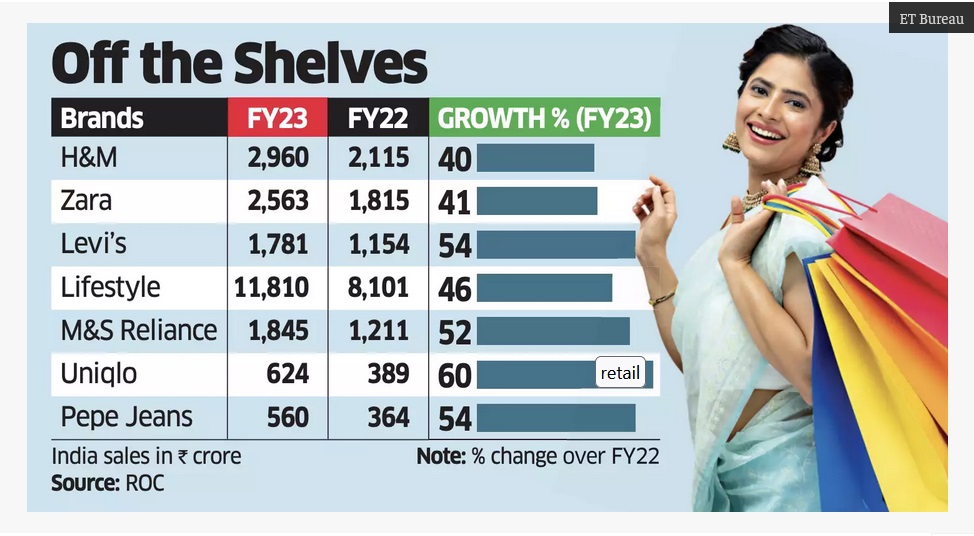
Top global apparel and fast fashion brands appear to have struck a strong chord with young customers, racking up sales growth of anywhere between 40% and 60% in FY23, bucking the trend in a market where the overall demand for discretionary products slowed down.
For instance, Swedish fashion retailer H&M and rival Zara reported a 40% increase in its topline while Japanese brand Uniqlo saw a 60% jump in sales. American denim maker Levi Strauss and British brand Marks & Spencer posted a 54% increase, latest filings with the Registrar of Companies showed. Dubai-based department store Lifestyle International, too, saw a 46% jump in revenues on a large base. These brands garnered combined annual revenues of nearly $2.6 billion, more than double compared to FY21 when it was $1.1 billion all put together.
“With consumers getting brand conscious, global brands have a natural advantage. There is a distinct aspirational momentum for international brands that carries them through. Also they can sustain having unsold inventory and discounting better than smaller peers,” said Devangshu Dutta, founder of Third Eyesight, a strategy consulting firm. “Also, these brands have not yet reached saturation point in terms of network and hence can invest further to widen their reach.”
The revenue surge was also led by brands’ shifting focus on ecommerce, which now accounts for more than a quarter of their sales, even as they face intensify competition from both local and global rivals in an increasingly crowded market where web-commerce firms continue to offer steep discounts. Over the past two years, sales growth for most retailers have been price-led, reversing the historic trend when volumes or actual demand drove a bulk of the sales.
The fashion retail segment has been struggling with a demand slowdown since January last year due to inflationary headwinds. The overall retail growth slowed down to 6% in both March and April, increasing marginally to 9% in August and September before falling slightly to 7% in October and November, according to the Retailers Association of India.
“Spends are shifting to experience, holidays and big ticket purchases such as cars. Stronger retailers which had the right product to price proposition works for consumers who are not necessarily looking at brands from global and local lens. What helped our sales was product rationalisation, renovation of stores as well as our value proposition,” said Manish Kapoor, managing director at Pepe Jeans that clocked 54% growth to Rs560 crore in FY23. “The current fiscal has been muted and we expect election spending and improved sentiment to drive recovery next fiscal.
As the world’s second most-populated country, India is an attractive market for aspirational apparel brands as rising disposable incomes cause the consuming base of the pyramid to broaden further. “The Indian economy is on course to be among the top economies in the world. The key factors driving the India consumption story include a large proportion of young population, rising urbanization, growing affluence, increasing discretionary spending and deeper penetration of digital,” said Levi Strauss in its latest annual report.
Last year Levi’s said India is now the largest market for them within Asia and sixth largest globally while M&S said it is opening a store every month in India, already its largest international market outside home in terms of store network.
(Published in Economic Times)
admin
June 29, 2023
Dia Rekhi & Faizan Haidar, Economic Times
New Delhi, June 29, 2023
Fast Retailing, the parent company of Uniqlo, is looking to set up a significant manufacturing presence in India through about 20 ‘production partners’, multiple people aware of the development told ET.
One of the world’s most valuable clothing retailers, Uniqlo already has a cluster of production partners in India and is looking to expand this network through a significantly large investment, they said without sharing any estimated amount.
“The investment amount will be significant because Uniqlo is serious about India and views it as an important market,” one of the persons said. “Unlike the existing facilities in India, which cater more towards exports, the production partners that Uniqlo will bring to India will be specifically meant for the domestic market.”
One of the company’s production partners that ET spoke to confirmed that their current mandate is to produce only for exports.
Uniqlo, which is Asia’s biggest clothing brand, had said India is one of the top priority markets for them where consumers are increasingly shifting from ‘fast-fashion’ to long-lasting essentials and functional wear.
The company’s ambitions for India are considerable with its CEO Tadashi Yanai indicating that he wants Uniqlo to become the “best-selling retailer in India”.
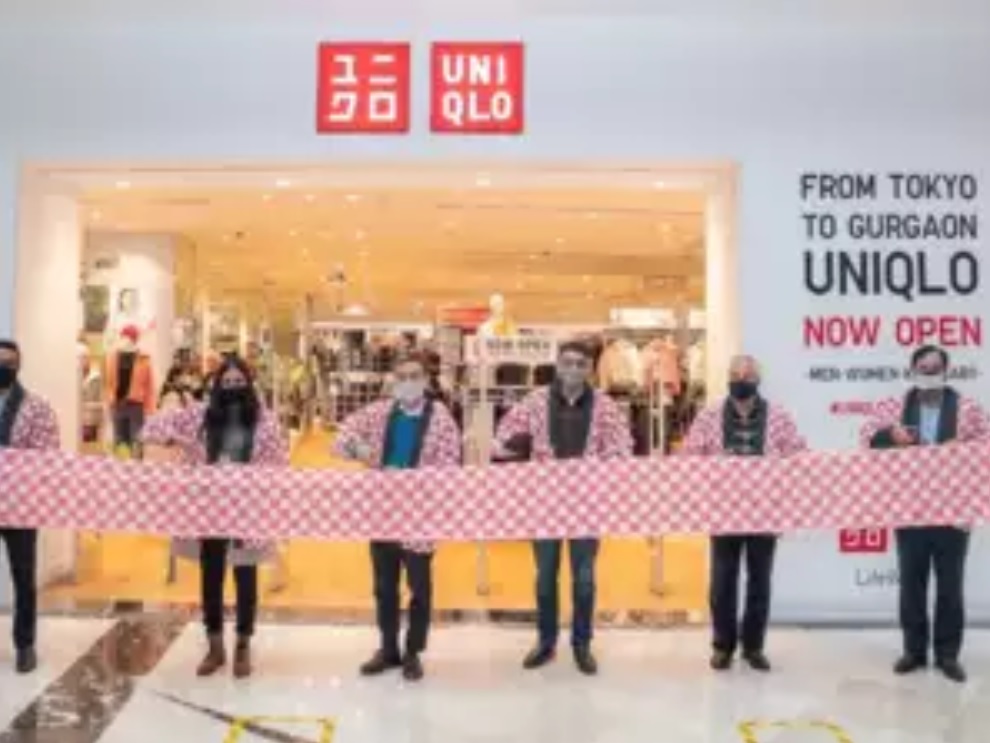
The Japanese brand opened its first door in September 2019, but stringent lockdown measures announced to contain the outbreak of the pandemic in March 2020 delayed the expansion plan.
The brand is now planning to enter Mumbai and Bangalore. It has already opened stores in Lucknow and Chandigarh after Delhi.
Uniqlo does not own any factories. Instead, it outsources production of almost all its products to factories outside Japan.
As per a report titled ‘The Uniqlo case: fast retailing recipe for attaining market leadership position in casual clothing’, this model allows Uniqlo to keep its breakeven point low and improve return on investment.
“As we expand our global sales, we continue to grow our partner factory network in countries like Vietnam, Bangladesh, Indonesia, and India,” the company has stated on its website.
As per its list of garment factories, as on March 1, 2023, Uniqlo has 227 factories in China, 54 in Vietnam, 33 in Bangladesh, 13 in Indonesia, and 16 factories in India and Japan among several other locations.
As the world’s second most-populated country, India is an attractive market for apparel brands, especially with youngsters increasingly embracing western-style clothing.
Over the past decade, global brands Zara and H&M became market leaders in the fast fashion segment in India.
“For global brands, India should be one of the most logical sourcing hubs given its large vertically integrated manufacturing sector on the one hand and the large, growing domestic market driving demand on the other hand,” Devangshu Dutta, founder of retail consulting firm Third Eyesight, told ET. “However, its weight in the sourcing baskets has historically been low due to several reasons, in spite of China being visible for decades to the management teams of brands and retailers as a concentrated sourcing risk,” he said.
Uniqlo’s existing production partners in the country include Shahi Exports, Brandix Lanka, Tangerine Design, Maral Overseas, Shingora Textiles, Silver Spark Apparel, SM Lulla Industries Worldwide and Penguin Apparels.
As per Fast Retailing’s first-half results, the company said its revenue was 1.4672 trillion yen, or around $10.2 billion, and that its operating profit had risen to 220.2 billion yen ($1.53 billion), bolstered by strong performances from operations in several regions, including India where it said it generated significant increases in both revenue and profit.
With regard to Uniqlo International, in particular, it said revenue stood at 755.2 billion yen ($5.25 billion), while operating profit was 122.6 billion yen ($852.93 million).
The company said regions like India “reported significant revenue and profit gains as they enter a full-fledged growth phase”.
(Published in Economic Times)
admin
February 23, 2023

India’s economy is in focus globally, and is also at an inflection point.
Join Devangshu Dutta at the Asia-Pacific conference of UFI, The Global Association of the Exhibition Industry. Registration Link: https://lnkd.in/dq89_rY3
See you at UFI Asia-Pacific Conference in Kuala Lumpur!
admin
March 25, 2020

T. Surendar, The Morning Context
25 March 2020
Standing on the porch of the Grand Hyatt Hotel in Mumbai suburbs, Diwakar Vaish, co-founder of Noida-based AgVa Healthcare, was trying to catch the attention of software industry executives. This is at the annual conference hosted by IT trade body Nasscom. Vaish’s stall was a side-show for startups to exhibit digital technologies in the healthcare sector.
On a cool, breezy February day, the atmosphere was nothing as grim you would expect in a hospital emergency ward. Vaish’s rig, comprising an iPad-like device on a short steel column mounted on wheels with dangling wires, was a cost-effective version of a ventilator used in critical care. There wasn’t much excitement about his solution, as few executives really understood the medical problem he aimed to solve.
Today, a robotic engineer by training, Vaish is super busy.
It is not easy to get him on the phone, as AgVa’s ventilator is suddenly in demand from all parts of the country. The company is running three shifts fulfilling orders, which have been pouring in since it became apparent that Indian hospitals did not have enough ventilators for patients rendered ill by the novel coronavirus.
Unwittingly, the need for ventilators has once again drawn attention to India’s medical devices industry or the lack of it. So much so that Anand Mahindra, chairman of the $17 billion Mahindra group, which has interests in automobiles, software and resorts, said that he was finding ways to manufacture ventilators in his factories. It isn’t easy putting together a ventilator, not when you are racing against time, but Mahindra is a hardy businessman with deep pockets, and maybe, just maybe, he will succeed.
In many ways, the Indian medical devices industry is an anomaly. India has a space programme, a nuclear programme, it is among the few countries that has developed patented medicines and a low cost version of anything from power turbines to trucks but when it comes to medical equipment, it fares poorly.
India is also the biggest supplier of FDA-approved drugs to the US, the biggest pharmaceutical market in the world. Even as the Indian market for medical equipment has grown at double-digit rates in the last five years to Rs 1 lakh crore, two-thirds of its needs are met by foreign companies such as Philips, GE Healthcare, Siemens and Abbott.
Import domination is all pervasive extending to even non-critical but common equipment like sonography machines, dentistry chairs and diagnostic equipment. Less than five Indian companies had revenue of more than Rs 500 crore a year and 90% were classified as small scale, with annual revenue less than Rs 10 crore. The biggest player in the domestic market is the Rs 1,300 crore Mumbai-based Transasia Bio-Medicals, which makes in vitro diagnostic solutions that are exported to Western markets too.
“For a long time, the government was the biggest buyer of medical equipment and they always preferred imported equipment. That meant that it was not lucrative for local entrepreneurs to invest their capital in the sector,” says G.S.K. Velu, managing director of Trivitron Healthcare, which makes and exports imaging equipment.
The proliferation of private hospitals in the last two decades also did not change things much. With well-entrenched foreign players and a liberal import duty structure to make available the best facilities in India, there were few local companies of scale who could invest big money to fend off competition. AgVa’s ventilators were priced at a fifth of the ones sold by the foreign competitors, yet it couldn’t make inroads into big hospitals. “It’s almost as if our cost was our barrier to sell. Being critical equipment, customers had a lot of inertia to even place test orders,” says Vaish.
Thanks to meagre domestic manufacturing. India also could not set standards of equipment specifications to suit the local needs. It had to tweak its own equipment standards to fall in line with those of foreign manufacturers. For example, in the US, defibrillators used to restore heartbeats by giving shock to patients had to last at least two shock cycles. But, in India, since access to hospitals and medical care was not as easy. patients arrive long after they have suffered heart attacks and Indian doctors use defibrillators for even 10 cycles at a time.
The local standards did not specify this need and as a result many imported defibrillators were not of much use in Indian conditions. “We still don’t have an act to regulate medical devices and it falls under the drugs category. Everything is still borrowed from the West,” says Aniruddha Atre, co-founder and director of Pune-based Jeevtronics Pvt. Ltd, which makes the world’s first hand-cranked defibrillator.
Trivitron’s Velu says that the share of locally produced medical equipment will increase within the next decade. This will be a combination of help from the government which will enforce more domestic manufacturing by overseas firms and increased entrepreneurship.
There is also a view that more global manufacturing will come to India, as firms de-risk their strategy of manufacturing everything in China. “In the past, when labour costs went up in the Chinese west coast, Indian garment companies were beneficiaries of increased orders even though other countries like Bangladesh and Vietnam too got a big share of it. The availability of labour and ability to scale up operations is something global players look for and to that extent India will always be an important outsourcing destination,” said Devangshu Dutta, managing partner at consultancy firm Third Eyesight.
The trend started even before the COVID-19 pandemic as companies in the US began to brace themselves for a trade war with China. For example, a US-based company has started sourcing Indian tyres at a 10-15% premium as it wants to diversify its risk from China. “India has witnessed a surge in mobile phone manufacturing. This is bound to increase the ecosystem in electronic manufacturing which in turn create ecosystems for industries like medical equipment,” says Sharad Verma, senior partner who oversees industrials at Boston Consulting Group.
The timing is also right for increase in local manufacturing, argues Verma. One of the important criteria for that is viable domestic consumption. It’s happened time and again in sectors like automobiles, mobile phones and more recently in manufacture of metro bogies after domestic consumption has reached a scale where it makes sense for companies to set up manufacturing facilities. “The industry is no longer small and the incidence of medical technology will only go up from here making it viable for even foreign companies to look at a manufacturing set up in India,” says Verma.
It will be interesting to see how it all plays out. The sector, so far, hasn’t seen much by way of private equity or venture investment. The most prominent one was an investment by a Morgan Stanley fund and Samara Capital in Surat-based Sahajanand Medical Technologies and Fidelity Growth Partners’s investment in Trivitron. But starting 2014, a government fund run by the Biotechnology Industry Research Assistance Council-incubated several companies who are slowly bringing their products to market. As some of these products hit home, especially in the wake of COVID-19, the action is definitely bound to pick up.
(published in The Morning Context)
