
admin
September 1, 2026
Pritha Pahari, The Core
1 September 2026
Reliance has spent more than a decade bringing together a long list of names such as Burberry and Tiffany & Co. to India. Its latest focus seems to be luxury celebrity brands, adding global pop star Rihanna’s Fenty Beauty and now media personality Kim Kardashian’s shapewear label SKIMS to its luxury brands portfolio.
Isha Ambani, executive director of Reliance Retail, has fronted most of these announcements herself.
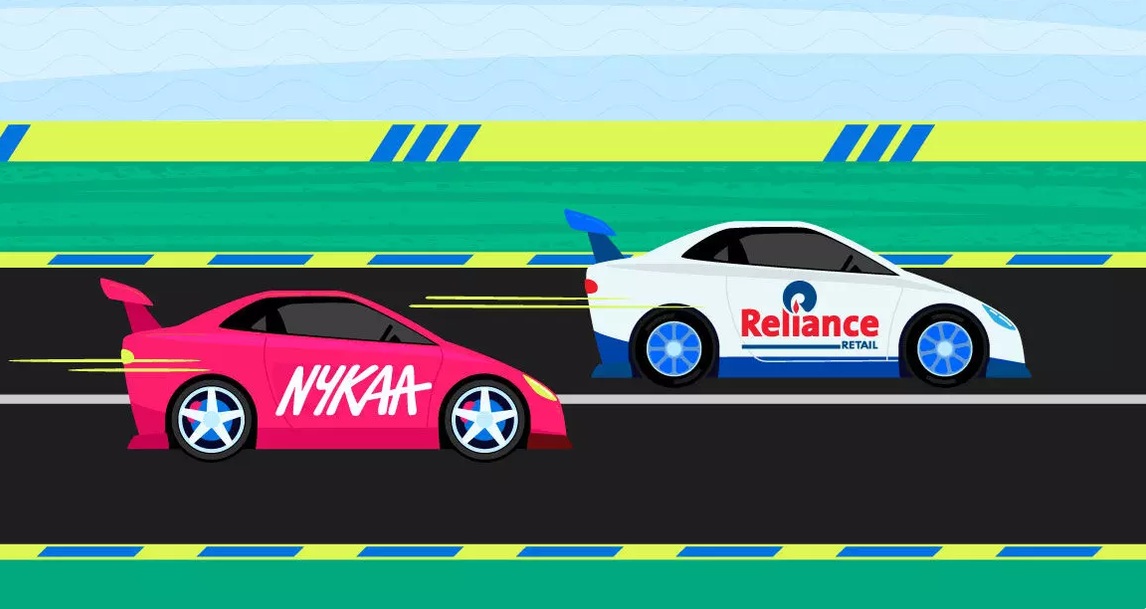
Meanwhile, Nykaa, the beauty platform Reliance Retail keeps getting compared to, spent the last year going after some of the same celebrity founders.
In August 2025, Fenty Beauty moved from Nykaa’s platform to an exclusive deal with Reliance’s Sephora India and Tira. In June 2026, Nykaa answered by signing pop star Selena Gomez’s Rare Beauty. A month later, Reliance landed SKIMS.
India’s luxury and celebrity-brand market is split between Reliance’s scale and Nykaa’s beauty expertise, with Fenty, Rare Beauty and SKIMS showing how ownership, reach and brand fit are shaping who gets the biggest names.
Big Brands, Different Bets
Reliance wins brands through scale (20,169 stores, 396 million customers) and ownership ties; Fenty’s move to Sephora India is less a market choice than an internal LVMH routing decision, given LVMH’s stakes in both Fenty and Sephora.
But Nykaa is holding its own by competing on specialism, not size; its beauty-literate audience and curated community pulled in Rare Beauty and Chanel.
The brand fit, not just distribution muscle, still decides who signs where, and some brands (like Birkenstock) skip both platforms entirely.
The economics behind these deals are harder to pin down than the headlines suggest. None of the three — Fenty, Rare Beauty, or SKIMS — have disclosed minimum guarantees, royalty rates, or sales targets for their India entries; these are announced as partnerships, not filed joint ventures.
SKIMS raised $225 million in November 2025 at a $5 billion valuation, nearing $1 billion in annual net sales.
Fenty tells a different story: $450 million in 2024 sales, now valued at $1-2 billion, down sharply from a $2.8 billion estimate in 2021, with Jay-Z’s MarcyPen Capital Partners in talks to buy LVMH’s stake.
Rare Beauty’s India entry rides on Nykaa’s own momentum; the company’s revenue from operations rose 29% year on year (YoY) to Rs 2,782 crore in Q1 FY27, up from Rs 2,154.9 crore a year earlier. In the last quarter of FY26, revenue stood at Rs 2,648.1 crore.
The Core has reached out to Reliance and Nykaa for their response, and will update this report if and when they respond.
Why Fenty Chose Reliance
Fenty’s move looks more like an internal one, according to Suumit Kapoor, a brand growth consultant.
LVMH owns 50% of Fenty Beauty through its beauty incubator Kendo Brands, a stake it has held since co-founding the brand with Rihanna in 2017. LVMH also owns Sephora globally, and Sephora in India is run by Reliance.
“When Fenty enters a new market through Sephora, LVMH is effectively distributing its own equity stake through its own global retail infrastructure,” Kapoor said. For a brand with that kind of ownership overlap, he added, the choice of partner is “close to an internal routing decision” and not a genuine trade-off.
That ownership overlap is itself now in a pickle.
LVMH has been exploring a sale of its 50% Fenty stake since October 2025, working with investment bank Evercore, according to Reuters. As of June 2026, American rapper and businessman, Jay-Z’s investment firm MarcyPen Capital Partners was reported to be among the parties in talks to buy it.
No sale has closed yet, so the Reliance-Sephora-LVMH alignment still holds for now, but it isn’t guaranteed to outlast the current ownership structure.
Fenty’s India journey backs this up. The brand’s first India listing wasn’t through Reliance at all.
It ran on Nykaa’s Cross Border Store, a low-commitment digital shelf that was discontinued before Fenty’s August 2025 relaunch, an exclusive omnichannel deal with Reliance spanning more than 50 stores across 16 cities on day one.
Kapoor doesn’t think of the switch as a deliberate strategic upgrade.
“The Cross Border Store listing may simply have underperformed on its own terms, without much marketing support behind it,” he said, adding that there is no clear evidence that Reliance stole the brand away.
Devangshu Dutta, founder of the research firm Third Eyesight, said celebrity backing only buys a brand little room.
“When a company or an investor buys into an early-stage celebrity brand, they are acquiring instant brand equity which acts as a top-of-the-funnel magnet and potentially lower CAC,” he said. “However, the ‘fame premium’ runs out if product and service execution isn’t compelling enough to drive repeat business and customer retention.”
Ownership decides the biggest deals before “competition” even enters the picture, Fenty landed at Reliance’s Sephora because LVMH owns half of each, though that alignment is shakier than it looks, with Jay-Z’s MarcyPen Capital Partners now the leading bidder for LVMH’s Fenty stake.
Beyond ownership, it’s a straight trade-off.
For brands chasing scale, Reliance’s tens of thousands of stores will get you reach. If brands want to chase community, Rare Beauty did by picking Nykaa specifically to tap its affluent, digitally engaged beauty shoppers and build loyalty. Some brands skip the fight altogether, like Birkenstock, which walked into India solo.
The Distribution Gap
Where Reliance doesn’t need an ownership story to make its case is scale. Reliance Retail closed the quarter ended June 2026 with 20,169 stores across 78.4 million square feet, 396 million registered customers, and 568 million transactions in that single quarter, up 46% year on year, according to the company’s Q1 FY27 earnings release. JioMart alone served 5,500 pincodes through its rapid delivery network in the same period.
Nykaa, by comparison, operated 324 physical stores across 105 cities as of its FY26 numbers, with a cumulative customer base of around 42 million, per its own disclosures and Business Standard’s reporting on the company’s results.
“That gap generally buys a brand not just bigger numbers, but reaches into places where a beauty specialist has no reason to be,” Kapoor said. For brands thinking beyond beauty into wellness, gifting, or lifestyle crossovers, he said that scale “is not a nice-to-have. It is the entire argument for choosing Reliance over a beauty-only platform.”
Satish Meena, founder of Datum Intelligence, a research firm, made a similar point on Reliance’s pull with brands weighing an India entry.
“With the kind of strength they have, they can always give a better deal,” he said, referring to Reliance’s ability to commit capital and guarantee scale that a newer entrant typically cannot promise on its own. He pointed to Reliance’s existing retail relationships, including Marks & Spencer, as part of the track record that makes brands comfortable signing with the group.
Experts say over the past two to three years, Nykaa has been the more prolific launch platform for major international beauty brands, while Reliance has had greater strength in international luxury and fashion.
According to experts, Nykaa reported more than 70 luxury-brand additions over the last three years, including names such as NARS, Prada Beauty, La Prairie, Chanel Beauty, Armani Beauty and Maison Margiela. Reliance, meanwhile, has built a luxury portfolio spanning Valentino, Balenciaga, Bottega Veneta, Tiffany & Co., Burberry and others, and most recently brought SKIMS to India. Reliance’s public disclosures do not provide a comparable 2–3-year count of new international brand entries.
Reliance is arguably a major gateway for international luxury/fashion, but calling it the default gateway for international brands overall is too broad.
Where Nykaa Still Wins
Reliance’s advantage on raw numbers doesn’t fully explain why Nykaa keeps landing brands too.
Nykaa built its beauty audience before it built its stores, using tutorials and curated storytelling to create what Kapoor called “a beauty-literate customer base that arrives already primed to trust the platform’s recommendations.”
That specialism is what pulled in Rare Beauty. Nykaa’s June 2026 launch made the brand available through its website, app, and 30 stores nationwide, and came from a company reporting its highest quarterly profit since listing at the time, per its own disclosures.
In a company statement announcing the launch, Anchit Nayar, Nykaa Beauty’s executive director and CEO, said the brand fit a “new generation of highly informed and globally engaged consumers seeking elevated brand experiences.” Rare Beauty’s chief executive, Scott Friedman, said in the same announcement that India was “a very important market” for the brand, citing Nykaa’s beauty community in the country as the reason to partner with it specifically.
Nykaa has run a similar playbook before. Chanel strengthened its India fragrance and beauty presence on Nykaa in 2025, Obagi Medical entered India through the platform specifically for its clinically driven skincare positioning, and Estee Lauder’s incubation arm has run its India beauty programme, Beauty and You, with Nykaa as lead partner every year since 2022.
Dutta pointed to Kay Beauty, Nykaa’s own celebrity line with actor Katrina Kaif, as an example of why platform fit matters as much as platform size. Contrasting it with 82°E, actor Deepika Padukone’s skincare brand on Tira, he said Kay Beauty had two advantages: it was priced for a much larger audience, and it had “Nykaa’s active participation across channels for merchandising and visibility.”
Not The Only Door
Reliance’s pull is real, but it isn’t the only route into India.
Reliance benefits from international-brand partnerships through retail economics, distribution and, in some cases, ownership or joint-venture economics. The potential conflict emerges because Reliance can simultaneously act as a brand’s market-entry partner and control substantial retail and digital routes to consumers. Public filings, however, do not establish that Reliance uses this position to disadvantage partner brands or competing retailers.
Meena pointed to Birkenstock, which entered by opening its own stores rather than partnering with either platform. Birkenstock and similar labels operate as single-brand retail; they can use India’s foreign direct investment rules to set up shop directly, bypassing the need for a local partner altogether.
“If the brands think that they have enough pull in the market and they can bring customers, they are opening these stores without any partnership,” Meena said. He added that most global brands take the partner route anyway because India, for many of them, is still a small share of global sales, and testing the market with an established partner for a few years is lower risk than building from scratch.
Kapoor flagged one risk worth watching no matter which partner a brand picks. Exclusive deals give a retailer more control. But Tira has also started building its own private-label products, including a colour cosmetics line, and sells them in the same stores as the global brands it distributes.
“A retailer can be a brand’s distribution partner and, on an adjacent shelf, its competitor, at the same time,” he said, a tension he noted that Nykaa’s marketplace model, without a comparable private label push against premium brands, does not carry in the same way.
For brands already tied to Reliance through ownership, like Fenty, there isn’t much of a decision to make. For everyone else, Nykaa signing Rare Beauty and Reliance signing SKIMS within weeks of each other shows this fight for celebrity founders in India is far from over.
(Published in The Core)
admin
August 6, 2026
Pritha Pahari, The Core
5 Aug 2026
Saurav, a 27-year-old resident of Navi Mumbai, has bought the same tub of whey protein for three years, same brand, same 1kg pack, same monthly ritual after his gym membership renews.
Last month, at checkout, the price had jumped by nearly a thousand rupees. He assumed it was maybe a limited-time markup. But when he checked his order history, he noticed that the price had been going up for two to three months until it crossed a threshold that made him realise that whey protein has gradually become more expensive.
India is the world’s largest milk producer, yet it imports most of its whey protein because its dairy sector was never built to make cheese, the one thing that whey needs to exist.
That gap is now colliding with a global protein boom, driven partly by weight-loss drugs that leave patients needing more protein.
The result is a price rise that is now reaching the local pharmacy and fitness stores, and one that is unlikely to recede.
The Price Move
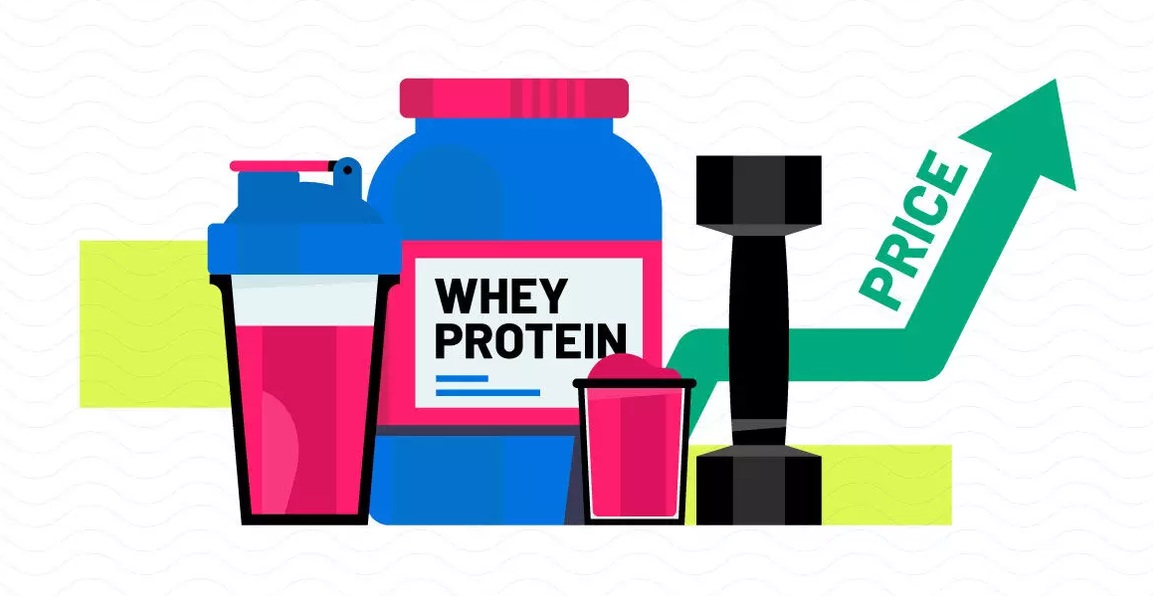
Research firm, The Daily Datum analysed Keepa price data for 11 whey protein SKUs on Amazon and found an average price increase of 32% and a median rise of 27% across varying tracking periods.
Keepa is a third-party price-tracking tool for Amazon, it logs a product’s price history over time by continuously scraping Amazon’s listing pages, so you can see a graph of how a specific SKU’s price has moved (sales, hikes, restocks) going back months or years.
Prices of different types of proteins i.e. blends, isolates and concentrates have all moved by similar amounts, and so have Indian D2C brands and long-established imported ones.
In protein powder terms, concentrates are ~70-80% protein (less processed, retain more fats/carbs), isolates are ~90%+ protein (more filtered, less lactose/fat), and blends mix two or more protein types (e.g., whey + casein, or whey concentrate + isolate) to combine benefits like fast and slow absorption.
The one outlier, MuscleBlaze’s premium Biozyme Performance line, has roughly doubled, but excluding it, the category average is still 26%, about five times India’s headline food inflation, which stood at 5.32% year-on-year in June 2026, according to government data.
The retail prices are only a reflection of what is happening with the raw ingredients needed for whey.
Imported whey protein concentrate landed in India at roughly Rs 700–800 per kg in 2024; by mid-2026, the industry estimates put it at Rs 2,300–3,000 per kg, a rise of over 200%.
Brands have absorbed much of that shock through smaller pack sizes and blended formulations rather than passing it straight through, which is why retail prices have risen a fraction of what the raw material has.
For scale, India’s protein supplement market (powders, bars and ready-to-drink shakes together) is put at roughly $860 million to just over $1 billion in 2025, though the exact figure depends a lot on which research firm and which product categories you ask (IMARC Group and Grand View Research land in that range but don’t agree closely). That compares with a global protein supplements market well above $30 billion.
Not A Farmed Commodity
“You don’t milk a cow for whey. You milk a cow for milk. And then you have to make cheese,” said Rajiv Mitra, Strategic Advisor, Sonai Dairy, a Maharashtra based dairy.
Whey from cheese-making is “sweet whey”, protein-rich and further processed through filtration and expensive drying infrastructure into the 80–90% protein concentrate that ends up in a gym-goer’s scoop.
“This is a structural bottleneck,” Mitra said. “It’s not a kind of seasonal commodity up and down.” New filtration and drying plants can take two to four years to build, with much of the machinery imported.
This is where India’s dairy habits work against it.
Devangshu Dutta, founder of the retail consultancy Third Eyesight, while speaking to The Core explained that globally, about 95% of whey protein comes as a co-product of Western-style hard and semi-hard cheeses such as cheddar and mozzarella. India’s dairy sector, by contrast, is built around paneer, curd, khoya and ghee.
Paneer is made by acid coagulation, which produces “acid whey”, lower in protein and higher in minerals, and not suitable for concentration into protein powder.
“Unless consumption of western-style cheeses grows dramatically in India, co-production capacity will remain low,” Dutta said.
Mitra makes the same point from the kitchen rather than the factory floor: squeeze lemon into milk to make paneer at home and the liquid that separates out simply gets drained. “Traditionally, for years, while we have been the highest producer of milk, our consumption pattern is such that we do not harness the whey that is produced,” he said.
That liquid is easy to overlook because it looks like nothing more than watery runoff, but it isn’t a waste.
When milk curdles, the solid part becomes paneer or cheese, and the yellowish liquid left behind, the whey, still carries a meaningful share of the milk’s protein along with lactose and minerals.
Filtered, concentrated and dried at an industrial scale, that liquid becomes the powder sold in tubs as whey protein concentrate or isolate. In most Indian kitchens it is simply poured away; in a cheese-and-whey-processing economy like the US or Europe’s, it is captured and turned into a saleable ingredient.
That gap between what gets thrown out and what gets processed is the crux of the shortage.
Why It’s Getting More Expensive
India imports an estimated 80–90% of its supplement-grade whey, mostly from the US, Europe, New Zealand and Australia, in dollars. The rupee has weakened sharply against the dollar over the past few years, from around 74 to nearly 97 by July 2026, adding another 10–15% to landed cost before customs and tax.
India’s own import policy adds a further layer of cost. Dairy is among the most protected sectors in the Indian economy: duties on whey, cheese and milk powder run 30–60% depending on the product, India offers no duty-free quota for dairy, and the government has repeatedly kept dairy outside trade negotiations, including in the interim India–US trade agreement reached in early 2026.
US suppliers, the world’s largest whey producers, also frequently fall short of the vegetarian-rennet certification Indian food rules require, which further narrows where Indian buyers can import from. None of this caused the current price spike, but it does mean India pays a built-in premium over the raw international price, and there is no sign of that premium being negotiated away soon.
Global demand, meanwhile, keeps climbing while milk output in the US and Europe grows only slowly. The global whey protein market is put at roughly $9.7 billion in 2025 by one widely cited estimate (Grand View Research).
It has clearly grown a lot over the past decade, but market-research firms disagree fairly widely on the starting point and pace of that growth.
Mitra pointed to a newer driver on top of the usual sports-nutrition demand: GLP-1 weight-loss drugs.
“Doctors have asked patients to consume more protein” to offset muscle loss from the drugs, he said, and as patents expire and generics spread to India and China, “the demand-supply gap is definitely going to increase further.”
(Some industry commentary points to semaglutide patents lapsing in markets including India and China around 2026, which would open the door to cheaper generics, though this detail comes from a single industry source and is worth treating as a general trend rather than a confirmed date.)
He laid out what he called a three-pronged squeeze: India’s own GLP-1 users will need more protein even as domestic production stays constrained; the US and Europe, which used to export surplus whey, will increasingly consume it themselves as their own GLP-1 use grows; and India’s roughly 30% vegetarian population, which depends on dairy for protein, will lean on it even harder.
Ingredient suppliers and dairy processors abroad broadly back this account, at least directionally, though they are careful not to call GLP-1 the sole cause. In wire-service and trade-press interviews, executives at FrieslandCampina and Lactalis have cited the weight-loss drug trend by name as a reason for new investment in high-protein whey processing, and StoneX’s dairy consulting head has said the food industry simply lacks the capacity to turn whey into the concentrates and isolates the market now wants. Those are real, on-record statements, but they’re a handful of quotes, not a market-wide survey, so it would be a stretch to read them as proof that GLP-1 is now a dominant driver.
The macro numbers, where they exist, suggest a more modest picture: one investment-bank estimate (cited secondhand rather than pulled from the original research note) put GLP-1’s impact on total European calorie demand at around a quarter of one percent, since only a low single-digit percentage of the population is on the drugs so far.
Separately, some retail-data providers have reported that households with a GLP-1 user spend noticeably more on protein-rich products than matched non-user households.
Taken together, traditional sports-nutrition and everyday-fitness demand almost certainly remains the larger base of whey consumption, GLP-1 use is a real and fast-growing add-on that industry executives say is starting to show up in sourcing decisions, but nobody has published a solid, independently verified number for how much of the current price spike GLP-1 specifically accounts for. Anyone who tells you an exact percentage is guessing.
Who Feels It First?
Large manufacturers are better insulated than small ones.
“The bigger players always get into long-term contracts,” Mitra said. Smaller brands and contract manufacturers, reliant on buying at spot prices, “get squeezed first.”
Big companies can also cross-subsidise from other product lines for a while, he said, but that isn’t a permanent fix: “Businesses are not there to absorb cost. Businesses are there to make profit.” Margin compression, in his words, “is never sustainable.”
An executive at HealthKart, which owns MuscleBlaze, was quoted saying in an Financial Express article that whey concentrate costs have more than tripled in two years and are “quickly approaching 4x,” and that the company has raised prices while absorbing part of the increase itself.
The founder of Wellbeing Nutrition was quoted in the same Financial Express article saying whey isolate prices have roughly tripled over the same period, and that whey, which makes up 15–20% of the company’s revenue, is now being promoted less actively as a result.
The founder of The Whole Truth, a clean-label brand that also uses cashews and cocoa, was quoted in the same article in Financial Express, saying input costs across its ingredient list have surged and that the company has pushed through several price increases, including a 15–20% hike on protein bars, rather than change its recipe.
Budget-focused brands such as Nakpro, AS-IT-IS and Avvatar have not made similar public statements, but their pricing sits in the same band as the rest of the market, and their category positioning, cheaper, no-frills whey aimed at price-sensitive buyers, looks consistent with the same cost pressure, even without a direct quote confirming it.
Smaller sachet and single-serve formats, which let a brand hold a lower shelf price even as the cost per kilogram rises, have also become more common across the category over the past year, though this is more an observed pattern than something brands have explained on the record.
Consumers shouldn’t expect quick relief either. “Commodity prices normally fall before retail prices,” Mitra said.
Existing contracts and retail pricing cycles are sticky, so the consumer will see relief much later than any drop in the raw material.
Some Headroom, No Quick Fix
Both experts see room for India to produce more eventually.
Dutta noted that rising protein-consciousness and GLP-1 adoption are giving Indian manufacturers “headroom for growth,” though feedstock constraints will remain a challenge.
Mitra talked about the scale needed: new capacity requires a couple of hundred crores of investment and years to commission, on top of a slow, generational shift in how Indians eat dairy. Cold storage for hard cheeses, which need months of ageing, is also still being built out.
Some of that investment is already happening.
Amul has launched a whey protein line priced well below imported brands, part of a broader push by Indian dairy majors to move into higher-margin, value-added products; cheese and whey can carry margins of 25–45%, against much thinner margins on liquid milk.
Parag Milk Foods already sells whey protein under its Avvatar brand and has positioned itself as a nutrition company rather than a pure dairy one.
Milky Mist, which is preparing a stock market listing, has said it will use part of the proceeds to add new production lines for whey protein concentrate, yoghurt and cream cheese at its Tamil Nadu plant.
Cheese-focused players including Schreiber Dynamix, Britannia Bel Foods and Lactalis India are separately expanding capacity, since more cheese production is what generates more whey as a by-product in the first place.
None of these projects will materially add to supply in the next year or two; dairy-processing plants of this kind typically take two to four years from investment to commissioning, and most industry estimates suggest India’s domestic whey production still covers only a small fraction of what the country consumes.
Neither expert expects plant-based protein to substitute for whey in a hurry. “Whey still offers a superior amino acid profile” and better digestibility, Mitra said, predicting diversification and hybrid blends rather than replacement.
What Could Break the Cycle?
Globally, the shortage is widely described by dairy analysts as a processing bottleneck rather than a milk shortage: milk supply itself has been broadly stable, and cheese production, which generates whey, has continued at normal levels. The constraint is the specialised filtration and drying capacity needed to turn liquid whey into the concentrated, dried powder the supplement industry uses, and that capacity takes years to build.
Major producers, including Glanbia, Fonterra, Arla, Tirlán and Idaho Milk Products, have announced billions of dollars of new whey-processing investment in the US, Europe and New Zealand over the past year. Most of these projects are expected to come online through 2027, not before, so global analysts generally don’t expect meaningful supply relief until late 2026 at the earliest, and more likely 2027.
US milk production is forecast to keep growing gradually into 2027 as well, which should help at the margin, though rising input costs (energy, feed, financing) are also squeezing dairy farmer margins in exporting regions, which cuts the other way.
For India specifically, easing would most likely need several things to move together over the next two to three years: new domestic processing capacity from players like Amul, Parag, Milky Mist and the cheese-focused majors actually coming online, rather than merely being announced; global WPC and WPI supply catching up with demand as the 2026–27 capacity wave lands; a stabler or stronger rupee, since a large share of India’s whey is still imported and priced in dollars; and some change to India’s own tariff and certification structure on dairy imports, which currently adds cost on top of the global price and shows no sign of loosening given how firmly successive governments have kept dairy out of trade deals.
GLP-1-driven demand would also need to plateau rather than keep accelerating as drug prices fall and generics spread.
Even if all of that happens, retail prices in India are unlikely to fall quickly. Brands are currently absorbing part of the cost increase rather than passing all of it through, which means a chunk of any future relief in the raw material would likely go toward rebuilding margins before it reaches the shelf.
Contracts, inventory cycles and psychological pricing (brands are usually slower to cut prices than to raise them) add further lag. Mitra’s framing captures this: raw material costs typically fall before retail prices do, and the gap between the two can run into quarters, not weeks.
What experts keep coming back to is that this has stopped being a niche fitness-industry story. “
This is no longer just about dairy,” Mitra said. It is now about healthcare, pharmaceuticals, nutrition, overall food.
(Published in The Core)
admin
July 20, 2026
Kartikay Kashyap, Financial Express / Brandwagon
30 July 2026
Wendy’s first foray into India’s quick service restaurant (QSR) market in 2015 remained a non-starter. Sierra Nevada Restaurants, the then master franchisee, could not scale its retail presence beyond four conventional restaurants concentrated largely in Delhi-NCR. This limited physical availability, brand awareness and ordering frequency.
Ten years on and under a new master franchisee Rebel Foods since 2023, Wendy’s seems to have turned over a new leaf. With more than 250 stores, and ₹200 crore in revenues, the brand wants to be the one-stop destination for the younger generation where consumers come together to celebrate food, music and a sense of community. “The longer-term ambition is to expand to approximately 500 locations by 2028 through a combination of delivery kitchens and physical restaurants,” says Joy Bamania, brand head, Wendy’s India.
As a first step, Rebel Foods recently opened what it calls its “dynamic cultural flagship store” in Delhi’s vibrant student hub of Hudson Lane, GTB Nagar. The two-level youth-centric space blends food, music and anime, offering fans experiences like live rap battles, meet-and-greets, and specialised menu items like the signature Teriyaki Burger range.
“It has been designed to be livelier, more youthful and visually engaging—an Instagram-worthy space. It is a physical expression of how we want consumers to experience Wendy’s in India: bold, fun, culturally relevant and full of energy,” says Bamania.
Even before taking over Wendy’s operations Rebel Foods had been managing its delivery-only cloud kitchens since 2020 and was familiar with the brand’s DNA and what was required to mount a serious challenge in the ₹15,000-plus crore organised burger restaurants market in the country. The low capex delivery-only model has helped to improve its gross margins, but taking on established brands like McDonalds, KFC and Burger King would be a completely new ball game.
Is the latecomer up to a second bout in the ring?
New, improved
Wendy’s has at least three things going against it. It arrived late on India’s shores and couldn’t really stand apart during its last outing. “No matter how big a global brand you are, you need to stand out in the clutter,” says Devangshu Dutta, founder & CEO, Third Eyesight.
So while McDonald’s is the kid-first family restaurant, Burger King is intentionally “imperfect” and rides on humour, pop-culture moments, and viral marketing. Wendy’s, say experts, had no differentiation than just being a global brand.
Its premium pricing was another bugbear. In its first foray, Wendy’s tried to justify its higher prices saying its ingredients were better than that offered by the rest of the pack. So while the price of a Wendy’s entry level burger was ₹100, McDonald’s retailed one at half that price. “In the QSR business, you have to get your price right. There is nothing ‘premium’ in that space,” says Ankur Bisen, senior partner, The Knowledge Company. Rebel Foods addressed these problems with four fundamental shifts.
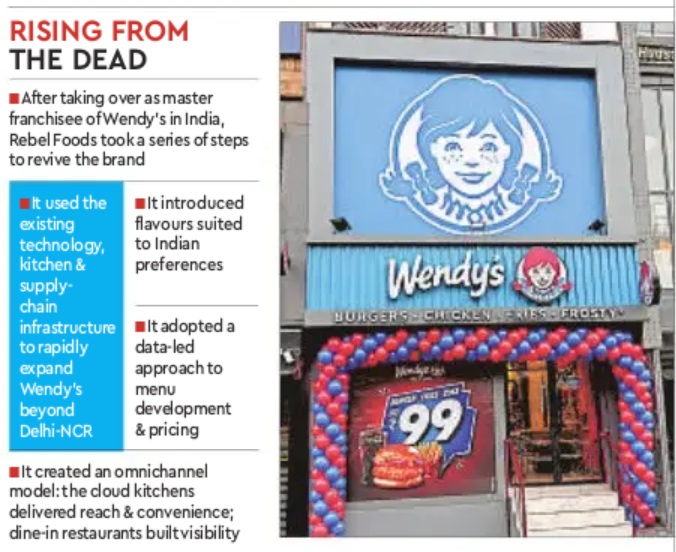
First, it used the existing technology, kitchen and supply-chain infrastructure to rapidly expand Wendy’s beyond Delhi-NCR. Second, it built a stronger and more accessible value architecture while introducing flavours suited to Indian preferences. Third, it created an omnichannel model in which cloud kitchens delivered reach and convenience, while selected dine-in restaurants built visibility and deeper brand experiences. Finally, it adopted a data-led approach to menu development, pricing, consumer feedback and operational performance.
Rebel Foods became Wendy’s master franchisee in India in 2023. At that stage, Wendy’s had approximately 90 locations across 19 cities. By March 2025, the brand had reached 200 locations across more than 50 cities, including 15 dine-in restaurants.
“The fivefold revenue growth has consequently not come from one product or campaign. It is the result of wider distribution, sharper value, continuous menu innovation, stronger operational execution and a much clearer proposition for the Indian consumer,” says Bamania.
(Published in Financial Express)
admin
May 1, 2026
Yuthika Bhargava & Vikash Tripathi, Outlook Business
Mumbai, 1 May 2026
For generations of Indians, the word Tata hasn’t just been a brand, it has been a permanent resident in our homes. Think back to the kitchens of your childhood. It was the familiar packet of Tata salt, the Desh ka Namak, that seasoned every meal. It was the steaming cup of Tata tea that signalled the start of the day for elders at home.
In every Indian household, the name represents trust and legacy.
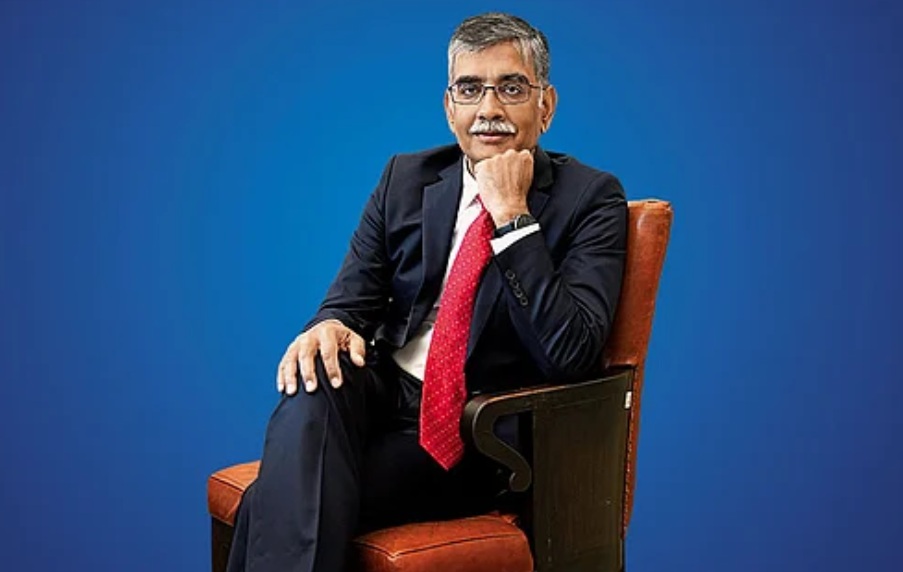
Yet, when N Chandrasekaran, chairman of Tata Sons, wanted to hire Whirlpool India’s head Sunil D’Souza to lead Tata Global Beverages (TGBL) in September 2019, he got a shock refusal.
Who in their right minds wouldn’t want to join a Tata company?
Well, D’Souza hadn’t heard much about TGBL. In fact, his colleague at Whirlpool India had called it a “sleepy company”.
At the time, TGBL’s revenues were a meagre ₹7,408cr compared to close to ₹50,000cr and ₹40,000cr logged by fast-moving consumer goods (FMCG) heavyweights ITC and Hindustan Unilever (HUL), respectively, in 2018–19.
Experts had noted TGBL had not much to show in terms of major product innovation for years. Primarily a tea and coffee company, it was locked in a low-growth cycle.
In 2018, various analysts had remarked that TGBL’s growth was muted as it wasn’t selling anything beyond tea and coffee.
At TGBL’s annual general meeting on July 5, 2018, Chandrasekaran said the company would exit loss-making subsidiaries and focus on profitable ones that can be scaled up. “Even though in volume terms, the company continued to be number one in the Indian market, the same was not true in value terms,” he said.
So, D’Souza’s immediate “no way” to the job offer was justified. TGBL wasn’t on his radar or anyone’s at the time.
But the headhunter convinced him to meet Chandrasekaran.
This meeting, says D’Souza, made all the difference for him. He recalls the Tata Sons’ chairman saying “I have the money. But I don’t have the team to run it.”
But the clincher for him was Chandrasekaran’s larger plan to foray into the FMCG space and the intent to disrupt the market.
In December 2019, Tatas announced D’Souza’s appointment as managing director and chief executive effective April 2020. One more important addition to this FMCG team was Tata Sons’ Ajit Krishnakumar as chief operating officer.
What followed was the duo’s visits to Mumbai, Bengaluru and Gurgaon. They walked to distributor offices and kirana stores and sat through market visits. “We drew out in great detail what we wanted this company to look like,” says Krishnakumar.
The mandate from Chandrasekaran was simple. He wanted a company commensurate with the Tata name, one that shared the same shelf space as the likes of HUL and ITC.
Humble Beginnings
The mission to become an insurgent company in the FMCG space kickstarted with the formation of Tata Consumer Products (TCPL) in February 2020 by merging TGBL’s tea and coffee units with Tata Chemicals’ salt and pulse businesses.
However, with established FMCG rivals like HUL, ITC and Nestlé India, D’Souza and Krishnakumar had their tasks cut out. The competition had a century of headstart in India.
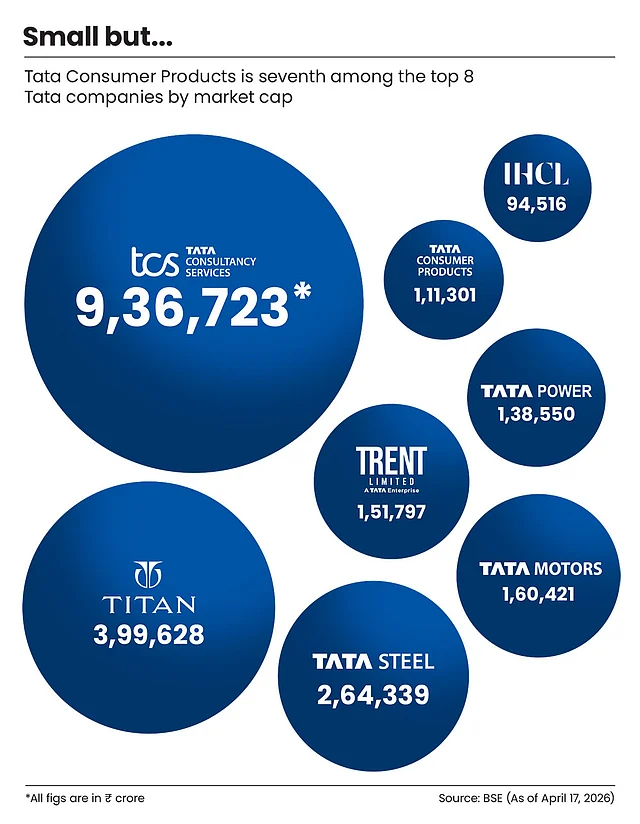
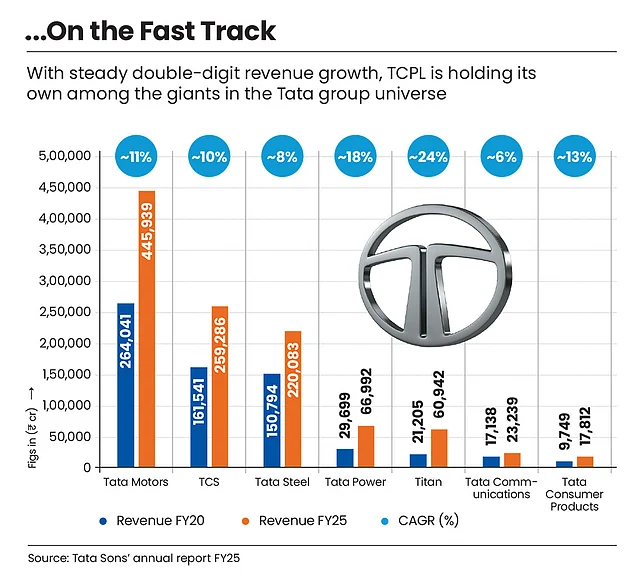
Within the Tata group itself, TCPL ranked eighth by revenue in 2019–20, behind Tata Motors, TCS, Tata Steel, Tata Power, Titan, Tata Communications and even Tata Chemicals.
But “things couldn’t get any worse than this, right? We were already at the bottom of the heap in FMCG. You could only get better,” recalls D’Souza about his mindset at the time (see pg 24).
Building a brand name as a Tata company opens doors. But competing is another. Could this new company take on HUL, Nestlé and ITC?
TCPL started by trimming the portfolio, streamlining the consumer products businesses spread across five continents, from India and the US to the UK, Canada, South Africa and Australia.
In Australia, the company held a 7% share of the tea market but was also running an out-of-home coffee dispensing business that was losing millions of dollars. It was shut down in December 2020.
In the US, a food-service joint venture, including a tea factory and a distribution unit, was disposed of as well in March 2021.
“We had 45 legal entities. That’s not tenable,” D’Souza says. “We exited areas where we didn’t see value. The focus clearly shifted to not just the topline, but margins.”
Six years later, TCPL’s entity count stands at 25 and is well on the way to the target of 18 entities.
What stood out in the next six years is TCPL’s sole focus to dominate the food and beverages (F&B) category. The company’s mantra: think big, move fast.
By late 2020, once the initial scramble post the merger had settled, TCPL ran a strategic exercise called Project Falcon. The result was a playbook: categories to foray into, categories to stay out of, where to build and what to buy.
The year 2021 provided a starting point for TCPL. In March that year, the United Nations officially declared 2023 as the International Year of Millets, acting on a proposal from India. The country being the largest producer of millets, accounting for 20% of global production, wanted to raise awareness of millet’s role in improving nutrition and creating sustainable market opportunities.
The timing was fortuitous for TCPL. In 2021, its first acquisition, Soulfull, was a millet-based health-food brand. This ₹155.8cr deal gave Tatas a foothold in a category it couldn’t have credibly entered on its own.
Within three years of acquisition, Soulfull’s distribution had grown from 15,000 outlets to 300,000, carried on the back of the Tata’s existing network.
Three years later, in January 2024, when TCPL announced two deals with combined worth of ₹7,000cr in quick succession, its stocks fell.
The market wasn’t convinced initially. TCPL had just committed roughly 40% of its annual revenue to two brands it did not build. At the time, it was a new player with its core business running on single-digit margins.
Analysts at Ambit Capital estimated the acquisitions would cut 2025–26 earnings by roughly 10%.
The first, a ₹5,100cr deal, was to buy Capital Foods, the company behind Ching’s Secret.
The second was a wellness play, a ₹1,900cr cheque for Organic India, a Lucknow-based brand with a devoted following in the US.
D’Souza had faith in these big-cheque acquisitions. “We are not playing this game for the next one or two years. We do these acquisitions knowing that we put money there. It will bear out over a period of time.”
Ching’s Secret had spent decades building the desi Chinese category in urban Indian homes almost single-handedly—the Schezwan chutney, the noodles and sauces.
As for Organic India, it had a network of farmers across Madhya Pradesh and Uttarakhand, a manufacturing facility in Lucknow and decades of Ayurvedic credibility in the American wellness market. It was built over years of relationships that TCPL simply did not have and could not quickly acquire.
And the numbers weren’t disappointing. By the third quarter of 2025–26, Capital Foods and Organic India together were generating ₹354cr in quarterly revenue, up 15% year on year, at gross margins of roughly 48%, well above TCPL’s blended average of 43%.
Motilal Oswal expects integration costs to ease substantially by 2026–27, after which the margin story should become clearer.
Fight for Shelf Space
From the get go TCPL was clear about the categories it wanted to enter and to avoid as well.
It didn’t want any stake in the basic edible-oil segment. This shelf had far too many players led by the likes of Fortune and Saffola.
But cold-pressed oil was a different ballgame. Consumers here were buying into a health claim with no way to verify if the product was trustworthy. “The Tata name does the magic there,” says D’Souza.
In August 2023, TCPL launched a range of cold-pressed oils under its brand Tata Simply Better, a new brand that was launched in 2022 to enter the plant-based mock-meat category.
The logic: find the trust deficit, fill it with the four-letter Tata name, became the basis for every category TCPL considered entering.
The sweet spot for the insurgent company was categories that were fragmented, where consumers didn’t fully trust what they were buying and where a credible brand could change the equation.
Biscuits was another category that TCPL gave a skip.
Britannia and Parle owned 56% of the market, built over decades of backward-integrated manufacturing and distribution muscle.
This restraint, wrote Motilal Oswal, in a recent note, is “rare in Indian FMCG”. Categories like biscuits, snacks, colas and base edible oils are permanently off the table, crowded segments where the Tata brand adds no meaningful trust-led differentiation. “Such portfolio discipline is a positive indicator of capital allocation quality,” the note observes.
Built organically, cold-pressed oil is now running at an annual revenue of ₹350cr. Dry fruits, another category Tatas entered with the same trust deficit logic is at a ₹300cr run rate.
What differentiates TCPL from other FMCG players?
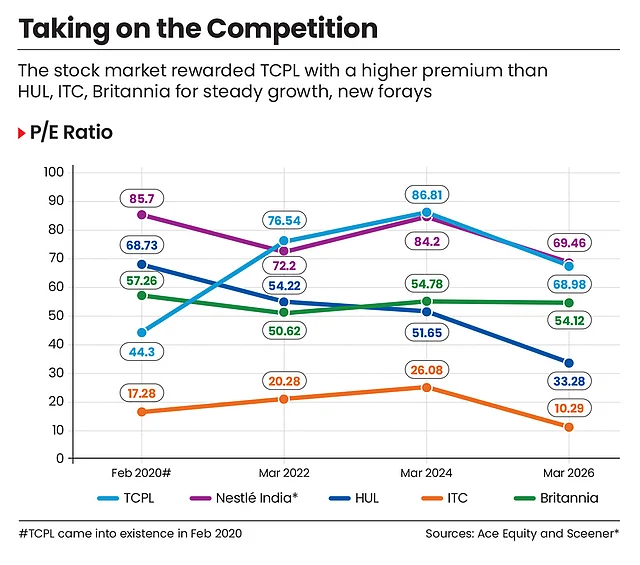
The categories that Tatas have built or bought into are still being defined. HUL and Nestlé, on the other hand, are dominant in mature markets where penetration is already high. HUL is buying established brands in categories it rules, plugging gaps in existing portfolios. TCPL is buying into categories it has never played in, at scale, while the core business is still being built.
Whether this is disciplined offence or over-extension is a question the next two years of integration will answer.
Even before acquisitions came into play, among the first things D’Souza and Krishnakumar did was to build accountability. There had been no one person who owned a category (tea, salt or pulses) from manufacture to sales.
They created category leaders who were responsible for the product’s profit and loss, bar the fixed costs. Functions that did not exist were created.
In 2020, Tata Salt was present in nearly 2mn retail outlets across India. TCPL’s own salespeople directly visited just 150,000 of them. The remaining 1.85mn stores were being supplied through a chain of middlemen, called super stockists or consignee agents.
These middlemen picked up Tata Salt in bulk from big distributors and moved it onward through their own networks. No one from TCPL knew what was selling fast, what wasn’t or what product a rival had placed on the shelf just two rows away.
“That shows the strength of the brand and also the lack of distribution reach,” says D’Souza. In FMCG, this gap between a brand’s total reach and its direct reach is called the wholesale multiplier. It measures how many outlets are stocking your product for every outlet you directly supply. A multiplier of five is considered normal. TCPL’s was 15, a number almost unheard of.
This meant TCPL had no direct relationship with over 90% of the shops and no mechanism to introduce anything new in those shops.
“There was this big layer [of middlemen] in each state. We removed that entire layer. That layer alone was about 1.2% in terms of cost. Then we appointed proper distributors, recruited the right people and rebuilt the distribution system,” says D’Souza. This was a saving of 36 paise on every 1kg pack of Tata Salt with an MRP of ₹30.
Rebuilding the entire distribution ecosystem took six to seven months. The distributor base was cut from 4,500 to around 1,500–1,600. These distributors were now carrying the full portfolio, reporting directly to TCPL. The sales force was expanded by 30%.
The results were quick. TCPL’s direct outlet reach stands at approximately 2.3mn today from roughly 500,000 in 2019–20. The total reach is 4.4mn outlets now.
“There are two key benefits to getting closer to the retailer. It supports margins and gives you better visibility into what’s happening at the point of sale,” says Arvind Singhal, chairman of The Knowledge Company, a management-consulting company.
Progress is real. But TCPL has miles to go. HUL reaches more than 9mn outlets, built over nine decades. ITC reaches 7mn. Nestlé 5.2mn. India has roughly 12–15mn kirana stores.
“The whole premise was to create a distribution funnel through which you can then push different products,” says D’Souza.
Bump in the Road
The first real test for TCPL was whether the idea of pushing new products through the distribution funnel would work.
Pradeep Gupta, a kirana store owner in Varanasi, has been a witness that it worked. Six years ago, two products were always on his shelf: Tata Salt and Tata Tea Premium. He didn’t need a salesperson to tell him to stock them.
Now, new products from Tata Sampann spices to Ching’s Secret sauces and Soulfull rusk are on the shelves of Gupta’s tiny store. TCPL’s distribution network made it happen. A distributor who had built his business around Tata Salt would now also handle Ching’s Secret. A salesperson who knew how to move a commodity would now pitch a branded sauce.
But not everyone was happy. The All India Consumer Products Distributors Federation (AICPDF) went up in arms against TCPL in 2025. Distributors were protesting excessive targets, stocks were piling up in warehouses and damaged goods sitting for months with no settlement.
The mismatch was structural. Salt moves through wholesale with 80% of it never seeing a retail salesperson. Most of the newer growth products like Ching’s Secret are sold almost entirely through direct retail.
Running both through the same distributor was asking a man who sold salt by the tonne to also build a market for Schezwan chutney.
The AICPDF president Dhairyashil H Patil explains what went wrong. “Salt is typically sold in large volumes. Products like Tata Sampann [a packaged pulses brand launched in 2017 under Tata Chemicals] and tea are the opposite, only about 8–10% goes through wholesale. After the merger with Capital Foods, there was a complete mismatch.”
Distributors built around salt did not find it viable to handle retail-heavy products. “Most Tata distributors derive 60–70% of their turnover from salt, so their focus remains there,” adds Patil.
TCPL eventually had to take back damaged goods sitting with distributors for six to eight months. D’Souza’s response was to separate the networks entirely.
TCPL’s growth businesses like Ching’s, Soulfull and Organic India had their own distributors and sales teams in just three months. “For any other company, it would have taken at least a year or more,” D’Souza says.
Also, the portfolio TCPL had inherited gave its own answer to what the distribution funnel could carry. Sampann, a “hobby for Tata Chemicals”, arrived at the merger doing ₹150–200cr in revenue. In 2025–26, Sampann is expected to touch ₹1,700–1,800cr, with pulses alone contributing ₹1,000 crore.
“The whole DNA of the company is to stay agile and make sure to move at full speed,” says D’Souza.
Fast and Furious
TCPL moved at full speed indeed when it came to trends. In May 2019, Beyond Meat, a company that made plant-based burgers from pea protein, listed on Nasdaq. Its stock more than doubled on the first day.
Within months, McDonald’s was testing a meatless McPlant and KFC was piloting plant-based chicken. Plant-based meat looked like the future of food.
TCPL bought into the trend. In 2022, it launched plant-based mock meat under the Tata Simply Better brand. However, the global buzz died sooner than expected. Two years later, TCPL exited the category.
The exit is not the point. What matters is that the product took 150 days from concept to shelf. TCPL had built something that would have been impossible two years before.
Mock meat required food science to replicate the texture of meat from plant protein, process technology, a team of chefs, food scientists and packaging engineers.
Capabilities were built from scratch. In the beginning, the R&D team was just 10–15 people. Today, it operates across three centres: Bengaluru as the research and packaging science hub, Mumbai for food innovation and product development, and Barabanki in Uttar Pradesh, anchoring the wellness work after the Organic India acquisition.
The team remains lean, around 60 people, roughly one-third the size of comparable FMCG rivals, estimates Vikas Gupta, R&D head at TCPL.
When D’Souza arrived in 2019, just 0.8% of TCPL’s revenue came from new product launches. The industry benchmark is 5%. TCPL was nowhere close. Today, that number stands at roughly 5%.
Onkar Kelji, research analyst at Indsec Securities, a brokerage firm, frames the economics of the chase: the early returns on innovation can be thin, he says, as companies push products aggressively and launch on e-commerce where margins are typically lower than general trade. “But if these products scale, they deliver better margins over time.”
Across the industry, the contribution of newly launched products has generally stayed under 5%. With acquisitions, that mix is expected to rise, notes Kelji.
In FMCG, innovation is not only about launching entirely new categories. It is also about rethinking what already exists. “We were singularly focused on vacuum-evaporated iodised salt,” says D’Souza.
The thinking that replaced it was simpler. “Give the consumer what they want. Plain salt. Salt with iron, with zinc. Low sodium for the health-conscious. Himalayan rock salt for the premium buyer. Sendha [during Navaratri]. One product became a portfolio,” adds D’Souza.
A patented granulation technology was developed for double-fortified salt, solving a long-standing industry problem of how to add iron to iodised salt and keep it stable.
TCPL also produced the Tata Coffee Cold Coffee liquid concentrate, a first-of-its-kind product in the Indian market that lets consumers make cold coffee at home without equipment.
The first 100 product launches after the merger took three-and-a-half years. The next 100 took 16 months. At one point, the company was turning out a new product every week, each one requiring its own supply chain, packaging, shelf-space negotiation and own sales story.
For a company that was criticised in 2018 for launching almost nothing new for years, this was a different metabolism entirely. “It’s easier when you are doing everything from scratch, says D’Souza, adding “As soon as we see a trend, we are on top of it and running with it.”
E-commerce is a good example of how TCPL, weeks into its merger, took on the very real challenge of lockdown and built a new digital vertical to boast of.
Lessons from Pandemic
In March 2020, most Indians had online grocery apps on their mobile phones. These were rarely used. But the Covid-19 pandemic and subsequent lockdown reshaped this landscape.
BigBasket’s servers strained with massive order volume surge. Dunzo crashed repeatedly. Amazon Fresh ran out of delivery slots. Millions of urban Indians were struggling to restock their kitchen shelves.
At the time, TCPL’s entire e-commerce operation was one person’s part-time responsibility. The southern regional sales head looked after e-commerce. TCPL had to race against time to build a digital channel. And D’Souza’s team built it fast.
E-commerce became a dedicated function with its own head. A modern trade team was created. Every new product launch went digital first. E-commerce gave TCPL something general trade never could: unfiltered data on what actually works.
While the company’s overall innovation-to-sales ratio was 3.4% by 2022–23, it was 10% on e-commerce. Products that proved themselves online were then pushed into general trade.
“The beauty of e-commerce is that it is only you and the consumer. It is the power of your product and your brand and your value proposition,” D’Souza said in an earnings call.
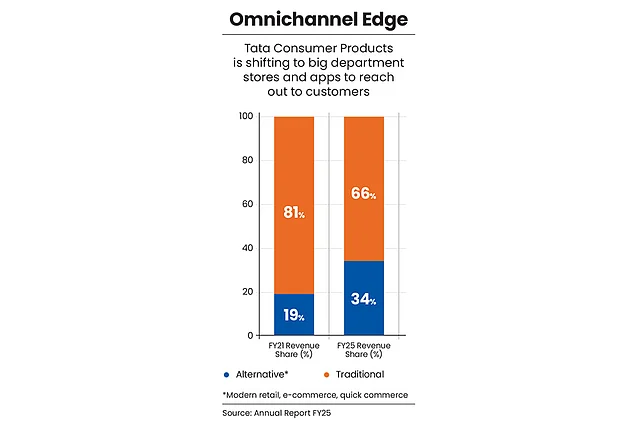
E-commerce’s revenue contribution at the time of merger was 2.5%. By late 2021, it was 7%, a growth of 130% in a single year. By 2024–25, it reached 14%, overtaking modern trade for the first time. By the third quarter of 2025–26, e-commerce and quick commerce together stood at 18.5%.
“I don’t think anyone else is in this ballpark,” says D’Souza. He is not wrong. HUL’s equivalent figure runs at 7–8%, Nestlé India’s at 8.5%. The company that almost missed the decade’s defining channel shift now leads it among its peers.
What makes the number more significant, according to Motilal Oswal, is TCPL’s margins on quick commerce are comparable to traditional channels, unlike most peers, who are seeing margin erosion on the platform.
The Tata group’s acquisition of BigBasket in May 2021 gave TCPL a window into how millions of Indians shop for groceries.
In an earlier earnings call D’Souza pointed out that BigBasket is a group company, not a TCPL asset. But within the group, he said, they were working closely to find synergies.
The channel shift also fits the company’s portfolio. Quick commerce skews toward the premium buyer: the person reaching for Himalayan rock salt at ₹100 rather than iodised salt at ₹30, Organic India’s tulsi tea rather than a commodity tea bag.
The premium end of TCPL’s portfolio, built over five years, is precisely what the fastest-growing channel wants. The mass business still dominates revenue.
Half-way Mark
In January 2021, D’Souza said, “If we get it right, the rewards would be endless. If we didn’t, we’d have to live with it for a long time.” Five years later, he rates himself “five out of 10”. Ask him what TCPL has that HUL and Nestlé don’t, and the answer is the four letters T-A-T-A.
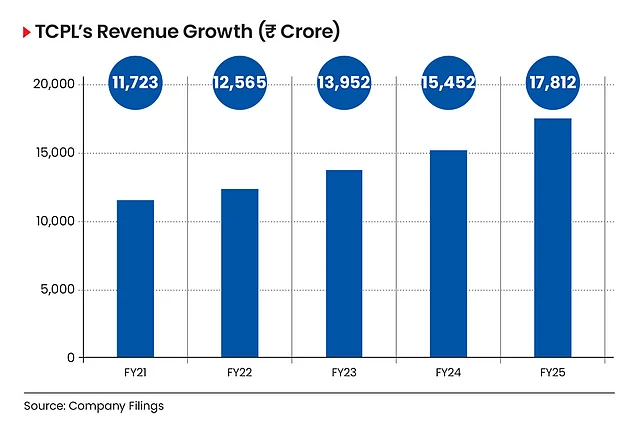
Here is what five out of 10 looks like. TCPL’s revenue has grown over 80% between 2019–20 and 2024–25. In annual terms, that is a compound rate of roughly 13%, faster than HUL’s 9.8%, Nestlé India’s 10.5% and ITC’s 9.7% over the same period, albeit off a smaller base.
TCPL reported a consolidated annual turnover of ₹17,618cr in 2024–25. Its operating margin, what survives from every rupee of revenue after paying for everything, runs at 14–15%. HUL’s is 23–24%.
Closing this gap requires high-margin businesses like Ching’s, Organic India, Soulfull, cold-pressed oil to grow fast enough to become roughly a third of total revenue. Right now, they are 8–9%.
Tea costs, which TCPL cannot control, need to normalise. Integration costs from the 2024 acquisitions need to wind down.
Motilal Oswal projects margins reaching 17% in three years. The path to 20%-plus, where HUL and Nestlé operate, is considerably longer than that.
Return on capital, how much profit a company earns on every rupee invested, tells the same story from a different angle. TCPL’s sits at roughly 10%. HUL’s is 27%. D’Souza points out that the core business, stripped of the 2024 acquisition capital, delivers 30%-plus.
The acquisitions are dragging the consolidated number while they are still being absorbed. Most analysts expect the trajectory to improve. The question is whether it does so within the timeline management has guided.
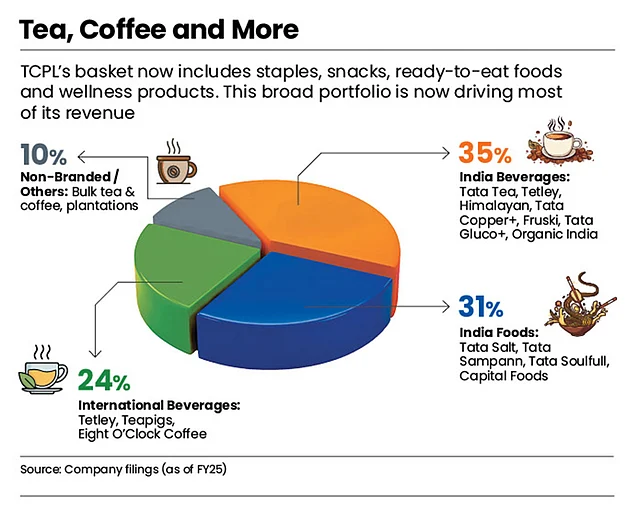
D’Souza describes the portfolio in three segments: the international business: Tetley, steady and cash-generative. The India staples: tea and salt, large but low-margin, subject to commodity costs he cannot control. And the growth businesses: Ching’s, Organic India, Soulfull and cold-pressed oil, which are small today but carry the highest margins and expectations.
“All three pieces need to come together,” says D’Souza.
“Each piece in the portfolio has a very specific purpose,” explains Krishnakumar. International for steady margins. Sampann for growth. Capital Foods and Organic India for both. “The headline target ties it together: a double-digit-plus topline and a bottom line growing higher than that,” he adds.
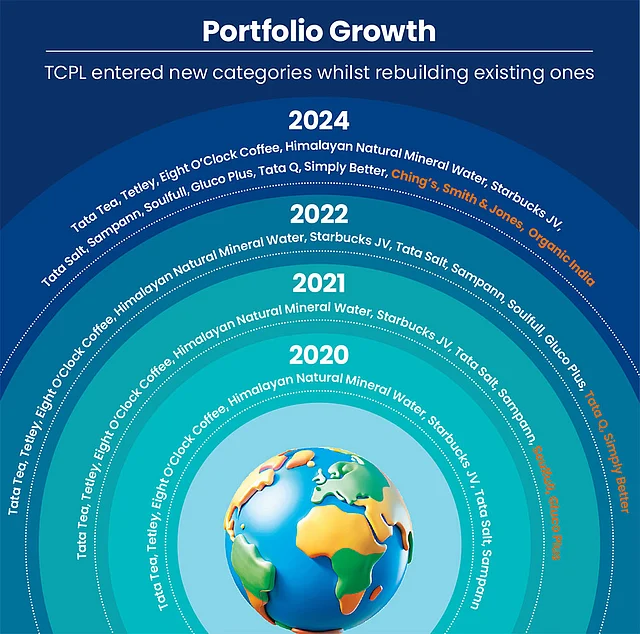
Today, the portfolio spans tea, coffee, water, ready-to-drink beverages, salt, pulses, spices, ready-to-cook and ready-to-eat offerings, breakfast cereals, snacks and mini meals.
However, the product range is in the food and beverages (F&B) universe. The company does not yet cover much else. “Without personal care or home care, TCPL is not yet a comprehensive FMCG powerhouse,” says Devangshu Dutta, founder of Third Eyesight, a boutique management-consulting firm.
Krishnakumar’s response is: “On a revenue basis, F&B accounts for nearly 80% of the FMCG universe. Outside of F&B, it requires a very different set of skills, a very different DNA.”
TCPL is not making bets in personal-care or home-care segments in the near future.
The Long Game
“There’s no magic breakout moment,” says Krishnakumar. What he points to instead are accumulations: salt crossing million packets a day, the stock market re-rating and the innovation pipeline turning out a new product every week.
The competition, however, is not waiting. HUL’s quick commerce is logging 3% of revenue, growing at over 100%. ITC plans to spend ₹20,000cr over five years with the bulk for foods. Nestlé is deepening its product pipeline.
These rival FMCG companies are now moving faster than they have in years. For TCPL, the race has gotten harder.
At the same time, these giant competitiors have their own challenges. HUL draws only 25% of its revenue from foods. Nestlé is concentrated in dairy and confectionery.
ITC, which is still moving away from tobacco, draws 40% of its revenue from packaged foods and personal care combined.
While these Goliaths have their attention split, TCPL’s focused approach is perhaps the one thing they cannot replicate. “In any category that we have a stake in, we would be among the top three brands,” says a confident D’Souza.
Six years in, the pieces are in place. “Our strategic road map and the strong foundation we have laid for the business have yielded good results…Our overarching ambition is to evolve into a full-fledged FMCG company,” Chandrasekaran said in TCPL annual report 2024–25.
Whether TCPL becomes big and matches his vision is a question the next six years will answer.
Within the Tata group, TCPL’s revenue ranking may not have moved much: eighth in 2019–20, seventh today. Both profits and market capitalisation have grown more than three times. It’s now worth over ₹1 lakh crore, nearly seven times Tata Chemicals, and more than double that of Tata Communications.
The market is not pricing what TCPL is. It is pricing what it might become. “Because if you’re not in the top three, there is no point,” says D’Souza. The man who chose to walk into the “sleepy company” is not done yet.
(Published in Outlook Business)
admin
February 18, 2026
Kartikay Kashyap, BrandWagon, Financial Express
18 February 2026
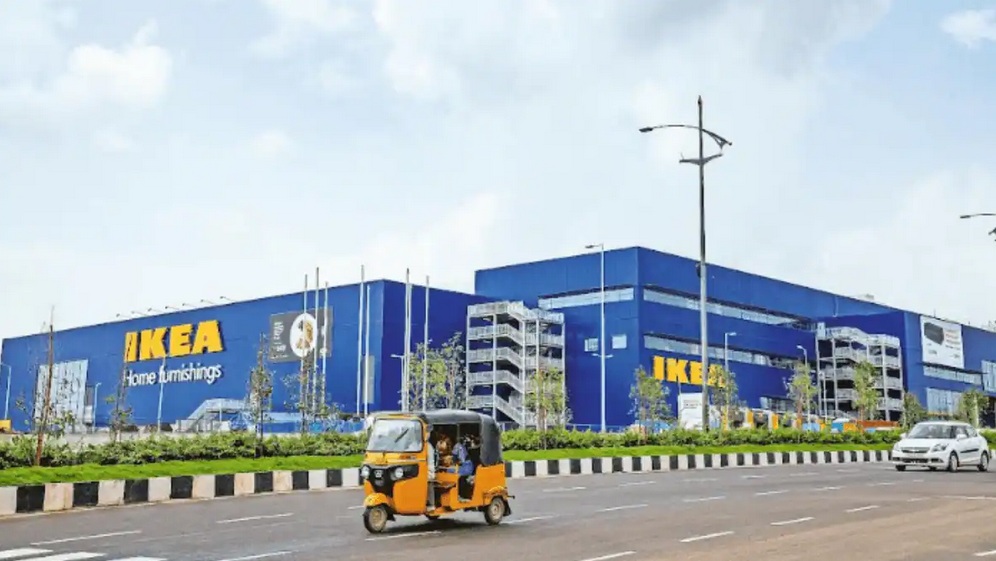
IKEA HAS BEEN around in India for about eight years, with another three years before that spent studying the market. It has developed a range that it deems “locally relevant-like the roti maker, the tava (pan), the belan (rolling pin), and the pressure cooker -which now constitute about 50% of the products it offers in the country. It has shifted its communication strategy to sync with local culture and fit into local spaces and has worked hard to beef up its omnichannel sales model with about 30% of its sales originating online. But profitability has remained elusive for the retailer whose global sales reached approximately €45billion in the 2015 financial year (FY25).
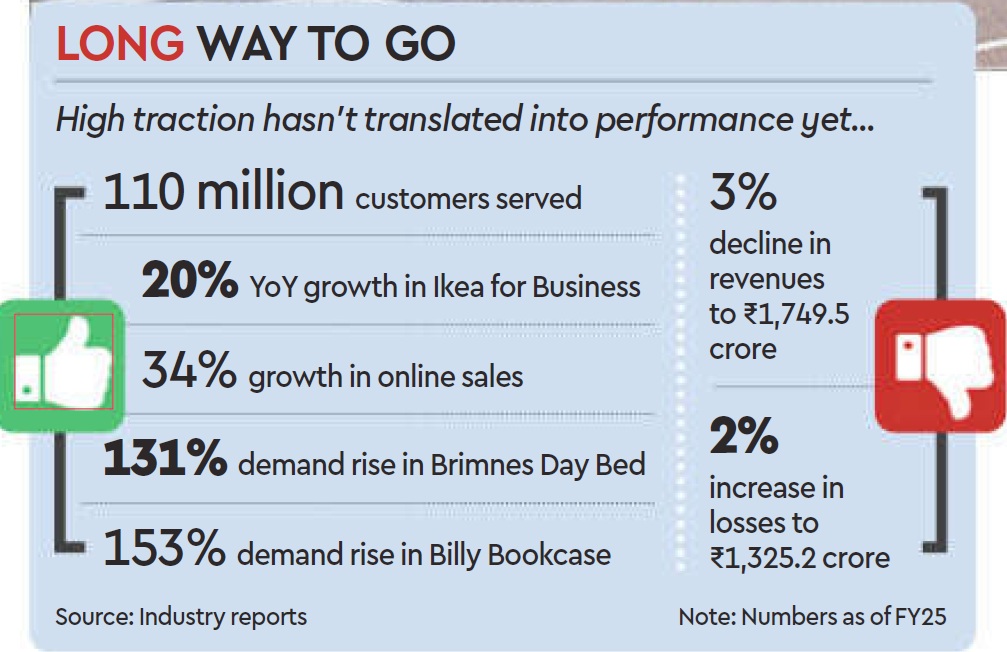
Just for context, the company’s India entity widened its losses by about 29 to 1,325.2 crore in the financial year ending March 31, 2025 (FY25). The revenue also dipped 3 to 1,749.5 crore from 1,809.8 crore in FY25.
So now the brand is taking a leaf out of its China playbook and tweaking its retail formats. Starting last year, it started piloting smaller store sizes ranging from 15,000-20,000 sq ft that are more cost-effective to set up and faster to integrate with its omnichannel model. “The goal is to create a simpler and more efficient shopping experience,” Ingka Group Retail Manager Tolga Oncu had said when the concept was unveiled last August.
Five months on, the furniture retailer is looking to take a step up the ladder – setting up new stores in the 50,000-70,000 sq ft range in the country, which will sit comfortably between its smaller stones (15,000-20,000 sq ft) and big box retail outlets (4 lakh sq ft), Adosh Sharma, country commercial manager at Ikea India told FE recently. Ikea’s broader plan also includes doubling its investments in the country to over 20,000 crore ($2.2 billion) over the next five years and improving local sourcing.
Will all this help the retailer grab a larger share of the highly fragmented furniture and furnishing market in the country? Will the brand achieve profitability in the next two years in keeping with its plans?
Ikea realises copy-pasting its global retail strategy in India is not going to work. That explains its recent moves to tweak store sizes and product design. Over and above the regular 5-M-L strategy, the fourth format the brand is developing comprises no-frills planning and order points, focused on customers who want to design homes or seek complex solutions without distraction.
“Smaller stores, which fulfill purpose-led needs will help them to get closer to their customers,” says Devangshu Dutta, founder & CEO, Third Eyesight.
The furniture and home decor segment has been up against slow purchase cycles in India. Smaller sized stores that are closer to residential arras might help step up the frequency of purchases. “Players are moving towards a higher purchase frequency strategy and smaller stores will help lkea cash in on this opportunity,” says Kushal Bhatnagar, associate partner, Redseer Consultant Strategy. He says quick commerce has helped improve the purchase cycle in the home decor space, and that is something Ikea will likely tap going forwand.
Dutta says Ikea has taken a long-term view on India and the investments in the pipeline is an indication of the opportunity that awaits players.
The brand claims it has served close to 110 million customers in FY25 across channels, and online sales are growing 34% compared to the previous fiscal. While furniture contributed the lion’s share of its revenue, the food business contributed 100% and Ikea for Business (tailored solutions for businesses) another 19% to its topline.
(Published in Financial Express)
