
admin
November 4, 2022
Christina Moniz, Financial Express / BrandWagon
November 4, 2022
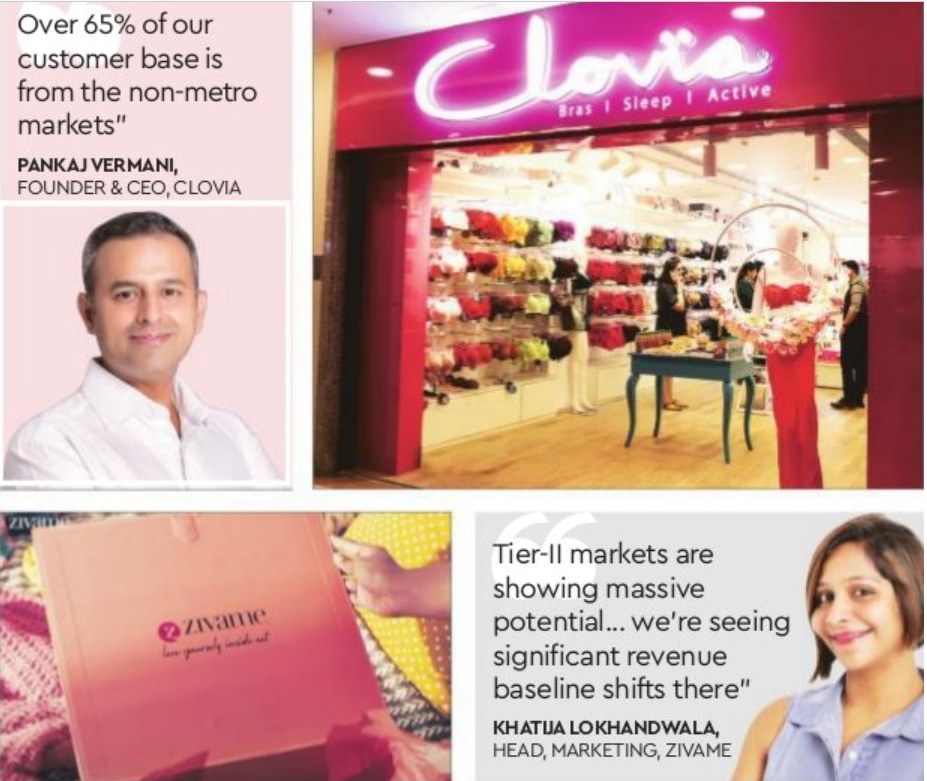
Direct-to-consumer (D2C) lingerie brands, often credited with transforming the category and the way women shop for innerwear, are expanding their offline footprint in response to growing demand from tier-II markets and beyond. Zivame, whose journey began online just over a decade ago in 2011, has grown its offline presence to over 120 stores and also sells through over 4,000 partner outlets. In its recently concluded Grand Lingerie Festival, Zivame saw its sales grow three times,with a 120% increase in new customer acquisition. “Tier-II markets are showing massive potential and though tier-1 remains our highest revenue contributor, we are seeing significant revenue baseline shifts in tier-II locations,” says Khatija Lokhandwala, head of marketing at Zivame. The company has announced that its focus will be retail expansion in the second half of this fiscal, going beyond metros and tier-I markets.
Another decade-old D2C player in the innerwear segment, Cloviais eyeing the immense opportunity presented by smaller markets with aggressive expansion plans in place. “Clovia currently has 45 exclusive brand outlets in the country and has been diversifying its product range, with plans to open 130 outlets by the end of this fiscal. Ours has always been a mass- market brand, and most of the repeat customers come from tier-II and tier-III markets,” explains Pankaj Vermani, founder and CEO, Clovia. He notes that over 65% of its customer base is from the non- metro markets, and average order values are 20% higher in these cities compared to the metros. Earlier this year, Reliance Retail Ventures acquired an 89% stake in Clovia’s parent company (Purple Panda Fashions) for Rs. 950 crore. Vermani adds that Clovia will ben- efit from the conglomerate’s scale and retail expertise, driving up growth and love for the brand. Reliance Retail had picked up 15% stake in Zivame back in 2020.
Shaping the market
The women’s innerwear market in India is set to double to reach $11-12 billion by 2025, according to a report by RedSeer. Aside from the key segments of bras and panties, ancillary products like athleisure, sleepwear, swimwear and lounge wear are also boosting the lingerie category’s growth in the country, as is evident from the widening portfolios of leading brands. The online segment for women’s innerwear is expected to become a $1 billion market by 2025.
Experts believe there is a large opportunity for companies to grow since 60% of the $6-billion women’s intimate wear market in India is unorganised, and the category is still largely underserved.
“The lingerie market is an example of improving supply feeding into a growing demand, and the increasing demand expanding the opportunity for more brands to step in. Larger cities, with their higher income profiles and demand concentration, are the logical first-choice market for companies such as Zivame,” points out Devangshu Dutta, CEO, Third Eyesight.
The competition in the large cities is greater, with a plethora of Indian and global brands, which is why Dutta recommends that e-commerce led companies should push aggressively in smaller markets to drive sustained growth.
The fact that D2C brands have better data sets at their disposal to glean insights about Indian women and their concerns when buying innerwear has also worked in their favour.
“Intimate wear shopping can be overwhelming for a lot of women. Finding the right size and choosing styles for their specific needs requires an environment free of embarrassment and judgement. At Zivame, we help women choose the right size and perfect fit, ensuring a private, comfortable and discreet shopping experience,” says Lokhandwala.
While lingerie can sometimes be prohibitively expensive, Vermani points out that Clovia’s feedback-led design approach helps it keep pricing competitive.
The brand creates each product in small quantities, and uses technology to predict future sales based on customer feedback, thereby determining the right quantities for production. He states, “With this approach, we have created a fashion brand that is low on cost, high on consumer appeal and efficient in inventory, leading to better margins and cash flows.”
(Published in Brandwagon, Financial Express)
admin
July 8, 2022
Akash Podishetty & Krishna Veera Vanamali, Business Standard
New Delhi, 8 July 2022
India’s $900 billion retail market has emerged as one of the most dynamic industries and is expected to reach anywhere between $1.3-$1.5 trillion by 2025. The organized retail is seen gaining 15% market share in the overall retail space, while food & grocery and apparel and lifestyle may account for 80% of India’s retail market by 2025.
Large market offers big opportunities. And it looks like Reliance Retail has seized it, with its massive omni-channel retail play of physical stores, B2B with kiranas and e-commerce.
The company went on an acquisition spree and partnerships in the last three years, adding to its portfolio some of the biggest names, including Hamleys, Dunzo, Zivame etc.
It has also partnered with famous global retail chain 7-Eleven. Catering to India’s affluent consumers, Reliance, meanwhile, houses some of the most iconic brands such as Versace, Armani Exchange, GAP, GAS, Jimmy Choo, Michael Kors among others. The premium segment has become one of the fastest growing categories.
Also firming up its inorganic play, the company is planning to acquire dozens of niche local consumer brands to build a formidable consumer goods business.
Arvind Singhal, Chairman and Managing Director, Technopak Advisors says, there’s focus on physical retail expansion. Reliance is looking to cater to both price conscious and brand conscious customers, while trying to capture as much of the private consumption market as possible, he says.
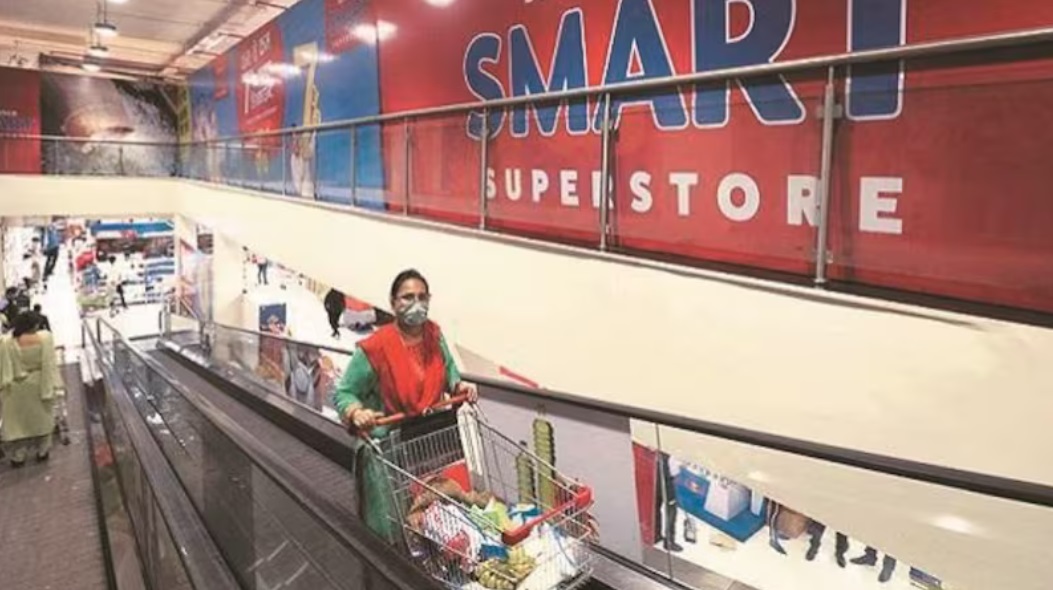
Reliance Retail’s competitors are nowhere close to even put up a fight. The company has over 15,000 offline stores across categories, compared with DMart’s 294 stores or Aditya Birla Fashion’s 3,468 outlets.
Reliance retail’s revenue has grown five times in the last five years and the core retail revenue of $18 billion is greater than competitors combined, according to a Bernstein report.
Speaking to Business Standard, Devangshu Dutta, CEO, Third Eyesight, says, Reliance wants a decent share of Indian consumers’ wallet. From that perspective, Reliance still has a long way to go, he says. As consumer preferences evolve, Reliance too should adapt.
An undisputed leader in the domestic market, the aim of Reliance, according to Mukesh Ambani, is to become one of the top 10 retailers globally. Part of this bet is based on the premise that incomes and consumption power of Indians will increase across the board in coming years. However, could the uneven recovery that different segments of the population have seen stop the pie from growing larger and prove to be a dampener for Ambani’s ambitions?
(Published in Business Standard)
admin
December 20, 2021
Written By Vaishnavi Gupta
The furniture brand’s retail roadmap includes city stores in Delhi, Mumbai and Bengaluru, followed by tier I and II towns

For the Ikea model to succeed, adequate demand-concentration is crucial, which is being currently provided by the bigger cities in India.
After launching two large-format stores in India in a span of three years — one each in Hyderabad and Navi Mumbai — Ikea opened its first small-format store in Worli, Mumbai, to become “more accessible and convenient”. About 90,000 sq ft in size, these ‘city’ stores are already present in markets such as New York, London, Paris, Moscow and Shanghai.
The furniture market in India stood at $17.77 billion in 2020, and is expected to reach $37.72 billion by 2026, growing at a CAGR of 13.37%, according to a Research and Markets report. Godrej Interio, UrbanLadder and Pepperfry are among the big players in this space, all with a significant online presence, too. Godrej Interio has 300 exclusive stores in India, while Pepperfry has more than 110 Studios.
Spread across three floors, Ikea’s first city store has 9,000 products in focus, of which 2,200 are available for takeaway and the rest for home delivery. “We have observed that it is not easy to find large retail locations in cities like Mumbai and Bengaluru. The small store offers convenience and accessibility for consumers to experience Ikea products,” says Per Hornell, area manager and country expansion manager, Ikea India. This launch is in line with the company’s aim to become accessible to 200 million homes in India by 2025, and 500 million homes by 2030.
More launches are being planned: another city store in Mumbai in the spring of 2022 and a large-format store as well as a city store in Bengaluru by the end of 2022. For its retail expansion in Maharashtra, the company plans to invest Rs 6,000 crore by 2030. “We are on track to exceed the investment commitment of Rs 10,500 crore made for India in December last year,” adds Hornell. Delhi, Mumbai and Bengaluru are the three cities on its radar at the moment, which will be followed by tier I and II towns.
Furthermore, Ingka Centres, part of Ingka Group that includes Ikea Retail, is coming up with its first shopping centre in Gurugram (followed by Noida), which will be integrated with an Ikea store.
In India, unlike its organised furniture market competitors, Ikea doesn’t have a pan-India online presence yet. It has been following a “cluster-based expansion strategy” for its online offering, but the company insists this is not a limitation. “At present, 30% of our overall India sales come from online channels,” Hornell informs. Through its e-commerce website and mobile shopping app, the company currently operates in Hyderabad, Mumbai, Pune, Bengaluru, Surat, Ahmedabad and Vadodara.
On the other hand, players like Godrej Interio and Pepperfry have big plans to tap new markets. The former aims to add 50 exclusive stores each year, while Pepperfry aims to achieve the 200 Studios mark by March 2022. In September this year, Pepperfry forayed into the customised furniture segment with the Pepperfry Modular offering, which focusses on modular kitchens, wardrobes and entertainment units.
Good start?
This is a good time for Ikea to establish its presence in the Indian market, says Alagu Balaraman, CEO, Augmented SCM. “Earlier, people used to rely on carpenters for furnishing their homes; now, they prefer to buy ready-made furniture. The market is moving towards acceptability, making plenty of headroom for growth for these companies,” he says.
Ikea’s cautious expansion approach in a market like India where several local dynamics are at play, is tactful, analysts say. Devangshu Dutta, founder, Third Eyesight, says, “In the past, Western businesses have made the mistake of simply copy-pasting formats and strategies in emerging markets from their more developed markets.” He believes there is “nothing wrong” in being incremental while growing footprint. “There’s no sense in carpet-bombing the market with stores, when many may end up being loss-making or sub-optimal,” he adds.
Getting the product mix and pricing right would be key in realising the full potential of this market. Balaraman says Ikea will have to balance its global portfolio with what it is doing locally, and make sure it is profitable.
For the Ikea model to succeed, adequate demand-concentration is crucial, which is being currently provided by the bigger cities in India. Given its global popularity, the furniture giant, analysts say, is poised to see traction in the metros and tier I cities.
Source: financialexpress
admin
June 7, 2020
Indian retailers welcoming customers back as stores are opening up – a look at what changes are in store.
admin
November 19, 2019
Written By Rasul Bailay

NEW DELHI: Jeff Bezos, the founder of Amazon, will visit India in January when he is likely to meet Prime Minister Narendra Modi. During his visit he will kick off the US retailer’s annual event around small and medium enterprises, which are perceived to be hurt by deep-pocketed ecommerce companies.
The world’s largest online retailer is said to be worried about the changing ecommerce rules in India, where the Seattle-based company has invested more than $5 billion and created one of its largest foreign subsidiaries.
Bezos comes calling amid protests by a group of small traders against foreign-funded ecommerce companies. The Amazon founder is expected to highlight that it is generating jobs in India and empowering SMEs and other small businesses, according to two people familiar with the matter. He will also raise aspects such as stable business environment and policy continuity for foreign companies, they said.
“We do not have any plans to share at present for this,” an Amazon spokesperson said in an emailed response to a questionnaire regarding Bezos’ upcoming visit.
The outcry against ecommerce companies escalated after the Diwali festive season, when small traders accused Flipkart and Amazon of “unfair business practices” and violation of foreign direct investment rules. They blamed the predatory pricing strategies of the two foreign-owned marketplaces for a slump in traditional retail business during Diwali.
Flipkart and Amazon generated combined sales of Rs. 31,000 crore ($4.3 billion) during the 15-day festival period in October, according to a report by Red Seer Consulting.
The government has been stepping up its scrutiny of Amazon and its India rival Flipkart over their compliance with India’s foreign direct investment laws for ecommerce marketplaces.
The commerce ministry had asked Amazon and Flipkart to furnish details including their shareholding, subsidiaries, business structure and information on their top sellers and their tax details.
Amazon and Flipkart have responded to the questions raised by the government and maintain that they are in full compliance with FDI legislation.
“It is a huge distraction for us,” a senior ecommerce executive said, asking not to be identified. Amazon has reasons to be nervous. The US giant considers India its fastest-growing market with a potential to reach $10 billion in gross merchandise value and outpace the UK, Germany and Japan as its largest overseas subsidiary. In October, Amazon pumped in Rs. 2,800 crore into the flagship Amazon, in marketplace after injecting Rs. 9,450 crore in the unit last year.
So far, Amazon has invested more than $5 billion in India. “The various twists and turns in policies and caveats over the years have created ambiguity and room for interpretation as to what is allowed under the ambit of foreign investment,” said Devangshu Dutta, CEO of retail consultancy Third Eyesight.
“If any foreign-owned or foreigninvested entity is operating in the fuzzy zones of policy and law, there is bound to be concern. ‘Interpretation’ is a double-edged sword — on the plus-side it can give businesses strategy flexibility, but the downside is that government officials can also interpret it strictly.”
In October, Walmart CEO Doug McMillon had written to Modi, seeking certainty and a predictable business environment in India.
Last year, Walmart had purchased Flipkart, India’s largest ecommerce entity, for $16 billion, bringing the US adversaries to a direct fight over market share in the nation’s burgeoning online retailing market.
Following Walmart’s acquisition of Flipkart, India amended the FDI rules for online marketplaces in December, plugging many holes that Amazon and Flipkart are alleged to have misused. Opponents of foreign-funded ecommerce accuse both the global titans of virtually running inventory-led ecommerce, which India bars.
The legislation called Press Note 2 restricted bulk purchases by any vendor from any entity or group company of marketplace to 25%. The rules banned any financial affiliate of the marketplace operator from selling on such platforms. These changes came as blows to Amazon and Flipkart as they either sold through partner entities or through independent vendors that sourced directly from wholesale units related to the FDI-funded
Source: economictimes
