
admin
September 1, 2026
Vikash Tripathi, Outlook Business
1 September 2026
Eight decades ago, the ‘nationalist businessman’ GD Birla helped prepare the ‘Bombay Plan’, which asked the state to pro-vide for the bare minimum needs of its people. His plan asked for 2,800 calories of well-balanced food per day, 30 yards of clothing per year and 100sq ft of housing per person.
Today, seventh-generation Aryaman Vikram Birla is betting on an entirely different opportunity: premium dining. “We continue to believe in the remarkable potential of the premium casual dining space, spurred by rising disposable income and evolving lifestyles,” the 29-year-old said after Aditya Birla New Age Hospitality acquired KA Hospitality in 2023.
The Birlas are not alone in trying to cash-in on rising prosperity in India. In the past five years alone, India’s top 10 industrial groups have announced new ventures in consumer-facing sectors or doubled down on existing ones. A rough tally of these investments crosses ₹4.8 lakh crore.
For decades, these same business houses built their dominance in core sectors like steel, power, aluminium, cement and chemicals, laying the industrial backbone of the economy. This helped the nation become a large producer of such goods and, in some cases, an exporter as well.
But as India’s economic conditions changed, so has the focus of its largest conglomerates.
For the likes of Tata, Aditya Birla, Bajaj and Bharti, that journey started way back. “What has changed in recent years is the speed and openness of the amount of capital being invested,” says Jitender Kumar, associate professor and programme chairperson, retail management programme at Birla Institute of Management Technology.
“It is not ‘opportunistic’ reasons, it’s structural reasons.”
Two factors seem to be driving the shift: the first is the arrival of an affluent consuming class that can buy branded and premium goods, and the second is the attraction of consumer businesses as a way to diversify revenue and, in some cases, improve the quality of earnings.
The Rise of Affluence
A couple of decades ago, if an Indian household had some extra cash, it often meant buying more of the same. Today, it increasingly means buying better. Even salt is being upgraded, from iodised to Himalayan pink or rock salt. The same shift is visible in bigger purchases: sports utility vehicles (SUVs) over hatchbacks, and ₹1cr-plus homes over budget flats.
But India isn’t simply consuming more. It is moving from basic consumption towards discretionary, branded and premium consumption. This boom is most clearly seen in the rapid expansion of the financial infrastructure that enables consumption. Formal retail credit penetration has more than doubled over the past decade, according to a TransUnion Cibil report, driven largely by personal loans, credit cards and consumer durable loans. Meanwhile, the government-backed Unified Payments Interface has untethered spending from the cash in a buyer’s wallet.
The signs show up across the broader consumption economy. Homes priced above ₹1cr accounted for 54% of total sales in 2025, up from just 30% in 2023—the market that decorative paints and home solutions are chasing.
Out of 4.7mn cars sold in the financial year 2025–26, SUVs accounted for more than half.
“The consumer market has grown substantially—not only through rising incomes but also the dramatic expansion of branded consumption across product verticals,” says Devangshu Dutta, founder of management-consulting firm Third Eyesight.
The bets are also getting more varied, from Reliance Retail tying up with global brands like Fenty and Skims to the Bharti Group bringing Olive Garden to India.
The Lure of Returns
For a passenger walking through an airport, the flight is only one part of the journey. There is coffee before boarding, food between flights, a lounge, retail outlets, parking and a host of other things to spend money on. For Adani Airports, those non-aero businesses are increasingly becoming the more lucrative part.
Its non-aero operations already generate about ₹2,500cr, with returns in the high-20% range, against roughly 12% from regulated aeronautical operations.
Jeet Adani, director of Adani Airport Holdings, expects the share of aeronautical revenue to fall to around 10% of total revenue, with non-aero becoming the bigger growth driver. The motivation can be seen as an escape from a return ceiling as much as a bet on rising affluence.
As Kumar puts it, consumer businesses help the conglomerates in two major ways. First, they help insulate them from volatile and often punishing commodity cycles, and second, they often offer far better returns with lower capital intensity and faster cash conversion.
Reliance Industries (RIL) shows how significant that shift can become. By 2025–26, its consumer-facing arms, Jio Platforms, Reliance Retail Ventures and Reliance Consumer Products, together contributed over 40% of group revenue and nearly 60% of operating profit.
And there is another advantage. “A small business, when it wants to build a new venture, faces constant margin pressure and often has to build its supply chain from scratch. A large conglomerate can leverage its existing scale, infrastructure and supply chain to enter a new business far more efficiently,” explains Kranthi Bathini, equity strategist at WealthMills Securities.
Different Strokes
In chasing consumers, some conglomerates are following the fastest-growing categories, while others are using their existing industrial capabilities to enter consumer-facing businesses. One is trying to build an entire ecosystem around it. But the lines between these approaches are not always clean.
Tatas is doing both: building entirely new consumer brands while also using the industrial ecosystem it has built over decades.
For Tatas, the consumer opportunity has largely been about following where spending is moving. Their consumer ventures have followed this arc longest. It began decades ago with Lakmé (1952), Tata Tea (1962) and Titan (1984). Tanishq and the expansion of Trent under brands such as Zudio are only the latest examples.
At Tata Consumer Products, once largely a staples business built around salt, tea and pulses, the focus has been shifting towards value-added foods and beverages, with ₹7,000cr spent on the acquisitions of Capital Foods and Organic India in 2024. Across companies such as Tata Digital, Indian Hotels, Air India and Tata Motors Passenger Vehicles, the group has announced close to ₹93,180cr in investment over the past five years.
Aditya Birla’s jewellery chain Indriya and its move into premium hospitality belong to the same category of ‘pull-based’ diversification.
JSW is taking a different route. It is taking its existing industrial strengths one step closer to the buyer. The group, which has traditionally been focused on areas such as steel, energy and cement, has expanded into consumer-facing areas such as auto, paints and home solutions.
It launched JSW Paints in 2019, and acquired a controlling stake in paintmaker AkzoNobel India for ₹8,986cr last year. Its strategy is to leverage an established network of contractors, dealers, architects and builders to reach consumers.
The same strategy can be seen in its push into autos, acquiring a 35% stake in the Indian unit of China’s MG Motor in 2024, leveraging synergies with its established steel business.
At Tatas, too, group companies like Tata Steel, Tata Power, Tata AutoComp, Tata Technologies and TCS are doing significant businesses with Tata Motors.
Adani is also using an asset it already controls to move further into the consumer’s wallet. Adani Airports announced a ₹20,000cr investment in June to develop hotels, retail, entertainment and commercial infrastructure around its eight airports, and has signed hotel management agreements with IHG Hotels & Resorts for five hotels. City-side developments could contribute 30–40% of Adani Airport Holdings’ non-aero revenue.
Yet another example of the extension strategy is Aditya Birla Group’s attempt to diversify from cement, metals and textiles into decorative paints with Birla Opus.
RIL took a different approach: trying to connect multiple consumer businesses into one ecosystem. It expanded its retail network through new formats and acquisitions, added brands and partnerships, and then built a consumer-goods business around acquisitions such as Campa Cola and Lotus Chocolate.
That expansion was helped by billions of dollars raised by both Jio Infocomm and Retail Ventures from foreign investors in 2020. The group now plans to spend another ₹8,000cr expanding consumer goods manufacturing. The advantage of having that kind of scale is clear. If RIL has Ajio at a mall and, next to it, GAP and Herschel, it can negotiate better rental terms.
For conglomerates, Kumar points out, the next level of competition will not be based on investment, “but on the ability to create different consumer experiences, foster innovation and create lasting brand loyalty through the integration of these capabilities”.
Can Scale Win?
When Reliance Fresh opened its first stores in 2006, it was part of a rush by some of India’s biggest business groups to crack organised retail. Aditya Birla Group, RP-Sanjiv Goenka Group’s Spencer’s and Kishore Biyani’s Future Group were all betting that organised retail could transform the way Indians shopped. What followed was years of experimentation, losses and, for some, eventual retreat.
Birlas essentially gave up on grocery retail after a decade of heavy losses and exited entirely.
Future was pushed into insolvency after a controversial ₹24,713cr deal with RIL. Spencer’s is still trying to find its footing, with ₹249.33cr in net losses in 2025–26.
Conglomerates may have deeper pockets, but that does not automatically make them better at selling to consumers. India has seen some of those bets fail or take years to work. And even among today’s biggest players, the results are still mixed.
Tata Sons has been in this segment longer than the Ambanis, yet its consumer businesses still make up less than 40% of its total revenue —a share that has not changed since 2020.
These groups have what most standalone consumer companies don’t: capital, distribution, infrastructure, brands, scale.
But winning consumers takes something else entirely—reading what people want, building brands, innovating fast and earning loyalty.
“In B2B [business to business], it’s about manufacturing at scale, getting your costs down. Then you can compete. In B2C [business to consumer], it’s all about the product. With the right product at the right price, you have a chance to win in the market,” Parth Jindal, managing director of JSW Cement and JSW Paints, told Outlook Business in 2025.
Tata Sons’ chairman N Chandrasekaran hit the same wall while revamping the group’s consumer unit. “I have the money. But I don’t have the team to run it,” he had told Sunil D’Souza while hiring him to lead Tata Consumer Products in 2020.
Reliance and Tatas have had the longest head start, but even their journeys show how difficult it is to turn scale and capital into consumer businesses. Birla, JSW and Adani are now trying to make that transition in their own ways.
A longer tail—Bajaj in hospitals, L&T in retail finance and education, Mahindra in insurance and hospitality, Murugappa in electric mobility—is playing it safer, going deeper into what it already owns rather than chasing new categories.
What ties them together is a bet on consumers buying not just more but better, and on those consumers being worth more per rupee of capital than the industrial customers who built these houses.
The prize is growing, but so is the competition. Capital and scale may get these conglomerates through the door. They won’t guarantee a seat at the table.
(Published in Outlook Business)
admin
June 12, 2026
Aanya Thakur & Writankar Mukherjee, Economic Times
12 June 2026, Mumbai/Kolkata
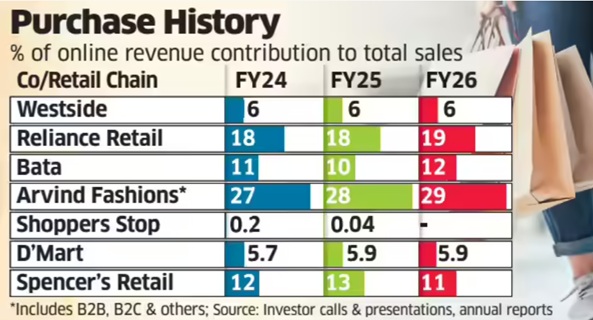
India’s leading retail chains have seen the share of e-commerce in total sales either remain flat or edge up by a sluggish 1-2 percentage points over the past four-five years despite a sustained push towards omnichannel retailing.
An ET analysis of eight major retailers-market leader Reliance Retail, Shoppers Stop, Westside, Arvind Fashions, DMart, Spencer’s Retail, Pantaloons and Bata-showed that the contribution of e-commerce to overall revenue has seen minuscule improvement since 2021-22 even as online sales continue to increase in absolute terms. By contrast, the Covid-19 pandemic spurred explosive growth, with the share of digital sales in total revenue surging three to four times in 2020-21 and 2021-22.
Industry executives attribute the slowdown partly to lower investment levels compared with pure-play digital firms such as Amazon, Flipkart, Swiggy and Blinkit-parent Eternal. Besides, retailers have consistently maintained that they will not pursue online growth at the expense of profitability, keeping prices largely aligned across online and offline channels.
The ET study found Tata-owned Westside’s online contribution stood at 7% in 2021-22 and thereafter remained around 6% till 2025-26. Reliance Retail’s online share ranged between 17% and 19% during the period, while Bata’s remained at 10-12%.
For DMart, e-commerce accounted for 5-6% of sales, while Shoppers Stop’s online arm, Shoppers Stop.Com (India) Ltd, contributed less than 1% to the consolidated revenue between 2021-22 and 2024-25. The company has not disclosed 2025-26 online sales figures yet.
“The DNA of these retailers is rooted in the physical world-infrastructure, processes and systems are not inherently designed for e-commerce, which requires a different operating model,” said Devangshu Dutta, chief executive of consultancy Third Eyesight.
“Most retailers calling themselves omnichannel are effectively multi-channel. Online retail is capital-intensive and hyper-competitive. Given the significant scope for physical store expansion, especially in tier-2 and tier-3 cities, retailers are reluctant to invest aggressively online,” he said.
Even so, Avenue Supermarts, which runs DMart, invested Rs 150 crore in online grocery platform DMart Ready this week, following a Rs 174-crore infusion a year earlier.
By comparison, Eternal infused Rs 2,600 crore into Blinkit in 2025 and another Rs 450 crore in March this year. Similarly, Swiggy approved a Rs 1,000-crore investment in supply-chain subsidiary Scootsy last year as both companies expanded their dark-store networks.
The chief executive of Aditya Birla-owned departmental chain Pantaloons, Sangeeta Tanwani, recently told analysts that online sales accounted for just 3-4% of the business. She said the company had earlier refrained from investing in the channel because profitability remained elusive.
“But over the last year, we called out omnichannel as one of our priorities… The reason why we had paused that business was because we wanted to make sure that we can get the unit economics right and make this business profitable… With all the shifts we have made this year, we feel confident of scaling up this business,” Tanwani said.
Reliance Retail, meanwhile, reported lower earnings before interest, taxes, depreciation and amortisation (EBITDA) margin growth in both the January-March quarter and entire 2025-26 as investments in quick commerce weighed on profitability. Chief financial officer Dinesh Taluja recently told analysts that margins depend on the pace at which online and business-to-business segments grow relative to the core offline business.
“If we slow down online growth, margins will improve. It is a mix as far as the online business continues to grow faster,” he had said.
An industry executive said the online contribution may go up modestly in this financial year due to high investment in scaling up dark stores for quick commerce.
Queries emailed to Reliance Retail did not elicit a response till press time. The company had in December last year appointed former Flipkart executive Jeyandran Venugopal as its new chief executive for the retail business.
(Published in Economic Times)
admin
December 1, 2025

Priyamvada C, Mint
1 Dec 2025
A wave of investor capital is flowing into India’s laboratory-grown diamond (LGD) segment, as fastscaling brands tap rising consumer adoption in a market now worth well over $300 million. New-age brands have raised multiple rounds of capital on the back of growing market share and improving margins.
Actor Shilpa Shetty-backed Limelight, which is in talks to raise its second round of capital this year, joins the growing list of other small brands such as Onya, Giva, Jewelbox, Lucira Jewellery and Aukera, among others, who have snagged monies in recent months. Limelight has appointed Ambit Capital to raise about $20 million to fund its expansion plans, two people familiar with the matter said.
Confirming the fundraise, the six year-old company’s co-founder Pooja Madhavan said the funds will be used towards store expansion and brand building as it looks to touch 100 stores over the next year. “We are in final talks with growth PE funds and reputed family offices (for the fundraise),” she told Mint.
Other similar fundraises include Onya’s ₹5.5 crore in a pre-seed round led by Zeropearl VC last week, Aukera’s $15 million raise led by Peak XV Partners and Aditya Birla Ventures-backed Giva raised ₹530 crore in an internal round led by Premji Invest, Epiq Capital and Edelweiss Discovery Fund, as it looks to scale up its lab-grown diamond offerings.
Nine pure-play lab grown diamond startups collectively raised a record $26.4 million in 2025, compared with $4.7 million across eight startups last year, data from market intelligence provider Tracxn showed.
The development comes as India’s lab-grown diamond jewellery market, valued at about $300-350 million in 2024, expects to grow at a compound annual growth rate (CAGR) of 15% over the next decade, as per consultancy firm Redseer’s estimates. As the market evolves, several prominent jewellery brands will gradually pivot from exclusively natural/mined diamonds in favour of lab-grown alternatives, alongside high-end jewellers incorporating the lab-growns into their select collections, which will drive sales volumes and act as an affordable entry point for consumers.
This segment has particularly picked pace in the last five years, with millennials and gen Z leading this shift, driven by better value, trendier designs from new-age brands, and growing comfort with lab-grown diamonds as a certified, high-quality product. This category has also widened beyond occasional fashion to gifting, daily wear and increasingly bridal, reflecting sustained consumer confidence and a willingness to treat them as a mainstream jewellery option, Rohan Agarwal, partner at Redseer told Mint in an emailed statement.
He further added that new-age brands have steadily gained market share in the mid-ticket gifting and daily wear segment with many trying to push into premium ranges. While the competitive landscape is still evolving, incumbents have already started responding by launching LGD lines of their own, although the extent to which they can challenge remains to be seen.
Major Indian brands that are considering a foray into this category include Malabar Gold & Diamonds, Senco Gold, which has launched the subbrand Sennes and Tata’s Trent, which launched its brand Pome in Westside stores.
Devangshu Dutta, founder and chief executive officer at Delhi-based consulting firm Third Eyesight, echoed the sentiment. He explained that new-age lab grown diamond players are forcing traditional jewellers to introduce LGD options or risk losing younger customers. “Not just precious jewellery brands, even those that started as fashion jewellery are expanding their range with LGD designs.”
“Down the road, there is potentially scope for consolidation as investors tend to prefer a handful of scaled platforms with strong brand recall and robust economics. So, as the category matures, there may be strategic acquisitions by large jewellery houses and corporates, as well as mergers among funded startups,” he added.
Those startups that can combine in-house manufacturing, design capabilities and data-driven retail expansion would be at an advantage, Dutta said. “Key future growth areas for LGD startups include omnichannel retail presence within India, with offline stores especially in demand-dense locations such as the metros and Tier 1 cities, export markets both with potential cost advantages and brand expansion, and extending into fashion jewellery, everyday wear, coloured lab grown stones and even luxury collaborations that position lab grown as aspirational rather than merely budget friendly.”
(Published in Mint)
admin
September 5, 2025

Shalinee Mishra, Exchange4Media
5 September 2025
Retailers in India are waking up to a hard truth: customer acquisition can no longer ride on advertising alone. Digital ad spends grew by 14-17% in 2024, touching nearly ₹50,000 crore (as per Pitch Madison report) and accounting for 46% of India’s total ad market. But with customer acquisition costs (CAC) rising 30-35% year-on-year and consumer attention fragmented across platforms, the ad-first growth engine is showing strain. What is emerging instead is an ecosystem where content in the form of video, celebrity-led storytelling, or creator-driven engagement is becoming the direct funnel to commerce.
Flipkart for instance is building influencer production hubs and embedding shoppable videos, Myntra has rolled out its video-first Glamstream, and Amazon has long blurred the line between streaming and shopping through Prime Video and Fire TV. From short videos to celebrity gossip, from beauty blogs to shoppable livestreams, e-commerce giants are no longer just marketplaces; they are evolving into media houses and the trend is only growing.
According to Mindshare’s latest Content Trend Report, India’s branded content marketing industry is now worth ₹10,000 crore, growing at nearly 20% annually, with video formats making up almost half of all spends.
India already has over 270 million online shoppers, a number that Bain projects will rise to 350 million by 2027, making it the world’s second largest e-retail user base. That scale is creating fertile ground for shoppable video and live commerce to take off.
Globally, branded content spend is projected to cross $500 bn by 2027. As per PwC estimates, India’s share is still <2% but among the fastest growing.
Video commerce today largely follows two prominent models. The first is driven by social platforms such as YouTube, Instagram, and Facebook, where shoppable posts allow users to move directly from content to purchase. The second is led by e-commerce platforms like Amazon, Myntra, Nykaa, and Flipkart and others which have added video sections to create immersive shopping experiences within their apps.
Within this, live commerce has emerged as a high-potential format. Meesho and Flipkart, for example, are leading the charge with 2-3% conversion rates, generating an estimated $150-200 million in GMV during festive 2024. Events like Flipkart’s Big Billion Days show how timed livestreams can capture active, purchase-ready audiences.
Meanwhile, influencer-led short videos are driving conversion rates as high as 63%, with beauty and personal care (BPC) and food & beverages (F&B) among the top categories benefiting from this shift. Redseer projects India’s live commerce market could touch $4-5 bn GMV by 2027, up from less than $300 mn today. This surge in shoppable video and live commerce is only the surface of a deeper structural change, one where content itself is becoming the moat that protects brands from rising ad costs, fragmented attention, and fickle consumer loyalty.
Beyond ads: Why content has become retail’s strongest defence
Chirag Taneja, co-founder of e-commerce enablement company GoKwik, framed the trend as a fundamental shift in ownership.
“It’s not just about enhancing top-of-funnel reach, it’s about owning demand, connection, and the touchpoint with end shoppers. For years, brands relied on ads to bring traffic. But acquisition costs have been rising, attention is fragmented, and privacy shifts have made targeting difficult. That’s why content is now the moat. When companies acquire content firms, they’re not just buying eyeballs, they’re securing access to communities that trust and engage with that content.”
According to him, content is collapsing the traditional funnel. “One short video or livestream can take a consumer from awareness to purchase in under a minute. That’s why we see D2C brands treating content as a compounding asset, not just an expense,” he added.
Devangshu Dutta, founder and CEO of management consulting firm Third Eyesight, echoed the sentiment.
“Large companies are buying or partnering with content-driven platforms to capture attention beyond transactional touch points. Short video, regional language content, and influencer-driven discovery are embedding commerce within entertainment. If you want to sell more than a commodity, storytelling is critical. Content builds credibility, differentiation, and trust in a cluttered and price-sensitive market.”
Flipkart bets big on media and creators
The shift is already reshaping strategy at India’s biggest retailers, and Flipkart has moved fastest. Its move to acquire a majority stake in Pinkvilla, a platform built on entertainment and celebrity news signals a clear push to deepen ties with Gen Z and millennials, a cohort that consumes content first and shops later.
“Our acquisition of a majority stake in Pinkvilla is a critical step in our mission to deepen our engagement with Gen Z. Pinkvilla’s robust content IPs and strong connection with its loyal audience base are assets that will accelerate our efforts to leverage content as a key driver of growth,” said Ravi Iyer, Senior Vice President, Corporate at Flipkart.
Flipkart in the last year has exited investments in companies like Aditya Birla Fashion & Retail, where it sold its 7.5% stake in the owner of Pantaloons, Van Heusen, Louis Philippe and Forever 21, as well as BlackBuck, the trucking marketplace that powers India’s mid-mile logistics.
At the same time, the company has doubled down on content and creators. Its Pinkvilla acquisition gives it access to a platform reaching over 60 million monthly users, while in-house features like Flipkart Feed already clock 5–6 million daily video views, highlighting how commerce and content are converging at scale.
Alongside this, Flipkart has launched Creator Cities in Mumbai, Bengaluru and Gurgaon, production hubs designed for influencers to shoot and scale shoppable content.
It has also introduced Flipkart Feed, a TikTok-style vertical video feature embedded in its app, offering bite-sized, influencer-led, fully shoppable videos. Myntra, its fashion arm, has developed Glamstream, with more than 500 hours of video-first shopping content across music, beauty, travel and weddings, featuring stars like Badshah, Tabu, Zeenat Aman and Vijay Deverakonda.
Flipkart has also partnered with YouTube Shopping, allowing creators with over 10,000 subscribers to tag Flipkart products in videos, Shorts and livestreams, enabling viewers to buy directly while creators earn commissions.
Amazon’s head start in content-commerce convergence Flipkart is not alone. Its biggest rival Amazon has long understood this convergence. Through Prime Video and its original programming slate, Amazon has built an entertainment ecosystem that doubles as a commerce funnel. The shows and films on Prime do not merely entertain; they drive shopping behaviour, influence trends, and lock audiences into Amazon’s larger universe of services. With Fire TV and Alexa integrations, the company has blurred the line between watching and buying, a model others are now racing to replicate.
D2C brands treat content as growth engine
Closer home, the Good Glamm Group, now closed, had pioneered a content-led commerce ecosystem in beauty and personal care. Through acquisitions like ScoopWhoop and MissMalini Entertainment, the group stitched together a portfolio where content platforms brought in audiences, who were then nudged towards its direct-to-consumer brands.
This “editorial-to-checkout” model demonstrated how cultural capital could be translated into purchase pathways. Alibaba has taken the strategy global. With stakes in Youku, a leading video-streaming platform, and Alibaba Pictures, the e-commerce titan integrates entertainment with retail operations. Taobao Live has shown how livestream shopping can dominate consumer behavior, particularly inAsia, creating billion-dollar shopping events entirely dependent on
entertainment-driven discovery.
Shopify, meanwhile, has invested in tools that empower merchants to become content creators themselves. Its partnerships with agencies like Sanity and investments in platforms such as Billo reflect a clear intent to enable retailers to embed storytelling, gamification, and user-generated content into their selling journey. Unlike large marketplaces, Shopify’s vision is not to own the content but to democratize access to it for small and mid-sized businesses.
From content to commerce
This content includes newsletters, creator partnerships, branded podcasts, and niche communities on social media. The idea, as industry experts note, is to treat content as an asset that compounds, not just as a cost.
Unlike ads, content continues to generate discovery and engagement long after it’s published. That’s why more D2C brands are making content central to their growth strategies.
Several big names are experimenting in this space. Durex, Plum, Mother Dairy, and HDFC Bank have launched their own podcasts where celebrities share stories along their brand journey. Founder-led podcasts too are on the rise on YouTube, with voices like Nitin Kamath and Deepinder Goyal drawing large audiences in India.
The big question, however, is whether content consumption can effectively be converted into product discovery and purchase pathways. “It’s already happening at scale,” said Taneja. “Content is redefining every aspect of the traditional funnel. In the past, you had awareness at the top, intent in the middle, and purchase at the bottom. Today, one short video or live stream can take a consumer through that entire journey in under a minute.
“From a D2C lens, this convergence is even more critical. D2C brands thrive on agility, the ability to turn trends, storytelling, and community engagement directly into sales. Platforms like Instagram, YouTube, TikTok, and even WhatsApp have embedded shoppable features, which means the content is no longer just ‘top-of-funnel.’ It’s the storefront. But the magic lies in authenticity and design. Consumers don’t want to feel ‘sold to’, they want to feel entertained, inspired, or educated. If the content does that well, conversion becomes a natural byproduct. For example, an athleisure brand showing a workout routine isn’t just demonstrating leggings, it’s giving value. The leggings purchase becomes an easy next step, not a forced pitch.”
The big question: Will content sustain sales at scale?
Taneja further reveals how content is driving sales and long-term growth. “The smartest brands, especially in D2C, have realized that high-quality
content is their most defensible growth engine. Performance marketing will continue to play a role, but the real long-term moat is the kind of content that builds relationships, trust, and recall. Consumers today are spoiled for choice. They don’t buy just products, they buy stories, values, and communities.
“High-quality content allows a brand to consistently show up in ways that feel relevant and credible. And from a business lens, it directly impacts unit economics: it reduces CAC because organic discovery compounds over time, improves LTV because content nurtures loyalty and repeat purchases, and builds resilience because brands with strong content ecosystems are less dependent on fluctuating ad platforms.”
The D2C ecosystem in India is already proving this point. Beauty and personal care brands now run editorial-led platforms alongside commerce, while fashion labels thrive on creator collaborations and storytelling-driven product drops. Their growth is not accidental but built on content strategies that treat every piece not just as a post, but as a business driver.
As an enabler, Taneja adds, the results are visible across platforms. “Brands that invest in content see better conversions on our checkout stack, lower cart drops, and stronger repeat cohorts. Content doesn’t just spark sales it sustains them.”
For all the optimism, the test for content-driven commerce will lie in scale and sustainability. Rising conversions in beauty, fashion, and food show the model works, but questions remain on whether every category can replicate that success, or whether consumers will tire of content-heavy shopping pitches.
(Published in Exchange4Media)
admin
August 31, 2024
MG Arun, India Today
Aug 31, 2024
Nearly five years after the Centre brought in norms to rein in multinational e-commerce companies operating in India, Union commerce minister Piyush Goyal sparked fresh controversy by raising concerns over the rapid expansion of e-commerce. He also drew attention to the pricing strategies used by some e-commerce firms, questioning what he termed “predatory pricing”.
“Are we going to cause huge, social disruption with this massive growth of e-commerce? I don’t see it as a matter of pride that half our market may become part of the e-commerce network 10 years from now; it is a matter of concern,” Goyal said at an event in New Delhi last week.
His comments come at a time when the ecommerce business in India is growing exponentially. Estimated at $83 billion (around Rs 7 lakh crore) as of FY22, the market is expected to grow to $150 billion (Rs 12.6 lakh crore) by FY26. The growth will be due to multiple levers: a growing middle class, rising internet penetration, the proliferation of smartphones, convenience of online shopping and increasing digitisation of payments. The overall Indian retail market was pegged at $820 billion (Rs 69 lakh crore) in 2023, according to a report published by the Boston Consulting Group and the Retailers Association of India. E-commerce still comprises only about 7 per cent of that, as per Invest India.
The Indian e-commerce market is dominated by global giants, including Amazon and Walmart (which took over Flipkart in 2018). They, along with domestic players, offer huge discounted prices compared to retail prices, which drives online sales significantly. In FY23, Amazon Seller Services and Flipkart posted Rs 4,854 crore and Rs 4,891 crore losses, respectively. Goyal’s argument is that these losses are due to their predatory pricing.
“Is predatory pricing policy good for the country?” Goyal asked, while stressing the need for a balanced evaluation of e-commerce’s effects, particularly on traditional retailers such as restaurants, pharmacies and local stores. “I’m not wishing away ecommerce—it’s there to stay,” he said. Later, he said e-commerce uses technology that aids convenience. But there are 100 million small retailers whose livelihood depends on their businesses.
The Centre has specific laws that permit foreign direct investment (FDI) in e-commerce exclusively for business-to-business (B2B) transactions. However, according to Goyal, these laws have not been followed entirely in letter and spirit. Currently, India does not allow FDI in the inventory-based model of e-commerce, where e-commerce entities own and directly sell goods and services to consumers (B2C). FDI is permitted only in firms operating through a marketplace model, where an e-commerce entity provides a platform on a digital or electronic network to facilitate transactions between buyers and sellers (B2B).
The country’s laws also stipulate that in marketplace models, e-commerce entities cannot ‘directly or indirectly influence the sale price of goods or services’ and must maintain a ‘level playing field’. Entities in the marketplace model re allowed to transact with sellers registered on their platform on a B2B basis. However, each seller or its group company is not permitted to sell more than 25 per cent of the total sales of the marketplace model entity.
Goyal said certain structures have been created to suit large e-commerce players with “deep pockets”. Algorithms have been used to drive consumer choice and preference. For instance, several pharmacies have disappeared, he said, and a few large chains are dominating the retail space. He invoked the importance of platforms like the Open Network for Digital Commerce where small businesses can sell their products.
E-commerce firms counter the argument on predatory pricing. “It is the sellers’ discretion as to what price they should sell at,” says an industry source. The e-commerce player who provides the platform seldom has a role in it, he explains. “Sellers could be doing clearance sales or liquidation of old products at cheaper prices. Some sellers also source products at manufacturing cost and park it with e-commerce firms instead of involving warehousing agents. This helps cut their overhead costs and allows them to offer lower prices on the platform,” he adds.
Some experts are of the view that the government should not step in with controls and allow the market forces to play their role in determining prices. Price controls may lead to shortages, inferior product quality and the rise of illegal markets. Moreover, the Competition Commission of India (CCI), which is mandated to act against monopolies, may be given more teeth. It is ironical that, on the one hand, the Centre wants more FDI to flow in, but places more and more controls on foreign players on the other hand. At the core are the interests of small traders and retailers, a key section of the electorate.
Others argue that the government has a role to ensure that there is fair competition. “It is not just small retailers the government would be speaking for, but for large domestic players too,” says Devangshu Dutta, founder of consultancy firm Third Eyesight, emphasising that the government’s role should be to establish laws and practices that promote fairness.
According to him, it is no secret that e-commerce has grown through discounts. “For large e-commerce firms, market acquisition happens by acquiring a share of the consumer’s mind and through pricing. When a large sum is spent on advertisements, it is for acquiring the mind share of the consumer,” he says. “Pricing matters in a big way too. Whether you call it predatory pricing or market acquisition pricing depends on which side of the fence you are.”
(This article was originally published in the India Today edition dated September 9, 2024)
