
admin
August 24, 2024
Writankar Mukherjee & Navneeta Nandan, Economic Times
24 August 2024
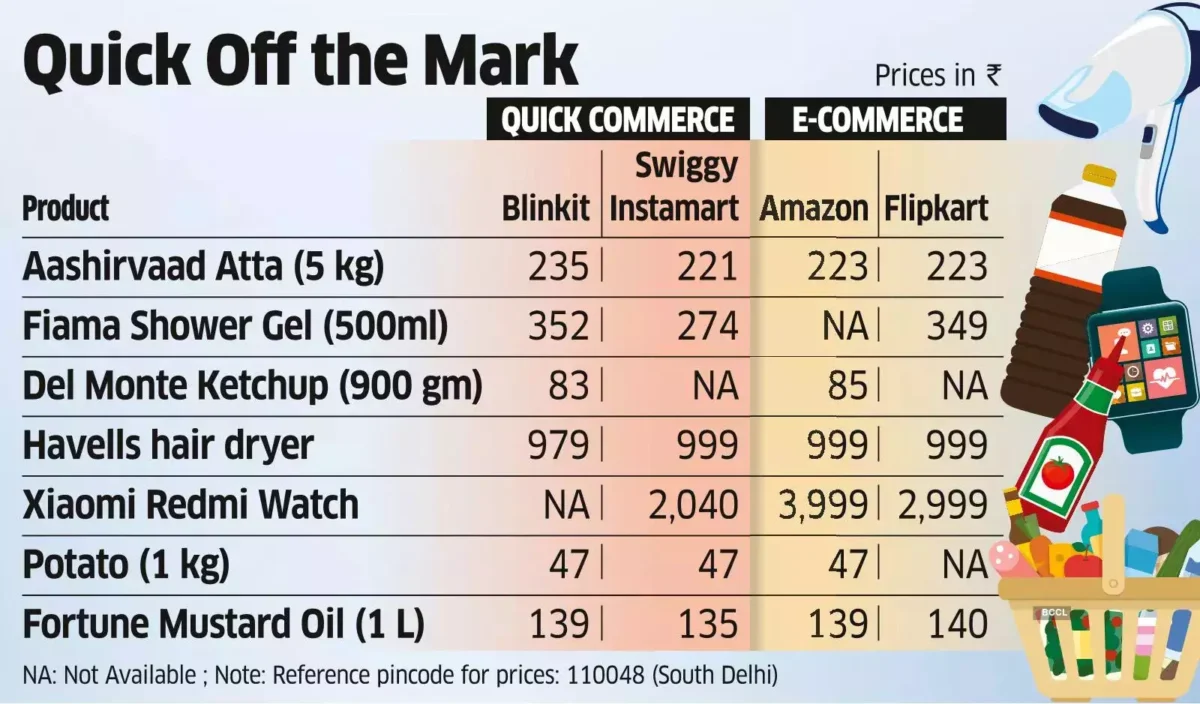
Quick-commerce operators such as Blinkit, Swiggy Instamart and Zepto are aggressively trying to lure away consumers from large ecommerce platforms like Amazon and Flipkart by matching their prices across groceries and fast-selling general merchandise, triggering a price war in the home delivery space.
This is a departure from the earlier pricing strategy of quick-commerce players who typically charged 10-15% premium over average ecommerce marketplace prices for instant deliveries, industry executives said.
The strategy now is to win consumers from large ecommerce at a time when urban shoppers increasingly prefer faster and scheduled deliveries, they said.
An ET study of prices of 30 commonly used products in daily necessities, discretionary groceries and other categories, including electronics and toys, in both ecommerce and quick-commerce platforms reveal the pricing disparity has been bridged. “The pricing premium which quick commerce used to charge for instant deliveries is gone with these platforms now joining a race with large ecommerce to offer competitive pricing to shift consumer loyalties,” said B Krishna Rao, senior category head at biscuits major Parle Products.
It seems to be working. Quick commerce is the fastest growing channel for all leading fast-moving consumer goods companies, accounting for 30-40% of their total online retail sales, according to company disclosures in earning calls.
These platforms are also expanding their basket with larger FMCG packs to cater to monthly shopping needs but also non-groceries such as electronic products, home improvement, kitchen appliances, basic apparel, shoes and toys amongst others.
“Consumers have all the apps on their phones and all they want is quick deliveries at the best price,” said Rao of Parle Products.
The increasing competition is putting pressure on ecommerce majors to reduce delivery time.
‘Market acquisition cost’
Flipkart is even eyeing a quick-commerce foray by piloting a 10-minute delivery service called Minutes in some parts of Bengaluru.
Jayen Mehta, managing director of Gujarat Cooperative Milk Marketing Federation that owns the Amul brand, said now that people are buying regularly from quick commerce with an increase in their assortment, legacy ecommerce platforms like Big Basket and Amazon are trying to deliver faster and same day, which has increased competition pressure.
“At the end of the day, consumers compare across channels before buying. So, pricing equality has become important,” Mehta said. “But then, quick commerce has a delivery charge if the order is below a certain value,” he added.
But does their business model allow quick-commerce players to wage a sustained price war against ecommerce platforms?
Quick commerce model requires multiple dark stores to be set up in close vicinity in each market, while ecommerce players mostly make deliveries from centralised warehouses.
But then, quick commerce platforms right now are at a phase where ecommerce was 7-8 years back, said Devangshu Dutta, CEO of consulting firm Third Eyesight.
“Price matching by quick commerce is to acquire market share and is part of market acquisition cost even when it might not be profitable at a per unit transaction level,” he told ET. “They may have to sacrifice margins in the short term to get customers shopping more frequently.”
Blinkit chief executive Albinder Singh Dhindsa earlier this month said the advent of quick commerce has made people want things faster than they would have otherwise got from ecommerce.
“This has led to a direct share shift of a number of non-grocery use cases to quick commerce where customers were primarily reliant on ecommerce for buying these products,” he said in the Zomato-owned quick-commerce platform’s June quarter earnings release.
Dhindsa said quick-commerce platforms are gaining sales by incremental growth in consumption, shift in purchases from next day ecommerce deliveries and mid-premium retail chains.
Citing an example, he claimed the demand Blinkit has generated for online-first oral care brand Perfora is a testament that such brands’ growth and adoption on quick commerce is much faster than on ecommerce.
(Published in Economic Times)
admin
June 15, 2024
Kolkata & New Delhi, 15 June 2024
Writankar Mukherjee and Faizan Haidar, Economic Times
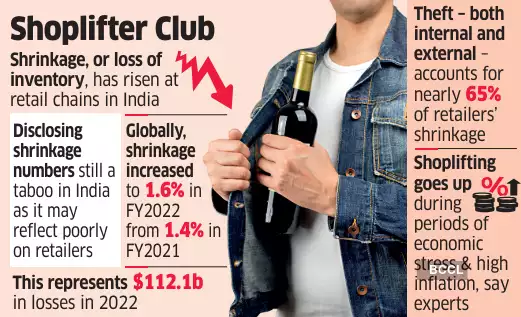
Indian retail is increasingly bedevilled by shrinkage or the loss of inventory due to shoplifting by customers, theft by employees, vendor fraud and supply chain errors. As a percentage of sales, shrinkage has risen at retail chains in India with industry executives attributing this to the rise in thefts amid growth in sales volumes.
Tata-owned Trent Ltd said in its annual report that shrinkage swelled to 0.41% of sales in FY24 from 0.22% in FY23, primarily due to significant volume growth. In FY20, it was 0.21% and had actually come down to 0.19% in FY22. Trent’s sales volumes have almost doubled year-on-year in FY22, FY23 and FY24. Trent owns the Westside and Zudio chains.
At V-Mart Retail, this has gone up from 0.4% in FY23 to 0.5% in FY24.
“Shrinkage has gone up in the industry and has become a whole new challenge,” said V-Mart Retail managing director Lalit Agarwal. “Whenever business goes up, it tends to go up. Also, the new generation wants more even when times are tough. We try to ensure it remains under control.”
The All India Mobile Retailers Association (AIMRA), which represents cellphone retail stores, said several of the large and regional retail chains have reported a surge in shrinkage, mostly by employees. While five years back, it used to be around ₹50,000 to ₹1 lakh per month for the retail chains, it’s now around ₹5-10 lakh per month, AIMRA chairman Kailash Lakhyani said.
Shrinkage goes up during events such as the Indian Premier League (IPL) and the festive season when some employees try to make a quick buck by selling store inventory in the grey market, at times to fund bets, Lakhyani said.
“Retailers file police complaints and claim insurance, but still it’s a pain,” he said.
Interestingly, shrinkage disclosures by most Indian retailers – including listed ones – are something of a taboo for them unlike their western counterparts.
Highest in Apparel, Shoes and Fashion
Devangshu Dutta, chief executive at Third Eyesight, a retail sector consultancy, said shrinkage is an operational reality and a cost which retailers monitor very closely.
“However, they may not publicly disclose the numbers if it reflects poorly on their operational controls and security. Shrinkage goes up when there is economic tightening and high inflation as India has gone through in the last couple of years,” he said.
Shrinkage is the highest in apparel, shoes and fashion categories, retailers said, followed by gadgets like mobile phones, smartwatches and headphones where the risk-reward ratio is higher due to small pack sizes and the high value of the goods.
Cracking Down
Retailers are going in for stricter audits to rein in such losses. Cellphone and electronic stores have started doing them on a daily basis. Shoe retailer Woodland has set up local audit teams, unlike the centralised ones earlier, so that shrinkage can remain under control at 0.2% of sales, said chief executive Harkirat Singh.
If it goes out of control, staff can get penalised. “Shrinkage beyond a certain limit is realised from the store team,” Singh added.
Still, Retailers Association of India chief executive Kumar Rajagopalan said shrinkage till 0.5% of sales is manageable as globally it is 1.5-2%.
“We are not yet at the alarming stage. In India, the return rate of a product is high and sometimes those products are not in the condition to be sold again, adding to the burden,” he said. RAI is a grouping of organised retailers.
In a 2023 retail security survey by the US-based industry body National Retail Federation, the average shrink rate in 2022 increased to 1.6% from 1.4% in 2021. That represented $112.1 billion in losses in 2022, up from $93.9 billion in 2021.
(Published in Economic Times)
admin
May 8, 2024
At the recent Phygital Retail Convention in Mumbai, Devangshu Dutta anchored an engaging “Fireside Chat” with Bhavana Jaiswal of IKEA India and Kapil Makhija of Unicommerce , on retailers engaging with their customers across channels and formats, and the opportunities as well as challenges in managing experiences seamlessly across online and offline interfaces.
Watch the video at this link:
admin
March 18, 2024

Christina Moniz, Financial Express
March 18, 2024
It is not difficult to understand why e-commerce firm Flipkart wants a bite of the Q-commerce pie.
India’s quick commerce market has been growing year-on-year at 77% to reach $2.8 billion in GMV (gross merchandise value) in 2023, according to a Redseer report. In comparison, e-commerce has been growing at 14-15% year-on-year. No one would dispute that with instant deliveries of products and groceries in 10-20 minutes, quick commerce firms like the Zomato-owned Blinkit, Zepto and Swiggy Instamart have changed the face of e-commerce and retail over the past few years.
While quick commerce thrives, none of the players in this ring are profitable yet. According to Devangshu Dutta, CEO at Third Eyesight, most quick commerce firms are in an expensive market acquisition phase and are at least a year away from profitability — perhaps longer. He expects that the unit economics for these companies will improve. “Some of the quick commerce players have created a substantial consumer base, which is growing in the frequency of transactions, moving to higher order values and transacting more products with potentially better margins,” says Dutta.
Both Zepto and Blinkit expect to turn profitable in FY25, as per their public statements.
So what are the primary challenges? “Traditional large e-commerce players face obstacles in facilitating last-mile deliveries, establishing dark stores, managing supply chains effectively, and navigating fierce market competition,” says Anshul Garg, managing partner & head, Publicis Commerce India.
The other key challenge for the late entrants is that customers seldom switch platforms. This is different from the way customers shop for products like electronics on e-commerce, where they compare prices/ deals across multiple e-commerce marketplaces. Brands like Flipkart need to define their playbook by maybe exploring categories other than grocery if they are to make a dent in this market.
As things stand, quick commerce has a mere 7% of the potential market. The total addressable market is estimated at $45 billion, higher than food delivery, as per JM Financial. Blinkit leads the market with a 46% share, followed by Swiggy Instamart at 27%, and Zepto at 21%.
Growing-up pangs
Kushal Bhatnagar, associate partner at Redseer Strategy Consultants, explains that there are broadly three ways that Q-commerce firms are working towards profitability. The first is by pushing higher priced items on their platforms and bumping up higher average order values. They’re also foraying into non-grocery segments such as cosmetics and headphones.
The other lever is ensuring dark store efficiencies. “While dark stores are an added cost, most platforms have a solid understanding of the demand across micro markets and are able to extract better profitability from each dark store. So the trend is positive, even if profitability is still to be achieved,” explains Bhatnagar.
For a dark store to deliver ROI and become profitable, it needs to cross 1,200-1,300 daily orders.
Some players like Zepto are also experimenting with a nominal platform fee of Rs. 2 per order, which they sometimes increase during peak times — by up to Rs. 10 — to gain from a surge in demand. Some are also implementing 12-15% fees for orders under Rs. 500, nudging customers to spend more.
Ad revenue is another important lever driving growth for these platforms, especially as D2C brands hop on board and advertise on them to reach GenZ and millennial consumers in metros and tier-I markets. Advertising revenue is around 3% of a platform’s GMV, and it is expected to keep growing.
FMCG and F&B are the top advertising categories on quick commerce currently but that can change as platforms move into higher value categories. “Quick commerce is also venturing into unconventional categories such as electronics, mobile and large appliances. If all goes according to plan, we can anticipate a significant shift in advertising contribution, given that these categories boast higher average selling prices, prompting advertisers to adopt a slightly more aggressive stance,” says Shashank Rathore, vice-president, e-commerce at Interactive Avenues (IPG Mediabrands India).
(Published in Financial Express)
admin
February 21, 2024
The ability of fashion businesses to endure and thrive in the face of stiff competition and changing market dynamics is all about adapting to innovation, customer-centricity, and strategic planning. The correlation between high performing fashion business and product innovation is undeniable.
This panel discussion brings Design and Business Heads together to brainstorm on how fashion companies can devise strategies to drive innovation to remain competitive, meet evolving consumer expectations, and stay ahead of the race.
Moderator: Devangshu Dutta, Founder & Chief Executive, Third Eyesight
Panelists:
