
admin
December 23, 2021
Devika Singh, Moneycontrol
December 23, 2021
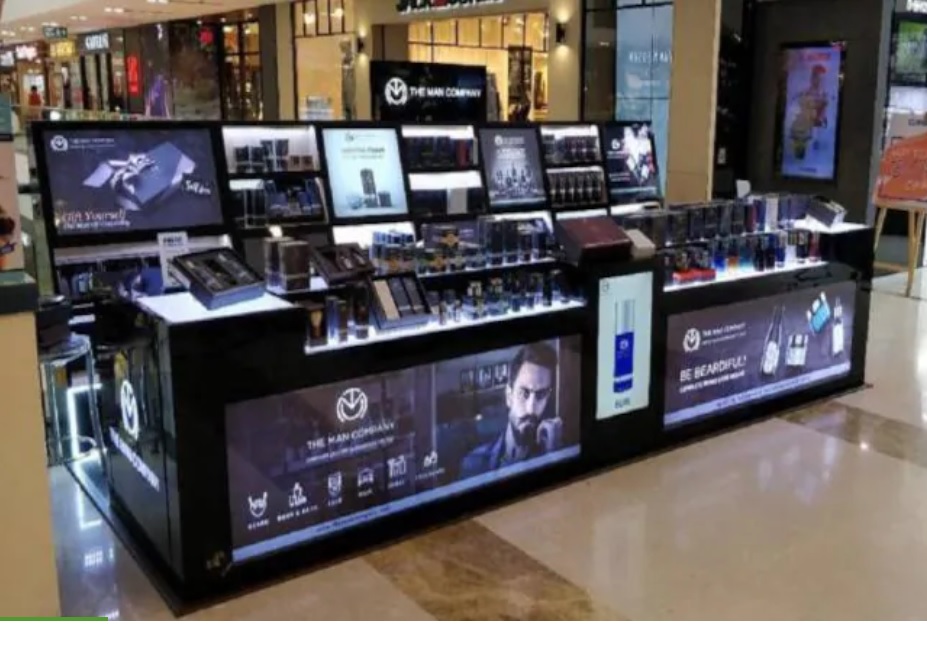
Male grooming products startup The Man Company, known for its online-first strategy, is looking at offline expansion for its next leg of growth. The company, which operates 28 exclusive brand outlets in the country, plans to launch 60-70 more stores by the end of this fiscal to gain presence across at least 100 locations.
“A lot of growth will come from the offline channel for the next one year at least, especially in Tier II and III cities where launching exclusive stores is a good way to introduce the brand to the consumer as shopping malls are weekend destinations there,” co-founder Hitesh Dhingra told Moneycontrol.
The company, backed by fast-moving consumer goods (FMCG) major Emami which holds a 48.49 percent stake in it, is also looking at introducing its products in more multi-brand outlets. The Man Company is present in 1,200 multi-brand outlets which include lifestyle stores such as Shoppers Stop, Central and Lifestyle as well as hypermarkets, supermarkets and pharmacies. The company plans to be in 2,500 multi-brand outlets by the end of financial year 2022-23.
It currently draws about 70 percent of its sales from online channels including its own direct-to-consumer (D2C) platform and online marketplaces and 30 percent from offline channels. The startup’s strategy is focused on expanding its base in Tier II cities and beyond, which account for 50-55 percent of its sales even on online marketplaces.
“Out of our 28 exclusive brand outlets, only five to six are in top 10 cities and the rest in Tier II and smaller towns. For the new store openings also, we are going to adopt a similar strategy and only 10 percent of the new outlets will be in large cities,” said Dhingra.
The offline way
Several D2C brands have been eyeing the physical retail channel as they try to scale up and tap a wider set of consumers. Brands in the women’s beauty and personal care segment such as Mamaearth, Sugar Cosmetics and Plum Goodness are expanding their presence in the offline retail format. Plum, for instance, is looking to launch 50 exclusive brand outlets in the next two years.
Male grooming startups, too, are following a similar trajectory. For instance, Bombay Shaving Company and Baeardo are launching their products in more and more offline stores.
Devangshu Dutta, chief executive of retail consultancy Third Eyesight, said it makes sense for digitally-native companies that have achieved some brand recognition to launch in offline format for the next phase of growth. Brands in the 1990s for example, he said, who wanted to establish an identity, entered new formats or channels besides the existing ones. Similarly, digitally-native brands need not restrict themselves to online platforms alone, he added.
But he pointed out that these brands will have to address challenges such as ensuring availability of their products in offline channels. “In the online segment, companies can cater to customers with limited stocks. However, in the offline channel, they need to ensure availability of products across stores,” he said.
New categories
Apart from new retail categories, The Man Company has plans to enter categories such as sexual wellness and personal appliances. It has tied up with a marketplace for the launch of personal appliances such as beard trimmers and shavers and the category will be launched exclusively on the platform. The sexual wellness products, too, will be introduced on its D2C platform and later to other marketplaces and offline stores.
“We always launch a product on our platform to test it and get consumer feedback and, based on the response, we introduce the product to the wider market,” said Dhingra.
Launched in 2015, The Man Company caters to the men’s grooming segment and claims to have developed more than 65 stock keeping units. According to Dhingra, the company which competes with Beardo, Bombay Shaving Company and Ustraa will double its sales to Rs 100 crore by the end of this financial year.
Male grooming startups have of late attracted attention from FMCG companies. Marico last year completed the acquisition of Ahmedabad-based Beardo by buying an additional 55 percent stake in the company. It had acquired an initial 45 percent stake in 2019. British consumer goods giant Reckitt Benckiser Group invested Rs 45 crore in Bombay Shaving in February 2021. LetsShave and Ustraa are backed by Wipro Consumer Care.
According to industry estimates, the male grooming market in India was valued at Rs 15,806 crore in 2019 and is expected to cross Rs 36,402 crore by 2025, growing at a compound annual rate of 15-14 percent. Though growth was hit by the pandemic, experts are still bullish about the segment.
(Published in Moneycontrol)
admin
December 20, 2021
Written By Vaishnavi Gupta
The furniture brand’s retail roadmap includes city stores in Delhi, Mumbai and Bengaluru, followed by tier I and II towns

For the Ikea model to succeed, adequate demand-concentration is crucial, which is being currently provided by the bigger cities in India.
After launching two large-format stores in India in a span of three years — one each in Hyderabad and Navi Mumbai — Ikea opened its first small-format store in Worli, Mumbai, to become “more accessible and convenient”. About 90,000 sq ft in size, these ‘city’ stores are already present in markets such as New York, London, Paris, Moscow and Shanghai.
The furniture market in India stood at $17.77 billion in 2020, and is expected to reach $37.72 billion by 2026, growing at a CAGR of 13.37%, according to a Research and Markets report. Godrej Interio, UrbanLadder and Pepperfry are among the big players in this space, all with a significant online presence, too. Godrej Interio has 300 exclusive stores in India, while Pepperfry has more than 110 Studios.
Spread across three floors, Ikea’s first city store has 9,000 products in focus, of which 2,200 are available for takeaway and the rest for home delivery. “We have observed that it is not easy to find large retail locations in cities like Mumbai and Bengaluru. The small store offers convenience and accessibility for consumers to experience Ikea products,” says Per Hornell, area manager and country expansion manager, Ikea India. This launch is in line with the company’s aim to become accessible to 200 million homes in India by 2025, and 500 million homes by 2030.
More launches are being planned: another city store in Mumbai in the spring of 2022 and a large-format store as well as a city store in Bengaluru by the end of 2022. For its retail expansion in Maharashtra, the company plans to invest Rs 6,000 crore by 2030. “We are on track to exceed the investment commitment of Rs 10,500 crore made for India in December last year,” adds Hornell. Delhi, Mumbai and Bengaluru are the three cities on its radar at the moment, which will be followed by tier I and II towns.
Furthermore, Ingka Centres, part of Ingka Group that includes Ikea Retail, is coming up with its first shopping centre in Gurugram (followed by Noida), which will be integrated with an Ikea store.
In India, unlike its organised furniture market competitors, Ikea doesn’t have a pan-India online presence yet. It has been following a “cluster-based expansion strategy” for its online offering, but the company insists this is not a limitation. “At present, 30% of our overall India sales come from online channels,” Hornell informs. Through its e-commerce website and mobile shopping app, the company currently operates in Hyderabad, Mumbai, Pune, Bengaluru, Surat, Ahmedabad and Vadodara.
On the other hand, players like Godrej Interio and Pepperfry have big plans to tap new markets. The former aims to add 50 exclusive stores each year, while Pepperfry aims to achieve the 200 Studios mark by March 2022. In September this year, Pepperfry forayed into the customised furniture segment with the Pepperfry Modular offering, which focusses on modular kitchens, wardrobes and entertainment units.
Good start?
This is a good time for Ikea to establish its presence in the Indian market, says Alagu Balaraman, CEO, Augmented SCM. “Earlier, people used to rely on carpenters for furnishing their homes; now, they prefer to buy ready-made furniture. The market is moving towards acceptability, making plenty of headroom for growth for these companies,” he says.
Ikea’s cautious expansion approach in a market like India where several local dynamics are at play, is tactful, analysts say. Devangshu Dutta, founder, Third Eyesight, says, “In the past, Western businesses have made the mistake of simply copy-pasting formats and strategies in emerging markets from their more developed markets.” He believes there is “nothing wrong” in being incremental while growing footprint. “There’s no sense in carpet-bombing the market with stores, when many may end up being loss-making or sub-optimal,” he adds.
Getting the product mix and pricing right would be key in realising the full potential of this market. Balaraman says Ikea will have to balance its global portfolio with what it is doing locally, and make sure it is profitable.
For the Ikea model to succeed, adequate demand-concentration is crucial, which is being currently provided by the bigger cities in India. Given its global popularity, the furniture giant, analysts say, is poised to see traction in the metros and tier I cities.
Source: financialexpress
admin
November 1, 2021
Written By Vaishnavi Gupta
D2C brands are taking the traditional retail route to scale up

Analysts say that the move to offline retail makes sense for digital-first brands in categories where experiencing the product is an important driver for purchase
While brands across categories made a beeline for e-commerce during the pandemic, physical retail earned prominence among direct-to-consumer (D2C) brands. Melorra, Plum, Pee Safe and Libas, among others, have been building their offline presence over the past year.
The total retail market in India is estimated to be worth Rs 63 lakh crore, of which 95% buying happens through offline formats, according to Devangshu Dutta, founder, Third Eyesight.
Having started as an online-only brand in 2013, Pee Safe launched its first exclusive store in India in February, 2021. The personal hygiene brand currently operates a store each in Gurugram, Bengaluru and Ahmedabad; and plans to launch 50 offline stores in the next 12 months. “There is a strong demand for personal hygiene and wellness products in the offline market. Hence, opening exclusive outlets is a crucial element of our growth strategy,” says Srijana Bagaria, co-founder and director, Pee Safe. These exclusive brand outlets (EBOs) will be launched through the franchise-owned and franchise-operated (FOFO) model.
Online ethnic wear brand Libas, meanwhile, unveiled two brick-and-mortar stores in New Delhi in September, 2021. The brand has an ambitious target of 200 more stores by 2025 in malls and high streets across metro and tier II cities. A click-and-collect facility will be operational soon, says Sidhant Keshwani, managing director, Libas. “We are aiming for our offline market share to be 25% in the coming two years,” he adds.
The brand offers a range of wedding and occasion wear, as well as ready-to-stitch fabrics exclusively in its offline stores. Soon, it also plans to foray into the kidswear and menswear categories, as well as home décor.
Beauty brand Plum, which has been retailing online since 2014, launched its first store in Mumbai in October, 2021. Plum’s founder and CEO, Shankar Prasad, says the goal is to take the store count to 50 by 2023, and for EBOs to contribute “10-20% of our total sales in two-three years”.
Jewellery brand Melorra extended its presence offline back in December, 2020. “We have been growing 200% year-on-year; we expect to post even stronger numbers this year with the addition of offline stores. We are looking to touch $1 billion in revenue in five years,” says the company’s founder and CEO, Saroja Yeramilli.
A good step?
Analysts say that the move to offline retail makes sense for digital-first brands in categories where experiencing the product is an important driver for purchase. “D2C players have so far done a great job of owning the consumer journey which is largely online. They now see that for the next wave of growth and penetration, they need good representation in a larger set of touchpoints,” says Rachit Mathur, partner and MD, BCG.
However, online is likely to remain the primary revenue stream for these digital-first brands. “Brands such as Lenskart, Nykaa and FirstCry have done a great job in driving strong retail presence and viable productivity, but continue to have a higher bias of online sales,” Mathur notes.
D2C brands could perhaps try a mix of formats for an offline foray, from EBOs to a presence in departmental stores, or even small SIS (shop-in-shop) counters in shopping centres. But brands would need to be cognisant of the fact that consumers behave differently depending on the shopping environment they are in. Hence, the interface, service offering, and even the product mix may have to be tweaked. “Simply bringing in technology into an offline environment just because you are an online-first brand may do nothing to enhance the consumer experience, and may even detract from it,” Dutta says.
Source: financialexpress
admin
June 29, 2021
Devika Singh, Moneycontrol
29 June 2021
Post-COVID, the sanitiser market will shrink considerably and there will be room only for old trusted brands or bulk low margin suppliers, suggest experts.
 Every one in two urban households are now using sanitisers, as per data from Kantar.
The pandemic has triggered a gold rush in the health and hygiene sector, particularly sanitisers – even if temporarily.
A severely underpenetrated category in the pre-pandemic period, sanitisers have witnessed massive adoption amongst the consumers since March 2020.
According to data from Kantar, annually, before the pandemic struck (March 2019 – February 2020) hand sanitiser penetration was about 1.2 percent; on an average in a month only 0.1 percent of the urban households bought the product.
However, during the first 12 months of the pandemic, the category reached nearly 50 percent penetration, a quantum leap.
It means everyone in two urban households are now using sanitisers, as per data from Kantar, the world’s leading data, insights, and consulting company.
Overall, the hygiene category had witnessed a huge spike in sales as the first wave of the COVID-19 pandemic struck the country in March last year.
Although the sales declined as the cases subsided, the demand jumped up again with the second wave of the pandemic.
Several companies had made a beeline for the category and joined the sanitiser gold rush.
According to data from Kantar, as many as 350 brands of sanitisers were launched in the first three months of the pandemic.
Consumers are also buying more products in the hygiene category such as vegetable cleaners and surface disinfectants.
Data from Kantar shows that vegetable and fruit cleaners now have a penetration of 2 percent and surface disinfectants 1.5 percent.
“For a category that is driven by a limited number of brands and has not even been there for a year, it is a huge success,” said K Ramakrishnan, MD – South Asia, Worldpanel Division, Kantar.
Though the category overall has seen an increase in demand, industry and experts expect only a few big brands with a strong legacy in the hygiene segment to sustain in the long run.
Hence companies such as Marico have already started deprioritising the category.
“Of late, we have realised that it (sanitisers) is more of a tactical opportunity for us to provide consumers what they needed then,” Pawan Agrawal, CFO, Marico, said.
“These products do not fit into our scheme of things as we understood that consumers will go back to the legacy brands with strong equity in hygiene, and hence three-four brands will have a larger play in the segment,” he added.
Marico, hence, has decided to not make any fresh investments in the category going ahead.
Raymond Consumer Care, which sells sanitisers under its brand Park Avenue, too, has similar plans.
“We believe post-COVID, the sanitiser market will shrink considerably and there will be room only for old trusted brands or bulk low margin suppliers. Given this context, we will maintain strategic presence in the chemist channel, but this segment will not be a priority,” admitted Sudhir Langer, CEO – Raymond Consumer Care.
Other companies such as CavinKare plan to focus on flagship products such as handwashes.
Said Raja Varatharaju, GM Marketing – Personal Care, CavinKare: “As the demand for sanitisers continues to slow down, our core focus will remain on offering a bouquet of products under the health and hygiene portfolio as we move forward. We will increase and strengthen our focus on hand wash, as it is a flagship product in our portfolio.”
Reckitt’s Dettol, ITCs’ Savlon and Hindustan Unilever Limited’s (HUL) Lifebuoy are some of the top brands in the health and hygiene space, which are likely to benefit from this trend in the long run, indicate experts.
Consumers associate certain products and categories with certain brands and are inclined to buy from them, said Devangshu Dutta, Chief Executive at retail consultancy, Third Eyesight.
Hence, companies, which saw in the pandemic the chance to tap the short-term opportunity, do not want to focus on it any longer.
Source: moneycontrol
admin
April 21, 2021
Debojyoti Ghosh, Fortune India
April 21, 2021
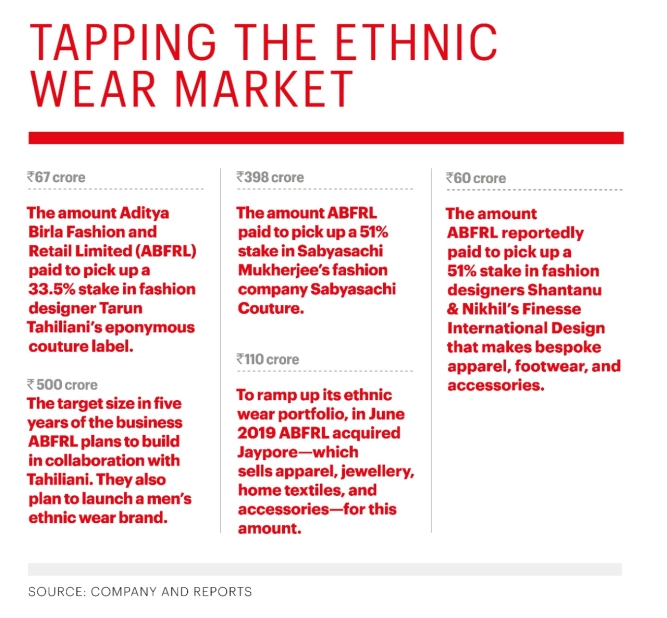
Billionaire entrepreneur Kumar Mangalam Birla-led retailer Aditya Birla Fashion and Retail Limited (ABFRL) has continued its build-up in the ethnic wear market with its fourth deal since 2019 and second this year. In February, the Mumbai-based fashion retailer picked up a 33.5% stake in fashion designer Tarun Tahiliani’s Goodview Properties—that will own and operate the designer’s eponymous couture label—for ₹67 crore. That was a month after ABFRL acquired a 51% stake in Kolkata-based designer Sabyasachi Mukherjee’s company, Sabyasachi Couture, which sells garments, accessories, and fine jewellery, for ₹398 crore.
ABFRL, which owns fashion brands such as Louis Philippe and Van Heusen, said in a statement that ethnic wear “is a large and growing market with a significant opportunity to build scale” and expects it to be an important category over the next few years.
Experts note the two recent deals come as the luxury industry, including fashion, has been hammered by the pandemic. The year-long shutdown in global travel has slowed over a decade of growth across luxury categories. Indeed, the global fashion industry’s profit is expected to have slumped about 93% in 2020, according to a report by consulting firm McKinsey and The Business of Fashion in December.
“[Luxury] business has been hit hard during the pandemic, like all fashion and retail businesses. And a significant injection of money is needed to maintain the business momentum, and to scale it further,” says Devangshu Dutta, chief executive of retail consultancy Third Eyesight.
In March, Italy’s billionaire Agnelli family—best known as the founders of automaker Fiat—acquired a 24% stake in French luxury shoemaker Christian Louboutin for $642 million. Three months before that it paid $95 million for a controlling stake in Shang Xia Paris, a Chinese luxury goods business founded by French luxury brand Hermès and Chinese designer Jiang Qiong Er.
Many fashion firms have used the Covid-19-induced slowdown to reshape business models, streamline operations, and sharpen their customer propositions, said the report by McKinsey and The Business of Fashion.
And that is exactly what Tahiliani plans to do with his new corporate partner. The duo will create a new entity—80% held by ABFRL and 20% by Tahiliani—to launch a new brand of apparel and accessories in the affordable premium ethnic wear segment, while it also plans to launch a men’s ethnic wear brand.
“Discussions with ABFRL have been in the works for nearly two years. I couldn’t be happier about entering into this partnership. They understand scale and numbers like no one else in the market today. Each of their home-grown brands is a resounding success,” Tahiliani, founder and CEO of Tarun Tahiliani Brand, tells Fortune India. “This collaboration permits me the financial freedom to focus on designing,” he adds.
ABFRL aims to build the new ethnic wear brand into a ₹500-crore business in the next five years, with more than 250 stores across India. The first tranche of stores is expected to open by September. “This new entity with ABFRL currently concentrates only on menswear. In our collective opinion, at present, there is only one branded national player in the Indian ethnic [wear] for men space. In order to scale this up, we need to be in three or four categories of clothing. This will give depth, both in terms of style and sizing to the men who come into the store,” says Tahiliani.
Currently, the top panIndia ethnic wear brand for men is Vedant Fashions’ Manyavar. The Kolkata-based company forayed into women’s wear in 2016 selling lehengas, saris, and the like under the label Mohey,
ABFRL’s previous deals in the segment—both in 2019—were a 51% stake in fashion designers Shantanu & Nikhil’s Finesse International Design for a reported ₹60 crore, and its ₹110-crore acquisition of Jaypore. Both make apparel, footwear, accessories, and other items.
ABFRL’s managing director, Ashish Dikshit, declined to comment for this story. ABFRL had, when announcing the Sabyasachi Couture investment, said it expected that deal to accelerate its strategy to build a comprehensive portfolio of brands across segments, occasions, and geographies.
Experts say ABFRL’s recent investments allow it to tap into the designer’s creative stream and goodwill, while providing the financial and organisational muscle of a large corporate. Albeit one that is not aiming too far upmarket.
“We shouldn’t see the ABFRL [stake] acquisitions as entry into couture, which is a different business from the ready-to-wear market. It is the expansion of these brands into ready-to-wear, tapping into the desirability of the designer brand, while making it accessible and affordable to a larger market is what will be of interest,” says Third Eyesight’s Dutta.
Indeed, Mukherjee, in a press release in late January, noted, “As my brand evolved and matured, I began searching for the right partner in order to ensure continuity and long-term sustainable growth.”
Nonita Kalra, a veteran fashion editor, says that the ABFRL deal shows the growing heft of the [Sabyasachi] brand in the fashion business. “Corporates aren’t sentimental. They are hard-nosed about investments, with careful due-diligence. ABFRL is paying what it is worth and expecting it to grow bigger. They are never going to invest in a stagnant business,” she says.
Experts, though, caution that while corporate partnerships and acquisitions allow a designer-entrepreneur and their investor partners to unlock some of the value being built, it is essential to have clarity about each brand’s design language and target consumer. “With [ABFRL’s] new venture [in men’s ethnic wear with Tahiliani], the key thing to understand is how the company will differentiate it from Shantanu & Nikhil’s positioning and focus, which is also menswear-driven,” says Abneesh Roy, executive vice president, Edelweiss Securities. “The challenge will be ensuring that each brand maintains its distinctive identity, while deriving synergies from the group.”
ABFRL has stitched up some unique deals; it now has to ensure they don’t unravel.
(The story originally appeared in Fortune India‘s April 2021 issue).
