
admin
May 30, 2022
Written By Akanksha Nagar
Having acquired Patanjali Ayurved’s food retail business, the company has ambitious plans

While its edible oil business has been its mainstay, Ruchi Soya’s CEO Sanjeev Asthana is confident that the share of FMCG revenue could touch 20% this fiscal.
Ruchi Soya has its sights set on clocking `20,000 crore- `22,000 crore in revenue over the next five years from its FMCG business, after recently having acquired Patanjali Ayurved’s food retail business worth `690 crore. The Patanjali food portfolio comprises 21 major products, including top-selling items such as ghee, honey and juices, besides staples such as atta and spices.
To achieve its target, Ruchi Soya plans to launch a D2C (direct-to-consumer) channel in the next two months for its nutraceuticals business, with more categories to follow, while also increasing its investment on e-commerce and expanding its offline footprint. It is quite active across all key online marketplaces including Flipkart, Amazon and JioMart.
According to the latest Statista report, India’s FMCG market was valued at $110 billion in 2020, and by 2025, it is expected to touch $220 billion, as more brands adopt the D2C route. Several top FMCG makers, including Hindustan Unilever, Dabur and Emami, have launched D2C brands in the past two years.
Oiling other products
While its edible oil business has been its mainstay, Ruchi Soya’s CEO Sanjeev Asthana is confident that the share of FMCG revenue could touch 20% this fiscal. It is targeting `7000 crore in revenue from FMCG and `25,000 crore from commodity sales by the end of FY23. “Over the next five years, the revenue split between FMCG and commodities will be equal,” he says.
Furthermore, Ruchi Soya plans on consolidating and rationalising the Patanjali food portfolio, while simultaneously revamping some of its existing products. “The aim is to reposition the entire company towards being a food FMCG major,” says Asthana.
Following the acquisition, Ruchi Soya will be renamed Patanjali Foods (after regulatory approvals). Asthana says that brands such as Nutrela, Mahakosh, Ruchi Gold and Sunrich will continue to be marketed under their existing names, while all the businesses that are coming in from Patanjali will use the Patanjali brand in exchange for a brand licensing fee
evangshu Dutta, chief executive, Third Eyesight, says the company name change may work in its favour, since there is a large audience aligned with the image and values of Patanjali Group and its founder Baba Ramdev.
Casting a wide net
But not all is smooth-sailing. Alagu Balaraman, CEO, Augmented SCM, suggests for the company to scale up, it needs to build a robust traditional distribution network, since a bulk of sales still happens through these channels. “The cost of doing e-commerce delivery is significantly high,” he notes.
Ruchi Soya is working on those lines. Asthana says besides utilising Patanjali’s existing distribution muscle, it is expanding its offline retail footprint by adding 10,500 non-exclusive modern grocery stores and 4,500 exclusive ones every month.
Source: financialexpress
admin
April 24, 2022
Written By Devika Singh
The Enforcement Directorate (ED) on April 19 accused Amway India of running a “multi-level marketing (MLM) scam” and attached its assets worth Rs 757.77 crore. This is not the first time that Amway India has been accused of running a ‘pyramid scheme’. Read on to understand how direct selling is different from pyramid schemes and why has the ED attached Amway India’s assets?

The direct selling industry is again under the regulatory scanner in India with the Enforcement Directorate’s (ED) move to attach the assets of the Indian unit of US-based direct selling company, Amway. The ED has accused the company of running a “multi-level marketing (MLM) scam” and attached its assets worth Rs 757.77 crore.
According to an ED statement, the attached property includes Amway India’s land and factory building at Dindigul district in Tamil Nadu, plant and machinery vehicles, bank accounts and fixed deposits.
“Immovable and movable properties worth Rs 411.83 crore and bank balances of Rs 345.94 crore from 36 different accounts belonging to Amway attached,” the ED said. The seizures, the ED said, have been made under the Prevention of Money Laundering Act (PMLA).
This is not the first time that Amway India has been accused of running a ‘pyramid scheme’. The company faced accusations on similar lines in the US in the 1970s and has been under government scrutiny in Karnataka and Kerala in the past. In fact, in 2013, Kerala police arrested then Amway India chief William Scott Pinckney and its directors, accusing them of running a pyramid scheme.
Direct selling has come under scrutiny time and again, as over the years, consumers have been duped by fake sellers hawking defective products and services in the garb of direct selling. To discourage such schemes, the government had proposed a draft policy last year, which aims at regulating the direct selling market segment.
Read on to understand what is direct selling, why the ED attached Amway India’s assets, what is Amway’s stand on the issue, how is direct selling different from pyramid schemes, and what are government regulations around direct selling in India?
What is direct selling?
Direct selling firms deploy agents who buy products from the company and then directly reach out and sell to consumers at their homes or other places instead of through a retail format like a store. The direct selling entity and the agent share the profits made through the sale of products. According to industry estimates, there are about 60 lakh agents in the country, who pursue direct selling as a means of earning additional income.
The direct selling industry, as per estimates, is pegged at Rs 10,000 crore in India, and has been growing at 12-13 percent per annum over the last five years. Experts say multi-vitamins, and home care and personal care products are the top-selling categories through this channel.
Beside Amway, companies such as Avon, Oriflame, Modicare and Tupperware operate in the direct selling segment. Some of these companies have been in India for decades now.
What is pyramid scheme and how is it different from direct selling?
Pyramid schemes are defined as a form of investment in which a paying participant recruits further participants and gets rewarded for it. Over the years, consumers have been duped by fake sellers hawking defective products and services in the garb of direct selling, often bringing the direct selling industry too, under scrutiny.
“Pyramid scheme is a scam to make money for a few people and it is based on selling an empty promise, multiplying it through recruiting people,” said Devangshu Dutta, CEO of retail consultancy Third Eyesight.
However, he added, it has to collapse somewhere because you are selling a product or service that does not exist.
“As opposed to that, in direct selling, the companies are selling products and at the end of it there is a tangible exchange of goods or services. So, even if you have downline distributors, as long as at the end of it the customer is getting something of value, then it’s not really a pyramid scheme,” he added.
Why has ED attached Amway India’s assets?
According to the ED’s press statement, Amway India runs a multi-level-marketing scheme or pyramid scheme, which “induces the common gullible public to join as members of the company and purchase products at exorbitant prices.”
The ED said the prices of most Amway products are “exorbitant as compared to the alternative popular products of reputed manufacturers available in the open market”. The new members, who are asked by the company to join it, are not buying the products to be used by themselves, but to become rich by becoming members as showcased by the upline members, said ED.
“The reality is that the commissions received by the upline members contribute enormously to the hike in prices of the products,” the ED said.
And this, indicated the ED, makes Amway’s operations similar to a pyramid scheme, where new members are recruited by existing members with claims of amassing wealth and becoming rich.
The agency claimed that between FY2003 and FY2022, Amway collected Rs 27,562 crore, of which it paid commissions worth Rs 7,588 crore to affiliate members and distributors in the United States and India.
What is Amway’s stand on the issue?
Amway, however, claims that it does not offer any incentives to new members to join the company and the members are only paid once they make a transaction or sell the product, and hence they are not operating a pyramid scheme.
The company has released a statement saying that the action of the authorities is with regard to the investigation dating back to 2011 and since then Amway has been co-operating with the department and has shared all information as sought from Amway from time to time. Amway said it will continue to cooperate with the government authorities for a fair, legal, and logical conclusion of the outstanding issues.
“As the matter is sub judice, we do not wish to comment further. We request you to exercise caution, considering a misleading impression about our business also affects the livelihood of over 5.5 lakh direct sellers in the country,” it said in a statement to media.
In an conversation last year with Moneycontrol, Amway India CEO Anshu Budhraja had said that Amway India does not charge any registration fee to its agents.
“There are no charges for joining Amway business. Further, to ensure that the customers have a satisfying experience with Amway, our products are backed by a money-back guarantee for 100 percent satisfaction of use,” Budhraja had said.
What are the regulations around direct selling?
The government last year included Direct Selling under the Consumer Protection Act (Direct Selling) Rules, 2021. These new rules prohibit direct selling companies from charging registration fees from their agents, and bars them from charging their agents for the cost of demonstration to prospective buyers.
The rules also forbid direct sellers from engaging in pyramid and money circulation schemes. The rules mandate that the companies operating in the segment would have to appoint a Chief Compliance Officer, a Grievance Redressal Officer, and a Nodal Contact Person. The companies would also need to be registered with the Department for Promotion of Industry and Internal Trade and must have an office in India.
They would also be mandated to maintain a website with all relevant information.
“Every direct selling entity shall establish a mechanism for filing of complaints by consumers through its offices, branches and direct sellers through a person, post, telephone, e-mail, and website,” as per the regulation.
“Every direct selling entity shall establish a mechanism for filing of complaints by consumers through its offices, branches and direct sellers through a person, post, telephone, e-mail, and website,” as per the regulation.
It adds: “Every direct selling entity shall ensure that such registration number is displayed prominently to its users in a clear and accessible manner on its website and each invoice issued for each transaction.”
In addition, such companies would have to maintain a record of direct sellers working with them, including their ID proof, address proof, email ID, and other contact information.
Source: moneycontrol
admin
March 29, 2022
Writankar Mukherjee & Sagar Malviya, Economic Times
Kolkata / Mumbai, March 28, 2022
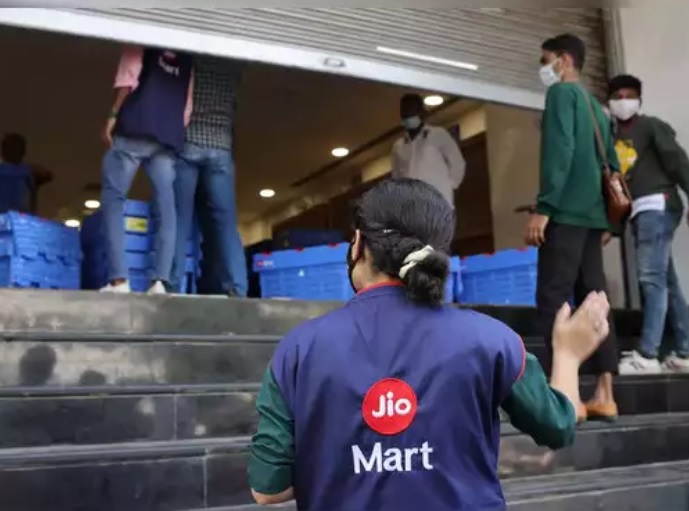
The war for instant grocery delivery is going to intensify with Reliance Retail entering the segment with its JioMart platform. The company will start the trial in next 2-4 days in Navi Mumbai for ‘JioMart Express’ which will sell and deliver around 2,000 stock keeping units (SKUs) in a few hours, two senior industry executives aware of the plans said.
Reliance has plans to take instant grocery sales to over 200 cities and towns where JioMart is currently operational by end of next quarter and double the reach in next few months to make it India’s largest instant grocer. The company will also tap its network of kirana stores for such fulfillment, apart from its own chain of grocery stores, the executives said. It is testing a separate app for express grocery deliveries as well as integrating it into the JioMart platform.
The plans of India’s largest brick-and-mortar retailer to enter quick commerce is to further grow its e-grocery business and Reliance will compete against Tata-owned Big Basket which will launch it in April, Zomato-funded Blinkit, Swiggy’s Instamart, Walmart-owned Flipkart Quick and Zepto. Earlier this year, Reliance had led a $240 million funding round in quick commerce hyperlocal firm Dunzo owning the largest 26% stake.
“JioMart Express will utilize Dunzo in the markets where it is strong like the metros as well as its own delivery fleet. JioMart Express can be quickly scaled up since Reliance has onboarded lakhs of kiranas under its B2B programme ‘JioMart Partner’ who buys the merchandise from Reliance and sells through the JioMart platform,” an executive said.
An email sent to Reliance Retail remained unanswered till Sunday press time.
Devangshu Dutta, chief executive of consulting firm Third Eyesight, said Reliance needs to ensure that it is in the right catchment which has a high concentration of demand, low competition and keep supply centres close to it to make instant grocery service profitable. “Margin contribution is low in grocery and hence apart from these there could be a higher focus on high margin products in the assortment,” he said.

To be sure, quick commerce is not new for Reliance Retail. It has been delivering orders in less than three hours placed through Reliance Digital online or app for smaller consumer electronics such as mobile phones and laptops. “However, order volumes are going to be much more frequent in grocery, and hence it would need a robust backend and delivery fleet,” an executive said.
While the pilot in Navi Mumbai will start with 1-3 hours delivery time, Reliance will progressively reduce the delivery time to match the industry standard of 45 minutes to an hour and will also expand the range. According to researcher RedSeer, India’s quick commerce market is all set to grow 15 times by 2025 reaching a market size of close to $5.5 billion. Online shoppers in the metros have been using quick commerce for their unplanned and top-up purchases.
(Published in Economic Times)
admin
March 24, 2022
Written By Aditya Kalra & Abhirup Roy

MUMBAI, March 6 (Reuters) – At a large Future Retail (FRTL.NS) supermarket in Mumbai last week, workers were unloading hundreds of bright blue grocery crates belonging to India’s biggest retailer Reliance.
Prospective customers were turned back by security, disappointed at the closed state of the store that still carries the signage of Future’s biggest brand, Big Bazaar, but which will likely soon be rebranded as a Reliance outlet.
Across India, similar scenes are being played out as Reliance Industries (RELI.NS), India’s biggest conglomerate run by Mukesh Ambani, the country’s richest man, presses ahead with a shock de facto takeover of prized retail real estate that Amazon.com Inc has been keen to take part-ownership of.
The high-profile bitter dispute between corporate titans in which Amazon has sought to block Reliance’s planned $3.4 billion purchase of Future Group’s retail assets is currently before India’s Supreme Court.
Reliance’s takeover began with utmost stealth on the night of Feb. 25 when its staff began arriving at Future stores. Many in Future’s management were in the dark about the plans as store employees from all over the country frantically began to call, according to people with direct knowledge of the matter.
“It was tense, everybody was panicking. We didn’t know who they were. They wanted access and seniors didn’t know about it,” a New Delhi Big Bazaar store employee said, describing what happened around 8 p.m. that day.
At a Future store in Sonipat town in northern Haryana state, announcements were made asking customers to leave as Reliance seized control, one source said. In Vadodara in western Gujarat, Future employees arriving for work the next morning were asked to go back home with no explanation, said another source.
Citing unpaid payments by Future, Reliance has taken control of operations of some 200 Big Bazaar stores and has plans to seize another 250 of Future’s retail outlets. Combined, they represent the crown jewels of Future’s retail network and around a third of all Future outlets. read more
Although Reliance had not played a large public role in the legal dispute, it had, according to sources, for some months assumed many of the leases held by cash-strapped Future, India’s No. 2 retailer and Amazon’s estranged business partner.
Reliance’s sudden possession of the stores appears to have landed what some analysts are calling a coup de grace that spoils Amazon’s chances of untangling the transfer of Future’s assets to Reliance. That’s despite a series of legal battles won by the U.S. e-commerce giant to date blocking the 2020 deal announced between the two Indian companies.
“What will Amazon fight for now?” said a source close to the U.S. company with knowledge of the legal dispute. “The shops are gone.”
Representatives for Reliance, Amazon and Future did not respond to Reuters queries for this article. Sources asked not to be identified due to the sensitive nature of the dispute.
AFTER THE TAKEOVER, TALKS
Future Retail said on Feb. 26 it was “scaling down its operations” to cut losses although it made no mention of Reliance in its statement. Future Group as a whole has more than $4 billion in debt.
Reliance plans to retain Future’s employees at the stores it takes over, sources have said.
Amazon, which has a stake in a separate Future Group unit that it argues prevents Future from selling retail assets without its permission, has called the supermarkets and other stores an “irreplaceable” network in a sector worth $900 billion in revenues annually.
The legal wrangles had over time become increasingly high-stakes and marked by ugly rhetoric. At one point, Amazon sought for Future Chief Executive Kishore Biyani to be detained in prison for disobeying a legal order. And Future once likened Amazon to Alexander the Great and his “ruthless ambition to scorch the earth”.
But on Thursday, six days after Reliance’s move, Amazon at a Supreme Court hearing unexpectedly called for cordial talks to end the dispute – a proposal Future agreed to.
“People have taken over shops … let’s at least have a conversation,” Amazon’s lawyer Gopal Subramanium said.
Discussions are expected to begin soon. read more
Whatever the outcome of the talks, analysts say Amazon had gravely underestimated Reliance.
“If anybody should have seen this coming, it should have been Amazon and they should have prepared against it,” said Devangshu Dutta of retail consultancy Third Eyesight.
“Clearly, they didn’t.”
Source: reuters
admin
January 24, 2022
Written By Devika Singh
The entry of Jubilant FoodWorks will intensify competition in the fried chicken segment, where KFC so far has maintained its stronghold.

Popeyes, founded in 1972 in New Orleans, Louisiana, has over 3,400 restaurants in over 25 countries around the world. Popeyes (Wikimedia Commons)
Jubilant FoodWorks, the franchisee for Domino’s Pizza, will launch the iconic US-based fried chicken brand Popeyes, known for spicy New Orleans-style fried chicken and chicken sandwiches, in India on January 19 with the unveiling of the first outlet in Bengaluru.
“Popeyes was founded in 1972 and has been one of America’s most popular and fastest-growing chicken brands. Popeyes aims to delight Indian guests with the bold and delicious flavours of its Louisiana-style chicken,” the company said in a filing to stock exchanges.
“The success of the brand lies in its traditional and unique technique of hand breading, battering, and marinating its fresh chicken for 12 hours in bold Cajun seasonings,” the company added.
Popeyes runs over 3,400 restaurants in 25 countries.
With the entry of Jubilant FoodWorks, the competition is set to intensify in the fried chicken segment, where KFC has maintained leadership in the country so far.
“KFC has enjoyed a free run in the fried chicken market. There are some local players in this segment but no large QSR (quick service restaurant) player had a presence in it until now. With Popeyes as a competitor, now Jubilant FoodWorks is stepping into that opportunity,” said Devangshu Dutta, chief executive at consulting firm Third Eyesight.
While launching its initial public offering (IPO) last year, Devyani International, the largest franchisee of Yum! Brands (which owns KFC), had stressed the advantage it has over other QSRs in the country.
“We have no competition for KFC in India,” Ravi Kant Jaipuria, chairman, Devyani International, had said at the time. Devyani International runs 284 KFC India stores across 107 cities and the brand contributes more than half of its revenues. Sapphire Foods, which too launched its IPO last year, is another major franchise for KFC in India.
Both the companies already compete with Jubilant FoodWorks in the pizza segment as they also operate Yum! Brands-owned Pizza Hut in India. Jubilant FoodWorks with Domino’s Pizza, however, has clear leadership in the pizza market. Sample this: Pizza Hut currently has 500 stores in India, of which 317 are run by Devyani International; Jubilant FoodWorks, on the other hand, already has 1,335 outlets of Domino’s Pizza in India.
Now with the launch of Popeyes, Jubilant FoodWorks, it seems, wants a chunk of the fried chicken pie too.
Westlife Development, which holds the master franchise for McDonald’s in southern and western India, also has set its sight on the fried chicken segment in India. In an interview with Moneycontrol in September last year, Smita Jatia, managing director of Westlife Development, shared an ambitious plan to become a market leader in the segment. The company has already introduced fried chicken in its 125 stores in South India and plans to soon launch the food item in the western region too.
Clearly, the fried chicken market is certainly headed for interesting times as several new QSR players vie for a share of it. According to experts, the segment also offers the next avenue for growth for QSR players. “While fried chicken was the first to take off in Southeast Asia, in India, pizza and burgers found takers given the preference towards wheat-based cuisine in some parts of the country,” said Rajat Tuli, partner at global management consulting firm Kearney.
“However, as Indians become more experimental with food and trying out different cuisines, the fried chicken segment offers the next arena for growth to QSR companies,” he added.
Tuli also believes that the segment has enough space for a couple of players. “The QSR space is poised for over 20 percent growth in the next five-six years and hence there is enough headroom for multiple players to grow in it,” he said.
‘Veg options and no MSG’
The Popeyes India menu will feature the signature Cajun-flavoured Chicken Sandwich and Popeyes signature Chicken in Classic and Spicy flavours. The Indian menu will also feature an array of vegetarian options and will also have rice bowls and wraps. The entire India menu has no flavour enhancer monosodium glutamate (MSG), and the chicken is antibiotic-free, said Jubilant FoodWorks.
In a statement, Shyam S. Bhartia, chairman, and Hari S. Bhartia, co-chairman, Jubilant FoodWorks, said, “We are excited to introduce the Popeyes Louisiana Kitchen brand to chicken-loving Indian consumers. We are confident that Popeyes will not only delight guests but also strategically complement our portfolio and fortify JFL’s leadership in the QSR domain.”
Popeyes will start with its flagship store in Bengaluru’s Koramangala on January 19, followed by stores in New BEL Road and Kammanahalli soon thereafter. The brand will have its own app (Android and iOS) and mobile website.
To ensure a smooth and seamless delivery experience, Jubilant FoodWorks has built its in-house delivery fleet with e-bikes to enable zero-emission delivery. The company is also taking precautions given the pandemic situation.
“Safety protocols like daily temperature screening for all employees and frequent sanitisation of the restaurant are being implemented and frequent sanitisation of bikes will be conducted. All delivery riders will be compulsorily wearing face masks and gloves while following the frequent hand sanitisation protocol,” it added.
Source: moneycontrol
