
admin
July 8, 2024
Sharleen D’Souza, Business Standard
Mumbai, 7 July 2024
In 2023, after more than two years of development and testing, Mondelez India launched a version of Bournvita that delivers about half the recommended daily allowance of key micronutrients for children, including iron, iodine, and zinc, as well as vitamins A, C and D. All this while having 15 per cent less added sugar.
“Prior to this and around two years ago we also introduced Bournvita 50 per cent less sugar variant to provide an option for consumers. We have made adaptations to our portfolio products like Bournvita biscuits, which now have 15 per cent less sugar, and our most loved Oreo chocolate variant has also seen a 5 per cent decrease in sugar content,” the company said in an email.
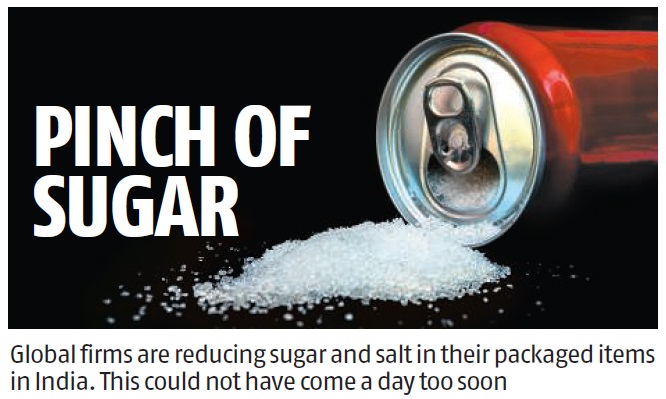
This drive is not confined to Mondelez. Other multinational companies, too, such as Coca-Cola, PepsiCo, and Nestle India, have been working on bringing down the sugar, salt, and sodium content. They could be patting themselves on the back for doing this. Not only has the Indian consumer become more health conscious than ever — with all the talk going around that salt and sugar are two of the monsters in your kitchen (the third being maida) — but also the country’s food regulator has swung into action.
On Saturday, the Food Safety and Standards Authority of India (FSSAI) approved a proposal that information about the sugar, salt and saturated fat content on labels of packaged foods and beverages should be bolder and bigger. “Along with empowering consumers to make healthier choices, the amendment will also contribute towards efforts to combat the rise of noncommunicable diseases and promote public health and wellbeing,” the FSSAI said in a statement.
Earlier, the regulator advised ecommerce platforms to ensure that dairy-, cereal-, and maltbased beverage mixes were not available under the “health drinks” or “energy drinks” categories. The recommended sugar intake is 20 grams a day for adults and 25 grams a day for those below 18. Not more than 5 to 10 per cent of a person’s total energy intake should come from sugar. Children under two are not supposed to consume any added sugar. However, these guidelines are often breached because people tend to consume packaged foods.
Therefore, experts and activists have been calling for a different labelling, which would announce out loud what lies inside.

Eating right, drinking right
Some multinationals had already been working on reducing the salt and sugar content. For instance, Coca-Cola removed more than 900,000 tonnes of added sugar globally since 2017, and 19 of its top 20 brands offer reduced-sugar or zero-sugar options. In India, Coca-Cola’s Minute Maid Honey Infused drinks offer added dietary fibre for healthy digestion in three flavours.
“In 2022, approximately 68 per cent of our global beverage portfolio contained less than 100 calories per 12-ounce serving (350 ml), with 246 low- or no-sugar options launched,” Coca-Cola India said in a statement to Business Standard.
The company added that it prioritised transparency by placing calorie information on the front of all its packaging worldwide and did not market its products directly to children under 13.
Nestle India joined the FSSAI’s Eat Right movement and signed the pledge to reduce an average of 6 per cent added sugar, 10 per cent salt, and 2.5 per cent fat in its relevant product categories. “The company has achieved these commitments,” it said.
Varun Beverages, PepsiCo’s India bottler, told its investors on a conference call that its gross margins improved significantly, rising by 385 basis points to 56.3 per cent — and sugar had a role to play in it.
“This increase was largely driven by our focus on reducing sugar content and the light-weighting packaging material, incidentally, also meeting our sustainability initiatives along with the benefits from reduced PET prices which contributed to this improvement,” Raj Pal Gandhi, chief financial officer of Varun Beverages, said on the investor call.
Approximately 46 per cent of the company’s reconsolidated sales volumes, he said, came from low-sugar or no-sugar products. The no- or less-sugar trend is working for the company as it optimises its cost structure and enhances its overall efficiency.
“These efforts have had a tangible impact on our financial performance with EBITDA increasing by 23.9 per cent to the level of Rs. 988.76 crore year-on-year, and the Ebitda margin improving by 240 basis points to the level of 22.9 per cent in quarter one of 2024 (January-March),” Gandhi said. Ebitda, a widely accepted benchmark of profitability, is short for earnings before interest, tax, depreciation, and amortisation.
“So, we are developing more and more — Gatorade, we mentioned a new launch which PepsiCo has given us formulation with zero sugar. So, effort is there, and constant effort is there to reduce the sugar content,” Gandhi said. PepsiCo India said in an earlier statement it had initiated trials of a blend of sunflower oil and palmolein oil in certain parts of its portfolio last year, thus becoming one of the few players in the food industry in India to do so.
Rush of junk
Experts say the standards for food and beverages vary across the world and India should have its own. “There should be thresholds for healthy and unhealthy and, in my view, this should be labelled boldly on the front of the pack,” says Arun Gupta, convener, Nutrition Advocacy for Public Interest (NAPi), a think tank.
A report titled The Junk Rush, jointly brought out by the Breastfeeding Promotion Network of India and NAPi, said: “India faces a severe public health crisis of obesity and diabetes.” In 2022, a group of public health experts, consumers, lawyers, and patient groups had called upon the government of India to check the soaring consumption of junk food among the country’s youth.
“Certain countries are more stringent than others. Even global brands have the same product, but the ingredients differ across countries and continents,” says Devangshu Dutta, founder of Third Eyesight. He explains that India still has some road to travel on food safety, alleging that some ingredients benefit companies more — such as by providing a longer shelf life — than the consumer.
“The Indian regulator is still very new to the game. If you look at processed foods, it is a newer market and the regulator needs to pick-up pace,” Dutta says.
On Saturday, the FSSAI picked up pace.
(Published in Business Standard)
admin
May 8, 2024
At the recent Phygital Retail Convention in Mumbai, Devangshu Dutta anchored an engaging “Fireside Chat” with Bhavana Jaiswal of IKEA India and Kapil Makhija of Unicommerce , on retailers engaging with their customers across channels and formats, and the opportunities as well as challenges in managing experiences seamlessly across online and offline interfaces.
Watch the video at this link:
admin
April 24, 2024

Mumbai, 24 April 2024
Sharleen Dsouza, Business Standard
With the Supreme Court cracking down on Patanjali over misleading advertisements, the advertisement industry is concerned. While industry players acknowledge that some degree of exaggeration in claims is common, the Supreme Court’s firm action signals an impending shift.
On Tuesday the SC said that its interest was not limited to Patanjali but all those Fast-Moving Consumer Goods (FMCGs) and drug companies that mislead consumers through their advertisements.
And Patanjali is not the first one to have crossed the line of puffery. There have been many cases in the past, like Horlicks Ltd versus Zydus Wellness Products where the former sought for a permanent injunction against Zydus for the broadcast of false advertisement.
Similarly, in Rajendra versus Union of India, the Bombay High Court restrained any good or service sale claiming it had supernatural and miraculous powers.
“Puffery in advertising is as old as advertising. There is always an element of exaggeration. Over the years, the government has looked the other way. Guys on the ground should take companies and brands to task and have largely been in cahoots with most of the brands,” said Sandeep Goyal, chairman and managing director of Rediffusion Brand Solutions.
Goyal believes that the SC coming down heavily on Patanjali would be a deterrent for other brands. “Puffery or not is for someone to figure out. In most food products, FSSAI doesn’t care. Who is to identify these ads? I think the SC has done something. This won’t deter other brands and get them to make claims which are within the realm of what is correct,” Goyal said.
A question of ethics
Industry experts point out that the primary objective of advertisement is to stimulate desire in the consumer’s mind. This happens by hook or by crook.
“Misleading a consumer has become inherent in advertising to a certain extent. I think this is dangerous when it comes to food, as it is basic nutrition. If you are embedding misleading information or mis-stating facts in ads then it has a real impact on whoever the customer or consumer is of that product. It is good that the issue has been highlighted,” said brand expert Devangshu Dutta, founder of Third Eyesight.
Then there is the Advertising Standards Council of India and discussions about ethical standards within the industry.
But Dutta believes there is a clear disconnect between what advertisements should say and what actually transpires. “I hope it gets acted upon from the government’s side as well. Self-regulation doesn’t seem to work. We all wish that it works, but it doesn’t. If it becomes more stringent, then it will be good overall,” he said.
While FMCG players are concerned about the stringent action of the Supreme Court, they believe that this will lead to improved advertisement regulation.
Ensuring compliance
Speaking on condition of anonymity, a senior executive of a leading FMCG company said, “The industry is already disciplining itself due to the growing consumer awareness, stringent ASCI guidelines and the impact of influencer marketing. This will further ensure that misleading ads will be few and far in the future.”
Some companies also ensure that their ads adhere to ASCI guidelines before launching them. “We run our ads with ASCI before we release them. This practice has worked in our favour,” said another executive on condition of anonymity.
In its hearing, the SC had said, “We are of the opinion that the issue relating to implementation of the relevant provisions of the Drugs and Magic Remedies Act and the Rules, the Drugs and Cosmetic Act and the Rules, and the Consumers Act and the relevant rules needs closer examination in the light of the grievances raised by the petitioner…not just limited to the respondents before this court but to all similarly situated/ placed FMCGs who have… misleading advertisements, and (are) taking the public for a ride… affecting the health of babies, school going children and senior citizens who have been consuming products on the basis of the said misrepresentation.”
(Published in Business Standard)
admin
March 18, 2024

Christina Moniz, Financial Express
March 18, 2024
It is not difficult to understand why e-commerce firm Flipkart wants a bite of the Q-commerce pie.
India’s quick commerce market has been growing year-on-year at 77% to reach $2.8 billion in GMV (gross merchandise value) in 2023, according to a Redseer report. In comparison, e-commerce has been growing at 14-15% year-on-year. No one would dispute that with instant deliveries of products and groceries in 10-20 minutes, quick commerce firms like the Zomato-owned Blinkit, Zepto and Swiggy Instamart have changed the face of e-commerce and retail over the past few years.
While quick commerce thrives, none of the players in this ring are profitable yet. According to Devangshu Dutta, CEO at Third Eyesight, most quick commerce firms are in an expensive market acquisition phase and are at least a year away from profitability — perhaps longer. He expects that the unit economics for these companies will improve. “Some of the quick commerce players have created a substantial consumer base, which is growing in the frequency of transactions, moving to higher order values and transacting more products with potentially better margins,” says Dutta.
Both Zepto and Blinkit expect to turn profitable in FY25, as per their public statements.
So what are the primary challenges? “Traditional large e-commerce players face obstacles in facilitating last-mile deliveries, establishing dark stores, managing supply chains effectively, and navigating fierce market competition,” says Anshul Garg, managing partner & head, Publicis Commerce India.
The other key challenge for the late entrants is that customers seldom switch platforms. This is different from the way customers shop for products like electronics on e-commerce, where they compare prices/ deals across multiple e-commerce marketplaces. Brands like Flipkart need to define their playbook by maybe exploring categories other than grocery if they are to make a dent in this market.
As things stand, quick commerce has a mere 7% of the potential market. The total addressable market is estimated at $45 billion, higher than food delivery, as per JM Financial. Blinkit leads the market with a 46% share, followed by Swiggy Instamart at 27%, and Zepto at 21%.
Growing-up pangs
Kushal Bhatnagar, associate partner at Redseer Strategy Consultants, explains that there are broadly three ways that Q-commerce firms are working towards profitability. The first is by pushing higher priced items on their platforms and bumping up higher average order values. They’re also foraying into non-grocery segments such as cosmetics and headphones.
The other lever is ensuring dark store efficiencies. “While dark stores are an added cost, most platforms have a solid understanding of the demand across micro markets and are able to extract better profitability from each dark store. So the trend is positive, even if profitability is still to be achieved,” explains Bhatnagar.
For a dark store to deliver ROI and become profitable, it needs to cross 1,200-1,300 daily orders.
Some players like Zepto are also experimenting with a nominal platform fee of Rs. 2 per order, which they sometimes increase during peak times — by up to Rs. 10 — to gain from a surge in demand. Some are also implementing 12-15% fees for orders under Rs. 500, nudging customers to spend more.
Ad revenue is another important lever driving growth for these platforms, especially as D2C brands hop on board and advertise on them to reach GenZ and millennial consumers in metros and tier-I markets. Advertising revenue is around 3% of a platform’s GMV, and it is expected to keep growing.
FMCG and F&B are the top advertising categories on quick commerce currently but that can change as platforms move into higher value categories. “Quick commerce is also venturing into unconventional categories such as electronics, mobile and large appliances. If all goes according to plan, we can anticipate a significant shift in advertising contribution, given that these categories boast higher average selling prices, prompting advertisers to adopt a slightly more aggressive stance,” says Shashank Rathore, vice-president, e-commerce at Interactive Avenues (IPG Mediabrands India).
(Published in Financial Express)
admin
February 23, 2024
Kailash Babar & Sagar Malviya, Economic Times
Mumbai, 23 February 2024
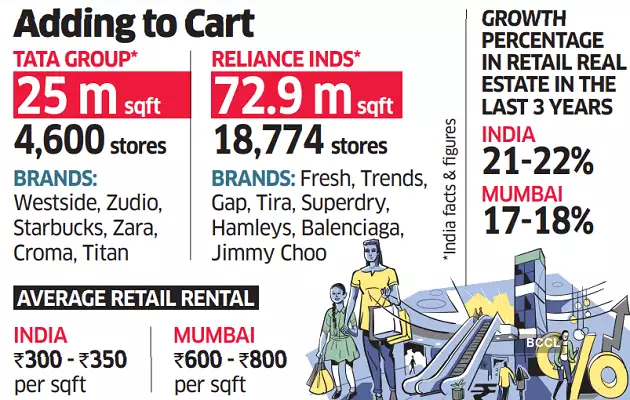
Tata Group and Reliance Industries, two of India’s largest conglomerates, are vying for premium retail real estate in Mumbai as they extend their footprints, creating rivalry in a city starved of marquee properties. From Zara and Starbucks to Westside and Titan, the Tata Group occupies nearly 25 million square feet of retail space in India. That is still no match for Reliance Industries that control three times more at 73 million sq ft for more than 100 local and global brands.
But in Mumbai, they are evenly matched, having nearly 3 million sq ft of retail space each. That is a quarter of what is considered the most prime retail real estate in the country, and both the retail giants are looking for more.
“In a modern retail environment, most visible locations contain more successful or larger brands. It just so happens that many of those brands are owned by either Reliance or the Tatas,” said Devangshu Dutta, founder of Third Eyesight, a strategy consulting firm.
“Tatas have been in retail for longer but also slower to scale up compared to Reliance which had this stated ambition of being the most dominant and put the money behind it,” he said.
In a market where demand is much higher than supply, developers and landlords seek to separate the wheat from the chaff, experts said. Ultimately, success in Mumbai’s retail real estate scene hinges on a delicate equilibrium between accommodating industry leaders and fostering a vibrant, varied shopping environment, they said. “In the competitive landscape of retail real estate in Mumbai, commercial developers and mall owners often face the strategic challenge of accommodating prominent retail brands,” said Abhishek Sharma, director, retail, at commercial real estate consultants Knight Frank India.
“These big brands, with a significant market share of 40-45% in the Indian retail sector, can easily be termed as industry giants and possess the potential to command 45-50% of space in any mall,” he said. According to Sharma, there may be perceptions of preferential treatments, but the dynamics are complex, and developers must balance the demand from these major brands with the need for a diverse tenant mix.
Tata Group entered retail in the late 1980s, initially by opening Titan watch stores and a decade later by launching department store Westside. So far, it has about 4,600 stores, including brands such as Tanishq, Starbucks, Westside, Zudio, Zara and Croma.
While Reliance Retail started in 2006, it overcompensated for its late entry by aggressively opening stores across formats. Reliance has over 18,774 stores across supermarkets, electronics, jewellery, and apparel space. It has also either partnered or acquired over 80 global brands, from Gap and Superdry to Balenciaga and Jimmy Choo. A diverse portfolio of brands across various segments through strategic partnerships and collaborations helps an entity like Reliance to leverage synergies and enhance retail presence, especially in malls, experts said.
“The array of brands with Reliance bouquet allows it to enter early into the project and set the tone and positioning of the mall,” said a retail leasing expert who requested not to be identified.
“This positively helps the mall to set its own positioning and future tenant mix. It also helps Reliance place their brands in most relevant zones within the mall. This will emerge as a clear differentiator in a city like Mumbai where brands are already jostling for space, which is the costliest in the country,” the person added.
(Published in Economic Times)
