
Devangshu Dutta
June 8, 2010
REVIEW: FLIP THE FUNNEL: Joseph Jaffe (John Wiley & Sons)

I’ve read Joseph Jaffe’s book across multiple air journeys, nationally and internationally. I agreed with the principles described and saw parallels with excellent services businesses over the past few years. However, the implications didn’t quite strike me in the gut until I realised – while writing this on board an aircraft – that the journeys I had taken with this book had also been with just one airline.
My loyalty to this airline is not because of the mileage card I hold, although their mileage programme is certainly among the best in the world. It is not because they were the cheapest or the most on-time, though they compete favourably with other comparable airlines.
My loyalty to them is because of what they did during the Mumbai floods in July 2005. Those who remember the chaos, through personal experience or through media, wouldn’t blame airline staff for abandoning their counters, and leaving the airport to try and reach home as early as they could. Certainly most of them must have felt helpless in the face of increasingly desperate passengers who couldn’t expect to depart any time soon. Jet Airways stood out as being the only one in Mumbai’s Terminal 1-B whose team felt responsible enough to stay back at the airport to be available to the passengers. Not only did they ensure that the passengers stuck in the terminal were safe, but that all waiting passengers got three meals a day! Whether or not they were flying with Jet Airways.
Now, in telling you about incident, I have closed the loop and given you a living example of the “flipped funnel” that Jaffe describes in the book.
The normal marketing funnel is described by the process Awareness, Interest, Desire and Action (or “AIDA”) which underlies the spray-and-pray approach of traditional marketing. The result of AIDA is that a lot of customers become aware of a business, brand or product. Some are interested enough to seek out the product. However the number who move on to the next stage of actually expressing desire to buy is lower, and those who actually buy are fewer still, as amply demonstrated by carts being abandoned before actually checking out.
Jaffe points out that the AIDA principle was created in times of abundant growth in the US, but is a suicidal funnel to fall into when resources are scarce. It is lopsided, with more money being spent on customers who will not buy. It is linear and does not capture the complexity of buying behaviour. It is open and incomplete because it only handles potential customers up to the point where they become actual customers, but does nothing with them thereafter. AIDA also inherently assumes customer churn, hence the opening focus on creating awareness among potentially new customers.
The alternative principles Jaffe describes are simple: getting more customers to buy from us and more often (repeat purchases), to spend increasing amounts with us (loyalty), and finally, to recommend us to their friends and associates (referrals). However, to do this requires dramatically different thinking from AIDA spray-and-pray. Jaffe’s alternative model – ADIA (Acknowledgment, Dialogue, Incentivisation and Activation) – focuses on customers more than prospects.
Acknowledging customers itself is such a major stumbling block for so many companies, such as the retailer whose front-line staff would prefer to fold and put away garments than meeting the eyes of the customer who has walked into the store. In some cases it may be about using technology effectively rather than as a barrier. When the taxi company can recognise the number you are calling from and close your order in less than 120 seconds, why does the telephone company that issued that number make you jump through burning hoops for 5-10 minutes before they will allow you to request a duplicate bill?
That acknowledgement should lead to an on-going dialogue, before, through and well after the purchase is done. This would be supported by constant incentives for the customer to buy more from you. It is not about having a loyalty programme, as Jaffe quotes studies that demonstrate that loyalty programmes alone don’t produce loyalty; in fact there are enough businesses that do not run loyalty schemes but have what can only be called fan followings.
The final link in that funnel is building that community of evangelist enthusiasts who will carry your brand message farther and far more effectively than any traditional form of marketing could. Religious organisations have known this for thousands of years – it is high time that businesses and other organisations recognised the power of the community as well.
Jaffe acknowledges that Seth Godin actually came up with the term “flipping the funnel” over 3 years ago, when he released the e-book of that name (available on sethgodin.typepad.com) primarily about using social media effectively. Jaffe, to his credit, has applied the principles more fully across the marketing and customer service process.
Jaffe recently sold his business, crayon, but has kept his title “Chief Interruptor” at the acquiring company. If you want to make your marketing really pay, you’ll find it worthwhile letting “Flip the Funnel” interrupt your normal marketing thought-process.
(This review was written for Businessworld.)
Devangshu Dutta
May 31, 2010
Are you being carried, or are you carrying others?
To know the answer to that question, bear with me while I take you on a short mental journey through the emerging landscape of “ethical business” and to the stories at the end of this piece. (Okay, you can cheat and skip ahead, but I would really prefer you to read through the whole thing.)
For the most part sustainability and responsibility – or “corporate social responsibility” (CSR) to use the proper jargon – is seen as more relevant to the western economies, rather than the emerging economies like China, India and Brazil.
The pressure to do the ‘right thing’ is like a carpenter’s vice, whose one jaw is public opinion and the other is regulation, together squeezing ever tighter on corporate business. Clearly, there is a significant portion of customers in western markets who are vocal in expressing their opinions on business practices that are seen as wrong or unethical. On the other side, judicial implementation of regulations is also extremely stringent.
In fact, in the last 10-15 years CSR and sustainability have become far more important to top management in western economies since the real penalties in terms of negative impact on the brand and financial penalties through regulation and litigation are extremely high. Multi-billion dollar businesses certainly have much at risk, as demonstrated by well-documented PR disasters of large brands and retailers in the last decade or so. The variety of issues they have faced has covered sweatshop factories, child-labour, product safety, food adulteration and many others.
Since the mid-1990s there has been a steady increase in CSR initiatives, or at least an increase in initiatives that are labelled under the CSR umbrella. There is no doubt that there is good intent behind many CSR initiatives.
Some of these are focussed on improving the core business processes and practices of the company, and have measurable improvement goals that also have a positive impact beyond the company itself. These can truly be called socially-responsible corporate initiatives.
However, one can’t help but question many others which are fuzzy in their impact on both within the business and outside. The motivation of this type of initiative seems to be a two-pronged PR effort: firstly to get positive PR for “good work” mostly unrelated to the business and secondly, more importantly, to avoid negative PR for poor or questionable business practices in the company’s mainstream products or services.
Lest I sound too cynical about the corporate efforts, let me say this: there is also lack of clarity and agreement in non-corporate circles about what constitutes “corporate social responsibility” or “responsible business”. The label is relatively new to mainstream management thinking and very mutable. Social responsibility, ethical business, sustainability are all terms that are broad-based, used interchangeably, and are open to interpretation which can change with the context. (I wrote about this in an earlier column “Corporate Responsibility – Beyond Babel” about 18 months ago.)
And that brings me to four separate incidents that happened recently, which are (in hindsight) neatly threaded together with a common thought process. (Thank you for your patience so far!)
The first was a discussion recently initiated by an international organisation about what could motivate Indian brands and retailers to make moves in the area of corporate responsibility, whether regulations needed to be tighter or whether it would be consumer pressure that would bring about a change. The underlying assumption – right or wrong – was that, as corporate entities, Indian retailers and brands were not sufficiently motivated to take significant and visible steps towards making their businesses more sustainable and socially responsible than their current state. The discussion was inconclusive, with many different, all potentially valid, points of view on the subject.
Very soon thereafter, I had the opportunity to participate in a dialogue with Gurcharan Das, the philosopher-author who, in his last corporate role, was Managing Director – Strategic Planning for Procter & Gamble worldwide. The dialogue primarily centred on his latest book: “The Difficulty of Being Good”. There was much debate and discussion on the wider consequence of individual actions and especially of those in positions of authority, highlighting the importance of individual choices.
A few days later, in a totally different context and with an entirely different person, the third incident occurred, when I was told an updated version of an old story to demonstrate the power of “a few good men” (and women). The story was as follows:
“50 people were travelling in a bus. Part-way through the journey, the weather suddenly turned stormy, with massive thunder and lightning bolts cracking all over the place. At times it seemed as if lightning would strike the bus and kill everyone on board. Then, someone proclaimed that there was someone on the bus whose end had come, who the lightning was seeking, and that it would be better for everyone else to get that person off the bus. The driver stopped the bus, and each person was sent off by turn, to go and touch a tree at a distance. 49 people got off the bus and returned unharmed after touching the tree. Then, as the last person got off and walked away from the bus, the bus was struck by a massive bolt of lightning.”
I thought this was a gruesome but effective moral science tale! During the next few hours I went about my activities, but kept mulling over the lesson(s) in that little story.
Then, that very afternoon, I got an email containing the following thought: “…when it looks like the whole place is going to implode – with pollution, disease, and war; famine, fatigue, and fright – there are still those who see the beauty. Who act with kindness. And who live with hope and gratitude. Actually, they carry the entire planet. (Mike Dooley)”
In looking back to the article 18-months ago, I closed the loop: it is the individual manager, who is also a citizen in a community, a consumer, and as a parent a stakeholder in future generations, who has to make the choices. His or her choices – both right and wrong – do have an impact beyond his or her own life and business. The so-called triple bottom line – profit, people (community) and planet (environment) – are irrelevant unless the first question is answered: “what does this mean for me?”
So as we go about our day, launching and growing brands, opening new stores, creating new products, I offer you this thought to reflect upon: are we carrying, or being carried? Is the bus safe because of us, or are we the ones the lightning is seeking?
[Go to the earlier post: “Corporate Responsibility – Beyond Babel“, December 2008]
Devangshu Dutta
January 5, 2010
If we were to look at phrases that have cropped up during the recent recessionary times in the consumer goods sector, “private label” has to be among those at the top of the list.
From clothing to cereals, toothpaste to televisions, there is hardly a category that has not seen retailers trying their hand at creating own labelled products.
The first motivation for most retailers to move into private label is margin. On first analysis, it appears that the branded suppliers are making tons of extra money by being out there in front of the consumer with a specific named product. The retailer finds that creating an alternative product under its own label allows it to capture extra gross margin. Typically the product category picked at the earliest stage of private label development would be one for which several generic or commodity suppliers are available.
At this early stage, the retailer is aiming for a relatively predictable, stable-demand and easily available product whose sales would be driven by the footfall that is already attracted into the store. A powerful bait to attract the customer is the visible reduction in price, as compared to a similar branded product. If the product can be compared like-for-like, customers would certainly convert to private label over time.
However, maintaining prices lower than brands can also be counter-productive. In many products, while customers might not be able to discern any qualitative difference, they may suspect that they are not getting a product comparable to one from a national or international brand. And while private label can drive off-take, the price differential can also erode gross margin which was the reason that the retailer may have got into private label in the first place. Over time, such a strategy can prove difficult to sustain, as costs of developing, sourcing and managing private label products move up.
The other strong reason a retailer chooses to have private label is to create a product offering that is differentiated from competitors who also offer brands that are similar or identical to the ones offered by the retailer. Department stores, supermarkets and hypermarkets around the world have all tried this approach – some have been more successful than others. The idea is to provide a customer strong reasons to visit their particular store, rather than any of the comparable competitors.
Of course, when differentiation is the operating factor, the products need more insight and development, and closer handling by the retailer at all stages. A price-driven private label line may be sourced from generic suppliers, but that approach isn’t good enough for a line driven by a differentiation strategy. In this case, costs of product development and management increase for the retailer. However, to compensate, the discount from a comparable national brand is not as high as generic nascent private label. In fact, some retailers have taken their private label to compete head on with national brands – they treat their private labels as respectfully as a national branded supplier would treat its brand.
So what does it take to go from a “copycat” to being a real brand?
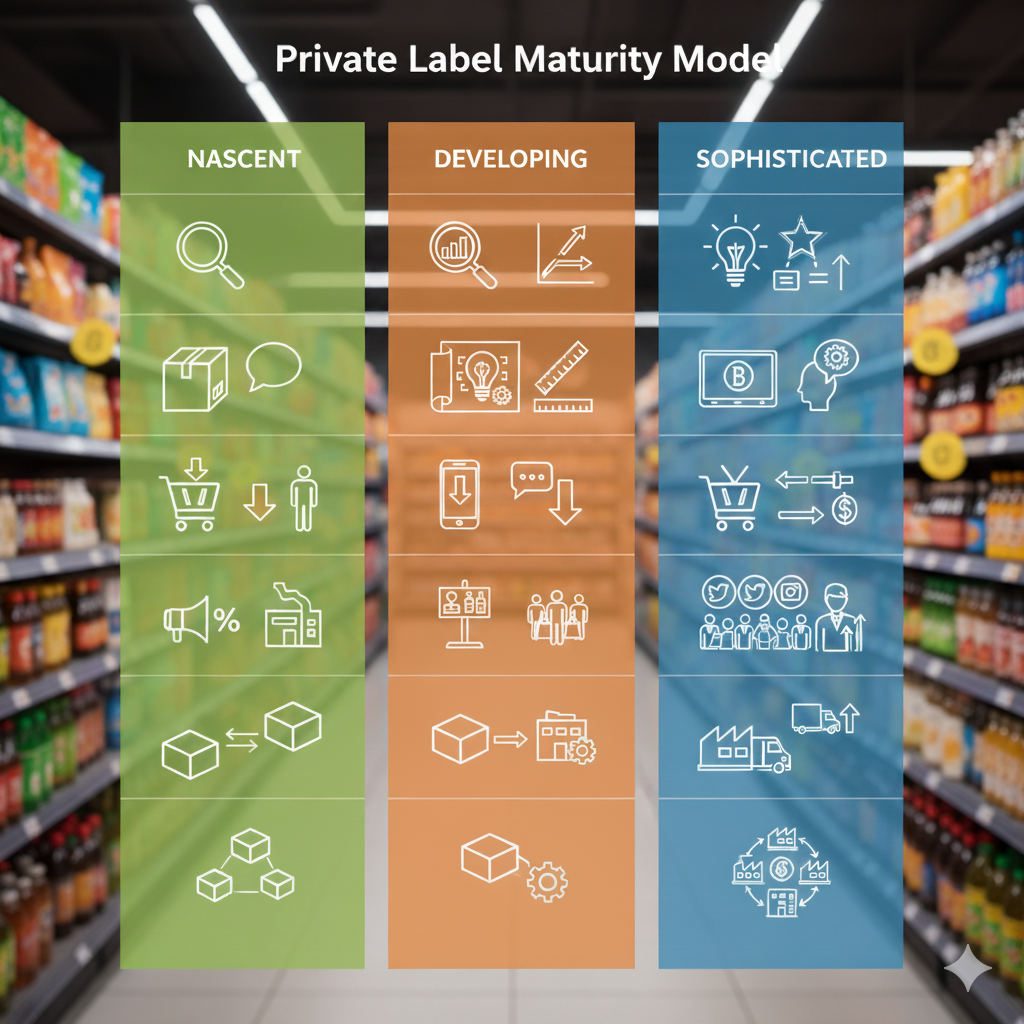
Third Eyesight has evolved a Private Label Maturity Model (see the accompanying graphic) that can help retailers think through their approach to private label, whether their product offering is dominated by private label, or whether they have only just begun considering the possibility of including private label in their product range. The model sketches out a maturity path on five parameters that are affected by or influence the strength of a retailer’s private label offering:
In some cases, retailers may have multiple labels, some of which may be quite nascent while others might be highly evolved, clear and comparable to a national brand. This could be by default, because the labels have been launched at different times and have had more or less time to evolve. However, this can also be used as a conscious strategy to target various segments and competitive brands differently, depending on the strength of the competition and their relationship with the consumer.
The interesting thing is that size and scale do not offer any specific advantage to becoming a more sophisticated private label player. Some extremely large retailers continue to follow a discounted-price “me-too” private label strategy where even the packaging and colours of the product are copied from national brands, while much smaller players demonstrate capabilities to understand their specific consumers’ needs to design, source and promote proprietary products that compare with the best brands in the market.
For a moment, let’s also look at private labels from the suppliers’ point of view. As far as we can see, private label seems to be here to stay and grow. Suppliers can treat private labels as a threat, and figure out how to ensure that they retain a certain visibility and relationship with the consumer. On the other hand, interestingly, some suppliers are also looking at private label as an opportunity. They see the growth of private label as inevitable, and would much rather collaborate in the retailer’s private label development efforts. This way they can maintain some kind of influence on the product development, possibly avoid direct head-on conflict with their own star branded products and, if everything else fails, at least grab a share of the market that would have otherwise gone over to generic suppliers.
If you are retailer, I would suggest using the Private Label Maturity Model to clarify where you want to position yourself, and continue to use it as a guide as you develop and deliver your private label offering.
If you are a supplier concerned about private label, my suggestion would be to gauge how developed your customer is and is likely to become, and ensure that you are at least in step, if not a step ahead.
Of course, if you need support, we’ll only be too happy to help! (Contact Third Eyesight to discuss your private label needs.)
Devangshu Dutta
April 27, 2009
Retailwire.com prompted a discussion on what, if anything, should grocers and other stores be doing to accommodate the growth in stay-at-home dads?According to the US Bureau of Labor Statistics, the recession is putting more men out of work than women, which has led to an increase of stay-at-home dads who are increasingly taking on the traditional women’s roles of childcare, housework, school life, and shopping.
Here’s my contribution to the Dad wishlist: salespeople who don’t look down their noses when asked a (“stupid”) question Mom would never have dreamt of asking. (Also, considering this is the gender that apparently never stops to ask for directions, please treat the question as close to a life-or-death emergency.)
Devangshu Dutta
April 15, 2009
The organic movement has touched a variety of products, including clothing, cosmetics and home products. Possibly the most emotive area is organic food, because food products are directly taken into the body while other products have a limited and external contact.
In a sense, before the appearance of industrial agriculture and the application of synthetic nutrients and pesticides, all farming was organic. In fact, the traditional Sanjeevan system of India dates back several millennia.
Even the existing organic farming movement has been around since its founding in Europe in the early-1900s. This was initially treated as fad and its proponents were seen as eccentric (at best) or insane. However, as damage to the environment and to human health became a bigger concern, organic farming emerged as the healthier option.
Organic farming is based on the following fundamental premises:
The aim is to drive a more healthy approach all around – for the environment, for people, as well as for the animals and plants.
The organic trade (all products) is currently estimated at over US$ 40 billion globally, with an annual growth of approximately US$ 5 billion. Organic production is driven today more by demand than by supply – in many cases supply constraints of certified organic produce is more of a concern than the market demand.
Every year, increasing numbers of consumers consciously buy organic products regularly or occasionally on the basis that it is good for them and good for the planet. Certainly, true organic farms do not use synthetic materials, avoiding damage to the environment and can help to retain the biodiversity. Whether measured by unit area or unit of yield, organic farms are more sustainable over time as they use less energy and produce less waste.
It is not as if, after decades of individual enthusiasts pushing their ideas from the fringes, consumers have suddenly become more environmentally conscious. This mainstream awareness has possibly been pushed up in recent years by the involvement of large companies which have spotted the tremendous growth of a profitable niche. “Organic” is the new speciality or niche product line that can be priced at a premium due to the greater desirability amongst the target consumer group, with potentially higher profits than inorganic products or uncertified products. Today, at least in the two largest markets (the USA and Europe), large companies have the lion’s share. For instance, statistics from Germany show that in 2007 conventional retail chains sold over 53% of organic produce, while specialist organic food retailers and producers lost share during the year. Similarly in the US, after the development of the USDA National Organic Standard in 1997, significant merger and acquisition activity has been visible.
However, as the interest in organic products has grown, so have the noise levels in the market. With that the potential for confusion in customers’ minds has also grown.
In day-to-day conversations, we tend to treat organic as superior to inorganic. But the reality is a little bit more complex.
For instance, we expect organic products to contain more nutrition and be better for our bodies. While this may be true of organic animal products compared to their inorganic counterparts, it has not been demonstrated for plant products, other than anecdotal experience of taste and appearance.
There are studies that suggest that inorganic farming can produce more crop per acre and more meat per animal, and is, therefore, the better option for a planet bursting with overpopulation. (Some proponents extend that argument to genetically modified foods as well, but let’s stay away from that for the moment.)
However, there are also other studies that counter this argument by suggesting that the organic farms can end up being more efficient and productive in direct costs, yield and long-term sustainability.
Then, the big question is: if organic foods are no better nutritionally than inorganic and could be as productive for the farmer, are organic brands just skimming the gullible customer while the going is good?
We might expect certification and regulation to clear the air, but in many instances these leave out as many things as they include. Labelling is yet another concern. Countries where labelling is more stringently monitored allow logos such as “100% organic”, “organic” (more than 95% organic ingredients) and “made with organic ingredients” (over 70% organic ingredients). In other countries logos and where labelling may be less strictly monitored, the use of the term organic is far looser and even more confusing. What’s more, the usage of terms such as “Bio” or “Eco” can also mislead consumers into believing that there is something distinctly superior about the product they are about to buy when, in reality, it is often only a marketing gimmick.
Further, just because something is certified as organic does not mean it is a higher grade of product. Organic produce may end up having a shorter shelf-life, or may also be otherwise inferior to inorganic produce in the store. In fact, as the KRAV (Sweden) website states: “The KRAV logo is a clear signal that the product is organically produced but does not say anything about the quality. That must be guaranteed by the producer, i.e. yourself”. This is similar to saying that the fact that someone has a management certification from a certain institute means that he or she passed the tests of that institute in a particular year, but that does not automatically make him or her a good businessperson.
Countries and regions that have a poor record of environmental consciousness, poor transparency norms, are also not seen as the best source for organic produce even if it is apparently from a certified producer. In some cases, certification may be carried out second-hand and unverified, leading to instances such as the one in 2008 where the US retailer Whole Foods pulled out pesticides-laden “organic-certified” ginger that was shipped from China. The mixing of inorganic ingredients of uncertain origin, especially in blended products such as juices or snacks, can also make a mockery of the organic labelling.
Another visible concern today is the carbon footprint, and some people raise the question whether buying local (whether inorganic or organic) may be less environmentally damaging than importing produce from distant countries. In such instances, the evidence of lax certification, such as the Chinese case mentioned earlier, takes support away from the cause of organic imports.
Arguments have also been raised about whether the larger “organic” factory farms merely follow the letter of the law rather than the principles behind the organic movement? Small organic farmers allege that large organic-certified factory farms – especially those selling animal products – do not really follow the core principles of “natural” growth, and confine their animals in unnatural surroundings.
With all these arguments and counter-arguments flying about, some organic (or nearly organic) producers elect not to be certified, letting their customers vote with their wallets. Some of these smaller farmers may be driven by economic necessity since certification could be costly and cumbersome, while others may just find it more feasible to stick with a local sales strategy where the customers are able to physically see the organic nature of the farm.
It’s clear that all of these questions will take years to sort out – through debate, research, legislation, as well as social and commercial pressure. Meanwhile, most conscientious retailers and concerned consumers will need to do their own studies to educate themselves, and will need to examine each product for genuineness of the organic promise.
And, if you are not quite that savvy, the final message would be: “caveat emptor” (“let the buyer beware”).

