
admin
February 14, 2026

This episode of theUpStreamlife is a freewheeling conversation between Vishal Krishna and Devangshu Dutta, founder of Third Eyesight, with insights into the growth of modern retail and consumption in India, brand building and M&A, the balance of power between brands and retailers/platforms, sustainability vs growth and many other aspects, and is well-suited for founders and teams who want to be building for the long run in India.
admin
February 12, 2026
Vaeshnavi Kasthuril, Mint
Bengaluru, 6 February 2026
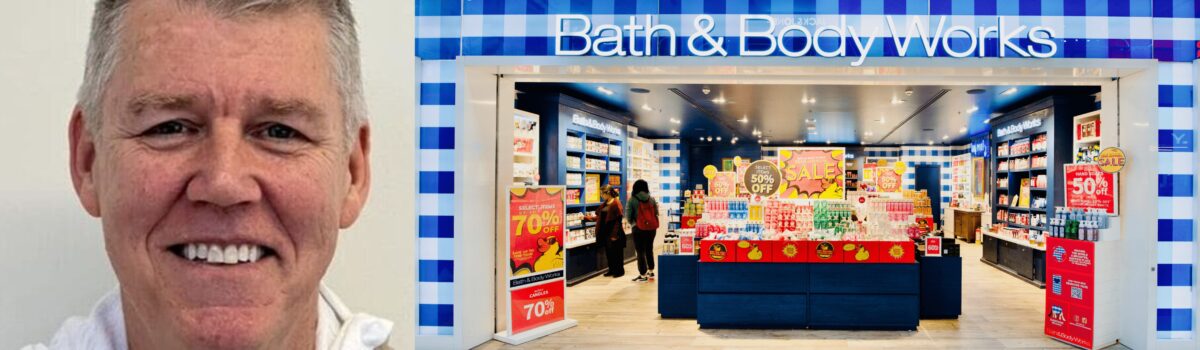
Global fragrance maker Bath & Body Works Inc. is betting on a reset to revive growth after years of heavy discounting and weak product innovation dulled its brand momentum across markets. The Columbus, Ohio-based retailer is pivoting to a “consumer-first” formula strategy centered around upgraded formulations, more disciplined marketing, and fewer promotions.
The reset matters as India is emerging as one of the company’s fastest-growing and best-performing markets and is also becoming a testing ground for how the brand evolves its retail model. India now ranks among Bath & Body Works’ top five international markets by growth.
“We’re seeing strong engagement across stores (in India), digital marketplaces and even quick commerce, which gives us confidence as we evolve the brand and introduce more innovation,” said Tony Garrison, global vice president at Bath & Body Works, in an interview with Mint.
The fragrance maker entered India in 2018 in partnership with Dubai-based Apparel Group and has since expanded to about 50 stores across major metros, while also building an online presence through platforms such as Nykaa, Myntra, and Amazon. Apparel Group brings over 80 global brands to India, including Victoria’s Secret, Charles & Keith, Aldo, Crocs, and Tim Hortons.
“We’re learning a lot from how the Indian consumer shops across platforms, especially the speed and convenience expectations,” Garrison said. “It’s helping us think differently about assortment, pack sizes and how we show up digitally”.
Even as discretionary spending softened, the brand’s franchise partner, Apparel Group, delivered double-digit sales growth in India and high single-digit comparable store gains in FY25. It reported a 26% year-on-year jump in FY25 revenue to ₹1,118 crore and a net profit of ₹20.5 crore, reversing a loss in the previous year.
Globally, Bath & Body Works’ earnings reflect soft consumer demand as well as margin pressures. Its revenue declined 1% to $1.59 billion in the third quarter of FY25, while net income fell 27% year-on-year to $577 million.
Reviving the fragrance engine
While legacy scents such as Japanese Cherry Blossom, Champagne Toast, and Thousand Wishes remain global blockbusters, the company admits it hasn’t produced enough new hits at a similar scale in recent years. Japanese Cherry Blossom is a $250 million fragrance.
“I think we haven’t done the best job of keeping up with some of the fragrance trends. We haven’t done a lot of innovation, and that’s what you’re going to see this year. This is a big change year for us,” Garrison said.
The company plans to elevate its home fragrance portfolio, bringing in more premium candle collections, gift-ready packaging, and deeper, more sophisticated scent profiles. The broader goal is to encourage shoppers to trade up within the brand rather than wait for markdowns. “We want customers to see the value in the product itself… not just the promotion,” Garrison said.
New retail formats
To test new retail formats, the company and Apparel Group plan to pilot a small “neighbourhood store” format of roughly 500 square feet in select non-metro markets later this year. These stores will focus heavily on core body care lines and hero fragrances, while creating a more discovery-led environment for first-time shoppers.
India is also emerging as a key market in testing how far premiumisation can go. Garrison noted that the company has not seen a slowdown locally: “India has actually been one of our strongest markets in the post-Covid period. Even when consumers are careful, they still spend on small luxuries that make them feel good”.
What experts say
Retail experts caution that the reset in India won’t be without challenges. Devangshu Dutta, founder of Third Eyesight, noted that brands often fall back on discounting when volumes don’t come through. He added that the personal care market has become intensely crowded, making brand clarity critical.
While the brand is leaning into quick commerce and smaller stores, Dutta cautioned that premium brands still need larger formats to build experience-led differentiation. “Neighbourhood stores can be spokes, but you still need the hub—the large store—to communicate the brand experience,” he said.
Race Intensifies
The turnaround plan comes at a time when rivals, including The Body Shop and Forest Essentials, are also vying for the Indian consumer’s wallet. The Body Shop plans to achieve ₹1,100 crore in revenue in India within the next three to five years. India’s fragrance market was valued at $1.0 billion in 2024 and is projected to grow at a 13.9% CAGR to $3.23 billion by 2033.
(Published in Mint)
admin
January 15, 2026
Sagar Malviya, ET Bureau
Mumbai, 15 January 2026
It’s mostly a tale of two halves for top western fashion labels in India after the runaway sales and retail expansion in the years soon after the pandemic.
While Marks & Spencer, Benetton, and Adidas are battling waning demand, Uniqlo and Nike are gaining fresh ground, reflecting wider choices and increasingly discerning buyers in one of the world’s fastest-growing consumer economies.
Spanish brand Zara is facing stagnant growth while it tapered off at Apparel Group, which sells Aldo, and Charles & Keith brands in India. Experts termed the divergent sales performance as a potential structural shift instead of demand slowdown in India’s fashion and lifestyle market.
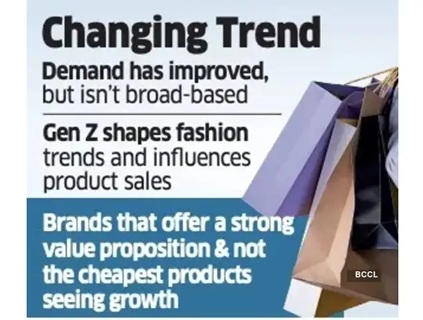
Devangshu Dutta, founder of retail consulting firm Third Eyesight, said consumers have clearly shifted towards function, even as trend-led brands continue to exist though they tend to be comparatively smaller. Some brands are also finding it harder to set or even follow trends the way they once did.
“This is especially true for Gen Z, which stays closely tuned to global trends and acts as the primary driver of fashion adoption,” said Dutta. “While older consumers may have greater spending power in absolute terms, it is younger shoppers who shape trends and influence product sales.”
Growth slowed across most leading retailers and fast-fashion brands in the country in FY24 as high inflation and stagnant incomes crimped discretionary spending.
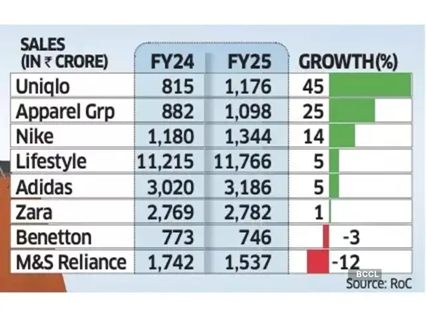
While the trend remained the same for many even in FY25, select brands staged a strong rebound. For instance, Nike India’s sales rose 14% in FY25, up from a 4% increase in the previous year, while Uniqlo accelerated growth to 45%, from 31% in FY24.
Revival after Festive Season
Even Lifestyle, India’s biggest department store chain, grew 5% last fiscal, rebounding from a 4% decline in FY24.
Uniqlo said it continues to see steady momentum in India, supported by strong customer response, retail expansion, rising brand awareness, and a strong ecommerce uplift. “India is now among Uniqlo’s fastest-growing markets in Asia and plays a meaningful role in the region’s overall business,” Kenji Inoue, chief financial officer and chief operating officer, Uniqlo India told ET. “The country’s young demographic, growing focus on quality, and increasing appreciation for functional everyday clothing have all contributed to this progress.”
According to the Retailers Association of India (RAI), sales growth in organised retail segments such as apparel, footwear, beauty and quick service restaurants (QSR) saw single-digit sales growth last fiscal year but the market has recovered after the festive season with double-digit sales performance.
“Demand has improved, but it isn’t broad-based,” said Kumar Rajagopalan, chief executive at RAI which represents organised retailers. “With more fashion options available, Indian consumers are becoming more selective, and growth is coming to brands that offer a strong value proposition and not the cheapest products, but those where prices are justified by innovation, design and quality.”
In FY25, Apparel Group recorded a 25% sales growth, slowing from a 37% increase a year ago. Inditex Trent, which sells Zara in India, saw flat sales compared with an 8% growth in FY24.
Adidas too saw its revenue growth rate slowing to 5% from 20% in the previous fiscal. Sales of M&S and Benetton fell 12% and 3% each, respectively.
Being the world’s most populous nation, India is an attractive market for apparel brands, especially with youngsters increasingly embracing western-style clothing. However, most international and premium brands have been competing for a relatively narrow slice of the sales pie in large urban centres.
(Published in Economic Times)
admin
September 24, 2025
Shabori Das & Sagar Malviya, Economic Times
Bengaluru/Mumbai, 24 September 2025
Chinese fast-fashion platform Shein plans to triple the number of launches in India and shrink its design-to-launch timeline by a third to deepen its push into an increasingly competitive market, a top official said.
The company, which re-entered India through a partnership with Reliance Retail in February this year, said it is overhauling its supply chain to enable faster turnaround times. To achieve this, it has moved away from large-scale manufacturing hubs to smaller production lines with each line focused on creating a single new design daily.
“Our current timelines, measured from ‘thought to site’, stand at 46 days. We are targeting 30 days,” said Vineeth Nair, chief executive of Reliance’s fashion platform Ajio that steers Shein in India. “We currently deliver 320 styles a day – about 10,000 a month – and plan to scale that to over 30,000 styles monthly in the coming months,” he told ET.
Speaking about the speed of manufacturing, Nair said, “We quantify our options in terms of production lines, with each line optimised to deliver one design option per day, rather than factories. Some of our large production units have been repurposed into multiple lines.”
Shein first launched in India in 2018 with its own online shop. However, the app was banned by the Ministry of Electronics and Information Technology (MeitY) along with TikTok, WeChat and over 55 other Chinese apps.
One of the primary issues and controversies surrounding Shein’s India operations was the use of the consumer data by the Chinese apparel retailer.
Under the current partnership model, Reliance Retail is operating Shein under licensing agreement and ensures complete customer data ownership as per the company.
Unlike international markets, Shein India products are made in India.
“It’s still early days – just about three months since we introduced Shein to the India Gen Z,” Nair said. “And we are still in the process of adding multiple products, which we intend to do in the next few months.”
He said the brand is witnessing two million daily average users, dominated by 21-year-old women who account for 62% of the traffic.
Shein, the world’s biggest ecommerce-centred fashion retailer, however, may find it hard to replicate its global success in India, according to Devangshu Dutta, founder of retail consulting firm Third Eyesight.
“Shein’s edge internationally has been its speed of dropping its products, and the width of its product category. The India model is not the same. The India model of fashion is slower, and the product category width is not as large,” he noted. “Hence, the brand will in all probability end up competing with the already established market like Myntra, Zudio and the likes.”

(Published in Economic Times)
admin
August 21, 2025
Praveen Paramasivam, Reuters
August 21, 2025
Summary
India's luxury beauty market to quintuple by 2035
Domestic brands account for less than a tenth of sales
Global brands modify offerings for India
India’s luxury beauty market is expected to quintuple to $4 billion by 2035 from $800 million in 2023, driven by its young, affluent, social-media savvy shoppers with rising disposable incomes, consulting firm Kearney and luxury beauty distributor LUXASIA said in a report.
Luxury beauty makes up just 4% of the $21-billion beauty and personal care market, compared with 8% to 24% across top Southeast Asian countries and 25% to 48% in developed markets including China and the United States.
That means there is plenty of room for growth.
“India is the last bastion of growth for premium beauty,” said Sameer Jindal, managing director for investment bank Houlihan Lokey’s corporate finance business in India.
“The Indian consumer is willing to experiment and try out new things.”
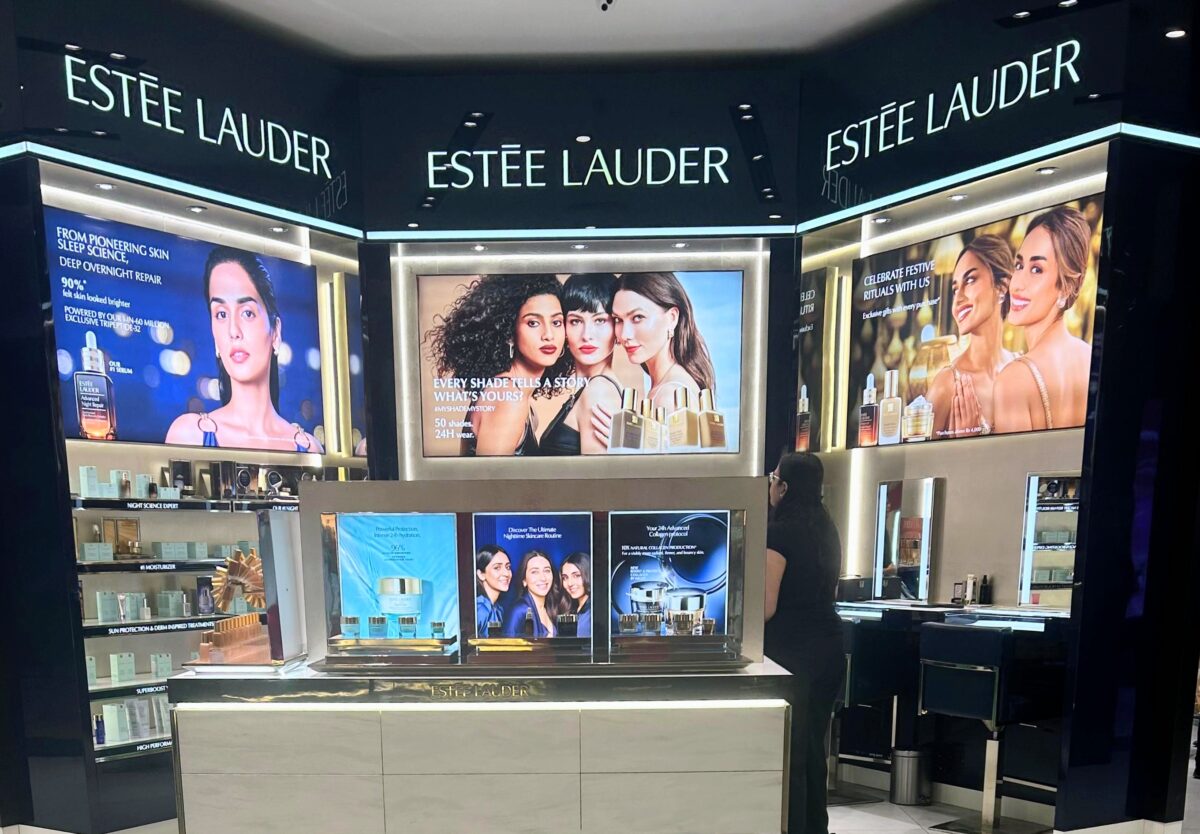
U.S. beauty giant Estee Lauder home to the brands Clinique and MAC, expects a strong runway for expansion and long-term growth in India, even as it grapples with soft sales in the Americas and Asia-Pacific.
“India today, within the Estee Lauder network, is looked at as one of the priority emerging markets,” said country general manager Rohan Vaziralli, highlighting plans to initially target 60 million women in the nation of more than 1.4 billion.
Homemaker R. Priyanka, based in the southern city of Chennai, said she was thrilled to have better access to Estee Lauder’s Jo Malone London fragrance in India, as a benefit of the companies’ efforts.
“It is easier than asking someone (abroad) to get it for you every time,” she added.
While global beauty brands might have to modify some of their products for India, which bakes in sultry temperatures in summer and oppressive humidity at other times, they face little competition from homegrown brands.
Kearney and LUXASIA identified only Forest Essentials and Kama Ayurveda as their major rivals, underscoring how domestic brands make up less than a tenth of luxury beauty sales.
In the more established markets of China, Japan and South Korea by comparison, domestic brands account for a 40% share.
“There is, of course, a premium perception gap between globally established brands and Indian brands,” said Devangshu Dutta, founder of retail consultancy Third Eyesight.
Global beauty giants’ huge marketing budgets also give them an edge over domestic brands, other industry watchers said.
WOOING INDIAN SHOPPERS
Estee Lauder is studying online sales patterns to identify the smaller cities to target, such as Siliguri in West Bengal state, partnering with designers such as Sabyasachi Mukherjee, and launching products such as kohl, an eyeliner Indians favour.
It has also invested in Forest Essentials, a brand with herbal ingredients, and in a programme offering funding to domestic beauty start-ups.
This year France’s L’Oreal said it was investing more in India and tapping into the “elevated beauty desires” of the nation’s young, digitally savvy, empowered women shoppers to drive growth. It declined further comment.
South Korea’s Amorepacific, known for brands such as Innisfree and Etude, is trying to leverage the Korean beauty craze in India with products geared to the market.
These include items for the popular “cleanser, serum, moisturiser, and sunscreen” beauty regimen, the country head, Paul Lee, said.
Japan’s Shiseido, with a history of more than 150 years, brought its NARS brand to Indian beauty retailer Nykaa’s website this year, and plans to step up growth of its brands in the subcontinent.
Global brands are very excited about India, where consumers are splurging more to stay on top of trends such as “cherry makeup”, Nykaa co-founder Adwaita Nayar said, referring to a look featuring flushed cheeks, glossy lips, and soft pink eyes.
Amazon, which has also been seeing a big boom in beauty demand in India, aims to identify emerging global trends and bring in more brands, said Siddharth Bhagat, director of beauty and fashion at the e-commerce company in India.
Retailer Shoppers Stop, which also pioneers foreign labels, plans to open 15 to 20 beauty stores in each of the next three years to boost its revenue from the segment to a quarter from less than a fifth now, its beauty business CEO Biju Kassim said.
Reporting by Praveen Paramasivam in Chennai; Editing by Dhanya Skariachan and Clarence Fernandez
(Published on Reuters)
