
admin
January 6, 2026
Saumyangi Yadav, Entrepreneur India
Jan 6, 2026
After years of rapid growth and a sharp reset, India’s direct-to-consumer (D2C) sector is expected to settle into a more balanced phase. The period of easy funding, aggressive customer acquisition and scale-at-all-costs expansion is clearly over, experts suggest. Now, what lies ahead in 2026 is a shift towards steadier growth driven by better execution, stronger retention and clearer brand positioning.
According to Bain and Flipkart, India’s e-retail market is projected to reach $170–190 billion in GMV by 2030, driven by a growing online shopper base and evolving commerce models. As adoption deepens across Tier-2 and Tier-3 cities, high-frequency categories such as grocery and lifestyle are expected to drive a larger share of growth, making repeat purchase and habit formation critical for D2C brands.
Against this backdrop, 2026 is shaping up as the year when D2C brands are judged less on ambition and more on outcomes.
A Post-Hype Phase of D2C
Industry observers say the D2C ecosystem has clearly moved beyond its hype-driven phase. Devangshu Dutta, Founder and Chief Executive of retail consultancy Third Eyesight, describes the current moment as one of structural correction rather than contraction.
“India’s D2C ecosystem is in a post-hype phase where growth may be slower but structurally healthier,” Dutta says, adding, “Earlier growth cycles prioritised visibility and sales at the expense of profitability and consistency. Now, success is being measured by repeat rates, contribution margins and the ability to fund growth internally.”
Tighter funding is also driving this shift. With D2C investments slowing and overall capital remaining cautious, brands are now being pushed to show predictability rather than promise. Tracxn data shows Indian D2C startups raised USD 757 million in 2024, significantly lower than previous years, while overall PE-VC investments in India remained flat at USD 33 billion in 2025, according to Venture Intelligence.
As a result, Dutta notes that many D2C companies are rationalising portfolios, tightening inventory cycles and optimising supply chains. Marketing strategies, too, are evolving, with greater emphasis on retention, community-building and owned channels instead of discount-led growth.
Uniqueness Will Define Winners
If capital discipline is one defining force, speed is another. Harish Bijoor, business and brand strategy expert, argues that D2C’s next phase will be shaped by how brands respond to a faster, more fragmented commerce environment.
“The e-commerce revolution led to a more refined orientation of D2C, and that has now given way to a q-commerce revolution that is even faster,” Bijoor says, adding, “The D2C revolution is going to be leveraged by speed. A whole host of players will invest time, energy and innovation into this.”
In Bijoor’s view, traditional e-commerce is now the slowest layer in a spectrum where quick commerce is the fastest, and D2C sits in between. In such a landscape, competing purely on price is no longer sustainable. He believes differentiation will increasingly come from uniqueness and premium positioning rather than ubiquity.
“When you know that you get a particular great-tasting biryani at just one place with no branches, you will go to that place. That uniqueness is what will distinguish D2C commerce in the future,” he says.
Bijoor adds that many D2C brands have been trapped in price wars under the guise of differentiation. He also argued that brands that premiumise and resist excessive omnichannel dilution are more likely to build desirability and long-term value.
Consumers Move Beyond Metros
Structural shifts in demand are reshaping how and where D2C brands grow. India now has one of the world’s largest and most diverse online consumer bases, with growth increasingly driven by Tier-2, Tier-3 and smaller towns rather than metros alone. Internet adoption continues to deepen across rural and semi-urban India, expanding the addressable market well beyond early digital buyers.
This widening base is changing the nature of growth. Consumers are becoming more deliberate in how they spend, weighing value, quality and trust more carefully than before.
As Devangshu Dutta notes, Indian consumers have always been discerning, but rising living costs and economic uncertainty have made them even more thoughtful, pushing brands to earn repeat demand rather than rely on impulse or discount-led purchases.
“Value is not just about discounts,” he says. “It’s a balance of price, performance and trust. For D2C brands, repeat consumption has to be earned through consistent quality, transparent pricing and dependable service.”
High-frequency categories such as grocery, lifestyle and general merchandise are expected to drive much of this expansion. Bain estimates these segments will account for two out of every three e-retail dollars by 2030, reinforcing the importance of habit formation and retention-led models.
Quick Commerce Expands Discovery, Not Profitability
Quick commerce has emerged as a powerful but complex growth lever for D2C brands. The format now accounts for a significant share of India’s e-grocery demand and has scaled into a multi-billion-dollar market, becoming a key discovery channel for food and everyday consumption brands.
However, expansion beyond metros remains challenging. RedSeer data shows non-metro markets contribute just over 20 per cent of quick commerce GMV, even as platforms scale to over 150 cities, with breakeven economics in smaller towns requiring significantly higher throughput.
Praveen Govindu, partner at Deloitte India, cautions that while quick commerce has helped many D2C brands gain discovery, particularly in food and beverage, it is not a sustainable growth engine on its own.
“From a customer acquisition standpoint, quick commerce is not fundamentally different from traditional e-commerce,” Govindu says, adding, “It is an expensive channel, and competition will only intensify. Over the long term, brands cannot rely on burning capital there.”
Omnichannel Enters Its Toughest Phase Yet
As digital acquisition costs rise, India’s ad market is projected to grow nearly 8 per cent in 2025 to Rs 1.37 lakh crore, with digital accounting for almost half of the spends, brands are being pushed to diversify distribution. Yet omnichannel presence alone is no longer enough.
“Many brands talk about omnichannel, personalisation and seamless journeys, but in practice these efforts are still disjointed. In 2026, the focus will shift from intent to execution,” Govindu says.
RedSeer projects India’s retail market to cross USD 2 trillion by 2030, with nearly 90 per cent of consumption still happening offline. For D2C brands, this makes offline expansion unavoidable, but success will depend on consistent execution across pricing, inventory, service and communication.
Consumers, Govindu notes, do not consciously differentiate between online, offline or social platforms. “They simply want a consistent experience,” he says. “Even small inconsistencies can erode trust.”
AI-Led Discovery and Experience
Perhaps the most transformative force shaping 2026 will be the evolution of buying journeys themselves. Govindu sees the rise of AI-led and agentic commerce as a major inflection point.
“Conversational platforms and AI-driven assistants will increasingly influence discovery, purchase, fulfilment and post-sales experiences. What earlier happened across multiple touchpoints is now beginning to happen in one place,” he says.
This convergence amplifies the importance of content-led discovery, owned data and deep consumer understanding. Brands that can unify storytelling, commerce and service into a coherent narrative are more likely to build loyalty in an environment where switching costs are low and alternatives are abundant.
Whether growth comes through D2C websites, marketplaces, quick commerce or offline stores, experts agree that the real differentiator will be a brand’s ability to build durable consumer relationships. As investors shift focus from short-term metrics to long-term value creation like retention, margins and brand strength, the next phase of India’s D2C story is less about rapid expansion and more about refinement.
(Published in Entrepreneur India)
Saumyangi is a Senior Correspondent at Entrepreneur India with over three years of experience in journalism. She has reported on education, social, and civic issues, and currently covers the D2C and consumer brand space.
admin
December 15, 2025

By Saumyangi Yadav, Entrepreneur India
Dec 15, 2025
India’s D2C ecosystem has grown rapidly over the past five years, but scale remains elusive. While thousands of brands have launched and many have crossed early revenue milestones, only a small fraction manage to break past INR 100 crore in annual revenue. According to a new report by DSG Consumer Partners, based on a survey of over 100 Indian D2C founders and operators, the problem is not demand or product-market fit, it is how brands attempt to scale.
The report shows that around 60–65 per cent of Indian D2C brands remain stuck in the INR 1–50 crore revenue band, with very few reaching the INR 100 crore mark. This stage marks the point where early traction exists, but growth begins to strain unit economics, teams, and operating systems.
Insights from over 100 D2C founders reveal that India’s fastest-growing brands win on fundamentals rather than speed alone. Clear product-market fit, disciplined data tracking, strong unit economics, creative velocity, and an early focus on retention consistently separate scalable brands from those that plateau. Founders also admit that performance marketing mistakes, pricing missteps, and weak creative systems slow growth far more than budget constraints. In a booming D2C landscape, capability gaps in operations, brand-building, and supply-chain depth are widening the divide between breakout brands and those stuck in the performance plateau.
Industry observers argue that this is where many brands mistake rapid online growth for sustainable scale.
As Devangshu Dutta, Founder & CEO, Third Eyesight, explains, “Scaling up online can be very rapid, but is also capital-hungry in terms of CAC. Given the intense competition, the lack of customer stickiness and the power of platforms, there is a constant churn of marketing spend which is a huge bleed for growing brands.”
CAC Inflation is The Real Constraint
One of the clearest findings from the playbook is that acquisition efficiency, rising CAC and unstable ROAS, is the single biggest blocker to growth, cited by more founders than funding or category expansion. Moreover, over 70 per cent of brands rely on Meta as their primary acquisition channel, increasing vulnerability to auction pressure and platform-driven volatility.
Dutta links this directly to the limits of a digital-only mindset. “Limited offline expansion can trap brands in narrow urban digital markets, blocking broader scale,” he said.
This over-reliance on online performance marketing often leads to growth that looks strong on dashboards but weak on cash flow.
Highlighting their report, Pooja Shirali, Vice President, DSG Consumer Partners, said, “Across over 90 consumer brands we’ve partnered with at DSGCP, one truth is clear: brands that master Meta’s ecosystem don’t just grow, they change their entire trajectory through strategic clarity and disciplined execution. The real drivers of scale have less to do with viral moments, and everything to do with the long-term fundamentals that make milestones like the first INR 100 crore predictable, not accidental.”
Why Omnichannel is Unavoidable
The report suggests that brands that scale sustainably are those that reduce overdependence on paid digital acquisition and expand their distribution footprint. However, offline expansion brings its own complexity.
Dutta stresses that omnichannel is not an optional add-on, but a strategic shift. “D2C brands must adopt an omnichannel approach, blending online with offline retail for sustainable and scalable reach. Clearly the channels work very differently and management teams have to be prepared and capitalised for the long haul to tackle acquiring customers with channel-appropriate strategies,” he adds.
This aligns with the DSGCP report’s broader insight that scale breaks down when brands fail to adapt operating models as they grow.

Even within digital channels, performance weakens over time. The playbook finds that 62 per cent of founders report creative fatigue, where repeated creatives fail to sustain ROAS despite higher spends. At the same time, 55 per cent admit to under-investing in CRM and retention, with most brands reporting repeat purchase rates of just 10–30 per cent.
Both the data and expert opinion point to a common theme: brands that cross the INR 100 crore mark are structurally different. They obsess over unit economics, processes, and capital efficiency rather than topline growth alone.
As Dutta puts it, “Scalable brands that cross the growth hump have leadership obsessed with unit economics and omnichannel execution rather than chasing vanity metrics. Cash always was and is king, especially at early stages of growth.”
He adds that execution strength matters as much as strategy. “They are able to grow and steer teams that build and replicate processes fast rather than spending time, effort and money reinventing all the time, and do so without constant CXO intervention.”
As competition intensifies and capital becomes more selective, the next generation of INR 100 crore D2C brands is likely to be defined not by speed, but by the ability to compound cash flows, institutionalise processes, and scale distribution beyond digital platforms.
Saumyangi is a Senior Correspondent at Entrepreneur India with over three years of experience in journalism. She has reported on education, social, and civic issues, and currently covers the D2C and consumer brand space.
(Published in Entrepreneur India)
admin
July 16, 2025
Prabhanu Kumar Das, Medianama
16 July 2025
E-commerce logistics platform Shiprocket announced the launch of Shunya.ai, a sovereign AI model developed in India to support the country’s Micro, Small and Medium Enterprises (MSMEs), on July 11. The company claims that it is India’s first multimodal AI stack, built in partnership with US-based Ultrasafe Inc.
This announcement comes at the heels of Shiprocket filing a confidential draft red herring prospectus (DHRP) with the Securities and Exchange Board of India (SEBI) in May 2025 for their Initial Public Offering (IPO). The company is expected to raise around Rs 2500 crore in its IPO.
What does the AI model offer?
As per Shiprocket’s website, Shunya.ai is built on a freemium model, with unlimited access priced at Rs 499 a month for MSMEs. It is directly integrated into the Shiprocket platform and offers AI agents across multiple languages. According to the company, the agents can perform the following tasks:
Shiprocket CEO Saahil Goel stated, “We’ve adapted Shunya.ai from the ground up for Indian languages, commerce workflows, and MSME needs. By embedding it directly into our platform, we’re giving over 1,50,000 sellers instant access to tools that are intelligent, local, and scalable, levelling the playing field for businesses across Bharat.” Notably, Larsen and Toubro’s AI cloud arm, Cloudfiniti is reportedly providing the underlying GPU infrastructure, ensuring that all data processing and storage remains within India.
This AI model does offer multiple benefits but it will not level the playing field against big players, as per Devangshu Dutta who is the founder of specialist consulting firm, Third Eyesight.
“While Shunya AI can help small businesses compete better, it won’t completely level the playing field. Large companies still have greater organisational capacity and capability to respond to the insights offered, including more data and bigger budgets. The real benefit for small businesses is improving how they work and serve customers within their current markets, rather than suddenly competing with giants,” Dutta said.
The E-Commerce AI Pivot
This is not the first time that an Indian e-commerce platform has unveiled a B2B AI service through its existing platform. Zepto recently launched Zepto Atom in May 2025, a real-time tool that offers consumer brands available on the platform minute-level updates, PIN-code level performance maps, and Zepto GPT, a Natural Language Processing (NLP) assistant trained on internal data that brands can query about their stock keeping units (SKUs) and performance data.
Zomato and its e-commerce arm Blinkit have also been growing their AI capabilities. Analytics India Magazine previously reported that the company’s generative AI team has grown from 3 to 20 engineers in the time-span of a year. Zomato introduced a personalised AI food assistant for users, and also uses AI in its backend to optimise delivery times and improve consumer support. Blinkit also released the Recipe Rover AI in May 2023, an AI assistant for recipes.
Other companies like Swiggy with ‘What to Eat’ AI, Myntra’s MyFashionGPT AI shopping assistant, and Amazon’s Rufus have also adopted AI assistants on their platform as a tool for the consumer.
The issue of merchant stickiness
Dutta asserts that this shift means platforms like Zepto and Shiprocket are changing from being service providers to becoming data intelligence companies. They are generating, or are in the process of generating revenue through transactional data that flows through the company.
“While this can create better insights and automation for merchants on these platforms, it also could make the merchants more dependent on the platforms. Once a merchant builds its operations around a platform’s specific AI tools and insights, it becomes much harder to switch to a competitor – creating stronger merchant stickiness. We already see this in infrastructure and core services such as banking and financial services, enterprise cloud services, building management etc. and the same is likely to happen in AI-enabled process management”, he said.
Why this matters
As Shiprocket is preparing for an IPO, Shunya.ai becomes another means to generate revenue for the company. This app can extend Shiprocket’s reach to local physical stores and MSMEs, by offering them the opportunity to provide the same experiences and support to the consumer that larger retailers and e-commerce platforms do, while automating delivery automation, cataloguing, and customer support.
Furthermore, the launch of this model is also part of the larger trend of AI integration and automation, both within e-commerce platforms for their consumers and within the back-end for optimisation.
Competition in these sectors and merchant stickiness may also become an issue, as businesses hosted on these e-commerce services may become reliant on specific AI tools and their outputs.
Questions of data privacy are also important when it comes to service companies moving towards data intelligence: How do these AI models gather and use data? The consent of end-consumers in these B2B models, data storage, and security are all issues that need to be studied as e-commerce and retails pivots towards AI.
Some Unanswered Questions
MediaNama has reached out to Shiprocket with the following questions and will update the article when we receive a response.
(Published in Medianama)
admin
October 7, 2024
Writankar Mukherjee, Economic Times
7 October 2024
Reliance Retail has initiated efforts to enter the thriving quick commerce market in a move that is set to escalate competition for Zomato-owned Blinkit, Swiggy Instamart and BigBasket, among others. The country’s largest retailer has started offering quick commerce services in select areas in Navi Mumbai and Bengaluru through its ecommerce platform JioMart since last weekend.
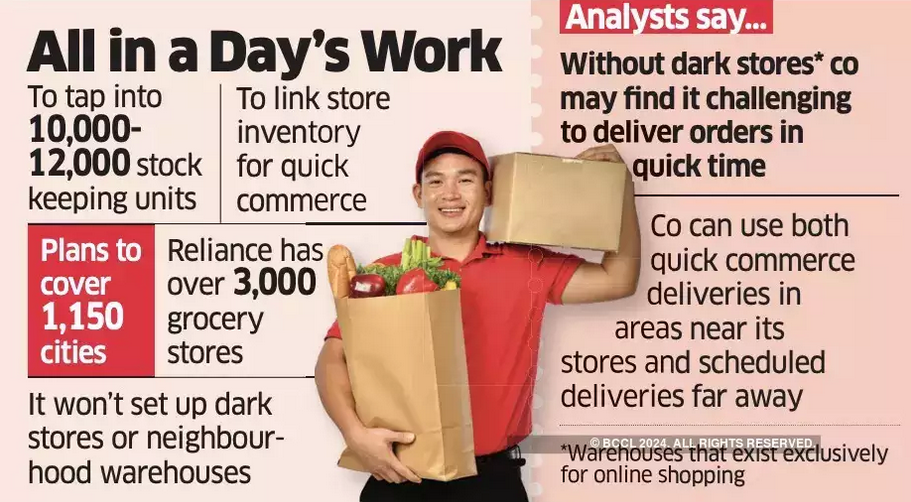
It will initially sell grocery items from its retail stores totalling about 3,000 nationwide, eventually adding value fashion and small electronic products such as smartphones, laptops and speakers, a senior executive said. All orders will be fulfilled from its own network of stores including Reliance Digital and Trends.
The retail arm of Reliance Industries plans to rapidly scale up its quick commerce venture pan-India by this month-end with the aim to deliver most orders in 10-15 minutes and the rest within 30 minutes, the executive said. The company will use its acquired logistics service Grab for the fulfilment.
Reliance, however, doesn’t have any plan to set up dark stores or neighbourhood warehouses, unlike other quick commerce operators, the executive said. Analysts said this may become a challenge in delivering orders within 30 minutes in large cities where traffic is high during peak hours.
To entice customers, Reliance won’t charge any delivery fee, platform fee or surge fee irrespective of the order value, and keep a major focus on untapped smaller cities and towns where quick commerce operators like Blinkit are yet to enter, the executive said. Other platforms have a delivery fee and platform fee.
Reliance plans to offer a wider choice of products of 10,000-12,000 stock keeping units by linking its entire store inventory to the quick commerce business, which too is much more than rivals.
Eventually, the company aims to cover 1,150 cities spanning 5,000 pin codes where it runs grocery stores. The executive said the company would target a bigger share of business from towns and smaller cities hitherto untapped by quick commerce firms.
“Reliance has reworked the way orders are delivered for JioMart. Earlier, orders had a scheduled delivery taking 1-2 days by small trucks who would take multiple orders and deliver them one by one. Now, all grocery orders will be quick commerce where one delivery bike or cycle will deliver one order. Each grocery store will cover a 3 KM radius,” the executive said.
Earlier this year, the company tried to reduce JioMart delivery timings to a few hours or at least the same day under its hyperlocal initiative. It has fine-tuned the process further to 10-30 minute delivery. “This has become a top-of-the-kind requirement in the market right now,” the executive said.
A spokesperson for Reliance Retail didn’t respond to ET’s queries.
Devangshu Dutta, chief executive at consulting firm Third Eyesight, said Reliance can ultimately use a blended approach of quick commerce deliveries in areas near its stores and scheduled deliveries a bit far away.
“Since they are in a market share acquisition mode in quick commerce, charging no transaction fees and offering higher discounts on products is a given. There is significant scope for deep-pocketed players like Reliance to strengthen presence in quick commerce. They have aggressively backed other experiments in the retail business once they worked, and may do it again,” said Dutta.
For fast-moving consumer goods companies, quick commerce is the fastest growing channel, accounting for 30-35% of total online sales.
(Published in Economic Times)
admin
September 16, 2024
Sesa Sen, NDTV Profit
16 September 2024
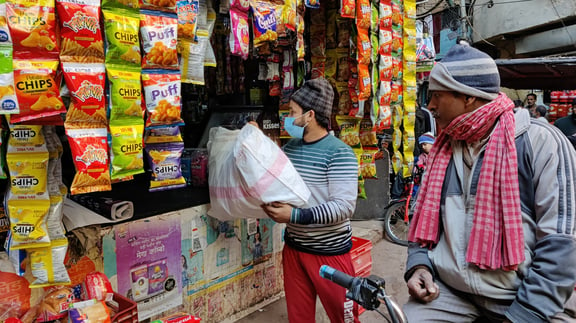
As India’s economy grows and digital technologies reshape consumer behavior, the future of kirana stores—the quintessential neighbourhood grocery shops—hangs precariously in the balance.
These soap-to-staple sellers, once impervious to change, now confront an existential threat from quick commerce players like Blinkit, Instamart, Zepto, and from modern retailers such as DMart and Star Bazaar, raising a pivotal question: Can kiranas survive the pressure of change, or will they die a slow death?
The All India Consumer Products Distributors Federation, that represents four lakh packaged goods distributors and stockists, has recently raised alarms, urging Union Minister for Commerce and Industry Piyush Goyal to investigate the unchecked proliferation of quick commerce platforms and its potential ramifications for small traders.
Their concerns are not unfounded. Data suggests that the share of modern retail, including online commerce, which is currently below 10%, is set to cross 30% over the next 3-5 years. Much of this growth will come at the cost of traditional retail.
“Unless the government takes on an activist role to support the smallest of business owners, the shift toward large corporate formats is inevitable,” according to Devangshu Dutta, head of retail consultancy Third Eyesight.
Casualties Of The Boom
Madan Sachdev, a second-generation grocer operating Vandana Stores in eastern Delhi, has thrived in the recent years, adapting to the digital age by taking orders via WhatsApp and employing extra hands for home delivery.
Despite having weathered the storm of competition from giants like Amazon and BigBazaar, he now finds himself disheartened, as his monthly sales have halved to about Rs 30,000, all thanks to quick commerce.
Sachdev is worried about meeting expenses such as rent, his children’s education, and other household bills. He finds himself at a crossroads, uncertain about how to modernise his store or adopt new-age strategies in order to attract customers in an increasingly competitive market.
India’s $600 billion grocery market, a cornerstone for quick commerce, is largely dominated by more than 13 million local mom-and-pop stores.
Retailers like Sachdev are also seeing a steep decline in their profit margins from FMCG companies, which now hover around 10-12%, down from the 18-20% margins seen before the Covid-19 pandemic. The consumer goods companies are instead offering higher margins to quick commerce platforms so that they can afford the price tags.
Quick deliveries account for $5 billion, or 45%, of the country’s $11 billion online grocery market, according to Goldman Sachs. It is projected to capture 70% of the online grocery market, forecasted to grow to $60 billion by 2030, as consumers increasingly prioritise convenience and speed.
Many of the mom-and-pop shops are family-run and have been in business for generations. Yet they lack the resources to modernise and compete effectively with larger chains. Modern retail businesses, including quick commerce, begin with significantly more capital, thanks to funding from corporate investors, venture capital, private equity, and public markets.
“They can scale quickly and capture market share due to a superior product-service mix, larger infrastructure, and more robust business processes,” said Dutta.
Moreover, their ability to engage in price competition poses a challenge for small retailers and distributors, making it difficult for them to compete.
“This is something that has happened worldwide, in the largest markets, and I don’t think India will be an exception,” Dutta said, adding that it would be incomplete to single out a specific format of corporate business such as quick commerce as the sole villain in this situation.
“India is a tough, friction-laden environment at any given point in time, including government processes which don’t make it any easier,” he said.
Peer Pressure
Data from research firm Kantar shows that general trade, which comprises kirana and paan-beedi shops, have grown 4.2% on a 12-month basis in June, while quick commerce grew 29% during the same period.
Shoppers are becoming more omnichannel, rather than gravitating towards one particular channel, said Manoj Menon, director- commercial, Kantar Worldpanel, South Asia. “While the growth [for quick commerce and e-commerce] might appear to have declined compared to a year ago, a point to note is that the base for these channels has significantly grown. Therefore, achieving this level of growth is still commendable.”
Consumer goods companies such as Hindustan Unilever Ltd., Dabur India Ltd., Tata Consumer Products Ltd., etc., have acknowledged the salience of quick commerce to their packaged food, personal and homecare products. The platform currently comprises roughly 40% of their digital sales.
“We are working all the major players in the quick commerce space and devising product mix and portfolio. This is a very high growth channel for us,” according to Mohit Malhotra, chief executive officer, Dabur India.
Elara Capital analysts have pointed out that the share of quick commerce is expected to rise to60% in the near future with e-commerce and modern trade turning costlier for FMCG brands than quick commerce. “The larger brands tend to make better margins on quick-commerce platforms versus e-commerce due to lower discounts on the former,” it said in a report.
However, it is too premature to draw a parallel between kirana and quick commerce in terms of competition, given the significant size difference.
The average spend per consumer on FMCG in kirana stores stands at Rs. 21,285 annually while the same is Rs. 4,886 for quick commerce, according to Menon.
Rural Vs Urban Divide
Quick commerce is still an urban phenomenon. In contrast, in rural settings, where internet penetration is still catching up and access to large retail chains is limited, kirana stores continue to thrive.
According to Naveen Malpani, partner, Grant Thornton Bharat, while the growth of quick commerce is undeniable, this channel is not poised to replace traditional retail, which still has a wider reach in the country. “It will complement older models, filling a niche for immediate, smaller purchases. Also, a 10-20-minute delivery may not have a strong market pull in rural markets where distance and time are not much of a concern.”
Yet many others believe, even in these areas, the challenge is palpable.
The small businesses are beginning to feel the sting of same slow decline that once befell the ubiquitous telephone booths in the era of mobile phone, according to Sameer Gandotra, chief executive officer of Frendy, a start-up that is building ‘mini DMart’ in small towns where giants like Reliance and Tatas have yet to establish their presence.
As rural customers slowly start to embrace digital shopping and seek more variety, kirana stores must adapt or risk becoming obsolete, he said.
Besides, the popularity of quick commerce is set to challenge the dominance of incumbent e-commerce platforms, especially in categories such as beauty and personal care, packaged foods and apparel.
“Quick commerce is primarily operational in metros and tier 1 markets, which is impacting the sales of traditional companies in these areas. However, if quick-commerce players were to extend their operations to tier 2 and tier 3, it would even challenge companies such as DMart and Nykaa, and would pare sales and profitability,” noted analysts at Elara Securities.
Frendy’s Gandotra believes the journey for kirana stores is not a lost cause, but it requires strategic interventions. Many kirana store owners struggle to integrate point-of-sale systems, inventory management software, or even digital payment solutions. These stores need to embrace technology.
Another aspect is the need for policy support. Regulations to ensure fair competition can prevent monopolisation by large retailers. Additionally, subsidies, tax benefits, and grants for infrastructure improvements can help small businesses adapt to changing market dynamics. With renewed support, kirana stores can continue to be the backbone of Indian retail.
Nonetheless, there will be some who’ll be left behind during this shift. Analysts at Elara Capital warn that the swift rise of quick-commerce platforms, combined with aggressive discounting, could wipe off 25-30% of traditional grocery stores.
(Published on NDTV Profit)
