
admin
January 7, 2026

Writankar Mukherjee & Shabori Das, Economic Times / Brand Equity
7 January 2026
There’s a renewed sparkle in the adage ‘Old is Gold’ at India’s biggest conglomerate Reliance. Banking on Indians’ nostalgia, it is hawking and reviving labels that once defined everyday life, Campa and BPL among them, to set its consumer venture’s cash registers ringing.
What started with sales of Rs. 3,000 crore in FY24, Reliance Industries’ fast-moving consumer goods (FMCG) business quickly accelerated towards Rs. 11,500 crore the following year. With a staggering Rs. 5,400 crore posted in the July to September FY26 quarter alone, the revival story is clearly striking a chord with consumers. But Campa, already the largest contributor to the Reliance Industries’ FMCG business, is only the beginning.
The company is injecting fresh life into acquisition of legacy brands such as Ravalgaon in confectionery and Velvette in personal care. Reliance is applying the same formula to the consumer electronics business, covering televisions, refrigerators and washing machines. Once a staple of Indian households, Kelvinator and BPL are being reintroduced.
Strategy Rings a Bell?
Driving this revival is a strategy Reliance knows well: aggressive pricing that is often 20 to 30% lower than competitors, offering generous trade margins to woo retailers, and a rapid expansion of distribution from its own stores to kiranas and local outlets, alongside local sourcing and an expanding product portfolio.
It’s a playbook that once created waves in the telecom market; this time, however, it comes with a generous dose of nostalgia.
The path ahead though may not be easy. While Campa may have yielded results in a category linked to instant gratification, electronics is a high-ticket, long-term purchase. Marketers are debating whether consumers in their 20s and 30s—spoilt for choice by global brands—would choose a Kelvinator refrigerator, a BPL TV or a Velvette shower gel over LG, Samsung, Dove or Fiama.
Deep Pockets and Retail Muscle
Reliance, experts say, has two advantages— its balance sheet and strong market presence with its own retail stores. “Reliance has the intent to dominate a market in whatever business it enters. Their brands in FMCG and electronics too have a more-than-decent chance of surviving and thriving,” says Devangshu Dutta, founder and chief executive of Third Eyesight, a consultancy in consumer space.
“As long as they have capital and management capability, they may cut their teeth,” he says.
The company is approaching the FMCG and electronics businesses in startup mode, but with deep pockets. As a Reliance executive explains, the strategy is to invest and invest more, gain market share, continue to absorb losses and after achieving scale, drive efficiencies to generate profit.
The path has been carved out. Reliance Consumer Products (RCPL), the FMCG business entity and what started as a unit of Reliance Retail Ventures, is now a direct subsidiary of Reliance Industries. This shift will help the company raise funds independently and eventually launch an initial public offering (IPO), and drive valuation independent of retail. The electronic business may follow suit as it grows in scale.
Reliance did not respond to Brand Equity’s queries.
Electronics: A Tough Play
Industry executives say the electronics foray will not be an easy battle against international brands. Global brands enjoy strong appeal in the Indian market, and companies such as LG, Samsung and Sony have been present for over two decades, cementing their position. Even the newer ones like Haier and Voltas Beko are rapidly gaining market share.
Pulkit Baid, director of the electronics retail chain Great Eastern Retail, says that unlike the cola industry, where two large players (Coca-Cola and PepsiCo) dominate, consumer durables are highly fragmented. “Kelvinator enjoys the brand heritage of an Ambassador car. But we will have to see if the brand is welcomed by Gen Z with the same euphoria as Campa.”
Industry veteran Deba Ghoshal notes that very few legacy brands have been able to withstand the onslaught of new-age brands in consumer electronics. Voltas (from the Tatas) and Godrej are exceptions, he adds.
“Reliance Retail has the strategic foresight to re-establish legacy brands in consumer durables space, instead of chasing a standalone private label business,” adds Ghoshal. “There is a strong opportunity in BPL and Kelvinator, provided they are re-launched with strong value and engaging emotive hooks, and not restricted to being a price warrior. Reliance has the capability; it just needs the right strategy.”
Reliance is readying campaigns for BPL and Kelvinator to connect with the younger consumers. The company is planning to re-launch them beyond Reliance Retail stores—targeting regional retail chains and e-commerce platforms and expanding quickly into smaller towns. With India’s electronics penetration still low—15 to 18% for flat-panel TVs, 40% for refrigerators, 20% for washing machines and less than 10% for air conditioners (ACs)—Reliance has substantial headroom for growth.
Angshuman Bhattacharya, partner and national leader for consumer products and retail at EY India, says Reliance may focus on tier two and three cities. “These markets have been a low priority for the Samsungs and LGs because they want to play in the premium segment where margins are higher. That is where Reliance may expand the market. It requires a lot of capital in terms of inventories and distribution, and Reliance has the ability and potential to do so.”
FMCG: Ball is Rolling
The FMCG push is gaining strong momentum. Reliance plans to double its distribution to three million outlets this fiscal.
Over the next three years, it looks to invest Rs. 40,000 crore to create Asia’s largest integrated food parks and has already invested Rs. 3,000 crore in manufacturing.
Isha Ambani, who spearheads Reliance’s retail and FMCG businesses, drew attention to Campa’s comeback at the company’s AGM in August: “Campa-Cola now holds double-digit market share across many states, breaking a 30-year MNC duopoly of Coca-Cola and PepsiCo. Campa Energy gained two million social media followers in just 90 days.”
Her target is bold: To reach Rs. 1 lakh crore in FMCG revenue within five years and become India’s largest FMCG company with a global presence.
Market watchers say such high ambitions require high investments. Kannan Sitaram, co-founder and partner at venture capital firm Fireside Ventures, said a company like Hindustan Unilever would set aside at least `30-40 crore to launch a brand. “Advertising and marketing alone would take up more than half of that. And when you are re-launching a brand which has not been around for a long while, the spending tends to be 25 to 30% higher in the initial three to four months,” he says.
Yet, analysts believe Reliance is in the consumer brands business for the long term. Bhattacharya says whatever Reliance has learned in this short time is meaningful and serious, something nobody else has managed.
Mover and Shaker
Competitors, including Tata Consumer Products, Dabur and PepsiCo’s largest bottler in India Varun Beverages, have acknowledged the turbulence created by Reliance in the FMCG sector. But the industry hopes low penetration levels will ensure there is room for everyone.
Varun Beverages chairman Ravi Jaipuria did not mince his words in the company’s latest earnings call in October-end: “They (Reliance) have woken all of us up and we are becoming more attentive… it is a very healthy sign for the country because our per capita consumption is so low that in the next five to 10 years, this market may double or triple…there is a huge room, and we see only positives in this.”
The revival of legacy brands and aggressive push into FMCG and consumer electronics indicates that Reliance is preparing for the long haul. In this fight driven by nostalgia, competitive pricing, deep pockets and distribution muscle, the battle for shelf space has just begun.
(Published in Economic Times/Brand Equity)
admin
October 24, 2025
Entrepreneur India
Oct 23, 2025
Indian consumers are increasingly opting for private labels and in-house brands over established ones, and retailers are taking note. According to EY’s ‘Future Consumer Index 2025’, more than half of India’s consumers are now choosing in-house brands over legacy labels.
The report highlights that 52 per cent of Indian consumers have switched to private labels for better value, while 70 per cent believe these in-house brands offer comparable or superior quality. Backed by this shift, retailers from BigBasket to DMart, and quick-commerce players like Zepto and Blinkit, are doubling down on their private label strategies, viewing them as a path to higher margins, stronger brand loyalty, and greater pricing control.
“Indian consumers’ growing preference for private labels reflects both short-term price pressures and a longer-term structural evolution in retail,” said Devangshu Dutta, CEO of Third Eyesight, speaking to Entrepreneur India.
Trending globally
The surge isn’t unique to India. A recent report by the Institute of Grocery Distribution (IGD) notes that globally, private labels now account for over 45 per cent of grocery volume and are expanding faster than legacy brands.
In India, this shift is becoming increasingly visible in-store. The EY report found that 74 per cent of consumers have noticed more private label options where they shop, and 70 per cent say these products are now displayed more prominently, often placed at eye level, signalling a strategic retail push.
Commenting on this trend, Angshuman Bhattacharya, Partner and National Leader, Consumer Products and Retail Sector, EY-Parthenon, said, “Consumer behaviour has traditionally evolved in response to changing economic situations, but the current shifts appear to be more permanent. Retailers are confidently launching private labels and allocating prime shelf space to them, while technology is enhancing the shopping experience by providing consumers with limitless options and the ability to compare products.”
From price-fighters to power brands
According to Dutta, private labels are no longer just “copycat” alternatives meant to undercut national brands.
“For retailers, not just in India but globally, lookalike private labels used to be tools at the opening price point to hook the customer, who saw them as credible, affordable alternatives to national brands,” he explained, adding, “However, as retailers have grown, they have gained both scale and expertise to widen and deepen their supply chains.”
Over time, he said, investments in formulation, packaging, and quality consistency have increased consumer trust.
“Private labels now compete on functional benefits rather than only on price, particularly in food staples and apparel, but also in brown goods and white goods, and increasingly in personal care and other FMCG categories,” he added. [Must read: “Private Label Maturity Model”]
Retailers scale up private labels
As demand for in-house brands grows, retailers are scaling up their strategies across sectors.
BigBasket, one of India’s largest online grocery platforms, reported that 35–40 per cent of its FY24 sales came from private labels like Fresho, BB Royal, and Tasties. The company aims to push this share closer to 45 per cent through expansion in frozen foods and ready-to-eat categories.
DMart’s private label arm, Align Retail, has reportedly more than doubled its sales in two years, touching INR 3,322 crore in FY25. The retailer’s in-house brands in staples, apparel, and home essentials have helped boost margins in a highly competitive retail landscape.
Zepto, the quick-commerce player, is taking private labels into the 10-minute delivery domain. Its brand Relish, focused on meats and eggs, has achieved INR 40 crore in monthly sales.
Meanwhile, Reliance Retail has also expanded its portfolio of private labels, including Good Life, Enzo, and Puric, across groceries, personal care, and household products, strengthening its broader FMCG play. In 2024, Reliance Retail’s Tira Beauty also announced the launch of its latest private label brand, Nails Our Way, signifying a major expansion in its beauty offerings.
Capturing a lion’s share in retail
Dutta noted that in India, private labels will remain a core pillar of modern retail strategy rather than a cyclical response to cost pressures.
“Consumers increasingly view retailers as brand owners rather than intermediaries. As private labels mature in branding and innovation, their growth aligns more and more with brand equity development rather than just opportunistic cost-saving,” he said.
From a retailer’s perspective, private labels deliver higher gross margins and greater strategic control, Dutta said. [Must read: “Private Label Maturity Model”]
Another report by the Private Label Manufacturers Association (PLMA), using Circana data, found that in 2024, private-label sales in food and non-edible categories grew faster than bigger brands globally. While figures vary by region and quarter, the pattern remains consistent: private labels are outpacing traditional FMCG growth.
Collectively, these shifts show that private labels are becoming a major revenue driver for retailers in India, and are fast evolving from value alternatives into brands with genuine consumer pull.
(Published in Entrepreneur India)
admin
September 15, 2025
Shabori Das & Sagar Malviya, Economic Times
15 September 2025
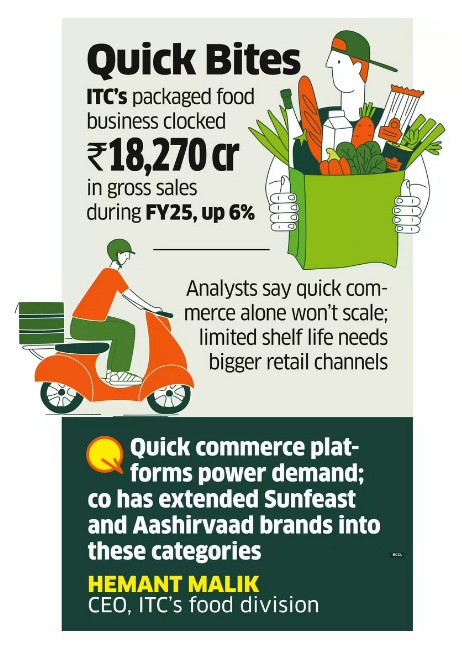
ITC Foods is making a strategic entry into fresh packaged foods including short shelf-life cookies, cakes, and chapatis, among others, part of its broader aim to ride the surge in quick commerce demand, said Hemant Malik, chief executive of the food division of ITC.
The move is also prompted by the cigarette-to-snack maker’s aim to capture India’s growing appetite for convenience-led, freshly-made food with shelf life of a few days, instead of 12-24 months for other food products, with quicker fulfilment systems.
“There is a growing consumer demand for fresh packaged food products, powered by enhanced accessibility and convenience provided by the surge in quick commerce platforms,” Malik told ET, adding that the company has extended its Sunfeast and and Aashirvaad brands into these categories.
ITC has created a hyper-local production and distribution ecosystem to enable next-day delivery from oven to doorstep in a country where supply chains are often fragmented and 75% of the sales are through local kiranas. The company said its small-batch model, scaled across urban micro-markets, will help maintain freshness while sidestepping the usual constraints of long-haul logistics and warehouse storage.
“We are leveraging tech-enabled capabilities, supply chain efficiencies including hyper-local agile production and rapid fulfilment together with focus on fresh sourcing,” Malik added.
Analysts however noted that relying solely on quick commerce won’t ensure scale while limited shelf life could require bigger retail channels including modern and general trade.
“These products will need to move fast. So inventory management in terms of space for quick commerce will be challenging,” said Devangshu Dutta, founder of retail consulting firm Third Eyesight. “And in case of quick commerce, it will need to have catchment focus as not every micromarket in a city will have demand for such products.”
“In the case of large FMCG companies, scalability is always what is needed, and quick commerce alone will not help with that. Eventually modern trade and general trade for these shorter shelf life products will be considered,” he said.
ITC’s packaged food business clocked ₹18,270 crore in gross sales during FY25, up 6% on-year.
Quick commerce platforms such as Blinkit, Swiggy Instamart, and Zepto have made it easier than ever to deliver ultra-fresh products within hours–and they have been tapped by local bakeries and direct-to-consumer companies including Theobroma, Baker’s Dozen, and Id Fresh.
Over the past few months, mainstream companies including Hindustan Unilever, Marico, Adani Wilmar and Parle have carved out separate sales and distribution teams for quick commerce, responding to the need for a faster turnaround in stocking as well as a distinct portfolio for the segment.
(Published in Economic Times)
admin
March 5, 2025
Nisha Qureshi, Afaqs
5 March 2025
Bournvita, a chocolate-flavoured malt drink produced by Cadbury under Mondelez, is a household name in India. Marketed as a health drink that supports children’s growth and development, it holds a 15-16% share in the Indian health food drink sector, second only to Horlicks, which dominates with nearly 50%.
Its advertising has traditionally centred on themes of health, confidence, and mental strength, with campaigns such as Tayyari Jeet Ki resonating strongly with consumers.
The Food Pharmer controversy
Despite its strong market presence, Bournvita has faced criticism over its high sugar content and other ingredients, sparking public debate and legal scrutiny. The controversy escalated last year when health influencer Revant Himatsingka, known as Food Pharmer, called out Bournvita for its excessive sugar levels.
Himatsingka’s video criticised Bournvita for its high sugar content and potentially harmful additives, such as caramel colouring agents. His claims triggered widespread consumer backlash and prompted Mondelez India to issue a legal notice, dismissing his allegations as “unscientific” and “distorted”.
However, the legal action only intensified public scrutiny. In response to mounting pressure, Bournvita reduced its added sugar content by 14.4%, from 37.4 grams to 32.2 grams per 100 grams of powder.
Can influencers salvage Bournvita’s reputation?
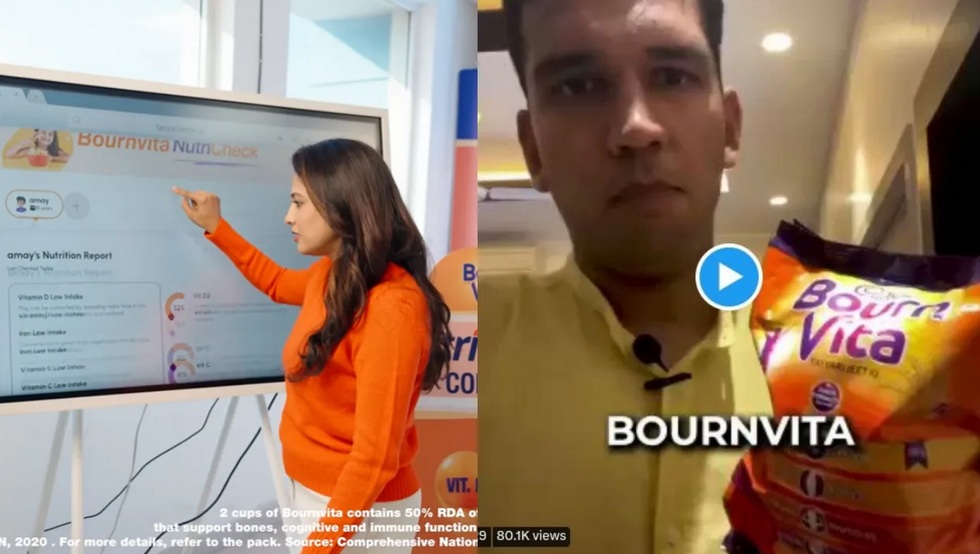
More than a year after the controversy, Bournvita has launched a large-scale influencer campaign to highlight its lower sugar content and nutritional benefits. The campaign features influencers visiting Bournvita factories to vouch for its authenticity and health benefits.
While the concept of factory tours is not new—brands such as Parle and Havmor use it as an extensive strategy to build consumer trust even in the absence of any controversy.
The concept has since been adapted by several brands. ID Fresh, known for its packaged idli and dosa batter, faced allegations of contamination with animal bones.
In response, it launched TransparenSee, a trust-building initiative that allowed consumers to take virtual tours of its production facility via live streaming, offering an unfiltered view of its operations.
However, marketing experts argue that Bournvita’s approach may not be enough to restore its credibility, as it relies heavily on influencer testimonials rather than direct consumer engagement. Crisis communication, they caution, must be handled with transparency and genuine action.
Bournvita’s strategy bears similarities to Shein’s controversial influencer-led factory tour campaign, which backfired. In June 2023, the fast-fashion retailer invited US influencers on a paid trip to its ‘Innovation Factory’ in Guangzhou, China, to counter allegations of labour exploitation.
Instead of improving Shein’s reputation, the trip sparked further backlash, with critics dismissing it as a PR stunt designed to manipulate public perception.
Mondelez defends the campaign
Speaking about the campaign, a Bournvita spokesperson says, “At Mondelez, our unwavering commitment to quality, transparency, and consumer trust defines everything we do. This campaign is a testament to our ongoing efforts to engage meaningfully with consumers.”
He further emphasises that Mondelez aims to go beyond influencer marketing by engaging directly with key stakeholders such as mothers and nutritionists, offering deeper insights into the product’s quality and nutritional benefits.
The need for authenticity over promotion
Krishnarao Buddha, a former senior category head of marketing at Parle Products, remains sceptical of Bournvita’s approach, arguing that credibility issues cannot be resolved through influencer endorsements alone.
“Instead of relying on paid influencers, brands should adopt a transparent and action-driven approach. In today’s digital age, where public scrutiny is at an all-time high, authenticity is the key to earning and retaining consumer trust,” he explains.
Devangshu Dutta, CEO, Third Eyesight, echoes similar concerns, stressing that once trust is broken, it takes time to rebuild.
“A single influencer campaign cannot erase past controversies. Brands need to engage in consistent and transparent communication about real improvements. Bournvita highlights its nutritional benefits, but consumers need more than promotional content—they need tangible proof of change, such as independent testing and direct consumer engagement,” he asserts.
Sandeep Goyal, chairperson and MD of Rediffusion, critiques Bournvita’s approach as an “MBA (Marketer’s Belly Ache) strategy” that prioritises corporate messaging over authenticity. “In today’s digital landscape, consumers are highly aware of paid promotions, making traditional marketing tactics less effective. Instead of attempting to control the narrative through influencers, brands should focus on rebuilding credibility through transparency and honest communication,” he advises.
Lessons from Cadbury’s past crisis management
This is not the first time Mondelez has had to navigate a brand crisis. In October 2003, just before Diwali, Cadbury Dairy Milk faced a major scandal when customers in Mumbai discovered worms in chocolates. The Maharashtra FDA seized stocks from its Pune plant, leading to widespread concern and a 30% drop in sales.
To regain trust, Cadbury launched Project Vishwas, an initiative to educate 190,000 retailers and reassure consumers. It invested Rs 15 crore in improved packaging without raising prices and enlisted Amitabh Bachchan as a brand ambassador. The campaign successfully restored consumer confidence.
Will Bournvita’s efforts be enough?
While Bournvita has taken steps to address consumer concerns, relying on influencer marketing alone may not be sufficient to rebuild its credibility. As past examples show, true reputation recovery requires more than just strategic campaigns—it demands tangible action, consistent transparency, and genuine consumer engagement.
(Published on Afaqs)
admin
March 4, 2025
Kashmeera Sambamurthy, Storyboard18
4 March 2025
A growing number of health advocates and industry watchdogs in India are raising concerns over misleading food advertisements, challenging brands on their claims and pushing for stricter regulations in an industry where marketing often outpaces oversight.
Recently, lifestyle guru Luke Coutinho called out quick-commerce platform Zepto over what he described as a misleading advertisement for garlic bread on Instagram. Sharing a screenshot of the ad on his social media, Coutinho criticized its promotion of refined carbohydrates as a bedtime snack, calling it “unethical” and a product of corporate greed. Tagging regulatory bodies including the Food Safety and Standards Authority of India (FSSAI) and the All India Institute of Medical Sciences (AIIMS), he urged authorities to take action.
Similarly, Dr. Arun Gupta, convenor of Nutrition Advocacy in Public Interest (NAPi), a national think tank of medical experts, pediatricians, and nutritionists, highlighted a full-page advertisement in Delhi Times for Amul TRU, a fruit drink brand. The ad, published on February 14, emphasized the “goodness of real fruits in every pack,” but Gupta pointed out that the listed ingredients contained concentrated fruit rather than fresh produce.
These instances reflect a broader pattern of misleading advertising in India’s food and beverage sector. While such controversies have long existed, it was only on February 7 this year that the Indian government announced the formation of a 19-member committee, led by Union Minister of Food Processing Industries Chirag Paswan, to address deceptive marketing practices and introduce more stringent regulations.
India’s struggle with misleading food advertisements dates back years. The Advertising Standards Council of India (ASCI) and FSSAI signed an MoU in 2016 to curb deceptive advertising in the food and beverage sector. Two years later, the Ministry of Information and Broadcasting (MIB) issued an order restricting junk food advertisements on children’s television channels, though they remained permissible on mainstream networks.
Despite these measures, misleading claims persist. In 2023 alone, FSSAI flagged 32 instances of food business operators violating the Food Safety and Standards (Advertisements & Claims) Regulations of 2018. That same year, actor Amitabh Bachchan faced criticism for endorsing Britannia Milk Bikis in a Kaun Banega Crorepati Junior commercial, where the biscuits were equated with the nutritional value of atta roti and a glass of milk.
Health influencer Revant Himatsingka, widely known as ‘Food Pharmer,’ also took on the industry, calling out Cadbury Bournvita for its high sugar content. Mondelez International reduced the product’s sugar levels by 15 percent and dropped its ‘health drink’ label from marketing materials.
The regulatory landscape includes four key frameworks to combat misleading food advertisements: the Food Safety and Standards Act (FSS Act), the Food Safety and Standards (Advertising and Claims) Regulations, 2018, the Consumer Protection Act (CPA), 2019, and the ASCI Code of Self-Regulation.
However, Gupta argues that these regulations require amendments to better define misleading claims. In 2024, NAPi lodged a complaint with FSSAI against advertisements for Parle-G Royale biscuits, which allegedly misrepresented their sugar content. The response? “There is no FSS regulation which says that nutrients will be declared in the advertisement,” authorities stated.
Gupta further highlighted that when FSSAI initially flagged 150 misleading advertisements in 2023, that number was later reduced to 32, with no clear updates on enforcement actions. “When the Kaun Banega Crorepati ad equated Britannia Milk Bikis with atta roti and milk, NAPi protested. The ad was pulled, but no fines were imposed,” he noted.
Celebrity endorsements add another layer to the issue. The 2024 TAM AdEx report found that food and beverage advertisements accounted for 28 percent of all celebrity-endorsed ads in India. The Consumer Protection Act, 2019, prohibits celebrities from endorsing banned products but allows promotions unless explicitly prohibited by law.
In a telling 2006 interview with journalist Karan Thapar, Bollywood superstar Shah Rukh Khan defended his endorsement of soft drinks, arguing, “If soft drinks are bad, ban their production. If production is not stopped due to revenue concerns, don’t stop my revenue.”
ASCI CEO Manisha Kapoor observed that influencers frequently promote foods without disclosing financial ties to brands, making endorsements appear organic rather than paid sponsorships. Sweta Rajan, a partner at Economic Laws Practice, expressed concerns that celebrity-backed marketing distorts public perception of healthy eating. “The continuous exposure to such ads makes it difficult for consumers to make informed choices,” she said.
The recently formed 19-member government committee has been met with skepticism from experts who believe it may lack independence. “The committee does not include a public health expert. Half its members belong to industry bodies. It should form a subcommittee to define what constitutes healthy food,” Gupta said.
Himatsingka called for stringent penalties against brands found guilty of misleading advertisements, suggesting that companies be publicly named on a weekly basis. Rajan, meanwhile, warned against excessive regulation, arguing that it could stifle creativity. “A balance must be struck between regulation and creative advertising,” she said. Instead, she proposed incentives for brands that adopt honest marketing practices.
Some experts advocate for clearer front-of-pack labeling. “Currently, most food labels prioritize regulatory compliance over consumer awareness. Since literacy levels in India are lower than in many Western nations, labels should be simple and easy to understand,” said Devangshu Dutta, chief executive of consultancy firm Third Eyesight.
Taxation has been another approach. Many processed foods in India attract an 18 to 28 percent GST rate, yet brands such as Coca-Cola, Lays, and Haldiram’s continue to thrive. “While taxes have some impact, they are not enough on their own,” Rajan noted.
Gupta suggested replacing FSSAI’s ‘Health Ratings’ – which he says benefit the industry more than consumers – with clear warning labels on ultra-processed foods. He said, “Consumers should be alerted to the risks, not misled by arbitrary ratings.”
(Published on Storyboard18)
