
admin
May 25, 2025
Gargi Sarkar, Inc42
25 May 2025
SUMMARY: Swiggy and Zomato are scaling back non-core bets such as 10-minute food delivery, private labels, and event logistics to sharpen focus on core businesses and improve profitability. Both companies are betting on platform fees and selective verticals like quick commerce and ticketing, but analysts warn that financial discipline, not endless expansion, is key to long-term sustainability. The foodtech duo is stuck in a balancing act of rationalising what works and doesn’t. However, going ahead, this rationalisation game is only going to get more pronounced as they will strive to shield their core bread and butter businesses
For foodtech giants Swiggy and Zomato (now Eternal), the last few years have been about engaging in a battle for expansion, so much so that it has become difficult to tell them apart.
From quick commerce and cloud kitchens to intercity food delivery and even selling tickets for events and concerts, the two companies appear to be aping each other’s every move to be everything everywhere all at once.
However, what began as a bold bet to dominate every possible vertical falling under the ambit of food, lifestyle and entertainment is now undergoing a major course correction.
For starters, both are reconsidering their blitzkrieg, and while at it, they are gracefully stepping away from non-core bets, diluting underperforming or experimental units to focus on core operations to drive profitability.
For context: Zomato, which once saw the future of food logistics in ultra-fast deliveries, gave up on its 15-minute food delivery service, Quick, four months after its launch in January. It has also pulled the plug on its home-made meal service, Zomato Everyday. Tailored for office-goers and budget-conscious consumers, the service was floated in January 2025.
Swiggy, too, has made similar retreats. It suspended Swiggy Genie, its courier and pick-up-and-drop service that had gained popularity during the pandemic. The company also gave up on its private label food business by entering a strategic agreement with Kouzina, a chain of virtual restaurants, granting it exclusive rights to operate Swiggy’s digital-first food brands.
So, what has triggered this metaphorical fission in strategy?
One possible reason could be the growing realisation that profitability hinges on diversifying smartly rather than untamed expansion.
A market analyst, who did not wish to be named, pointed out that the duo’s attempt to rule their customers’ wallets for everything from food to groceries and entertainment to lifestyle has been quite ambitious. “The course correction was overdue,” the analyst said.
He believes that foodtechs are now forced to burn the visceral fat in the form of non-core businesses because those have been slowing them down, also eating into the revenues of core businesses and impacting operational efficiencies.
“Moreover, the more the segments, the higher the chances of operational hiccups. Managing logistics, customer experience, and quality control across a wide array of verticals inevitably leads to fragmentation and strain on core operations,” he added.
State Of Eternal Affairs: Zomato’s Diversification Saga
Eternal’s push to transform Zomato into a broader lifestyle platform in 2024 was not only about ambition but also a strategic response to a slowing core business — food delivery, according to industry observers.
Also, a glance at the table below reveals how the company has seen a marginal QoQ increase in its monthly transacting users.
In terms of monthly transacting customers, Zomato’s food delivery growth began strong with a 6.84% QoQ jump in Q1, but momentum quickly slowed, and Q2 saw only a 1.97% sequential rise, followed by a slight decline of 0.97% in Q3. This dip signalled stagnation, and although Q4 showed a mild recovery (1.95%), overall FY25 growth of the company’s monthly transacting users (food delivery) was modest at just 2.96%
Interestingly, Eternal founder and CEO Deepinder Goyal, too, acknowledged a slowdown in the company’s food delivery business while announcing the company’s Q4 FY25 results. He said the slowdown was due to rising competition from quick commerce platforms and weak discretionary spending. Goyal added that services like Zepto Cafe, Swiggy Snacc, and Blinkit Bistro, too, were eating into demand for restaurant deliveries.
In terms of Zomato’s food delivery numbers, average monthly transacting numbers grew to 20.9 Mn in Q4 FY25 from 20.5 Mn in Q4 FY24. Net order value (NOV) growth also remained subdued at 14% YoY versus the 20% YoY growth guidance.
Hence, the company was under pressure to unlock new revenue streams. Blinkit’s success became the reference point, and the company started envisioning similar success stories with other verticals too, a former Zomato employee said.
This was when the company got engulfed in the wave of diversification, paving the path for Zomato’s yet another bold move (besides Blinkit) — the INR 2,078 Cr acquisition of Paytm’s movies and events ticketing business, Insider, in August last year.
The acquisition that was planned with the launch of the ‘District’ app meant but one thing — declaration of war against BookMyShow, the lone behemoth in the realm of the entertainment ticketing segment. Even the company knew the path wouldn’t be all rainbows and sunshine.
In its Q4 FY24 earnings call, the management acknowledged that while the gross order value (GOV) of the going-out vertical continues to grow at over 100% YoY, the business still operates at an adjusted EBITDA loss of -2 to -2.5% of net order value (NOV).
Besides, given that the transition of users from Paytm’s ticketing business and Zomato’s dining out platform to the District app requires sustained investment, the company doesn’t expect the business to turn profitable in the near term.
But Zomato expects losses to eventually see stability at current levels.
“However, even with plateauing losses, the company will have to keep spending on creating supply. This means: curating new event experiences, forging partnerships and acquiring new users for the District app… and all of this translates into one thing — prolonged burn,” the market analyst added.
Moving on, Zomato’s ambition to become a lifestyle super app didn’t just manifest into flashy verticals like events, entertainment, and ticketing — it also showed up in its renewed aggression in food delivery, the very space where it first made its name.
Therefore, Zomato began piloting a 15-minute food delivery service in select parts of Mumbai and Bengaluru early this year.
But the company now finds the initiative extremely difficult to operationalise as it has failed to generate incremental demand.
“Customers do not necessarily want food fast, they just want it reliably. A 10-minute turnaround without full control over the supply chain leads to poor customer experiences, operational stress, and negligible upside. Instead of delighting users, it makes the company vulnerable to inconsistent quality and frequent delays,” a Zomato insider added.
Satish Meena, the founder of Datum Intelligence, opined that without controlling the entire supply chain, delivering food items within 10 to 15 minutes cannot be a profitable proposition.
Swiggy’s U-Turns
In 2024, also the year of its public listing, Swiggy aggressively expanded its service offerings, launching several new verticals to diversify beyond its core food delivery business.
Among the most prominent launches was Bolt, a 10-minute food delivery platform. Initially launched in Bengaluru, Chennai and Mumbai, Bolt quickly expanded to over 400 cities, with over 40,000 restaurants, including KFC, McDonald’s and Starbucks.
To complement Bolt, Swiggy introduced Snacc, a separate app for instant delivery of snacks, beverages, and small meals within 15 minutes.
Continuing to diversify its portfolio, Swiggy launched Pyng, an AI-powered platform that bridges users with verified experts like yoga teachers or chartered accountants.
With this, Swiggy marked its entry into the on-demand services marketplace, making professional services easier to access.
Apart from these customer-facing services, Swiggy also entered events via Scenes and the B2B space with Assure, to keep pace with Zomato.
Interestingly, Swiggy, too, has begun consolidating its operations. The company has shut down Genie, its hyperlocal courier business, which competed with Porter, Borzo and Uber.
According to a competitor, sourcing delivery riders specifically for packages is a challenge, particularly in cities like Bengaluru. For Swiggy, which was already managing fleets for food delivery and quick commerce through Instamart, sustaining a separate rider network for Genie only added to the complexity.
In another such move, Swiggy exited its private label food business by transferring exclusive rights for its digital-first brands, including The Bowl Company and Homely, to cloud kitchen operator Kouzina.
Balance Sheet Blues
Imperative to highlight that the rollbacks by Zomato and Swiggy are rooted in the growing pressures on their respective balance sheets.
After diversifying at a breakneck speed, they are now faced with the hard realities of cost structures that don’t always align with revenue potential.
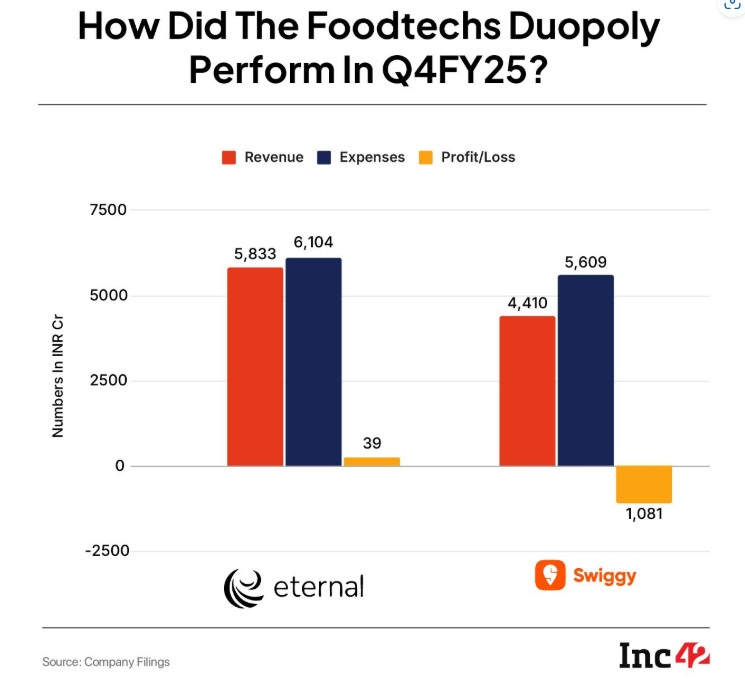
In Q4 FY25, Zomato and Swiggy both reported robust top-line growth. Zomato’s revenue surged to INR 5,833 Cr, largely buoyed by its three core pillars — the food delivery business (INR 1,739 crore), Blinkit’s quick commerce arm (INR 769 Cr), and Hyperpure, its B2B supply chain vertical, which posted a 99% YoY growth in revenue to INR 1,840 Cr.
However, despite the momentum, the company’s net profit declined sharply to INR 39 Cr in the quarter, largely thanks to ongoing investments in Blinkit and newer bets like the ‘District’ lifestyle app.
Meanwhile, Swiggy clocked INR 4,410 Cr in revenue in Q4, up 45% YoY, but saw its net loss nearly double to INR 1,081 Cr. The widening losses were fuelled by surging operational expenses.
“All of this explains the strategic pullbacks witnessed lately, Swiggy exiting Genie and private labels, Zomato pulling the plug on services like Quick and Legends. The rationalisation marks a reset, indicating that while growth via diversification was necessary, financial discipline and profitability are in the spotlight,” the market analyst said.
Platform Fee To The Rescue… But For How Long?
While it won’t be easy for Zomato and Swiggy to suddenly change course, the future of these two foodtech giants is all about heading towards a more focussed set of revenue streams driven by value rather than FOMO.
In the process, both foodtech giants appear to have struck gold with the platform fee, which has grown from just INR 2 in 2023 to INR 10 today.
But the real question is: Can rising platform fee help the duo neutralise the impact of aggressive expansion? Or is rationalisation the only way forward?
Devangshu Dutta, the founder of Third Eyesight, thinks otherwise. He believes that the companies will not stop looking for new revenue streams, even as they will continue to amputate the ones that offer little value.
“All of these companies have to look for growth, which is a given. If their existing businesses are not delivering the kind of growth they need to justify their stock price or valuation, then they have to look at new avenues.”
According to him, we are bound to see a flurry of experiments, trials of different services and new verticals as these companies attempt to expand their addressable markets.
At the end of the day, the foodtech duo is stuck in a balancing act of rationalising what works and doesn’t. However, going ahead, this rationalisation game is only going to get more pronounced as they will strive to shield their core bread and butter businesses.
[Edited by Shishir Parasher]
(Published in Inc42)
admin
January 9, 2025
Sagar Malviya, Economic Times
9 January 2025
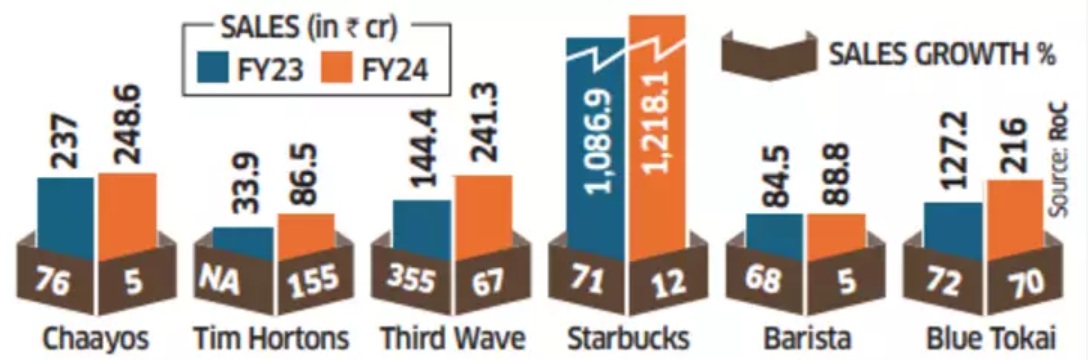
Starbucks, Barista, Chaayos and Third Wave Coffee are among café chains facing the brunt of a slowdown in discretionary consumer spending. The impact is more severe for these retailers as they opened hundreds of new stores last fiscal year even as losses widened. To be sure, smaller chains such as Tim Hortons and Blue Tokai have bucked the trend.
Experts attribute the expansion rush to the urge among these retailers – both chains and standalone stores – to outpace competition. In certain instance, it led the same retailer to add stores in the same location, impacting its own growth instead of growing the pie.
At Rs 250 to Rs 350 for a cup of coffee, most chains target affluent, discerning coffee enthusiasts with artisanal brewing and experiential consumption, restricting the consumer base.
Devangshu Dutta, founder of retail consulting firm Third Eyesight, said the number of outlets have been expanding since 2022.
This was true for not just the new brands but also existing ones, Dutta said. “Cafe density in larger cities has gone up dramatically in the last couple of years.”
Growth rate fell to just 5% in FY24 from nearly 70% at Barista and Chaayos while Starbucks’ sales growth declined to 12% in FY24 from 70% in FY23. Third Wave saw sales growth slump to 67% from 355% during the period. Cafe Coffee Day posted a 9% increase in FY24, though sharply slowing from 59% a year ago.
Tim Hortons, however, more than doubled its sales last fiscal, its first full year of operations. Blue Tokai also bucked the slowdown trend with a 70% growth in FY24, compared to 73% in FY23.
Blue Tokai cofounder Matt Chitharanjan believes growth in India’s out-of-home coffee market is more than just a caffeine surge—reflecting the country’s shifting economic fabric. “Coffee consumption is strongly linked to income growth and India has reached a tipping point where it will support growth in the segment and should only accelerate going forward,” Chitharanjan told ET. “We have not seen any slowdown in coffee consumption and our positioning is also more product centric instead of just a cafe, which helped in double-digit same store sales growth.”
Tim Hortons, a Canadian coffee chain, which opened its first outlet in India in 2022, plans to have over 100 stores in the next three years. British coffee and sandwich chain Pret A Manger too launched its first shop in Mumbai as part of a franchise agreement with Reliance Brands. It plans to open up to 100 stores over the next five years. Third Wave and Blue Tokai are running more than 250 stores combined while Starbucks had over 330 stores as of March-end.
Tata Starbucks—the equal JV between Tata Consumer Products and US-based Starbucks Corp—said store footfalls have become a concern and the company has tweaked portfolio and pricing to attract traffic. Last year, the chain introduced classic hot and iced coffee starting at Rs 150 for a small cup, about 20-30% cheaper than regular coffee offered at Starbucks and other cafe chains.
“The stress is being seen across the quick service restaurant segment. It’s an overall consumer spending issue, especially in urban areas. And my hypothesis is probably food inflation is higher than what we think,” Sunil D’Souza, MD at Tata Consumer Products said during the December quarter earnings call.
Globally as well as in India, coffee growers have been hit with uncertain weather conditions while geopolitical factors are also affecting supply chains, which in turn, lifted prices to a record high. “The biggest challenge is erratic weather and climate change which has sent coffee prices to a 50-year high, but we will have to see how it impacts our pricing and profit after the current harvest,” said Chitharanjan at Blue Tokai.
(Published in Economic Times)
admin
August 19, 2024
Ratna Bhushan, Economic Times
New Delhi, 19 August 2024
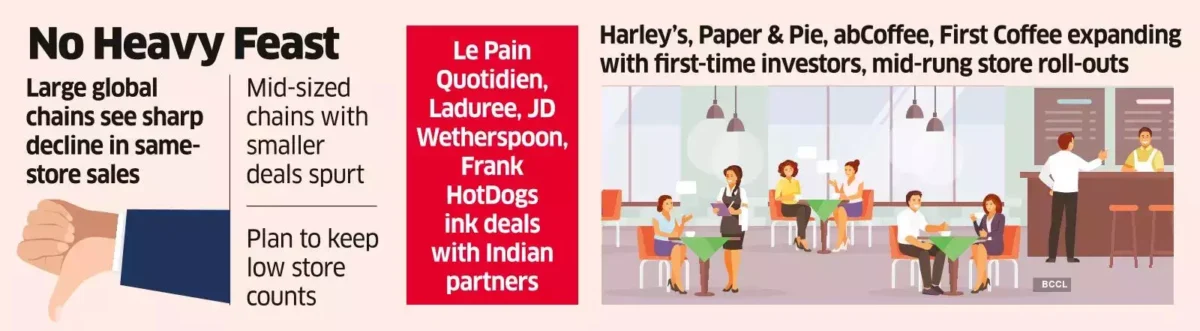
Close to a dozen small to mid-sized global cafes and restaurant brands have either entered India in the past two quarters or are in talks with local players at a time when large global chains are seeing sharp decline in same store sales and growth.
Mid-sized global chains are making investments even in a modest range of Rs. 20-30 crore to tap select cities and intend to keep store counts under about 30 to stay profitable on each store. This is in contrast to earlier times when cafes and chains entered India with mega deals and investment plans, executives said.
Belgian bakery Le Pain Quotidien, French patisserie chain Laduree, UK’s JD Wetherspoon and Frank HotDogs are among those to have inked collaborations with Indian partners, while newer homegrown ones such as Harley’s, Paper & Pie, abCoffee and First Coffee are expanding with first-time investors and mid-rung store rollouts.
“A combination of factors is driving this change of newer, smaller launches,” said Devangshu Dutta, chief executive of retail consultancy Third Eyesight. “There are niches the newer chains are addressing as consumers’ choices evolve and get more specific. Also, there’s a broadening of a wealth base in India leading to mid-sized business houses having capability to invest and willingness to try out newer segments,” he said.
With the big-bang launches in food services drying up, there’s been a mushrooming of small deals that is expected to surge.
Bake & Brew, which has inked a master franchise agreement with Belgian bakery chain Le Pain Quotidien to re-enter India, is investing Rs 35 crore in the first year. “We’ll start in metros and may expand to smaller towns later. We also see potential in travel retail, airports and larger train stations,” Annick Van Overstraeten, chief executive of Le Pain Quotidien, told ET. Bake & Brew is backed by the Nalanda group with core business interests in automotive metal parts.
Earlier this month, the French patisserie chain Laduree said it was launching its cafe at Ritz-Carlton, Pune, in collaboration with CK Israni Group which has business interests in home decor and construction. Its Managing Director Chandni Nath Israni said in a statement that the CK Israni group planned to expand Laduree’s presence across other Indian cities.
Experimenting in newer cuisines is also driving the change. “Our decision to expand in India stems from a deep appreciation for variety and a passion for bold flavours. We see great potential in the Indian market,” said Benjamin Attal, founder of US chain Franks Hot Dog.
Smaller and newer homegrown chains, in contrast, are expanding, backed by mid-ticket investors and business houses, many of whom are foraying into food services for the first time.
Last week Brigade Group, a realtor, announced a partnership with specialty coffee chain abCoffee to set up six outlets within Brigade properties.
“We partnered with abCoffee to enhance the F&B offerings at our office parks. abCoffee is able to retrofit into operational buildings without requiring additional water or gas points,” Arvind Rao, vice president – commercial business, Brigade Group, said.
Specialty coffee startup First Coffee plans to open 35 stores by 2024-end “focused on delivery and minimalist store aesthetic,” according to a company statement, to sell flavoured coffees, cold brews and bubble teas.
(Published in Economic Times)
admin
August 19, 2024
Sagar Malviya & Faizan Haidar, Economic Times
19 August 2024, Mumbai/New Delhi
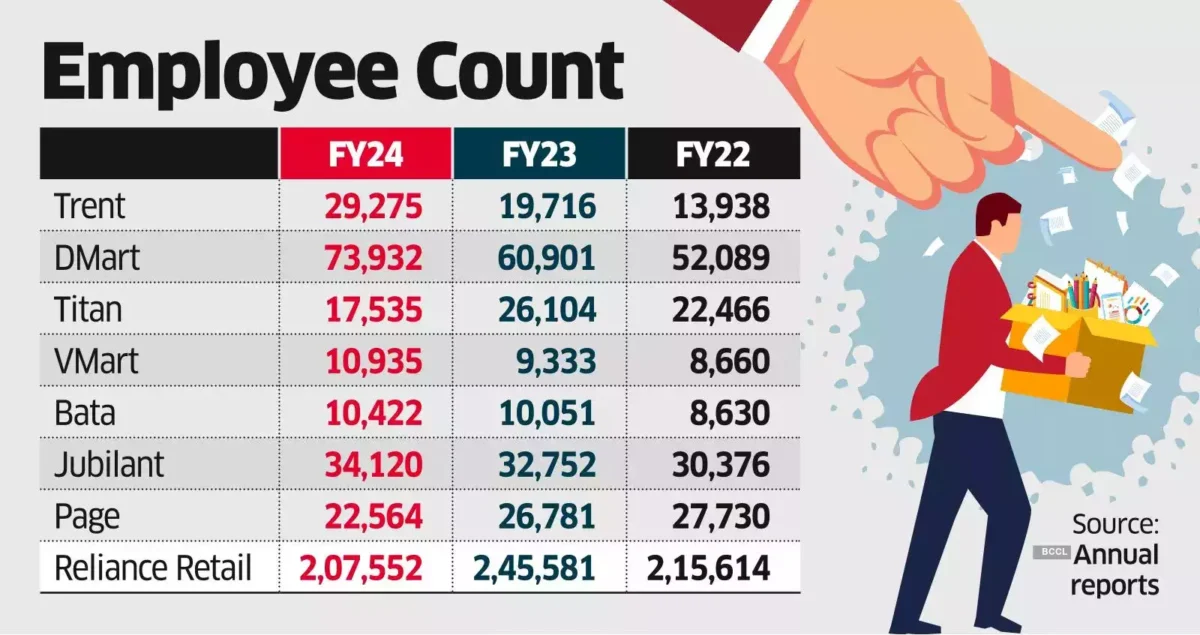
About a dozen listed lifestyle, grocery retailers and quick-service restaurants (QSRs) reduced their employee count by nearly 26,000 in FY24, retreating from the hiring spree of the past two financial years after they slowed down store expansion rate amid weakening demand.
According to their latest annual reports, the reduction was completely led by five retailers – Reliance Industries’ retail arm, Titan, Raymond, Page and Spencers – which saw their combined workforce decline 17% or by 52,000 people. The staff count was across permanent and contractual employees and adjusted for attrition in the retail segment, the second largest employer after agriculture. These retailers had a combined workforce of 429,000 people in FY24 compared to 455,000 employees a year ago.
“There is a shortage of talent and we are trying to tie up with universities so that the industry has the option to hire. Some companies might have reduced staff due to shutting of some business, but companies like Shoppers Stop and Trent continue to expand and will require staff,” said Kumar Rajagopalan, CEO of Retailers Association of India that represents organised retailers in the country.
Consumers had started reducing non-essential spending such as that on apparel, lifestyle products, electronics and dining out since Diwali 2022 due to inflation, increase in interest rates, job losses in sectors like startups and IT, and an overall slowdown in the economy. India’s retail sales expansion slowed to 4% last year after a surge in spending across segments-from clothes to cars-in the post-pandemic period, triggered by revenge shopping.
RIL in its annual report said the overall voluntary separations in FY24 were lower than FY23 and the retail industry typically has a high employee turnover rate, especially in store operations.
“Store productivity usually happens in cycles and we have seen consumers unleash their spending post pandemic, which led to retailers expanding their network or square footage. However, if some of the stores are unviable, then management teams are now highly objective, even ruthless, and will shut stores,” said Devangshu Dutta, founder of retail consulting firm Third Eyesight. “In addition, any company planning to list would like to have healthy and lean operations, although we cannot pin-point it to Reliance in this case.”
Weak sales saw these retailers having the slowest pace of store expansions in at least five years at 9%. The retail sector took 7.1 million square feet of space across top eight cities in 2023, which is expected to dip to 6-6.5 million sq ft in 2024, according to commercial real estate services firm CBRE.
“There’s an enormous management bandwidth requirement to just get this entire ship running in the right trajectory, right direction, and with the relevant speed. We are thinking about what this company will be 10 years from now. And hence, if you want to reach there in a nice way without too much damage or bruises, then what is the kind of talent we need to have today in the next 2 years, in the next 3 years?” Avenue Supermarts CEO & MD Neville Noronha asked investors.
(Published in Economic Times)
admin
February 23, 2024
Kailash Babar & Sagar Malviya, Economic Times
Mumbai, 23 February 2024
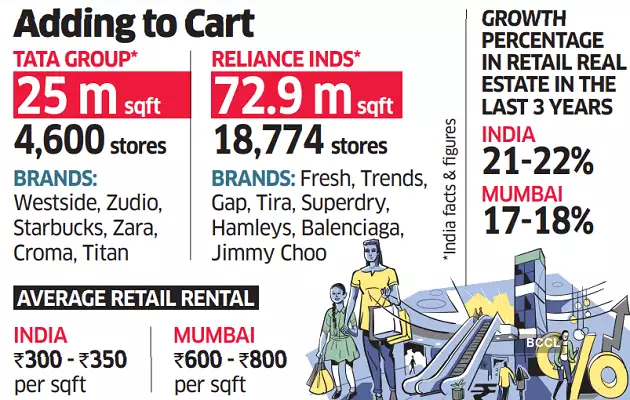
Tata Group and Reliance Industries, two of India’s largest conglomerates, are vying for premium retail real estate in Mumbai as they extend their footprints, creating rivalry in a city starved of marquee properties. From Zara and Starbucks to Westside and Titan, the Tata Group occupies nearly 25 million square feet of retail space in India. That is still no match for Reliance Industries that control three times more at 73 million sq ft for more than 100 local and global brands.
But in Mumbai, they are evenly matched, having nearly 3 million sq ft of retail space each. That is a quarter of what is considered the most prime retail real estate in the country, and both the retail giants are looking for more.
“In a modern retail environment, most visible locations contain more successful or larger brands. It just so happens that many of those brands are owned by either Reliance or the Tatas,” said Devangshu Dutta, founder of Third Eyesight, a strategy consulting firm.
“Tatas have been in retail for longer but also slower to scale up compared to Reliance which had this stated ambition of being the most dominant and put the money behind it,” he said.
In a market where demand is much higher than supply, developers and landlords seek to separate the wheat from the chaff, experts said. Ultimately, success in Mumbai’s retail real estate scene hinges on a delicate equilibrium between accommodating industry leaders and fostering a vibrant, varied shopping environment, they said. “In the competitive landscape of retail real estate in Mumbai, commercial developers and mall owners often face the strategic challenge of accommodating prominent retail brands,” said Abhishek Sharma, director, retail, at commercial real estate consultants Knight Frank India.
“These big brands, with a significant market share of 40-45% in the Indian retail sector, can easily be termed as industry giants and possess the potential to command 45-50% of space in any mall,” he said. According to Sharma, there may be perceptions of preferential treatments, but the dynamics are complex, and developers must balance the demand from these major brands with the need for a diverse tenant mix.
Tata Group entered retail in the late 1980s, initially by opening Titan watch stores and a decade later by launching department store Westside. So far, it has about 4,600 stores, including brands such as Tanishq, Starbucks, Westside, Zudio, Zara and Croma.
While Reliance Retail started in 2006, it overcompensated for its late entry by aggressively opening stores across formats. Reliance has over 18,774 stores across supermarkets, electronics, jewellery, and apparel space. It has also either partnered or acquired over 80 global brands, from Gap and Superdry to Balenciaga and Jimmy Choo. A diverse portfolio of brands across various segments through strategic partnerships and collaborations helps an entity like Reliance to leverage synergies and enhance retail presence, especially in malls, experts said.
“The array of brands with Reliance bouquet allows it to enter early into the project and set the tone and positioning of the mall,” said a retail leasing expert who requested not to be identified.
“This positively helps the mall to set its own positioning and future tenant mix. It also helps Reliance place their brands in most relevant zones within the mall. This will emerge as a clear differentiator in a city like Mumbai where brands are already jostling for space, which is the costliest in the country,” the person added.
(Published in Economic Times)
