
admin
June 5, 2025
Aakriti Bansal, MediaNama
June 5, 2025
A restaurant owner recently took to X (formerly Twitter) to publicly slam Zomato for “mystery charges” and unauthorised ad placements, reigniting concerns over how the platform treats its small business partners. The tweet, accompanied by screenshots of the restaurant’s earnings dashboard, claimed that despite months of listings, his restaurant received zero payouts, and Zomato allegedly ran ads without his consent.
“Dear @zomato @deepigoyal I’m finally pulling my restaurant off your platform. Congrats! Your mystery service charges, surprise ad placements (without consent), and a POC who ghosts like it’s a talent show—truly inspiring. Small outlets deserve better,” restaurant owner Manish posted on X, under the username @maniyakiduniya.Zomato responded: “We hear you! As mentioned earlier, please share your restaurant ID with us via DM, so that our team can get in touch with you.”
The post has struck a chord among restaurant owners who say Zomato’s ad model bleeds their business dry. In conversations with MediaNama over the week, two restaurant owners and a former manager with Zomato independently confirmed that the platform’s advertising system leaves little room for transparency, choice, or sustainable profit.
The names of the restaurant owners and the former Zomato manager have been withheld to protect their anonymity.
Forced Ad Spending and Diminishing Returns
Restaurant owners say visibility on Zomato is tightly tied to how much they spend on advertising.
“If you don’t run ads, your restaurant won’t even show up unless someone searches for you by name,” one owner told MediaNama. He further added, “From what I’ve seen, the top 10 restaurants you see when you open Zomato are all paying for that spot.”Even ratings and reviews don’t help. For instance, if a user searches for ‘noodles’, only those who have paid for the ad category will show up in the list.
Restaurant owners explained how the ad budget starts small, around Rs. 300–400 per week, but grows rapidly. In one case, as seen by MediaNama in a restaurant’s ad dashboard, spending jumped from Rs. 9,000 to Rs. 15,000 per week in just two to three weeks.
“Some are spending Rs. 18,000 to Rs. 20,000 weekly now on ads just to stay afloat,” an owner explained, noting that these costs are hard to bear for restaurants with weekly sales as low as Rs. 2,500.
“When everyone is pushed to advertise just to stay visible, it raises serious questions about how fair the competition is on the platform,” they said. “It’s not about food quality or ratings anymore, it’s about who pays more,” they added.
A screenshot shared by a restaurant owner showing a decline in sales from ads, offers, and orders with applied discounts, highlighting concerns over the effectiveness of Zomato’s advertising model.
Click Charges with No Sales
Zomato charges restaurants based on clicks, not conversions. This means a restaurant is charged whenever a user taps on its listing after seeing a sponsored ad, regardless of whether the user places an order.
One owner explained, “A single click can cost around Rs. 6. Even if a customer just views the restaurant by clicking on it and doesn’t buy, that money is deducted.” He showed a dashboard with 4,877 clicks – most of which occurred before noon – but no conversions. “They exhaust our daily limit by 12 PM and then tell us to increase ad budgets,” he added.
Another restaurant owner echoed similar concerns in a Reddit conversation reviewed by MediaNama. The owner stated that Zomato counts a ‘visit’ even when a user scrolls past an ad and places an order a day later. “That is on purpose,” he wrote, calling the model “scammy for sure”. He also confirmed that restaurants receive no detailed data on who placed orders via ads versus organically.
Furthermore, the owner noted that Zomato lacks a clear grievance redressal mechanism for ad-related issues, as complaints are often ignored by a restaurant owner’s point of contact.
“There’s no formal audit or independent review if an ad campaign fails,” he said.The Legal Escape Hatch: You Signed the Contract
Restaurant owners say Zomato deducts ad spends automatically, citing terms buried in the onboarding agreement – terms many admit they didn’t fully understand before signing. Once enrolled, there’s no clear way to pause or cancel.
“There’s no way to opt out once it starts, and no refunds either,” one merchant said. “Zomato just says, ‘You came to us,’ whenever we raise concerns,” he added.
But is this consent truly informed? “It’s a honeytrap,” the merchant said. “There’s no other option but to keep spending on ads if you want to stay relevant on the platform,” he explained.
Price Parity, Platform Pressure, and Squeezed Margins
Another major source of concern is Zomato’s price parity push. According to one owner, the company convinced restaurants to upload their table-rate menu on the platform by offering to lower commission fees. However, this strategy has backfired for many.
“They promised lower commission if we maintained the same prices online and offline. But now we pay Good and Services Tax (GST), high commissions, and ad spends on top of that. Our margins are cut down to 5–10%,” he said. Commissions alone can go up to 35–40% every month, forcing smaller restaurants to comply just to remain competitive.
In effect, merchants are footing the bill for everything: discounts, ads, visibility, and commissions, while Zomato gains from each layer.
Coupons and Data Obscurity
The dashboard Zomato offers shows data like clicks and visits, but it hides key financial insights that would help merchants make informed decisions. “They will show you how much you sold, but not how much you are paying to the platform,” one owner said.
Restaurant owners also said they have little to no control over how Zomato spends their ad budget. “We don’t know when our ads are shown, or to whom. There’s no data on which campaign worked better, or what to change,” one merchant said. Without visibility into targeting and performance strategy, many feel they are blindly spending in hopes of visibility.
Coupon codes, too, are deducted from the restaurant’s share, even if the platform offers them without informing the merchant. “Whatever discount a customer sees, it’s cut from our side. Zomato’s share is tiny, about 15%. We bear the rest,” the merchant added.
If a platform issues discounts unilaterally but bills restaurants for them, is that a fair bargain?
Opaque Categories and Manipulated Targeting
Merchants also highlighted how Zomato divides ad rates by cuisine categories — North Indian, Chinese, etc. — and even by customer frequency. “There are eight to 10 customer categories, each with a different ad rate,” an owner said. “Frequent buyers are more expensive to target”, he added.
The platform nudges merchants to buy targeted ads by showing graphics and dashboards that suggest potential boosts. But when profits drop, and merchants reach out, they are told that competition has increased significantly since they last got in touch with Zomato and they should spend more.
“It’s a vicious cycle. They’ll say: ‘Try a brand title ad or pay Rs. 300 extra to reach daily customers.’ The game never ends,” revealed the restaurant owner.Inside Zomato: How Ads Shape Visibility
A former Zomato manager told MediaNama that restaurants not running ads don’t get deliberately penalised, but they do end up losing visibility. “Those who run ads automatically rise in rankings. So the others fall behind,” he said. Even a high-rated restaurant may slip if competitors outspend it.
For context, how much a restaurant pays for ads often depends on their rapport with the specific Zomato account manager and their business goals. “If a restaurant wants aggressive growth, we push it to the top line: high spend, high return. Others stay in the down line: lower investment, slower scale,” he said.
Ad pricing, he said, is not standardised. “It varies depending on what the manager thinks the client can afford and how much they are willing to push.”
He added that Zomato’s discovery algorithm changes every five to six months, which makes it difficult for restaurants to adapt or plan long-term. “The idea is to keep the system rotating so one client doesn’t dominate.”
Performance tracking for restaurants, he said, is mostly transparent except for one missing piece: acquisition data. “Zomato doesn’t show how many customers came through advertising. That’s where it becomes murky.”
He admitted Zomato doesn’t intervene if a restaurant complains about bad ad results. “It depends on the manager’s willingness but hardly anyone did it because of too many internal disputes on this issue.”
Why Ad Revenue Matters So Much
Ad revenue, the former Zomato manager said, is especially crucial in Tier 2 and Tier 3 cities.
“In big cities, order values are high, so aggregators can survive on commissions. But in smaller cities, ad income is the main driver as the order values are comparatively low”, the former manager added.Zomato’s Q4FY25 Shareholders’ Letter reflects this reliance: the company’s advertising and sales promotion expenses rose to Rs. 1,972 crore on a consolidated basis in FY25, up from Rs. 1,432 crore in FY24. While these are expenses borne by the platform, they highlight how advertising has become a structural lever in both customer acquisition and revenue generation.
Elsewhere, an HDFC Securities report states that quick commerce companies have theoretical levers to improve margins, such as increasing take rates, including higher ad income. It also observes that Blinkit would need to improve its take rates from 18.5% to 22% to reach a 5% adjusted EBITDAM (Earnings before Interest, Taxes, Depreciation, Amortisation, and Management Fees), with ad revenue identified as a key lever to meet that target.
However, the report notes that heightened competition may keep some of these levers non-operational.
Zomato‘s Response
In response to MediaNama’s queries, a Zomato spokesperson shared the following statement:
“All marketing collaborations such as ads, promotions, and discounts etc., as well as commercials, are mutually discussed with our restaurant partners before being switched on, switched off or modified. Our multi-factor authentication system ensures that partners retain full control and give explicit consent which is registered before any changes go live. We also maintain robust escalation mechanisms, allowing partners to raise concerns and receive prompt, satisfactory resolutions through the Restaurant Partner App as well as centralised helpline numbers.
We continue to see restaurants having confidence in our partnership and are taking a proactive step to improve and enhance our interactions and processes. For our smaller restaurant partners, we work extra hard to make it easier for them to grow with us. There are always opportunities to improve and we are committed to working on them, on-time.”
While Zomato says it maintains robust escalation mechanisms and explicit partner consent, restaurant owners who spoke to MediaNama described a different reality: one of automatic deductions, limited control, and opaque ad operations.
What Zomato’s Policy Says and Doesn’t
According to Zomato’s Sponsored Listing Service terms, merchants are expected to make full payments in advance. Refunds are not guaranteed, and Zomato has full discretion on ad placements, sizes, and category changes.
The company “assumes no liability or responsibility for any… click frauds, technological issues or other potentially invalid activity that affects the cost of Service.” It also “does not warrant the results from use of Service, and the Merchant assumes all risk and responsibility.”
The Sponsored Listing Service terms grant Zomato broad rights to use merchant content, brand names, and logos, while limiting the company’s liability to the amount of fee paid during a term. These terms become legally binding once the Service Request Form (SRF) is signed.
While Zomato offers a merchant dashboard to track visits, it does not disclose the full breakdown of how ad money is being spent or how much value is being returned. One merchant noted that visibility data only started appearing in the last five to six months. Before that, they had no metrics at all.
Swiggy’s Self Serve Ads: A More Transparent Model?
Swiggy says its ad platform puts control in the hands of restaurant partners. Through the Self Serve Ads tool, restaurants can create their own campaigns, adjust daily spends, and track how those campaigns perform. The company promotes the tool as flexible and cost-effective, with no upfront payments.
The onboarding process is laid out step-by-step: restaurants upload documents like GST and Food Safety and Standards Authority of India (FSSAI) certificates, complete Know Your Customer (KYC), and sign a Partnership Agreement after a verification visit from a Swiggy representative, As per Swiggy, commissions are based on location and whether a restaurant opts for extra promotions.
Compared to Zomato’s Sponsored Listings model, which some restaurant owners say they didn’t fully understand when signing up, Swiggy’s approach looks more structured and consent-driven, at least on the surface.
But that clarity doesn’t always hold up. One of the restaurant owners told MediaNama that Swiggy’s model isn’t entirely different from Zomato’s. “You have to pay them if you want your restaurant to show up in search. It’s the same thing, just framed differently,” the owner said, suggesting that visibility on the platform often comes at a cost, regardless of how the ad system is marketed.
Advertising as a Structural Lever in Quick Commerce
Restaurant owners have flagged the rising costs and opacity of advertising on platforms like Zomato. But industry research shows that this isn’t just a revenue stream but it’s central to how delivery platforms, especially in quick commerce, are designed to operate.
A September 2024 report by CLSA, titled App-racadabra- Magic Behind Instant Delivery Liberating Customers, found that ad revenue makes up around 3.5% to 4.5% of gross merchandise value (GMV) on Zepto. That figure is only expected to grow as more brands start recognising the significance of quick commerce.
Interestingly, Zepto doesn’t just run ads for brands that sell on its platform. It also allows companies to advertise even if they aren’t listed, using spaces like the order tracking page, according to the report.
Quick commerce platforms can also use past purchase data to deliver more targeted ads and push higher-value products – what the report calls driving “premiumisation” of fast-moving consumer goods (FMCG).
Zomato’s quick commerce arm, Blinkit, is expected to lean heavily on ads to hit profitability targets. CLSA notes that Blinkit’s margins could eventually exceed those of food delivery, given the larger potential for ad revenue and the shift toward higher-margin categories.
The report adds that quick commerce is especially useful for smaller or direct-to-consumer (D2C) brands. These businesses can tap into a pan-India audience without having to build their own distribution networks.
The CLSA findings reinforce how advertising isn’t just about visibility, but it is baked into the business model. As margins tighten, discovery on these apps is no longer organic but paid.
Expert View: Power, Visibility, and Platform Dependence
These patterns mirror broader trends across retail and platform ecosystems, not just food delivery.
Devangshu Dutta, the Founder and Chief Executive of specialist consulting firm Third Eyesight, told MediaNama that these dynamics are not unique to Zomato or even food delivery.
“Advertising and promotion focussing on specific brands or products is standard across various platforms and formats. It is an outcome of the balance of power between the platform and the supplier brand, and is equally true of physical retail chains, online marketplaces and aggregation platforms such as Zomato,” he said.
Brands or restaurant chains with deeper pockets tend to secure greater visibility—whether through premium shelf space in physical stores or prominent placements like sponsored listings and banners on delivery platforms.
“Demand-side concentration inevitably favours larger suppliers and brands who can fund visibility, whether it is through endcap displays in a retail aisle or sponsored banners or top-of-search-list positions on an app,” Dutta stated.However, he noted that some established brands may choose to bypass platform dependence altogether.
“If brands are well-established or have other means to ensure that their message and product reaches the target consumer, they may choose to opt out of the channel, as many restaurants have done with Zomato and Swiggy,” Dutta explained.
How Can Restaurants Push Back?
In the context of restaurants displaying resistance to food delivery apps, one of the restaurant owners said that small restaurants need to come together.
“There should be local unions who can stand up to Zomato. And there should be a blanket rule on how much ad spend is allowed, so merchants don’t fall into this trap,” the owner said.He added that Zomato seems to earn more from merchants than from customers. “Whatever we pay to be visible, it all goes into the platform’s pocket”, he explained.
Further, he argued that without collective action, individual pushback rarely works. “The minute we stop ad spend, our listings drop to the bottom. So we need to walk together. If even 30% of merchants stop ads at once, it will force a reaction.”
Why This Matters
As India’s online food delivery market continues to grow, so does the reliance of small businesses on platforms like Zomato. However, these platforms are acting as gatekeepers by deciding who gets seen, how often, and at what price.
By tying discovery to opaque algorithms and costly ad spends, they tilt the playing field in favour of businesses that can afford to pay more. In such a system, can small restaurants survive?
And the issue goes beyond advertising. Zomato recently paused its 50:50 refund-sharing policy after public backlash and partner complaints. Restaurant owners said the company auto-enabled the policy and deducted money without consent or clear explanation. As with ads, there was no transparent opt-out process or formal appeal.
Together, these practices raise broader concerns: Should platform-led monetisation come with stricter disclosure norms? Can regulators step in to ensure pricing fairness and transparency in merchant contracts? And what role can merchant collectives play in counterbalancing this power?
For now, many restaurant owners feel caught in a system that offers visibility and participation at a cost they cannot afford and exit without impact.
(Published in MediaNama)
admin
May 19, 2025
Aakriti Bansal, Medianama
May 19, 2025
Zepto has launched Zepto Atom, a paid analytics product for consumer brands. The tool offers live dashboards with minute-level updates, PIN-code level performance maps, and Zepto GPT, an in-house Natural Language Processing (NLP) assistant trained on internal data.
While Blinkit and Swiggy Instamart have not announced comparable offerings, Zepto is pitching Atom as a first-of-its-kind play in quick commerce data access.
The launch comes as Zepto gears up for a public offering. The company is in talks to sell $250 million in secondary shares to Indian investors to boost local ownership ahead of its IPO. With a $5 billion valuation and a presence in just 15 cities, Zepto is seeking new ways to expand both revenue and market influence.
A strategic product in the lead-up to IPO
Zepto’s push to monetise platform tools comes at a time when it is attempting to raise its domestic shareholder base to 50%, reportedly as part of regulatory preparation for a future IPO. CLSA, in its 2024 App-racadabra report, estimates Zepto holds 28% of India’s quick commerce market despite a limited presence, trailing Blinkit at 39%.
With Zepto Atom, the company appears to turn its data infrastructure into a service layer for brands. This raises questions about how user behaviour transforms into brand-facing insight.
Zepto’s Multi-Lever Margin Play
Zepto’s cost structure is divided into warehouse transport, dark store operations, last-mile delivery, and corporate overheads. According to CLSA’s App-racadabra report, the company has achieved measurable efficiency gains across each of these categories. For instance, long-haul warehouse transport costs fell from Rs 1.7 per order in March 2022 to Rs 0.8 in February 2024. Handling costs inside dark stores declined from Rs 11 per order in June 2023 to under Rs 10 by January 2024. Last-mile delivery expenses dropped 20% between December 2023 and February 2024, from Rs 50 to Rs 40 per order.
HDFC Securities highlights three key levers for e-commerce profitability: raising average order values via premium or bundled products, improving take rates through ads and private labels, and reducing last-mile costs through better routing. Zepto has pursued these through initiatives like Zepto Café, Relish (in-house food and meat brands), the Zepto Pass loyalty program, and now Zepto Atom—signaling a multi-pronged approach to expand margins beyond logistics.
Whether brands will act on the data that Atom delivers, remains an open question.
Granular offtake data is rarely made available to brands, whether it is by offline retailers or by online platforms; so far brands have been largely flying blind, especially when it comes to marketplaces. In that sense, Zepto’s Atom can be a huge enabler and gamechanger,” Devangshu Dutta, Founder, Third Eyesight, told MediaNama.
Not All Brands May Be Ready
Zepto Atom lets brands monitor impressions, conversions, share of voice, and customer retention in near real-time.
“While having access to real-time geographical and time-stamped sales data is potentially an absolute goldmine for any brand, how useful it is will depend much more on how ready or capable the brand is to use the analysis and make adjustments to its strategy,” said Dutta.
Brands can use Zepto GPT, the NLP assistant embedded in Atom, to query platform data conversationally—for instance, to identify under-indexed Stock Keeping Units (SKUs) in a specific PIN code or analyse what’s driving category sales. However, it remains unclear how brands interpret or act on these insights in practice.
The company has not disclosed Atom’s pricing model. It also hasn’t confirmed whether access will be open to all brands or restricted to high-volume partners. These details will likely determine adoption.
How Atom Fits into the Margin Strategy
Zepto Atom’s real-time sales metrics, SKU-level performance data, and customer retention patterns align closely with the margin levers identified by HDFC Securities. By providing granular insights, Atom enables brands to fine-tune pricing, reposition products, and run targeted campaigns, potentially increasing order values, improving take rates, and optimizing delivery routes. Such adjustments could boost volumes and conversions, benefiting Zepto through higher commissions and ad revenues.
“For Zepto it is certainly a differentiator and could be a driver for additional revenue not just in terms of the subscription fees that they would charge but the incremental impact it could make on the brand partners’ sales and, by extension, on Zepto’s own overall fees/revenues,” said Dutta.
Still, widespread adoption may depend on how well Zepto supports brand onboarding and data literacy. “It may make sense for Zepto to even assist brand-side personnel in understanding how best to use the new tools and also help them create tangible operational changes on their side using the insights.”
Search behaviour and profiling concerns remain unresolved
Earlier this month, Zepto used search behaviour to curate mood-specific product categories such as “Crampy” and “Hangry,” in response to searches related to premenstrual syndrome (PMS)—a recurring condition affecting many women before menstruation. Critics told MediaNama that this kind of emotional profiling could occur without user awareness or consent.
Zepto’s privacy policy states that it collects lifestyle, health, and behavioural data for personalisation and internal analysis. However, the company does not explain whether it stores inferred data, shares it with brands, or applies it to pricing and promotions.
Whether Atom makes any of this data visible to brands remains unclear.
Why This Matters
Zepto Atom signals a shift in how quick commerce platforms are looking to generate value—not just from delivery, but from the data their ecosystems produce. With tools like real-time dashboards and search-linked behavioural insights, Zepto is turning user interactions into assets for brand partnerships.
The move raises larger questions about where platform growth is coming from. Is the business of quick commerce becoming the business of behavioural data? As brands gain new visibility through Atom, the balance between consumer experience and commercial analytics becomes harder to separate.
MediaNama has reached out to Zepto with these questions:
What specific types of consumer behaviour and purchase data are made available to brands through Atom?
Does Zepto Atom include inferred metrics such as user intent, repeat behaviour, or emotional tagging in its brand-facing dashboard?
Are brands shown real-time access to individual-level trends, or only aggregated cohort-level insights?
Are users informed that their platform activity may be used to generate commercial insights for brands?
Can users opt out of this data being shared with third parties via Atom?
As of publication, Zepto has not responded. We will update the story when we receive a response.
(Published in Medianama)
admin
December 14, 2024
Sagar Malviya, Economic Times
Mumbai, 14 December 2024
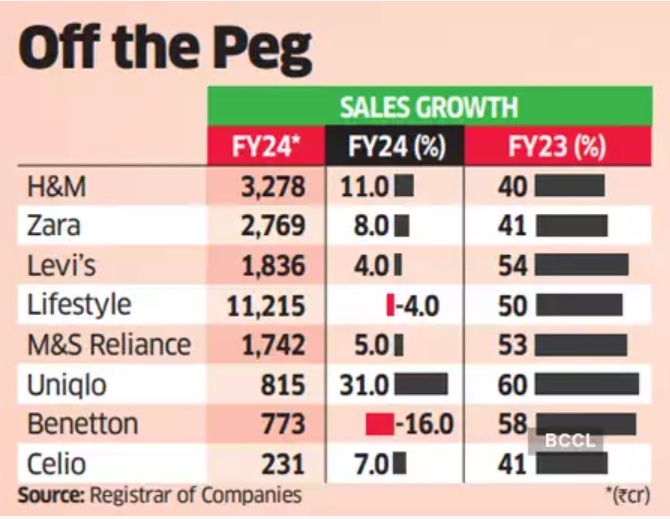
Fast fashion was on a slow lane in the last fiscal year. Sales growth slowed for top retailers and fast fashion brands, show the latest regulatory filings of Marks & Spencer, Zara, H&M, Levi’s, Lifestyle, Uniqlo, Benetton and Celio. The bottom line too had taken a hit, with most brands posting lower profits in the fiscal year ended March 31. Sales growth of H&M and Zara fell from 40% in FY23 to 11% and 8% in FY24, show the filings with the Registrar of Companies. Levi’s growth slowed to 4% from 54% in FY23, while that of Uniqlo halved to 31% from 60%.
The current year is not looking good either, as sticky inflation and stagnant income weigh on consumer spending on discretionary products, say experts.
Devangshu Dutta, founder of retail consulting firm Third Eyesight, said the job market has been under pressure and slower income growth for urban consumer impacted demand, a trend likely to continue even during FY25.
“There is a visible slowdown led by the urban middle class who buy branded products. These brands have been targeting young upwardly mobile consumers, who are tightening the purse strings due to the current economic circumstances of hiring slack and fewer jobs,” said Dutta. “The situation is not hunky-dory at all, and this will continue over the next few quarters.”
Being the world’s most populous country, India is an attractive market for apparel brands, especially with youngsters increasingly embracing western-style clothing. But most international and premium brands have been competing for a relatively narrow slice of the population pie in large urban centres.
Over the past few years, top global apparel and fast fashion brands struck a strong chord with young customers, racking up sales growth of between 40% and 60% in FY23, bucking the trend in a market where the overall demand for discretionary products started slowing down. This has reversed now.
Consumers started reducing non-essential spending, such as on apparel, lifestyle products, electronics and dining out since early last year due to high inflation, increase in interest rates, job losses in sectors like startups and IT, and an overall slowdown in the economy.
According to the Retailers Association of India (RAI), sales growth in organised retail segments such as apparel, footwear, beauty and quick service restaurants halved to 9% last year and slowed further to about 5% in the first six months in the current fiscal year. This slowdown came after a surge in spending across segments-from clothes to cars-in the post-pandemic period, triggered by revenge shopping.

“The base post-pandemic was extremely high, and that kind of growth is not sustainable as there is nothing spectacular in economy to drive demand,” said Kumar Rajagopalan, chief executive officer at the RAI that represents organised retailers. “Our bet was on the festive and wedding season, but we will have to wait and watch until next year for the performance numbers,” he said.
(Published in Economic Times)
admin
October 7, 2024
Writankar Mukherjee, Economic Times
7 October 2024
Reliance Retail has initiated efforts to enter the thriving quick commerce market in a move that is set to escalate competition for Zomato-owned Blinkit, Swiggy Instamart and BigBasket, among others. The country’s largest retailer has started offering quick commerce services in select areas in Navi Mumbai and Bengaluru through its ecommerce platform JioMart since last weekend.
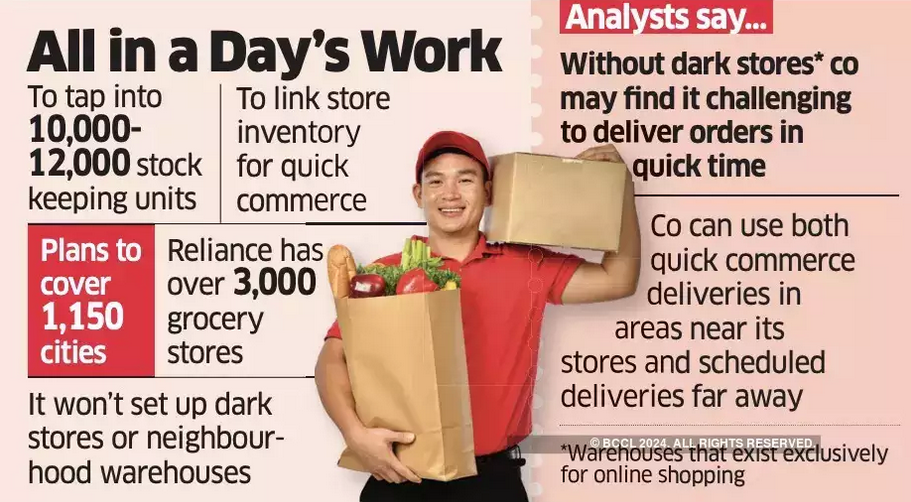
It will initially sell grocery items from its retail stores totalling about 3,000 nationwide, eventually adding value fashion and small electronic products such as smartphones, laptops and speakers, a senior executive said. All orders will be fulfilled from its own network of stores including Reliance Digital and Trends.
The retail arm of Reliance Industries plans to rapidly scale up its quick commerce venture pan-India by this month-end with the aim to deliver most orders in 10-15 minutes and the rest within 30 minutes, the executive said. The company will use its acquired logistics service Grab for the fulfilment.
Reliance, however, doesn’t have any plan to set up dark stores or neighbourhood warehouses, unlike other quick commerce operators, the executive said. Analysts said this may become a challenge in delivering orders within 30 minutes in large cities where traffic is high during peak hours.
To entice customers, Reliance won’t charge any delivery fee, platform fee or surge fee irrespective of the order value, and keep a major focus on untapped smaller cities and towns where quick commerce operators like Blinkit are yet to enter, the executive said. Other platforms have a delivery fee and platform fee.
Reliance plans to offer a wider choice of products of 10,000-12,000 stock keeping units by linking its entire store inventory to the quick commerce business, which too is much more than rivals.
Eventually, the company aims to cover 1,150 cities spanning 5,000 pin codes where it runs grocery stores. The executive said the company would target a bigger share of business from towns and smaller cities hitherto untapped by quick commerce firms.
“Reliance has reworked the way orders are delivered for JioMart. Earlier, orders had a scheduled delivery taking 1-2 days by small trucks who would take multiple orders and deliver them one by one. Now, all grocery orders will be quick commerce where one delivery bike or cycle will deliver one order. Each grocery store will cover a 3 KM radius,” the executive said.
Earlier this year, the company tried to reduce JioMart delivery timings to a few hours or at least the same day under its hyperlocal initiative. It has fine-tuned the process further to 10-30 minute delivery. “This has become a top-of-the-kind requirement in the market right now,” the executive said.
A spokesperson for Reliance Retail didn’t respond to ET’s queries.
Devangshu Dutta, chief executive at consulting firm Third Eyesight, said Reliance can ultimately use a blended approach of quick commerce deliveries in areas near its stores and scheduled deliveries a bit far away.
“Since they are in a market share acquisition mode in quick commerce, charging no transaction fees and offering higher discounts on products is a given. There is significant scope for deep-pocketed players like Reliance to strengthen presence in quick commerce. They have aggressively backed other experiments in the retail business once they worked, and may do it again,” said Dutta.
For fast-moving consumer goods companies, quick commerce is the fastest growing channel, accounting for 30-35% of total online sales.
(Published in Economic Times)
admin
September 16, 2024
Sesa Sen, NDTV Profit
16 September 2024
As India’s economy grows and digital technologies reshape consumer behavior, the future of kirana stores—the quintessential neighbourhood grocery shops—hangs precariously in the balance.
These soap-to-staple sellers, once impervious to change, now confront an existential threat from quick commerce players like Blinkit, Instamart, Zepto, and from modern retailers such as DMart and Star Bazaar, raising a pivotal question: Can kiranas survive the pressure of change, or will they die a slow death?
The All India Consumer Products Distributors Federation, that represents four lakh packaged goods distributors and stockists, has recently raised alarms, urging Union Minister for Commerce and Industry Piyush Goyal to investigate the unchecked proliferation of quick commerce platforms and its potential ramifications for small traders.
Their concerns are not unfounded. Data suggests that the share of modern retail, including online commerce, which is currently below 10%, is set to cross 30% over the next 3-5 years. Much of this growth will come at the cost of traditional retail.
“Unless the government takes on an activist role to support the smallest of business owners, the shift toward large corporate formats is inevitable,” according to Devangshu Dutta, head of retail consultancy Third Eyesight.
Casualties Of The Boom
Madan Sachdev, a second-generation grocer operating Vandana Stores in eastern Delhi, has thrived in the recent years, adapting to the digital age by taking orders via WhatsApp and employing extra hands for home delivery.
Despite having weathered the storm of competition from giants like Amazon and BigBazaar, he now finds himself disheartened, as his monthly sales have halved to about Rs 30,000, all thanks to quick commerce.
Sachdev is worried about meeting expenses such as rent, his children’s education, and other household bills. He finds himself at a crossroads, uncertain about how to modernise his store or adopt new-age strategies in order to attract customers in an increasingly competitive market.
India’s $600 billion grocery market, a cornerstone for quick commerce, is largely dominated by more than 13 million local mom-and-pop stores.
Retailers like Sachdev are also seeing a steep decline in their profit margins from FMCG companies, which now hover around 10-12%, down from the 18-20% margins seen before the Covid-19 pandemic. The consumer goods companies are instead offering higher margins to quick commerce platforms so that they can afford the price tags.
Quick deliveries account for $5 billion, or 45%, of the country’s $11 billion online grocery market, according to Goldman Sachs. It is projected to capture 70% of the online grocery market, forecasted to grow to $60 billion by 2030, as consumers increasingly prioritise convenience and speed.
Many of the mom-and-pop shops are family-run and have been in business for generations. Yet they lack the resources to modernise and compete effectively with larger chains. Modern retail businesses, including quick commerce, begin with significantly more capital, thanks to funding from corporate investors, venture capital, private equity, and public markets.
“They can scale quickly and capture market share due to a superior product-service mix, larger infrastructure, and more robust business processes,” said Dutta.
Moreover, their ability to engage in price competition poses a challenge for small retailers and distributors, making it difficult for them to compete.
“This is something that has happened worldwide, in the largest markets, and I don’t think India will be an exception,” Dutta said, adding that it would be incomplete to single out a specific format of corporate business such as quick commerce as the sole villain in this situation.
“India is a tough, friction-laden environment at any given point in time, including government processes which don’t make it any easier,” he said.
Peer Pressure
Data from research firm Kantar shows that general trade, which comprises kirana and paan-beedi shops, have grown 4.2% on a 12-month basis in June, while quick commerce grew 29% during the same period.
Shoppers are becoming more omnichannel, rather than gravitating towards one particular channel, said Manoj Menon, director- commercial, Kantar Worldpanel, South Asia. “While the growth [for quick commerce and e-commerce] might appear to have declined compared to a year ago, a point to note is that the base for these channels has significantly grown. Therefore, achieving this level of growth is still commendable.”
Consumer goods companies such as Hindustan Unilever Ltd., Dabur India Ltd., Tata Consumer Products Ltd., etc., have acknowledged the salience of quick commerce to their packaged food, personal and homecare products. The platform currently comprises roughly 40% of their digital sales.
“We are working all the major players in the quick commerce space and devising product mix and portfolio. This is a very high growth channel for us,” according to Mohit Malhotra, chief executive officer, Dabur India.
Elara Capital analysts have pointed out that the share of quick commerce is expected to rise to60% in the near future with e-commerce and modern trade turning costlier for FMCG brands than quick commerce. “The larger brands tend to make better margins on quick-commerce platforms versus e-commerce due to lower discounts on the former,” it said in a report.
However, it is too premature to draw a parallel between kirana and quick commerce in terms of competition, given the significant size difference.
The average spend per consumer on FMCG in kirana stores stands at Rs. 21,285 annually while the same is Rs. 4,886 for quick commerce, according to Menon.
Rural Vs Urban Divide
Quick commerce is still an urban phenomenon. In contrast, in rural settings, where internet penetration is still catching up and access to large retail chains is limited, kirana stores continue to thrive.
According to Naveen Malpani, partner, Grant Thornton Bharat, while the growth of quick commerce is undeniable, this channel is not poised to replace traditional retail, which still has a wider reach in the country. “It will complement older models, filling a niche for immediate, smaller purchases. Also, a 10-20-minute delivery may not have a strong market pull in rural markets where distance and time are not much of a concern.”
Yet many others believe, even in these areas, the challenge is palpable.
The small businesses are beginning to feel the sting of same slow decline that once befell the ubiquitous telephone booths in the era of mobile phone, according to Sameer Gandotra, chief executive officer of Frendy, a start-up that is building ‘mini DMart’ in small towns where giants like Reliance and Tatas have yet to establish their presence.
As rural customers slowly start to embrace digital shopping and seek more variety, kirana stores must adapt or risk becoming obsolete, he said.
Besides, the popularity of quick commerce is set to challenge the dominance of incumbent e-commerce platforms, especially in categories such as beauty and personal care, packaged foods and apparel.
“Quick commerce is primarily operational in metros and tier 1 markets, which is impacting the sales of traditional companies in these areas. However, if quick-commerce players were to extend their operations to tier 2 and tier 3, it would even challenge companies such as DMart and Nykaa, and would pare sales and profitability,” noted analysts at Elara Securities.
Frendy’s Gandotra believes the journey for kirana stores is not a lost cause, but it requires strategic interventions. Many kirana store owners struggle to integrate point-of-sale systems, inventory management software, or even digital payment solutions. These stores need to embrace technology.
Another aspect is the need for policy support. Regulations to ensure fair competition can prevent monopolisation by large retailers. Additionally, subsidies, tax benefits, and grants for infrastructure improvements can help small businesses adapt to changing market dynamics. With renewed support, kirana stores can continue to be the backbone of Indian retail.
Nonetheless, there will be some who’ll be left behind during this shift. Analysts at Elara Capital warn that the swift rise of quick-commerce platforms, combined with aggressive discounting, could wipe off 25-30% of traditional grocery stores.
(Published on NDTV Profit)
