
admin
August 31, 2024
MG Arun, India Today
Aug 31, 2024
Nearly five years after the Centre brought in norms to rein in multinational e-commerce companies operating in India, Union commerce minister Piyush Goyal sparked fresh controversy by raising concerns over the rapid expansion of e-commerce. He also drew attention to the pricing strategies used by some e-commerce firms, questioning what he termed “predatory pricing”.
“Are we going to cause huge, social disruption with this massive growth of e-commerce? I don’t see it as a matter of pride that half our market may become part of the e-commerce network 10 years from now; it is a matter of concern,” Goyal said at an event in New Delhi last week.
His comments come at a time when the ecommerce business in India is growing exponentially. Estimated at $83 billion (around Rs 7 lakh crore) as of FY22, the market is expected to grow to $150 billion (Rs 12.6 lakh crore) by FY26. The growth will be due to multiple levers: a growing middle class, rising internet penetration, the proliferation of smartphones, convenience of online shopping and increasing digitisation of payments. The overall Indian retail market was pegged at $820 billion (Rs 69 lakh crore) in 2023, according to a report published by the Boston Consulting Group and the Retailers Association of India. E-commerce still comprises only about 7 per cent of that, as per Invest India.
The Indian e-commerce market is dominated by global giants, including Amazon and Walmart (which took over Flipkart in 2018). They, along with domestic players, offer huge discounted prices compared to retail prices, which drives online sales significantly. In FY23, Amazon Seller Services and Flipkart posted Rs 4,854 crore and Rs 4,891 crore losses, respectively. Goyal’s argument is that these losses are due to their predatory pricing.
“Is predatory pricing policy good for the country?” Goyal asked, while stressing the need for a balanced evaluation of e-commerce’s effects, particularly on traditional retailers such as restaurants, pharmacies and local stores. “I’m not wishing away ecommerce—it’s there to stay,” he said. Later, he said e-commerce uses technology that aids convenience. But there are 100 million small retailers whose livelihood depends on their businesses.
The Centre has specific laws that permit foreign direct investment (FDI) in e-commerce exclusively for business-to-business (B2B) transactions. However, according to Goyal, these laws have not been followed entirely in letter and spirit. Currently, India does not allow FDI in the inventory-based model of e-commerce, where e-commerce entities own and directly sell goods and services to consumers (B2C). FDI is permitted only in firms operating through a marketplace model, where an e-commerce entity provides a platform on a digital or electronic network to facilitate transactions between buyers and sellers (B2B).
The country’s laws also stipulate that in marketplace models, e-commerce entities cannot ‘directly or indirectly influence the sale price of goods or services’ and must maintain a ‘level playing field’. Entities in the marketplace model re allowed to transact with sellers registered on their platform on a B2B basis. However, each seller or its group company is not permitted to sell more than 25 per cent of the total sales of the marketplace model entity.
Goyal said certain structures have been created to suit large e-commerce players with “deep pockets”. Algorithms have been used to drive consumer choice and preference. For instance, several pharmacies have disappeared, he said, and a few large chains are dominating the retail space. He invoked the importance of platforms like the Open Network for Digital Commerce where small businesses can sell their products.
E-commerce firms counter the argument on predatory pricing. “It is the sellers’ discretion as to what price they should sell at,” says an industry source. The e-commerce player who provides the platform seldom has a role in it, he explains. “Sellers could be doing clearance sales or liquidation of old products at cheaper prices. Some sellers also source products at manufacturing cost and park it with e-commerce firms instead of involving warehousing agents. This helps cut their overhead costs and allows them to offer lower prices on the platform,” he adds.
Some experts are of the view that the government should not step in with controls and allow the market forces to play their role in determining prices. Price controls may lead to shortages, inferior product quality and the rise of illegal markets. Moreover, the Competition Commission of India (CCI), which is mandated to act against monopolies, may be given more teeth. It is ironical that, on the one hand, the Centre wants more FDI to flow in, but places more and more controls on foreign players on the other hand. At the core are the interests of small traders and retailers, a key section of the electorate.
Others argue that the government has a role to ensure that there is fair competition. “It is not just small retailers the government would be speaking for, but for large domestic players too,” says Devangshu Dutta, founder of consultancy firm Third Eyesight, emphasising that the government’s role should be to establish laws and practices that promote fairness.
According to him, it is no secret that e-commerce has grown through discounts. “For large e-commerce firms, market acquisition happens by acquiring a share of the consumer’s mind and through pricing. When a large sum is spent on advertisements, it is for acquiring the mind share of the consumer,” he says. “Pricing matters in a big way too. Whether you call it predatory pricing or market acquisition pricing depends on which side of the fence you are.”
(This article was originally published in the India Today edition dated September 9, 2024)
admin
August 19, 2024
Sagar Malviya & Faizan Haidar, Economic Times
19 August 2024, Mumbai/New Delhi
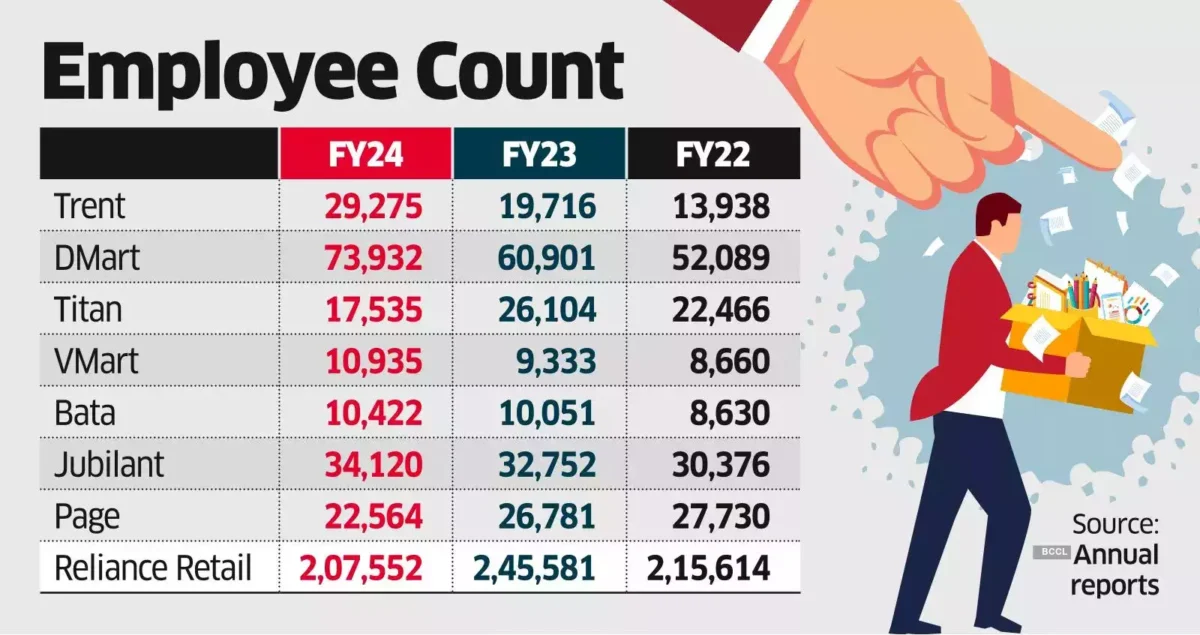
About a dozen listed lifestyle, grocery retailers and quick-service restaurants (QSRs) reduced their employee count by nearly 26,000 in FY24, retreating from the hiring spree of the past two financial years after they slowed down store expansion rate amid weakening demand.
According to their latest annual reports, the reduction was completely led by five retailers – Reliance Industries’ retail arm, Titan, Raymond, Page and Spencers – which saw their combined workforce decline 17% or by 52,000 people. The staff count was across permanent and contractual employees and adjusted for attrition in the retail segment, the second largest employer after agriculture. These retailers had a combined workforce of 429,000 people in FY24 compared to 455,000 employees a year ago.
“There is a shortage of talent and we are trying to tie up with universities so that the industry has the option to hire. Some companies might have reduced staff due to shutting of some business, but companies like Shoppers Stop and Trent continue to expand and will require staff,” said Kumar Rajagopalan, CEO of Retailers Association of India that represents organised retailers in the country.
Consumers had started reducing non-essential spending such as that on apparel, lifestyle products, electronics and dining out since Diwali 2022 due to inflation, increase in interest rates, job losses in sectors like startups and IT, and an overall slowdown in the economy. India’s retail sales expansion slowed to 4% last year after a surge in spending across segments-from clothes to cars-in the post-pandemic period, triggered by revenge shopping.
RIL in its annual report said the overall voluntary separations in FY24 were lower than FY23 and the retail industry typically has a high employee turnover rate, especially in store operations.
“Store productivity usually happens in cycles and we have seen consumers unleash their spending post pandemic, which led to retailers expanding their network or square footage. However, if some of the stores are unviable, then management teams are now highly objective, even ruthless, and will shut stores,” said Devangshu Dutta, founder of retail consulting firm Third Eyesight. “In addition, any company planning to list would like to have healthy and lean operations, although we cannot pin-point it to Reliance in this case.”
Weak sales saw these retailers having the slowest pace of store expansions in at least five years at 9%. The retail sector took 7.1 million square feet of space across top eight cities in 2023, which is expected to dip to 6-6.5 million sq ft in 2024, according to commercial real estate services firm CBRE.
“There’s an enormous management bandwidth requirement to just get this entire ship running in the right trajectory, right direction, and with the relevant speed. We are thinking about what this company will be 10 years from now. And hence, if you want to reach there in a nice way without too much damage or bruises, then what is the kind of talent we need to have today in the next 2 years, in the next 3 years?” Avenue Supermarts CEO & MD Neville Noronha asked investors.
(Published in Economic Times)
admin
February 23, 2024
Kailash Babar & Sagar Malviya, Economic Times
Mumbai, 23 February 2024
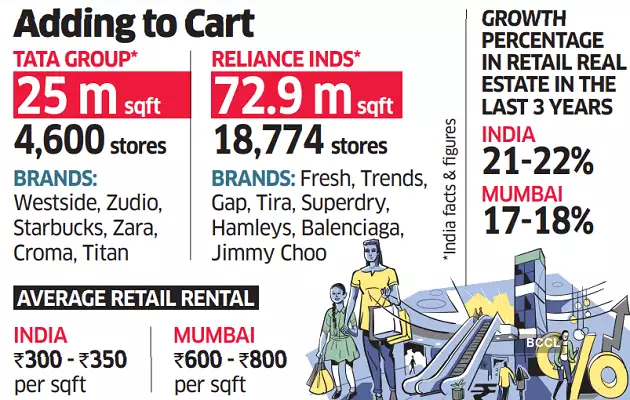
Tata Group and Reliance Industries, two of India’s largest conglomerates, are vying for premium retail real estate in Mumbai as they extend their footprints, creating rivalry in a city starved of marquee properties. From Zara and Starbucks to Westside and Titan, the Tata Group occupies nearly 25 million square feet of retail space in India. That is still no match for Reliance Industries that control three times more at 73 million sq ft for more than 100 local and global brands.
But in Mumbai, they are evenly matched, having nearly 3 million sq ft of retail space each. That is a quarter of what is considered the most prime retail real estate in the country, and both the retail giants are looking for more.
“In a modern retail environment, most visible locations contain more successful or larger brands. It just so happens that many of those brands are owned by either Reliance or the Tatas,” said Devangshu Dutta, founder of Third Eyesight, a strategy consulting firm.
“Tatas have been in retail for longer but also slower to scale up compared to Reliance which had this stated ambition of being the most dominant and put the money behind it,” he said.
In a market where demand is much higher than supply, developers and landlords seek to separate the wheat from the chaff, experts said. Ultimately, success in Mumbai’s retail real estate scene hinges on a delicate equilibrium between accommodating industry leaders and fostering a vibrant, varied shopping environment, they said. “In the competitive landscape of retail real estate in Mumbai, commercial developers and mall owners often face the strategic challenge of accommodating prominent retail brands,” said Abhishek Sharma, director, retail, at commercial real estate consultants Knight Frank India.
“These big brands, with a significant market share of 40-45% in the Indian retail sector, can easily be termed as industry giants and possess the potential to command 45-50% of space in any mall,” he said. According to Sharma, there may be perceptions of preferential treatments, but the dynamics are complex, and developers must balance the demand from these major brands with the need for a diverse tenant mix.
Tata Group entered retail in the late 1980s, initially by opening Titan watch stores and a decade later by launching department store Westside. So far, it has about 4,600 stores, including brands such as Tanishq, Starbucks, Westside, Zudio, Zara and Croma.
While Reliance Retail started in 2006, it overcompensated for its late entry by aggressively opening stores across formats. Reliance has over 18,774 stores across supermarkets, electronics, jewellery, and apparel space. It has also either partnered or acquired over 80 global brands, from Gap and Superdry to Balenciaga and Jimmy Choo. A diverse portfolio of brands across various segments through strategic partnerships and collaborations helps an entity like Reliance to leverage synergies and enhance retail presence, especially in malls, experts said.
“The array of brands with Reliance bouquet allows it to enter early into the project and set the tone and positioning of the mall,” said a retail leasing expert who requested not to be identified.
“This positively helps the mall to set its own positioning and future tenant mix. It also helps Reliance place their brands in most relevant zones within the mall. This will emerge as a clear differentiator in a city like Mumbai where brands are already jostling for space, which is the costliest in the country,” the person added.
(Published in Economic Times)
admin
October 26, 2023
Sagar Malviya, Economic Times
26 October 2023
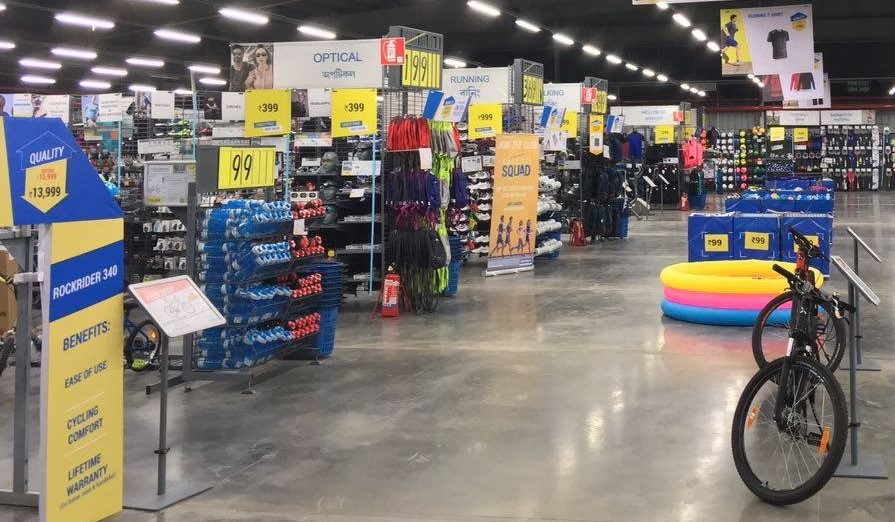
Surging demand for fitness wear and sports equipment for disciplines other than cricket and football helped Decathlon’s India unit expand sales 37% to Rs 3,955 crore in FY23. With more than 100 large, warehouse-like stores selling products catering to 85 sporting disciplines, the French company is bigger than Adidas, Nike and Asics all put together in India.
In FY22, sales were Rs 2,936 crore, according to its latest filings with the Registrar of Companies. The retailer, however, posted a net loss of Rs 18.6 crore during the year ended March 2023 compared to a net profit of Rs 36 crore a year ago.
Experts said a host of factors – from pricing products about 30-40% lower than competing products to selling everything from running shoes, athleisure wear to mountaineering equipment under its own brands – has worked in its favour. “They have an extremely powerful format across different sporting activities and have something for both active and casual wear shoppers. For them, the market is still under penetrated with the kind of comprehensive product range they sell for outdoor sports beyond shoes and clothing,” said Devangshu Dutta, founder of retail consulting firm Third Eyesight. “Even their front end staff seem to have a strong domain knowledge about products compared to rival brands.”
By selling only private labels, Decathlon, the world’s biggest sporting goods firm, controls almost every bit of operations, from pricing and design to distribution, and keeps costs and selling prices low.
Decathlon uses a combination of in-house manufacturing and outsourcing to stock its shelves. In fact, it sources nearly 15% of its global requirement from India across sporting goods. And nearly all of its cricket merchandise sold globally is designed and made in India.
(Published in Economic Times)
admin
April 24, 2022
Written By Suvashree Ghosh, Bijou George, and Sankalp Phartiyal

It was a contentious plan to repay overseas bondholders in full that brought what would have been India’s biggest retail deal to a grinding halt.
Debt-laden Future Retail Ltd.’s offshore bondholders — a relatively smaller part of the creditor pool — were promised 100% payment in the rescue offer from billionaire Mukesh Ambani, according to people with knowledge of the matter. Indian lenders were asked to take a haircut of as much as 66%, the people added, asking not to be identified discussing confidential information.
The unequal treatment led to the move last week, when the local banks rebuffed the $3.2 billion offer from Ambani’s conglomerate. Reliance Industries Ltd. announced the purchase plan in August 2020 but struggled to complete the transaction in the face of legal challenges mounted by Amazon.com Inc., which argued it had the first right of refusal contractually.
Bank of India and State Bank of India, the main bankers to Future Retail, didn’t immediately respond to emails seeking comment on reasons for voting down the deal. Representatives for Future Group and Reliance also didn’t immediately comment.
State-run lenders risked probes from federal agencies if they accepted these discriminatory terms, they said, explaining their preference now for a court-mediated insolvency process where bids are called in and there’s no risk of them being accused of cutting a bad deal. Bank of India has already requested an Indian court to initiate the process.
Hard-Nosed Decision
The hard-nosed decision by Indian banks has pushed the teetering Future Retail, which ran one of the nation’s largest retail grocery chains before the pandemic struck, one step closer to bankruptcy. Future Retail is almost certain to default on its $500 million bond coupon payment due July 22, S&P Global Ratings said Tuesday, while downgrading the company’s ratings deeper into junk territory.
The lenders’ action has also taken the wind out of a tortuous two-year-old litigation between Reliance and Jeff Bezos-owned Amazon — the e-tailer had started arbitration proceedings in Singapore to block the deal — but left the door open for Ambani to snag these retail assets, possibly at an even cheaper price, under the bankruptcy process.
“Reliance and other parties could be eligible to bid for its assets by submitting their resolution plans” even if Future Retail ends up in bankruptcy, according to Satwinder Singh, New Delhi-based partner at law firm Vaish Associates Advocates. “This would also lead to moratorium on any or all ongoing arbitration proceedings against Future.”
While the local lenders were agreeable to the deal when it was first announced, a lot changed in the past year or so, the people said. While the Amazon lawsuit dragged on, the asset value eroded and the pandemic worsened the cash crunch at Future Retail that began defaulting on its debt repayments.
Secured Indian lenders were promised recoveries ranging between 34% to 88% of the total $4 billion in dues and even those payouts were staggered over seven years, the people said.
Bloodless Coup
Reliance dealt a body blow to the Kishore Biyani-led Future Group in February when it quietly began poaching employees and taking over rental leases of hundreds of stores earlier run by Future Retail and Future Lifestyle Fashions Ltd. Ambani’s bloodless coup prompted Amazon to suggest settlement talks on the bitter dispute and alarmed Future’s investors and lenders who worried about asset-stripping.
Reliance’s unexpected takeover of Future’s stores eroded bankers’ confidence in the deal as it stripped off value from the chain and potentially could erode Reliance’s offer terms.
The out-of-court truce talks between Amazon, Future and Reliance collapsed soon after the store-purchases were initiated, the companies informed India’s top court on March 15. Amazon will continue with its arbitration proceedings against Future Group in Singapore, according to a person familiar with the matter, who asked not to be identified as the deliberations are private.
“A major turning point was when Reliance physically took over Future’s stores, which turned it into a no-holds barred situation,” said Devangshu Dutta, head of New Delhi-based retail consultancy Third Eyesight. “Before this the battle was being fought in courts and across the negotiating table. But at this point it moved over to the real business.”
Source: bloomberg
