
Devangshu Dutta
June 30, 2025

In every strategy meeting today, one metric is invariably mentioned: Customer Acquisition Cost (CAC). Whether you’re a well-funded corporate retailer, or raising your first angel round, or a well-established digital duopolist brand scaling Series C, CAC is one of the key performance metrics. “Real” spend that is neatly broken down by channel, optimised by funnel tweaks, scrutinised to the last rupee or dollar.
But there’s a metric we almost never hear about that could be costing brands far more in the long run.
Let’s call it Customer Forfeiture Cost (CFC), the residual lifetime value that is lost when a customer walks away from your business not because of price, competition, or even shifting needs, but because of a “burn”: a delivery missed or messed up, a refund that took weeks, an arrogant customer service call, or a product that failed spectacularly against the promise. In other words, when your brand hurts someone enough to make them walk away. Probably for ever.
It’s a paradox: brands are pumping thousands of crores into acquiring users, but they’re bleeding value at the other end. Yet, while CAC is a line item in every financial statement, CFC is invisible in management dashboards. CEOs don’t announce, “We’ve cut our forfeiture cost by 20% this quarter.”
Yet. every CXO knows it exists. The NPS scores, the social media complaints, the “never again” comments in reviews, the sinking feeling when repeat purchase rates fall.
Why CFC Matters More Than Ever
In every business, during the early stages each sale is a victory. Whether it was the retail chains that grew in the 1990s and early-2000s or the digital upstarts that came up through 2010s and 2020s, scale has been the mantra, and investors have poured money into scaling through the growing consumption of India 1 and India 2 customers.
Today customer acquisition isn’t cheap. The same person who clicked impulsively in 2020 now thinks twice before confirming payment. In this landscape, retention isn’t optional, it’s existential.
Every lost customer isn’t just a refund processed, or a cart abandoned. It’s the long tail of future repeat purchases that will never happen, negative word of mouth and brand distrust in the customer’s circle of influence, and increased future CAC due to declining organic reach.
Way back in 1967, management consultant Peter Drucker wrote in his book “The Effective Executive”: “What gets measured, gets managed”.
Today your CAC may be Rs. 500-1,000. If the average customer life time value (LTV) is Rs. 10,000, and a single burn causes churn after just one order worth Rs. 2,000, your CFC is Rs. 8,000, and that doesn’t even include reputational spillover.
Why We Don’t Measure It
Yes, CFC is hard to quantify. It’s not as easily attributable as ad spends. There’s usually no neat model telling you why someone never returned, because tech stacks aren’t typically designed to track emotional exits. And let’s face it, introspection about broken relationships is uncomfortable, even for management teams.
But that doesn’t mean it’s not real. If a customer leaves because your delivery executive messed up, or because your app crashed during checkout twice in a row, that’s on you, not the market. And in a business climate where sustainable growth is the mantra, LTV is king.
Ignoring CFC is like watching your roof leak and blaming the rain.
Toward a New Discipline
Brands and retailers must start measuring CFC, the value lost when customers disengage due to friction, mistrust, or neglect, and then start working on reducing it. This can be done by:
The Competitive Edge We’re Not Using
In a crowded space where everyone’s vying for eyeballs, trust is the true moat. Customers don’t expect perfection – they do expect accountability, authenticity, and recovery when things go wrong.
Brands that understand and act on Customer Forfeiture Costs will quietly start building a powerful edge: deeper brand loyalty, lower CAC over time thanks to referrals and repeats and greater lifetime value per user.
In other words, real, compounding value.
As the Indian brand ecosystem matures, Customer Forfeiture Cost needs to be as visible and valued as CAC. Acquisition is the invitation; experience is the relationship. Relationships, once broken, are expensive to rebuild; if they can be rebuilt at all.
In the end, growth isn’t just about who comes in. It’s about who stays, and why.
(Written by Devangshu Dutta, Founder of Third Eyesight, this was published in Financial Express on 2 July 2025)
admin
March 20, 2025

Sagar Malviya, Economic Times
Mumbai, 20 March 2025
Established beauty product makers such as Forest Essentials, Colorbar, Kama Ayurveda, Body Shop, VLCC Personal Care and Lotus Herbals saw a slowdown in sales growth in FY24, according to the latest Registrar of Companies filings. Consumers favoured new-age rivals such as Minimalist and Pilgrim, specialised derma brands, as well as global labels Shiseido, Innisfree and Eucerin.
Sales growth of established brands mostly in the natural skincare segment, more than halved to single digits during the previous financial year amid a broader economic slump.
In contrast, companies such as L’Oreal, Nykaa and Sephora continued to grow at 12-34% on a significantly bigger base, even as they lost pace.
Direct-to-consumer brand Pilgrim more than doubled its sales, Minimalist’s revenue increased 80% and Foxtale’s sales surged 500% on a lower base.
“With most consumers tightening their budget on discretionary spends in FY24, they seem to have opted for brands that give instant benefits compared to natural products, which take time to be effective,” said Devangshu Dutta, founder of retail consulting firm Third Eyesight.
Over the past few years, there has been a flurry of beauty product launches, which have depended on platforms such as Nykaa and Tira for sales.
In the past two years, Nykaa has launched more than 350 brands, or In the past two years, or nearly one new label every alternate day on average.
This includes international brands such as CeraVe, Uriage and Versed, as well as home-grown brands such as Foxtale and Hyphen.
Reliance Retail, which entered beauty retailing with Tira two years ago, now sells nearly 1,000 brands, including exclusive labels such as Akind, Augustinus Badee, Allies of Skin, Kundal and Patchology.
“10 years ago we were only competing against big guys,” Vincent Karney, global chief executive of Beiersdorf, maker of Eucerin, Nivea and La Prakrit, told ET last month. “Now we have those local brands, and we have to become a bit more agile.”

On Nykaa, Fenty Beauty by Rihanna is the highest-selling brand in lipcare while Eucerin has become its biggest premium dermo-cosmetic serum. South Korean beauty brands Axis-Y, Tirtir and Numbuzin grew over 60% in 2024, with sales of toners increasing 104%, serums 45%, moisturisers 52% and sunscreens 154% on the platform.
VLCC and Colorbar did not respond to ET queries, while Forest Essentials was not reachable.
In January, Mike Jatania, cofounder and executive chairman of The Body Shop and Aurea Group, told ET, “There would be continuation of new entrants. Inflation is still a global issue and we will see the pressure. Competitive environment will be a challenge… 70% of our stores are showing decent growth. We have closed some stores and opened a few also, that’s the nature of the business.”
Ingredients Matter
Warnery of Beiersdorf emphasised the need to stay focused on “big innovation, by being able to talk to GenZ, (a position) which might be filled in by those local brands coming with basic ingredients.”
The likes of Minimalist, Ordinary and Pilgrim disclose active ingredients at a granular level, specifying the exact percentage of acid used in the product to appeal to GenZ users (those born between 1997 and early 2010s), who are said to be far more conscious of what they use on their skin compared to millennials (those born during 1980s to mid-1990s) and Gen X (those born from about 1965 to 1980).
Shoppers Stop, which manages brands such as Estee Lauder, Shiseido, Bobbi Brown, Mac and Clinique in India, sees the overall beauty market driven by companies focusing on consumers across age groups, and not just younger ones. Both natural and dermatological products are expected to find takers.
“While most new age brands tap younger cohorts, their pocket size allows them to mostly buy affordable products and the more affluent consumers opt for established global brands that have proven themselves since decades,” said Biju Kassim, chief executive, beauty, at Shoppers Stop. “Beauty is still not a habit in India and with hundreds of brands being launched, the focus is to grow penetration. There is also a shift from care to cure, driven by derma-recommended products and brands disclosing active ingredients, but it is still a niche sub-segment.”
Dutta of Third Eyesight sees the current trend as temporary. “We expect growth of (established) companies to bounce back in the current fiscal, driven by a strong demand for beauty,” he said, pointing especially to online platforms. India’s beauty and personal care market is expected to reach $34 billion by 2028, up from $21 billion now, driven by an online surge and a growing preference for high quality, premium beauty products according to a report by Nykaa and consulting firm Redseer.
Nicolas Hieronimus, chief executive of cosmetics giant L’Oreal, last year said consumers in India are more demanding and are not just settling for very basic things like putting an ingredient in a product such as salicylic acid or collagen. “That’s where L’Oreal has the best cards to play, and that’s where we really thrive,” he had told ET.
Beiersdorf, Unilever, L’Oreal and Shiseido, among the world’s largest cosmetics companies, have all identified India as a key growth driver, citing the burgeoning population and growing affinity for beauty products.
(Published in Economic Times)
admin
February 23, 2025
Chitra Narayanan, BusinessLine
New Delhi, 23 February 2025
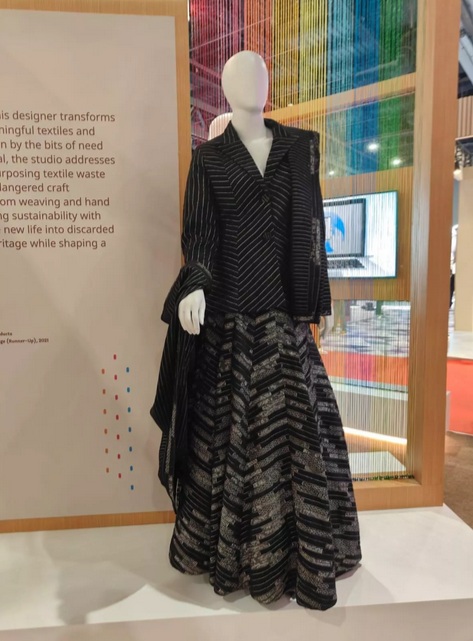
India’s formidable array of craft traditions got full play at the just concluded Bharat Tex 2025, the mega textile trade show in New Delhi that showcased the best of Indian weaves to the world. But if there was one theme that dominated this year’s textile extravaganza, aimed at generating more exports, it was the focus on zero-waste fashions and upcycling. Everywhere the eye could see were standees and gigantic posters pushing the message of conscious consumption and sustainability — be it regenerative cotton, innovative models of textile waste collection, or eco-friendly fibres.
Taking centre stage at one of the halls at Bharat Mandapam, the venue, was a section that showcased age-old traditional arts like rafugari (creative darning or artistic mending), patchwork quilts and toys, and chindi durries (the art of weaving rugs and carpets with waste).
Juxtaposed against these ethnic ways of upcycling waste were the modern works of startups that rose to the textile ministry’s grand innovation challenge to work with discarded materials. From microbial dyes that are non-polluting to flowing fashionable lehengas created out of textile waste, the startups showed that a lot can be done in this area. The ministry had challenges in three more segments — jute, silk and wool.
Some takeaways from a walk-through of the textile trade show:
Closing the loop
The fashion and textile industry generates enormous waste. How to cut down on this was a subject of much deliberation and showcases. There were a lot of good ideas on display, showing that a fair amount of work has been done with fibres (bamboo, banana, flax), as well as creativity and ingenuity in weaves and finished garments.
As Devangshu Dutta, Chief Executive of the consultancy Third Eyesight, points out, due credit must be given for the good work going into generating solutions that will reduce waste, be it textiles that are reprocessed and reused as yarn, or refashioned garments or reloved apparel. But, as he adds, on the other hand we have brands that are constantly looking to grow their business and there is a race to the bottom in terms of price. The relaunch of fast fashion retailer Shein in India is sending conflicting signals. “The basic engine is pumping out more and more products, and that has to be tackled,” he says, pointing to the competing forces at work.
The source of hope, he says, is the fact that the young are a bit more conservative about how they consume and what they consume.
Sandip Ghose, CEO of MP Birla Group, which has one of the oldest jute companies in India, was among the visitors at Bharat Tex. “As an industry insider, what I found good at Bharat Tex was that quite a bit of research seems to be on, both for finished fabric and for weaving. There was a lot of work on making jute look aesthetic. There were some vanity projects like tea leaves packed in jute bags. But the challenge is in two areas — commercialisation, and scaling up of these ideas,” he says.
He rues that the jute sector has not taken advantage of the production-linked incentive scheme at a time when the world is looking for eco-friendly and biodegradable textiles. “A tripartite partnership between the Centre (Niti Aayog and textile ministry), State government, and industry would address the issue of industry’s dependence on subsidies, labour issues and exports,” he says, adding that if India is looking at textiles as a major export area, jute is an option that has been missed.
Spinning into luxury
A clear trend evident from a tour of some of the apparel and home textile pavilions is the move towards premiumisation, similar to what is visible in other sectors, noticeably FMCG.
Talking to the manufacturers, especially those focused on the domestic market, the story one heard was that consumption had slowed in the mass segment, but was reassuringly strong in the premium segment.
Several players were also moving into the luxury and uber luxury segments. Both myTrident and Welspun had striking luxury collections.
Another trend visible in the home textiles section was the use of celebrity designers — myTrident’s eye-catching collection by resort-wear designers Shivan-Narresh; and Welspun’s beautiful sets from Kate Shand and Payal Singhal.
“When the economy suffers, it is the poor and middle class who cut down. There is no pressure to reduce consumption at the upper levels, and companies will try to tap into demand that is recession-proof,” says Dutta, explaining the push towards luxury by textile manufacturers.
New trade routes?
Export houses seemed reasonably happy with the buyer interest. Some mentioned that it was interesting to see buyers from Russia at the fair. However, for those supplying to US entities and Western Europe, the buyer interest from Russia may not translate into deals, given the risk of sanctions they could face.
To sum up, it was a fairly good showcase of India’s textile prowess to the world, but whether it will ring in more export orders is debatable as many of the problems and challenges the sector faces were swept under the carpet.
(Published in BusinessLine)
admin
August 30, 2024
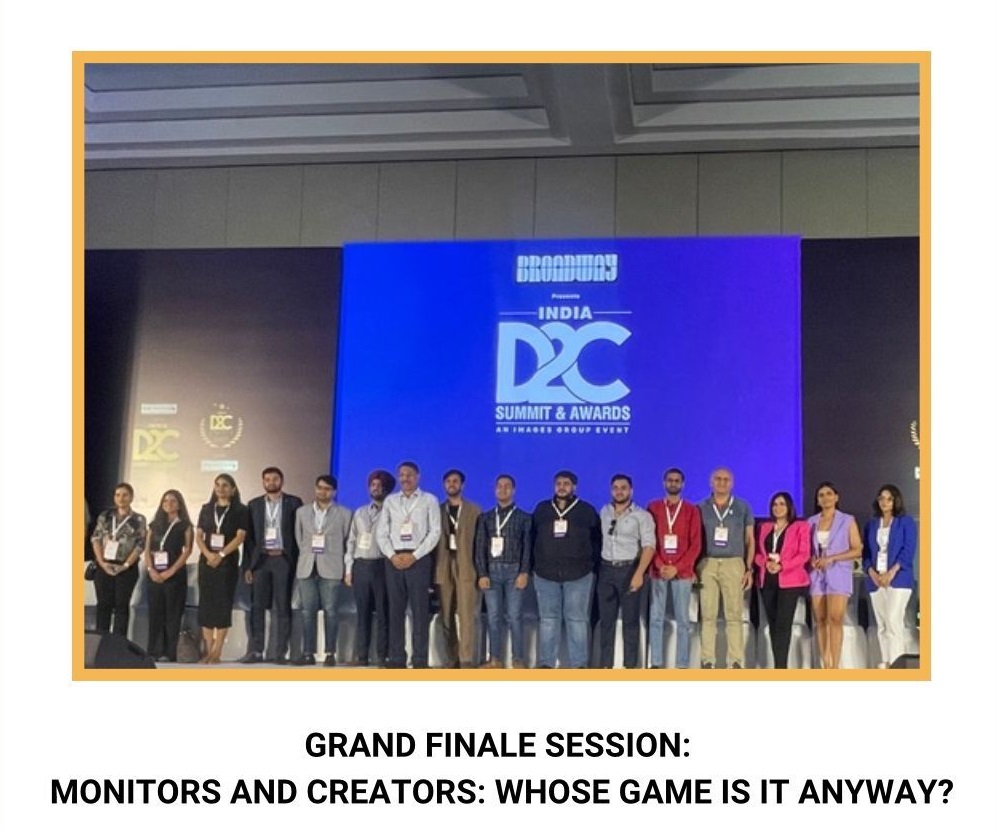
In a startup world, founders are typically creators first while investors see themselves as the monitors. Therefore, conflicts between the two are almost a default feature of a relationship that in effect funds a dream. From ‘off’ chemistry to differences of opinion to what some founders see as shackles on entrepreneurial freedom, the reasons could be any or a mix of all. Watch this discussion, with a mega-panel of intense start-up founders on the one hand and investors with VC funds on the other, addressing the pain points on Cash, Control, Creativity, Chemistry and Culture in a supercharged encounter. Session Anchor, Devangshu Dutta (Founder, Third Eyesight) reflected, “Those who have heard classical music jugalbandi or witnessed jazz musicians jamming will appreciate the creative tension, the give and take that was the thread throughout this discussion, reflecting the reality of the relationship between entrepreneurs and VCs.”
Watch the video
INVESTORS:
Ankita Balotia, VP, Fireside Ventures
Aashish Vanigota, Principal – Investments, IvyCap Ventures Advisors Private Limited
Bhawna Bhatnagar, Co-founder, We Founder Circle
Nitya Agarwal, VP-Investments, 3one4 Capital
Harmanpreet Singh, Founder & Managing Partner, Prath Ventures
Vamshi Reddy, Partner, Kalaari Capital
Zoeb Ali Khan, Vice President, Sauce.vc
D2C FOUNDERS:
Abdus Samad, Founder, Sam & Marshall Eyewear
Akshay Mahendru, Co-Founder & CEO, The Pet Point & Nootie
Malvika Jain, Founder, SEREKO
Nitin Jain, Founder, Indigifts
Puneet Tyagi, Egoss Shoes
Radhika Dang, CEO & Founder, The Good Karma Company
Rahul Aggarwal, Coffeeza
Udit Toshniwal, Founder & Director, The Pant Project
Vaani Chugh, Co-founder & Director, D’chica
Yash Kotak, Co-founder, Bombay Hemp Co.
Yashesh Mukhi, Co-founder, Chupps
admin
May 8, 2024
At the recent Phygital Retail Convention in Mumbai, Devangshu Dutta anchored an engaging “Fireside Chat” with Bhavana Jaiswal of IKEA India and Kapil Makhija of Unicommerce , on retailers engaging with their customers across channels and formats, and the opportunities as well as challenges in managing experiences seamlessly across online and offline interfaces.
Watch the video at this link:
