
admin
November 13, 2025
Saumyangi Yadav,Entrepreneur
Nov 13, 2025
India’s consumer landscape is undergoing a decisive shift in 2025. While D2C brands that once thrived on digital-only distribution are now aggressively building an offline footprint, legacy FMCG majors are simultaneously acquiring digital-first brands to strengthen their portfolios and tap into new consumer behaviours.
As analysts suggest, these trends signal a maturing phase for India’s D2C ecosystem, one that blends physical retail and strategic consolidation.
Offline Push Accelerates
According to a recent CBRE report, ‘India’s D2C Revolution: The New Retail Order’, D2C brands leased nearly 5.95 lakh sq ft of retail space between January and June 2025, accounting for 18 per cent of all retail leasing during this period, up sharply from 8 per cent in the first half of 2024. Fashion and apparel dominated the expansion, contributing close to 60 per cent of D2C leasing, followed by homeware and furnishings and jewellery at about 12 per cent each, while health and personal care brands accounted for roughly six per cent. The shift is equally visible in the choice of retail formats: 46 per cent of D2C leasing went to high streets, 40 per cent to malls, and the remaining to standalone stores, reflecting the category’s growing focus on visibility, trial and experiential discovery.
Experts suggest that it represents a strategic pivot to blended engagement.
As Devangshu Dutta, CEO of Third Eyesight, notes, “India’s D2C surge is powered by digital-first consumers, tremendous improvement in seamless logistics, and low-cost market entry, supported subsequently by substantial amounts of investor capital chasing those startups that stand out from the competition. Yet, lasting success demands a more holistic view: the divide between online and offline is a business construct, not a consumer reality. The larger chunk of retail sales still happens through physical channels and, for brands that want to be mainstream, an omnichannel presence is absolutely essential.”
This also aligns with the broader market outlook. The India Brand Equity Foundation (IBEF), in its Indian FMCG Industry Analysis (October 2025), estimates the value of India’s D2C market at USD 80 billion in 2024, with expectations of crossing USD 100 billion in 2025. Much of this growth is being led by categories that combine frequent purchase cycles with strong digital discovery, beauty, personal care, and food and beverage segments where consumers are open to experimentation but demand authenticity, transparency, and a compelling product narrative.
“The Gen Z and millennial consumer cohorts value newness but also authenticity and unique product stories, which are best communicated in spaces that are controlled by the brand,” Dutta added, “In the launch and growth phases, this could be the brand’s digital presence including website and social media, but over time this can include pop-up stores, kiosks, shop-in-shops and even exclusive brand stores.”
CBRE’s data reflects this shift clearly, with D2C brands increasingly opting for flexible store formats and high-street locations to maximise traffic and visibility.
M&A Gains Momentum
Parallel to the offline push is a noticeable wave of consolidation. Large FMCG companies are accelerating acquisitions to capture emerging consumer niches and strengthen their digital-native capabilities.
In recent years, Hindustan Unilever has acquired Minimalist; Marico has bought Beardo, Just Herbs, True Elements, and Plix; ITC has taken over Yoga Bar; and Emami has secured full ownership of The Man Company. These deals, reported widely across business media in 2024 and 2025, point to the need for established companies to fast-track entry into high-growth, ingredient-forward, and youth-focused categories without the lead time of in-house incubation.
“Legacy FMCG companies are acquiring D2C brands to rapidly gain access to new consumer segments, product innovation, and digital-native capabilities, including direct engagement and insights. Such deals enable large companies to diversify portfolios, accelerate entry into trending segments by-passing the initial launch risks, and rejuvenate their brands with modern digital marketing expertise,” Dutta explained.
Challenges and Risks
But the acquisitions do not come without risk and challenges, analysts warned.
“However, integrating D2C operations also poses challenges, including cultural differences, the risk of stifling entrepreneurial agility, and the need to harmonise data and omnichannel strategies. The ability to nurture acquired brands without diluting their distinctive appeal will determine acquisition success,” Dutta added.
Yet even as the ecosystem expands, challenges remain. Offline stores add operational complexity, inventory planning, staffing, last-mile logistics, and real-time data integration. Still, the bottom line is that India’s D2C sector is moving into a hybrid era defined by tighter omnichannel integration, sharper product storytelling, and portfolio realignment through acquisitions.
(Published in Entrepreneur)
admin
September 22, 2025
Christina Moniz, Financial Express
22 September 2025
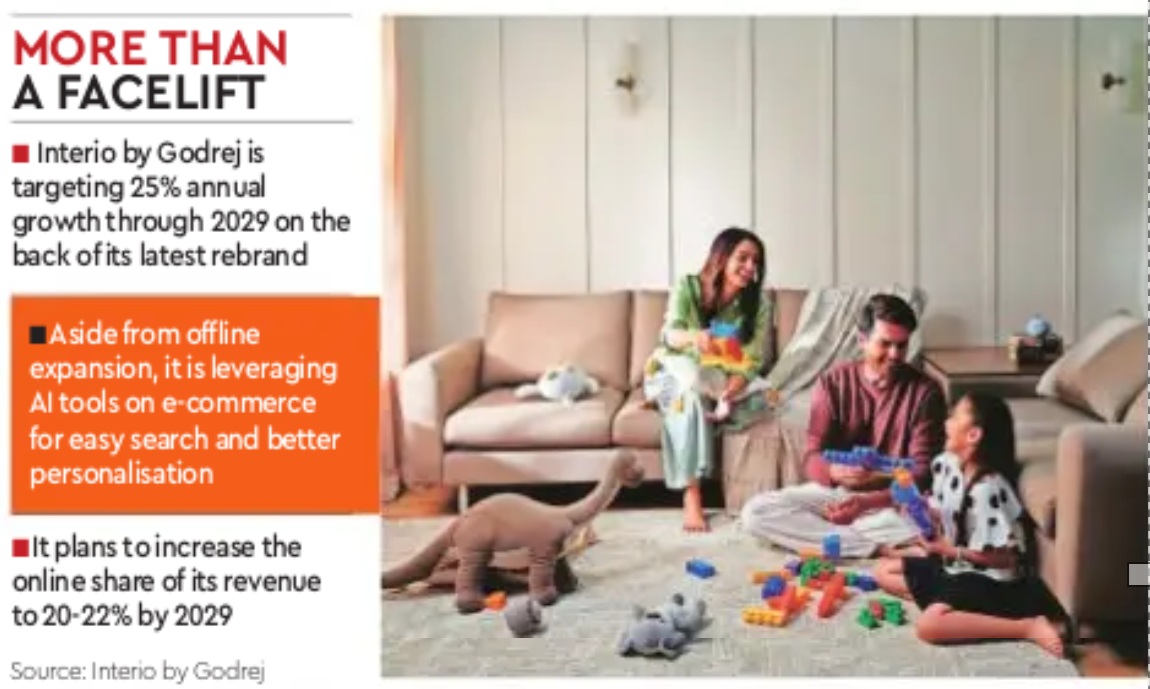
It is already the largest player among organised fumiture makers with over 15% of the market. With 1,000 stores, it has the widest retail store footprint among organised players. The 102-year-old brand is also the second-largest revenue con-tributor to the parent enterprise.
So why is Interio tinkering with its name, logo and colour attributes?
“We want to move away from being viewed as a functional brand to more of a design-led lifestyle one. We have a wider range of offerings that are more modular and aesthetic,” says Reshu Saraf, head of marketing communications at Interio by Godrej.
As a first step, it has a new logo and name change – from Godrej Interio to Interio by Godrej. The brand has earmarked ₹50 crore towards an integrated campaign across TV, digital, outdoor and in-store branding to promote its new proposition over the next year. Overall, it will invest ₹300 crore in expansion and technology with the goal to more than double revenues to ₹10,000 crore by FY29.
Younger consumers don’t see furniture as utility but as lifestyle, observes Puneet Pandey, strategy head and managing partner, OPEN Strategy & Design. “By moving from ‘solid and sturdy’ to ‘stylish and aesthetic’, the brand earns the right to play at higher price points as well. Design-led positioning will also unlock repeat purchase since people no longer wait a decade to change their furniture based on utility; they want constant upgrades to refresh their living spaces as their tastes evolve,” he notes, adding that Interio needs to make the marketing leap from “catalogue to culture”.
Saraf says the brand is also building differentiation with its customer experience. “We’re using digital tools for store walkthroughs and visualisers to help visualise our products in the home. Our product portfolio, which is deeply personalised ane tailored for Indian sensibilities, it is a major differentiator that few other brands offer,” she points out.
E-commerce is also a focus area with the brand looking to increase the revenue share from 15% to 20-22% by 2029. The company is leveraging Al to improve the search functionand sharpen personalisation. Saraf adds the that offline too, the brand will have large format experience centres to help people envision what their rooms could look like, along with mid-size and small-format stores.
Interio also plans to widen its retail store footprint from 1,000 to 1,500 by 2029.
As per industry estimates, the Indian furniture market is set to grow at 11% annually to reach $64.1 billion by 2032 from $30.6 billion in 2025. It is this growth momentum that Interio is looking to cash in on.
Built-in differentiation
Although a significant chunk of Interio’s business comes from its home remodelling services, within the furniture category, it competes with global players like IKEA and digital-first brands like Pepperfry. The challenge for Interio in this market is to embed the design-led positioning in its productsandcus-tomer experience, says Nisha Sam-path, managing partner at Bright Angles Consulting.
One of its biggest advantages is the Godrej brand. “The Godrej brand stands for many values prized in interiors such as quality, trust, reliability and durability with a ‘Made in India’ tag. However, the brand has not been so successful in building an image of cutting-edge design and innovation. These are new values that can make the brand more contemporary,” she remarks.
Devangshu Dutta, CEO of Third Eyesight concurs, pointing out aside from nimble competition, Interio’s key challenges also come from the dual pressures of increasing consumer expectations for rapid delivery and customisation on the one hand, with aggressive price competition on the other.
(Published in Financial Express – Brandwagon)
admin
September 19, 2025
Anuja Jain, Exchange4Media
19 September 2025
Retail media is now the fastest-growing line in Indian advertising, with brand budget tilting hard toward e-commerce as digital shopping scales.
Fresh FY25 financials underline the shift: Amazon India’s ad sales jumped 25% to *8,342 crore, while Flipkart booked ₹6,310 crore. Together, the two platforms command 14,652 crore in commerce advertising, signaling a decisive move of performance spends from traditional channels to shoppable, data-rich placements.
At Amazon India, advertising has become the second largest revenue pillar after marketplace services, contributing nearly 28% of a 30,139-crore operating base. The heft now rivals or surpasses several legacy media categories, highlighting brands’ tilt to closed-loop, performance-led placements on commerce.
On the other hand, for Flipkart, ads are now a clear topline engine. Marketplace revenues have crossed ₹20,000 crore, with income from marketplace services more than doubling on the back of brand promotions, even as the company ploughs investment into logistics, new commerce formats, and Al-driven personalization.
For context, marquee media houses sit well below commerce ads, Zee Entertainment’s FY25 advertising revenue was 838 crore, while HT Media logged about a little over 1,070 crore for the year. Even Network18’s entire news segment revenue (ad + subscription) was approximately 468 crore, clearly indicating the scale retail media now commands.
Why retail media Is booming
According to brand experts, the surge in ad revenues of Amazon and Flipkart not only reflects the growing dominance of retail media in India but this works because it is closest to the point of purchase, akin to securing premium shelf space in physical retail.
“Consumers come to Amazon and Flipkart with high purchase intent, and coupled with first-party data, brands can sharply target audiences-premium or mass-with clear measurability of ROI,” said one of the experts.
Underlining the growing dominance of retail media, “E-commerce platforms know exactly who you are and what you buy,” he explains that this knowledge allows brands to pitch products with far greater precision thab traditional digital channels.
Retail expert Devangshu Dutta explains that the surge in ad revenues for e-commerce needs to be compared with the long-standing practices of large retailers, who have historically charged slotting fees for shelf placement and additional promotional charges for in-store or media visibility.
“As far as ad revenues for e-commerce companies in India are concerned, this is a fundamental structural shift rather than a temporary spike. It is a mature monetisation strategy that mirrors global trends,” he said.
The size and accuracy of retail media networks (RMNs) are the main drivers of the increase in e-commerce ad spending. According to Bloom Agency, an NCR based digital marketing outfit, companies are discovering unmatched reach and conversion prospects in India, where there will be over 342 million online consumers by 2025 with platforms like Amazon (with 150 million users) and Flipkart (with 180 million users) controlling over 65% of the market. In contrast to traditional digital advertisements on Google or Meta, retail media provides closed-loop attribution, which allows advertisers to track sales impact directly. This is a crucial indicator in today’s ROI-driven market.
IBEF (Indian Brand Equity Foundation) data shows that India’s digital advertising industry has crossed ₹60,000 crore in FY24, with retail media accounting for a fast-expanding share. Globally, retail media is already being hailed as the “third wave” of digital advertising after search and social media, and India is now firmly aligned with that trajectory.
Nipun Marya, CEO of iQOO, credited Amazon Ads as a crucial growth driver for the brand’s recent launches. “For recent launches, iQOO leveraged Amazon Ads to reach relevant audiences and build pre-launch buzz, using formats like Amazon Live, influencer-led shopping events, display, video, and search ads,” he said.
Emphasizing the centrality of Amazon in its strategy, Marya highlighted, “Based on consumer insights, iQOO identified Amazon as the key shopping destination for its core audience and built its e-commerce strategy around the platform.” This approach, which combines influencer-led activities, Amazon Live storytelling, and always-on Search Ads, has helped the brand deepen engagement and sustain consumer consideration in a competitive and price sensitive market.
Tight demand is also lifting platform pricing, through last Diwali, India retail-media CPMs spiked 30% at peak and CPCs ran 33% above baseline, and brands are budgeting for similar pressure this season. New premium placements, video/CTV and Amazon’s Sponsored TV are further nudging average rates up as advertisers chase shoppable reach.
Quick commerce platforms like Zepto, Blinkit and Swiggy Instamart are also capitalising on festive demand with steep hikes in ad rates, especially for premium slots like homepage banners and sponsored placements. Categories such as FMCG, snacks and personal care are leading the charge, with brands committing lakhs each month to secure visibility. By turning digital shelf space into monetised real estate, Q-comm ad revenues are projected to cross ₹5,000 crore by 2025, reinforcing why retail media is one of the fastest-growing, ROI-driven channels.
Quick commerce players are seeing varied traction from advertising revenues. Zepto has emerged as the frontrunner, crossing ₹1,000 crore in annualised ad revenue, or over ₹83 crore a month. In contrast, Blinkit earned just 7 crore in FY25 from related-party ads, dwarfed by its 502 crore ad spends. Zomato’s food delivery arm reported ₹8,080 crore in revenue, up 27% YoY on the back of commissions, ads and platform fees, while Swiggy’s operations grew 45% YoY to 4,410 crore but losses widened to 1,081 crore due to heavy quick commerce investments.
Intensifying competition for brand wallets
Sponsored listings, video commercials, and Al-driven targeting are just a few of the ways that Amazon’s commerce ecosystem seamlessly incorporates advertising, giving businesses greater visibility at the point of sale. Flipkart, on the other hand, is using its creator-led campaigns (Creator Cities), subscription play (Flipkart Black), and holiday specials to create an engaging layer of brand interaction.
The competitive dynamic is forcing consumer brands, especially in FMCG, electronics, and fashion, to rethink their media mix. With e-commerce penetration expected to jump from 25% in FY24 to 37% by FY30 as per the IBEF report, advertising spends on these platforms are projected to scale even faster. Analysts suggest that retail media could command over 20% of India’s total digital ad market by 2030.
A Reshaped Media Landscape
The implications for India’s advertising ecosystem are profound. Traditional digital duopoly players Google and Meta still command scale, but the entry of retail giants is fragmenting spends. For brands, the choice is less about “whether” to advertise on Amazon or Flipkart and more about “how much” to allocate in order to capture consumers at the point of intent.
As India races toward becoming the world’s second-largest online consumer market with 600 million shoppers by 2030, says Grab On report, retail media is set to be the fastest-growing channel. Amazon and Flipkart’s FY25 numbers signal that we are only at the beginning of this pivot. The clear signal for advertisers is that e-commerce has evolved beyond sales, now standing at the very core of digital ad planning.
(Published in Exchange4Media)
admin
September 17, 2025
Sowmya Ramasubramanian, Mint
17 September 2025
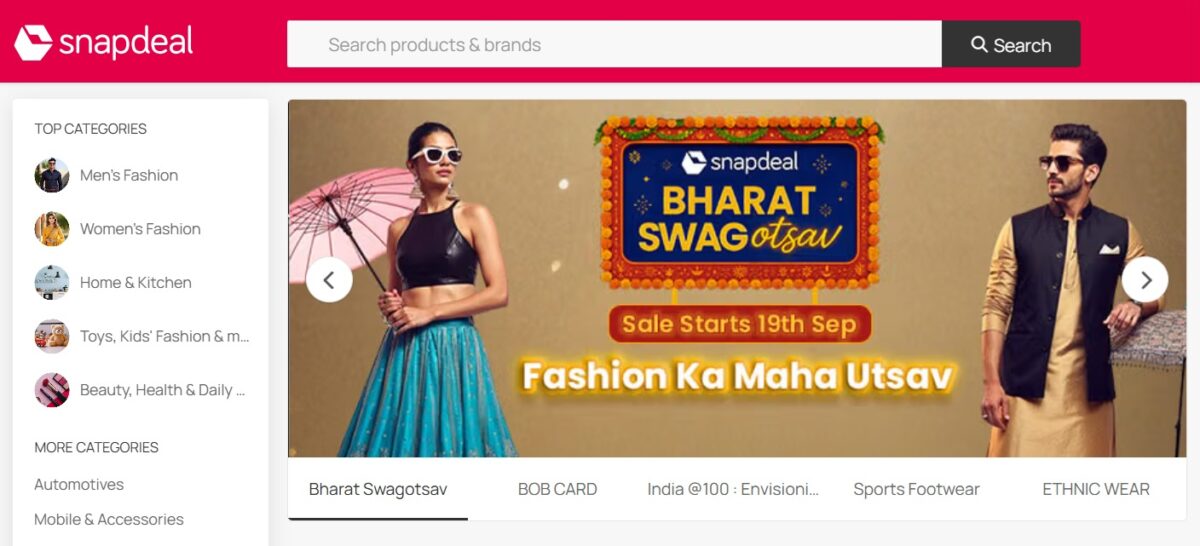
Snapdeal, run by AceVector, is relying on strong growth in fashion and apparel to strengthen its position in the competitive e-commerce space, especially during the high-stakes festive season when customer loyalty is low. According to CEO Achint Setia, the company has seen its fashion and lifestyle categories triple in growth this year, though exact figures remain undisclosed.
“Fashion has been a standout category this year and, in fact, has been possibly the fastest-growing one so far. Overall, lifestyle [including fashion, home decor, and kitchen] already accounts for 90% of our business today, and fashion is a major driving force,” Setia told Mint in an interview.
Setia was appointed to the role in January, replacing Himanshu Chakrawarti, who led Snapdeal and its subsidiary Stellaro Brands for three years. Setia has over two decades of experience across marketing and strategy roles in firms like Myntra, Viacom18 Media, and Zalora Group.
While the festival season is a key period for all consumer-facing brands and platforms, this year is important for Snapdeal as it is currently waiting for the Securities and Exchange Board of India (Sebi) clearance to list in the public markets.
“Approval from Sebi before the end of the financial year is crucial for Snapdeal. If they don’t get it, or if they have to refile, they’ll need to update their IPO documents with a full year of financial data. This means the festive season performance will be key in shaping investor sentiment, especially in a volatile market,” said a senior e-commerce executive, asking not to be named.
The firm filed its draft papers for an IPO reportedly to raise ₹500 crore through the confidential route in July, which allows it to withhold public disclosure of IPO details until later stages. Setia declined to comment on the progress of the filing.
Despite its early entry, Snapdeal is yet to make a mark among the top e-commerce players in the country by both market share and volume of transactions. For context, industry estimates show Flipkart as the market leader with 48% share, followed by Meesho and Amazon. The Indian e-commerce market is projected to grow at a compound annual growth rate (CAGR) of 21% and reach $325 billion dollars in 2030 as per an October 2024 report by Deloitte.
Founded in 2010 by Kunal Bahl and Rohit Bansal, Snapdeal was initially launched as a daily deals platform and later pivoted to a full-fledged marketplace in 2011. Over the years it raised more than $1.8 billion in funding from Softbank, Alibaba group, Foxconn and Blackrock among others. However, intense competition and the absence of a distinct growth strategy have gradually eroded Snapdeal’s momentum in the e-commerce space.
Snapdeal largely caters to cities outside metropolitan areas where value retail has picked up in recent years. Within this, fashion remains the top growth driver-with more than 80% of orders placed priced below 1599 and 80% of them com-ing from small town India, accord-ing to CEO Setia. “For us, it’s about the value-conscious mindset that could be sitting out of anywhere,” he noted.
Over the last few months, Snapdeal has invested substantially in in-house festive campaigns, as well as technology and tools for returns forecasting and logistics. According to Setia, it has also expanded its seller portfolio, adding more from key clusters like Tirupur, Surat, Ludhiana, and Agra.
According to a September 2024 report by market research firm Centrum, the mass-market fashion segment accounts for 56% of India’s total apparel market.
However, offline continues to account for more than half the sales, with Tata’s Trent, D-Mart, and Vishal Mega Mart offering a sufficient selection of price-conscious consumers in smaller towns.
While small-town India offers a wide online shopping-savvy market waiting to be captured, Meesho has raced past Snapdeal in those geographies, especially in value commerce.
“For a very long time, Snapdeal has been positioned as an e-commerce platform for Bharat, but it doesn’t necessarily hold a strong position. Meesho, Flipkart and Amazon have expanded their presence in these markets over the years, which means competition is so much more now,” said Devangshu Dutta, founder and chief executive officer at consulting firm Third Eyesight.
(Published in Mint)
admin
August 18, 2025
Hiral Goyal, The Morning Context
18 August 2025
A trend that has been playing out through big and small changes over the last two decades is that in urban India the kirana store is easily replaceable.
When it comes to buying groceries, urban Indians have a number of options. They can visit a fancy supermarket run by a conglomerate or order online through a number of e-commerce and instant-delivery companies. And if the above doesn’t seem easy enough, they can hop over to a nearby mom-and-pop store.
It would appear it is now the turn of smaller towns in the country to witness the kirana disruption. Even though 99% of grocery shopping in these tier-3 cities is done through neighborhood general stores, there are startups that believe this is an outdated and inefficient form of retail and a change is in order.
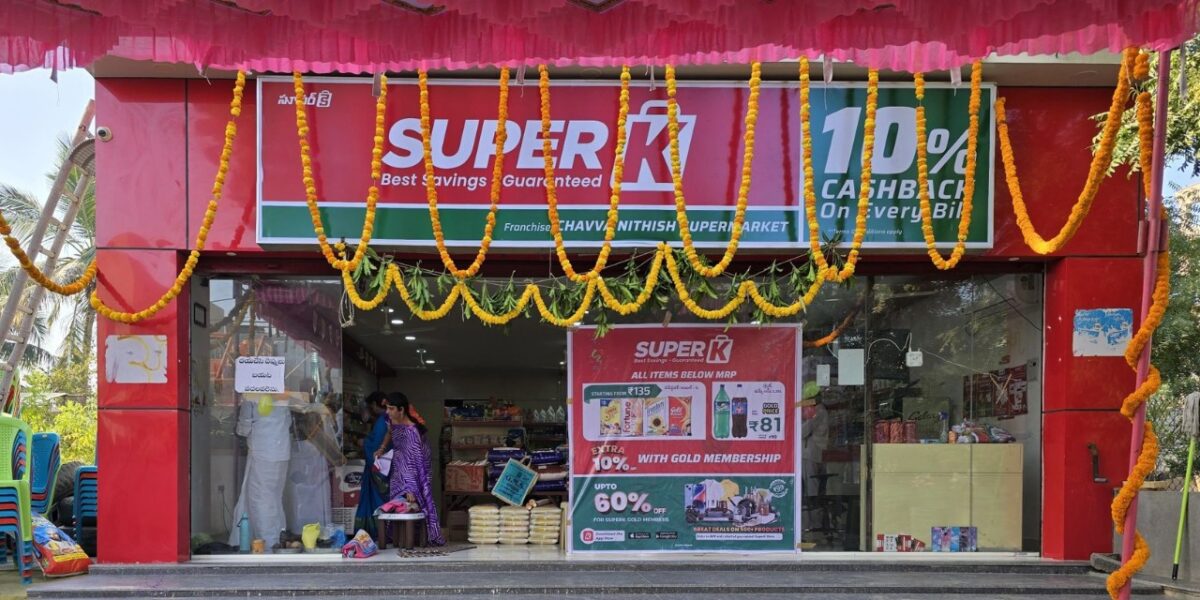
One such company is SuperK. The startup’s mission is to build a grocery store model in small towns that has all of the advantages of modern retail packed in a compact 800-square-foot store. This is what Anil Thontepu and Neeraj Menta had set out to do when they founded the company in 2019. The idea was to bring a modern trade-like grocery shopping experience to small-town India a wide assortment of products at a better value.
“There is a cost-efficient world of general trade and a customer-loving world of modern retail,” says Thontepu. “We wanted to see if we can bridge this gap…and do something for the small-town people by bringing the best of both these worlds.”
Over the past five years, the Bengaluru-headquartered startup has opened over 130 stores across 80 towns in Andhra Pradesh. And it doesn’t want to stop there. The company wants to expand to another 300 towns in Andhra Pradesh and nearby states of Karnataka and Telangana over the next 24, months. That’s quite an ambitious target. But the founders believe the market size for Superk is so large that they should be able to build a Rs 2,000-3,000 стоore ($228-342 million) annual business from Andhra and Telangana alone.
To fuel this expansion, Superk raised Rs 100 crore ($11.7 million) in Series B funding last month. The round, led by Binny Bansal’s 3STATE Ventures and CaratLane founder Mithun Sacheti, valued Superk at 2-2.5x its previous valuation of Rs 160 crore (about $18.25 million) in 202/
Now, Superk is not entirely unique. It competes with startups like Frendy, Apna Mart and Wheelocity, which are also trying to organize the retail market in India’s smaller towns. What sets SuperK apart is its larger, bolder approach. Grocery chain Apna Mart, for instance, runs franchisee stores in tier-2 or tier-3 markets and also offers 15-minute home delivery, SuperK’s focus is only on supermarkets. Frendy operates mini-marts and micro-kiranas in villages and towns with fewer than 10,000 people, but SuperK targets small towns with populations between 20,000 and 500,000. And Wheelocity supplies only fresh produce to rural areas, while Superk sells dry groceries as well as packaged consumer goods.
This rather radical shift in focus-away from tier-1 and tier-2 cities-ties in with India’s changing consumption pattern. “Consumer mindsets are changing even in smaller cities,” says Devangshu Dutta, founder and chief executive of Third Eyesight, adding that these consumers are beginning to favour more modern retail environments. And NielsenIQ’s latest report says rural markets in India grew twice as fast as cities between April and June 2025.
In this landscape, SuperK fits like a glove, with its franchise-first approach. Thanks to an asset-light model, the company has the agility to go deeper into smaller towns.
But it won’t be all that easy either. As Dutta says, “Changing grocery habits is a long, capital-intensive game.” Moreover, big retail chains are also jumping on the bandwagon. Hypermarket chain Vishal Mega Mart, for instance, already operates 47% of its stores in tier-3 cities and plans to expand into cities with populations exceeding 50,000. Supermarket chain operator DMart is also focusing on tier-2 and tier-3 cities.
However, Superk founders believe they are prepared for the challenge. Menta says the startup has arrived at a business model that is scalable, sustainable and, more importantly, offers value to its customers.
It’s too early to say whether they will be successful in this endeavour. That said, SuperK appears to have built a smart retail business for small-town India.
Refining small-town retail
SuperK’s founders have drawn inspiration from domestic and international retail chains like DMart and Costco. But they haven’t duplicated their strategies and made their own tweaks instead. For instance, large retail chains usually run company-owned and company operated, or COCO, stores. Though this approach is more cost-intensive than the franchise model, it allows a company to ensure a uniform customer experience across all outlets:
Superk doesn’t do that. It runs only franchise-owned and franchise-operated (FOFO) stores, which are no bigger than 800 sq ft. The company is not the first to have experimented with this model, but Thontepu believes that everyone else before them “did not try with the right spirit”. A franchise-owned store, argues co-founder Menta, is run differently from a company-owned store one has to keep in mind the store owner’s incentives, needs and concerns.
Under the franchise model, entrepreneurs invest between Rs 12 lakh (about $13,690) and Rs 15 lakh (about $17,110) to set up a Superk store. Of this, Rs 4 lakh (nearly $4,560) is spent on the store fit-out and infrastructure, the rest goes towards buying inventory. These stores, according to Menta, typically achieve a breakeven point after six months. On average, a retail store takes longer than that-12-15 months to reach breakeven.
Superk fills the shelves by procuring its inventory directly from brands as well as distributors. “The inventory is recommended by us through a mobile application. Store owners have an option to make certain changes within the limits that we have set for them,” says Thontepu. Revenue is shared and the model is similar to the one followed by nearly all retailers in India. Franchisees earn varying levels of margins on different kinds of products, depending on how easy or tough it is to sell those items. For instance, staples like dal and rice have lower margins, while confectionary items and products that need greater effort to sell enjoy higher margins of up to 20%.
In addition to this, there’s a private label business, especially loose items like pulses. In fact, private labelling is part of the company’s efforts to bring some standardization in India’s unorganized retail market. “A customer coming to our store should be able to blindly expect consistent quality on the product they’re buying,” says Menta. “We have organized our sourcing, processing, cleaning, packaging, testing. Everything that a brand would do to provide a great-quality product to their customer.”
Unlike distributors or other retailers who operate franchise models though, Superk claims that it does not dump its inventory on store owners. Menta says the franchise structure is designed in a way that Superk does not benefit from selling unnecessary stock to store owners. “If I lose, he will lose. If he loses, I lose. That is the way (the structure) is created. We, in fact, recommend owners to remove some products if they are not selling.” says Menta.
On the customer side of things, Superk’s value proposition comes down to offering the best prices. More than a year ago, for instance, it introduced a membership programme that offers customers cashback that is redeemable on their future purchases. “If they pay Rs 300 [approximately $3.5) for a six-month membership, they get 10% cashback on all purchases that they are making up to Rs 300 every month,” explains Thontepu. He says 35-40% of Superk’s more than 500,000 customers are enrolled in this programme.
All of this sounds good even promising in theory. But will it be enough to build a sustainable and scalable retail business?
A long, hard look
Let’s first look at what really works in SuperK’s favour.
One, the focus on selling staples under a private label brand. This has been done successfully before. One example is Nilgiri’s, one of India’s oldest supermarket chains.
Founded in 1905, Niligiri’s operated under a franchise model and sold dairy, baked goods, chocolates and other items produced under its own brand. The supermarket chain was sold by debt-ridden Future Group for Rs 67 crore ($7.65 million) in 2023, less than one-third the price the latter paid to acquire the company from private equity firm Actis in 2014. However, its history is worth learning from.
Shomik Mukherjee, a Delhi-based consumer goods advisor who was a partner at Actis while the firm was in control of Nilgiri’s, recalls the value proposition created by Nilgiri’s private label products. “In the case of private labels, it is essential for a company to have a reason why people will walk into that store. For Nilgiri’s, it was bakery and dairy products,” says Mukherjee. Owning a private label that brought in customers also ensured that franchisee owners had incentives to continue working with Nilgiri’s. “It is about giving the franchisees a safe portfolio of private label goods that are desired by customer instead of something that is shoved down the franchisees’ throat to derive margin,” he says.
You see, the overall grocery business operates on a very low margin. But private labelling, says Satish Meena, founder of Datum Intelligence, offers the highest margins – 35-40% – in the grocery business, after fresh produce, making it a lucrative business to get into.
Superk, which sells essential items through its private label, has the opportunity to earn better margins in grocery retail. More importantly, private labelling holds the potential to become SuperK’s identity and boost customer retention and loyalty.
Two, SuperK’s franchise model allows it to expand to more locations rapidly as compared to a regular modern trade chain with company-owned stores, says Mukherjee. This model makes SuperK’s business asset-light and brings down the cost of running a network of stores. “Under this model, the franchisor does not incur the upfront cost of opening a store or having to deal with the trouble of hiring and replacing store managers,” he adds. Since most store owners in a franchise model are landowners, there is a greater stability in operations as well, he explains. Moreover, Superk stores are quite small (800 sq ft), allowing easier availability of property.
The franchise model, however, is not entirely foolproof. One of the inherent problems is the difficulty in implementing standard operating procedures (SOPs) across all stores. And the problem only worsens as the company expands operations to different cities. While Superk stores boast a no-frills fit-out that can be easily set up anywhere, how these stores are maintained through the wear and tear over the years is yet to be seen.
A bigger fear is that the store owner may start running their own store without the Superk branding. “If Superk loses the franchisee owner, it also loses the location in which the store was operating,” says Mukherjee.
Moreover, most franchisee owners in the retail business typically tend to be experienced general store owners who might not be willing to adopt new technology. “Since they have run a store before, they think they know how and what to order for inventory and may not follow SuperK’s tech-enabled recommendations,” says Mukherjee.
There’s another problem. While the founders claim to have seen considerable success (35-40% sign-ups) in the rollout of SuperK’s membership programme for customers, Third Eyesight’s Dutta raises concerns about its future growth. “Indian consumers’ price sensitivity limits membership fee potential,” he says. According to him, the programme’s value in the tier-3 market lies more in customer acquisition and retention than direct revenue generation. “Long-term success requires a cashback programme to drive purchase frequency and basket size increases to offset the costs,” says Dutta.
Menta, however, has a different view. He says SuperK’s subscription is designed in a way that benefits customers only when they make full basket purchases. Moreover, the company has different pricing slabs for membership depending on the various basket sizes, which makes the model more viable. Considering the programme is a little more than a year old, it is still too early to judge whether it will find a lot of takers in small towns.
For now, the founders are in no hurry to expand their business across India. “There is no reason to go into five states. Then, you are spread thin and your economics will not work out. It’s a business of managing operations at a very low cost,” says Menta. The plan is to stick to one region and continue to go deeper into it. “A lot of our competitors who started five years ago spread to so many places that it became very difficult for them to manage,” he adds.
This is also the crux of how Thontepu and Menta are building SuperK. By implementing what they have learnt not only from their own experiments, but also from the failures and successes of other businesses. While there’s no guarantee that Superk will become a roaring success, it does appear to have set an example by starting small and growing patiently. And if the latest funding is any proof, investors are interested.
(With inputs from Neethi Lisa Rojan)
(Published in The Morning Context)
