
admin
April 24, 2022
Written By Christina Moniz
Brand and marketing experts, while expressing surprise at the development, as the two labels enjoy significant brand equity, also noted that if true, it highlights the challenges faced by legacy brands, with international brands growing their footprint in the country.

Apparel and textile major Raymond may be in the midst of talks to sell its prized apparel brands Park Avenue and ColorPlus, amid rising speculation about the future of the company’s apparel business. As per media reports, the company is in talks with Danish retail group Bestseller — which houses labels such as Jack & Jones, Vero Moda and Only — for the sale, seeking a valuation of around Rs 500 crore for ColorPlus, and even more for Park Avenue.
Brand and marketing experts, while expressing surprise at the development, as the two labels enjoy significant brand equity, also noted that if true, it highlights the challenges faced by legacy brands, with international brands growing their footprint in the country. Also, legacy brands, especially in the formal wear category, have been facing headwinds ever since the pandemic led to a work-from-home culture.
However, Sunil Kataria, the newly-appointed CEO of lifestyle business for Raymond, told FE these reports are “speculative”, stating that both Park Avenue and ColorPlus currently account for close to 50% of the company’s apparel business. In September last year, the board had approved the demerger of Raymond’s apparel business, which, at that time, was being managed by a 100% subsidiary of Raymond Ltd, Raymond Apparels, explains Kataria. The demerger covers all of the company’s ‘power brands’ — Park Avenue, Raymond Ready to Wear, ColorPlus and Parx.
“We want to double our apparel business revenues in the next three years. We ended up doing business of over Rs 300 crore in Q3 FY22, even at a time when the Covid-19 impact was still there, and that is the clearest proof that the sale of our brands is not on the cards,” asserts Kataria. The company also claims to have plans to further expand its retail footprint for Park Avenue, ColorPlus and even the newly-launched Ethnix brand. Kataria is betting big on the upcoming wedding season and the resurgence of travel in the next few months to drive growth.
Raymond currently has a retail footprint of close to 1,500 stores across 600 cities, of which 300 or so are exclusive outlets for brands like Park Avenue, Parx and ColorPlus.
For Samit Sinha, founder & MD, Alchemist Brand Consulting, said the reports of the sale of these two labels are surprising since both enjoy significant brand equity. “For a long time, Raymond and Park Avenue have been inextricably linked. Independent of its marketing performance, Raymond as a brand continues to hold great aspirational value and still holds its own despite the presence of big international labels,” he remarked, noting that the reported `500-crore valuation would be much below what the brand could command.
On the flip side, the speculation about the sale of these brands also highlights the new reality facing legacy brands in the retail segment — particularly in the formal wear category, with ‘work from home’ eclipsing professional lives. Offline-heavy Raymond has been no exception, with its business being impacted by the pandemic and the consumer shift to online shopping, observes business strategist Lloyd Mathias. “Apparel retailing is a competitive space, and many international brands have been increasing their retail footprint in India. These global companies with deep pockets will continue to grow in size and scale, and penetrate into smaller towns and cities,” points out Mathias. This means that brands like Park Avenue and ColorPlus will face serious challenges in sustaining their growth.
Interestingly, over the last three years, Raymond has increased its footprint in Tier III and IV markets as a part of its growth strategy. Devangshu Dutta, CEO of retail consultancy Third Eyesight, states that when a brand seeks to widen its presence in smaller markets, it is usually because it is facing headwinds in terms of growth, or because there is saturation in demand from the big markets, on account of the large number of international labels entering the country. “The challenge in smaller cities, though, is that the sales density you can achieve is also much lower as compared to the larger ones. You have to have an operation that is growing in terms of topline while also running efficiently to make this kind of expansion strategy successful,” Dutta explains.
Raymond’s Kataria adds that the company will continue to invest in these smaller markets and leverage its current brand equity.
Source: financialexpress
admin
March 24, 2022
Written By Aditya Kalra & Abhirup Roy

MUMBAI, March 6 (Reuters) – At a large Future Retail (FRTL.NS) supermarket in Mumbai last week, workers were unloading hundreds of bright blue grocery crates belonging to India’s biggest retailer Reliance.
Prospective customers were turned back by security, disappointed at the closed state of the store that still carries the signage of Future’s biggest brand, Big Bazaar, but which will likely soon be rebranded as a Reliance outlet.
Across India, similar scenes are being played out as Reliance Industries (RELI.NS), India’s biggest conglomerate run by Mukesh Ambani, the country’s richest man, presses ahead with a shock de facto takeover of prized retail real estate that Amazon.com Inc has been keen to take part-ownership of.
The high-profile bitter dispute between corporate titans in which Amazon has sought to block Reliance’s planned $3.4 billion purchase of Future Group’s retail assets is currently before India’s Supreme Court.
Reliance’s takeover began with utmost stealth on the night of Feb. 25 when its staff began arriving at Future stores. Many in Future’s management were in the dark about the plans as store employees from all over the country frantically began to call, according to people with direct knowledge of the matter.
“It was tense, everybody was panicking. We didn’t know who they were. They wanted access and seniors didn’t know about it,” a New Delhi Big Bazaar store employee said, describing what happened around 8 p.m. that day.
At a Future store in Sonipat town in northern Haryana state, announcements were made asking customers to leave as Reliance seized control, one source said. In Vadodara in western Gujarat, Future employees arriving for work the next morning were asked to go back home with no explanation, said another source.
Citing unpaid payments by Future, Reliance has taken control of operations of some 200 Big Bazaar stores and has plans to seize another 250 of Future’s retail outlets. Combined, they represent the crown jewels of Future’s retail network and around a third of all Future outlets. read more
Although Reliance had not played a large public role in the legal dispute, it had, according to sources, for some months assumed many of the leases held by cash-strapped Future, India’s No. 2 retailer and Amazon’s estranged business partner.
Reliance’s sudden possession of the stores appears to have landed what some analysts are calling a coup de grace that spoils Amazon’s chances of untangling the transfer of Future’s assets to Reliance. That’s despite a series of legal battles won by the U.S. e-commerce giant to date blocking the 2020 deal announced between the two Indian companies.
“What will Amazon fight for now?” said a source close to the U.S. company with knowledge of the legal dispute. “The shops are gone.”
Representatives for Reliance, Amazon and Future did not respond to Reuters queries for this article. Sources asked not to be identified due to the sensitive nature of the dispute.
AFTER THE TAKEOVER, TALKS
Future Retail said on Feb. 26 it was “scaling down its operations” to cut losses although it made no mention of Reliance in its statement. Future Group as a whole has more than $4 billion in debt.
Reliance plans to retain Future’s employees at the stores it takes over, sources have said.
Amazon, which has a stake in a separate Future Group unit that it argues prevents Future from selling retail assets without its permission, has called the supermarkets and other stores an “irreplaceable” network in a sector worth $900 billion in revenues annually.
The legal wrangles had over time become increasingly high-stakes and marked by ugly rhetoric. At one point, Amazon sought for Future Chief Executive Kishore Biyani to be detained in prison for disobeying a legal order. And Future once likened Amazon to Alexander the Great and his “ruthless ambition to scorch the earth”.
But on Thursday, six days after Reliance’s move, Amazon at a Supreme Court hearing unexpectedly called for cordial talks to end the dispute – a proposal Future agreed to.
“People have taken over shops … let’s at least have a conversation,” Amazon’s lawyer Gopal Subramanium said.
Discussions are expected to begin soon. read more
Whatever the outcome of the talks, analysts say Amazon had gravely underestimated Reliance.
“If anybody should have seen this coming, it should have been Amazon and they should have prepared against it,” said Devangshu Dutta of retail consultancy Third Eyesight.
“Clearly, they didn’t.”
Source: reuters
admin
April 21, 2021
Debojyoti Ghosh, Fortune India
April 21, 2021
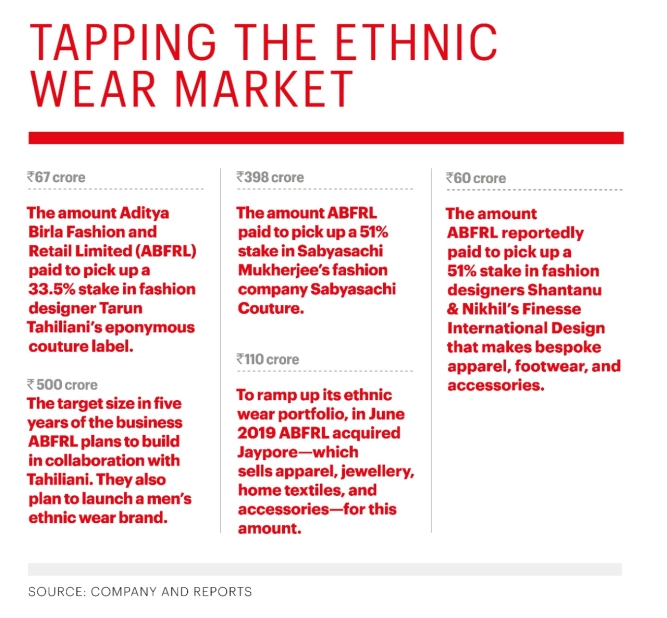
Billionaire entrepreneur Kumar Mangalam Birla-led retailer Aditya Birla Fashion and Retail Limited (ABFRL) has continued its build-up in the ethnic wear market with its fourth deal since 2019 and second this year. In February, the Mumbai-based fashion retailer picked up a 33.5% stake in fashion designer Tarun Tahiliani’s Goodview Properties—that will own and operate the designer’s eponymous couture label—for ₹67 crore. That was a month after ABFRL acquired a 51% stake in Kolkata-based designer Sabyasachi Mukherjee’s company, Sabyasachi Couture, which sells garments, accessories, and fine jewellery, for ₹398 crore.
ABFRL, which owns fashion brands such as Louis Philippe and Van Heusen, said in a statement that ethnic wear “is a large and growing market with a significant opportunity to build scale” and expects it to be an important category over the next few years.
Experts note the two recent deals come as the luxury industry, including fashion, has been hammered by the pandemic. The year-long shutdown in global travel has slowed over a decade of growth across luxury categories. Indeed, the global fashion industry’s profit is expected to have slumped about 93% in 2020, according to a report by consulting firm McKinsey and The Business of Fashion in December.
“[Luxury] business has been hit hard during the pandemic, like all fashion and retail businesses. And a significant injection of money is needed to maintain the business momentum, and to scale it further,” says Devangshu Dutta, chief executive of retail consultancy Third Eyesight.
In March, Italy’s billionaire Agnelli family—best known as the founders of automaker Fiat—acquired a 24% stake in French luxury shoemaker Christian Louboutin for $642 million. Three months before that it paid $95 million for a controlling stake in Shang Xia Paris, a Chinese luxury goods business founded by French luxury brand Hermès and Chinese designer Jiang Qiong Er.
Many fashion firms have used the Covid-19-induced slowdown to reshape business models, streamline operations, and sharpen their customer propositions, said the report by McKinsey and The Business of Fashion.
And that is exactly what Tahiliani plans to do with his new corporate partner. The duo will create a new entity—80% held by ABFRL and 20% by Tahiliani—to launch a new brand of apparel and accessories in the affordable premium ethnic wear segment, while it also plans to launch a men’s ethnic wear brand.
“Discussions with ABFRL have been in the works for nearly two years. I couldn’t be happier about entering into this partnership. They understand scale and numbers like no one else in the market today. Each of their home-grown brands is a resounding success,” Tahiliani, founder and CEO of Tarun Tahiliani Brand, tells Fortune India. “This collaboration permits me the financial freedom to focus on designing,” he adds.
ABFRL aims to build the new ethnic wear brand into a ₹500-crore business in the next five years, with more than 250 stores across India. The first tranche of stores is expected to open by September. “This new entity with ABFRL currently concentrates only on menswear. In our collective opinion, at present, there is only one branded national player in the Indian ethnic [wear] for men space. In order to scale this up, we need to be in three or four categories of clothing. This will give depth, both in terms of style and sizing to the men who come into the store,” says Tahiliani.
Currently, the top panIndia ethnic wear brand for men is Vedant Fashions’ Manyavar. The Kolkata-based company forayed into women’s wear in 2016 selling lehengas, saris, and the like under the label Mohey,
ABFRL’s previous deals in the segment—both in 2019—were a 51% stake in fashion designers Shantanu & Nikhil’s Finesse International Design for a reported ₹60 crore, and its ₹110-crore acquisition of Jaypore. Both make apparel, footwear, accessories, and other items.
ABFRL’s managing director, Ashish Dikshit, declined to comment for this story. ABFRL had, when announcing the Sabyasachi Couture investment, said it expected that deal to accelerate its strategy to build a comprehensive portfolio of brands across segments, occasions, and geographies.
Experts say ABFRL’s recent investments allow it to tap into the designer’s creative stream and goodwill, while providing the financial and organisational muscle of a large corporate. Albeit one that is not aiming too far upmarket.
“We shouldn’t see the ABFRL [stake] acquisitions as entry into couture, which is a different business from the ready-to-wear market. It is the expansion of these brands into ready-to-wear, tapping into the desirability of the designer brand, while making it accessible and affordable to a larger market is what will be of interest,” says Third Eyesight’s Dutta.
Indeed, Mukherjee, in a press release in late January, noted, “As my brand evolved and matured, I began searching for the right partner in order to ensure continuity and long-term sustainable growth.”
Nonita Kalra, a veteran fashion editor, says that the ABFRL deal shows the growing heft of the [Sabyasachi] brand in the fashion business. “Corporates aren’t sentimental. They are hard-nosed about investments, with careful due-diligence. ABFRL is paying what it is worth and expecting it to grow bigger. They are never going to invest in a stagnant business,” she says.
Experts, though, caution that while corporate partnerships and acquisitions allow a designer-entrepreneur and their investor partners to unlock some of the value being built, it is essential to have clarity about each brand’s design language and target consumer. “With [ABFRL’s] new venture [in men’s ethnic wear with Tahiliani], the key thing to understand is how the company will differentiate it from Shantanu & Nikhil’s positioning and focus, which is also menswear-driven,” says Abneesh Roy, executive vice president, Edelweiss Securities. “The challenge will be ensuring that each brand maintains its distinctive identity, while deriving synergies from the group.”
ABFRL has stitched up some unique deals; it now has to ensure they don’t unravel.
(The story originally appeared in Fortune India‘s April 2021 issue).
admin
December 3, 2020
Written By Dheeraj Tagra
At a time when India is seeing a growing number of young entrepreneurs eager to innovate and take risk in the shape of ‘start-ups’, it is sad to note that the apparel manufacturing sector has not attracted these youngsters. If we do see some intervention in the textile value chain, it is mostly on the retail side and little bit on the tech side. Over the years, there are very few professionals who have taken the plunge to be entrepreneurs and run a factory successfully.

While entrepreneurship is being encouraged greatly these days, the definition of MSME is enhanced and many Government schemes are inviting investments in apparel manufacturing, why has the apparel industry been left behind in getting new ‘entrepreneurs’ is a question many are asking. The fact remains that the Indian apparel professionals lack entrepreneurial skills and feel safe working with established companies rather than using their experience to upgrade the industry.
It is also pertinent to mention here that the second generation of established players are not much enthusiastic to continue in the apparel or textile manufacturing sector; so having a fresh entrepreneur, for whom understanding the functions of the industry is difficult, is indeed a cause of worry for many.
At a time when India is seeing a growing number of young entrepreneurs eager to innovate and take risk in the shape of ‘start-ups’, it is sad to note that the apparel manufacturing sector has not attracted these youngsters. If we do see some intervention in the textile value chain, it is mostly on the retail side and little bit on the tech side. Over the years, there are very few professionals who have taken the plunge to be entrepreneurs and run a factory successfully.
Often, Indian apparel factories claim that a particular department/unit of their company is a separate profit centre for them and their teams runs its business as entrepreneurs, rather than just doing their stated job, but is that enough? What more can be done to encourage fresh entrepreneurs to be a part of the apparel industry, needs serious debate.
Many at small scale but none at the large level To its credit, the industry in the last few years has seen a few players that have started their own business and are surviving well. Majority of such entrepreneurs are those that have decades of experience in a particular department of an apparel unit, developed strong network as well as resources. And now they are utilising their strengths as a business promoter. In most cases these units are very small and operations are very much under the control of the promotor, so they are surviving, and a few of them have even grown reasonably well. There also there are few who are still struggling to create a place of their own.
Major obstructions
This is a hard fact, but the reality is that over the last 5 years, Indian apparel export is facing negative growth and it is very hard to grow for most of the established players. Very few companies have expanded in recent years while majority of the companies have seen standard growth. So, it’s natural that no one would like to invest in such an industry which does not promise growth on the base of past performance.
New players prefer to invest in other industries like retail, e-commerce as the variables are more manageable. One of the biggest constraints in apparel manufacturing or even in textile industry is managing a large labour base, besides being deadline driven and seasonal in nature (in export mainly).
Government push
It is heartening to note that the Government in the last few years has announced various initiatives to promote entrepreneurship across the manufacturing industry, that too at state as well as centre level like incubation centre, one district one product (ODOP), Mudra loan, Start-up India, Make in India, Single Window Clearance and various other kinds of subsidies.
The overall industry can expect to see more inflow of investment with initiatives likes proposal for creation of National Technical Textiles Mission for a period of 4 years (2020-21 to 2023-24) with an outlay of Rs. 1,480 crore and approval to introduce the Production-Linked Incentives (PLI) Scheme with the financial outlay of Rs. 10,683 crore for over a 5-year period.
Yet, experts believe that Government is not much concerned regarding new entrepreneurs in the apparel business as fresh investment by old players also serves the purpose of the Government – large-scale employment generation. According to information shared by Apparel Export Promotion Council (AEPC), there are 493 members who have established their companies from 2017 to date, but how many of them are actually new entrepreneurs, even AEPC is not sure about this.
Giving the obvious reasons for lack of fresh talent in the industry, Rahul Mehta, Chief Mentor, CMAI and MD, Creative Garments, Mumbai, argues, “The simple reason is the meagre profitability of the apparel sector. Garment manufacturing is a labour-intensive activity, involving largely hands-on working and day-to-day operations. Although the investment tends to be lower than most other industries, the returns do not justify the effort. Hence, whilst existing companies continue to operate, very little incentive is there for new entrepreneurs coming in.” He further adds that apparel industry is considered a traditional industry, and does not have the appeal of a ‘New Age’ industry – which most people of the younger generation would be interested in.
Regarding Government schemes, he is of the view that most of the Government schemes are for refund of taxes, and not really for making the business more profitable. Hence, these would not incentivise fresh investments and that too from new entrants.
What could be the solution!
To bring fresh approach to a stagnant industry, new entrepreneurs are a must and to encourage this, Government schemes have to be devised accordingly. At the same time, proper guidance and hand holding by existing players is also required rather than looking at these new players as just a competition.
Akhilesh Anand, MD, Carnation Creations, Coimbatore who is among the successful entrepreneurs to have grown in last few years, is of the view that first of all, any professional planning to start their own business should have clarity regarding what they wish to do and why. After this they should build partnership with like-minded people so that both the sides have a common vision and their team should also align with the same vision. He further adds that along with positive aspects, budding entrepreneurs have to think and plan for negative aspects also. “Whatever age a professional has, his/her thought process should be young, should have a knack for rapidly accepting the changes and be innovative at all levels,” he reasons.
A proper ecosystem having equal focus on export as well as domestic market should also exist to promote new players in this industry. With the recent labour reforms and strong focus on skill development, one can expect that managing labour, one of the most difficult aspects of the apparel manufacturing industry, will be easy in coming years. And it will help to attract entrepreneurs in the trade.
Dr. Biswajit Acharjya, Assistant Professor, Entrepreneurship Development Institute of India (Ahmedabad) agrees that Indian apparel manufacturing industry has been missing new entrepreneurs in the last couple of years in India. “The need is to strengthen and properly execute the labour law on a national level. Major textile and apparel units run on electricity which costs more compared to other mediums, especially CNG gas. At the same time, India is having limited water facilities in specific areas. We need to create sufficient water preservation through rainwater or recycling seawater. Infrastructure also needs to improve,” he says. He further adds that there is always a mismatch between the State and Central Government policies in India, which is again a concern. “Existing entrepreneurs should play an active role in mentorship for the new, like job training, grooming and assurance for future responsibility,” he argues.
Apart from Entrepreneurship Development Institute of India (EDII), there are other institutes in the country also dedicated to entrepreneurship like Institute of Entrepreneurship Development (IED), The National Institute for Entrepreneurship and Small Business Development (NIESBUD).There is a strong need to push for entrepreneurship, with a focus on the apparel sector.
Devangshu Dutta, CEO, Third Eyesight, a leading consultancy company, is of the view that the textile value chain has not really been seen as a strategic area by the Indian Government for many years, regardless of the political composition of the Government at the centre.
“Textile and apparel exports have grown at a compounded rate of around 7 per cent annually, a rate almost half of overall exports, when some other major sectors have grown 12-15 per cent, or even as high as 22 per cent annualised in the case of the automotive sector which was virtually non-existent in the export basket 20 years ago,” he says and further adds that India has some critical disadvantages against other competing nations – it is logistically distant from most developed markets, and it is not part of any trade bloc that would give it duty-free access.
To fight against these disadvantages, its natural advantages of entrepreneurship, design and product-development capability and vertical value chain need a lot of support. The Government must also stop seeing the sector in terms of its individual components (fibre, yarns, fabrics, apparel), and must see it as a chain in which we should be focused on the end-point (finished products) to maximise the value captured by India.
“There is no dearth of entrepreneurs in India, and the apparel business has relatively low barriers to entry. If the overall operating environment is cleaned up and made less cumbersome, our firms will do much better. A strategic push is also needed to be funded by the Government for technological upgradation of Indian apparel businesses, not only in terms of manufacturing but also in terms of the improvement of business processes, human capital and digitisation – it will not be expensive in the larger scheme of things but will go a long way in making Indian entrepreneurs and their teams better equipped to deal with the rapidly changing business environment,” he says.
Closing the debate on a thoughtful note, Deepak Mohindra, Editor-in-chief, Apparel Resources opines, “New ventures require professionals at its realm, those having the foresight to see and adapt to new consumer needs and changes and well-honed skills to take calculated risk. The existing stalwarts are largely not willing to take up this challenge, neither have they trained the generation next to take up these kinds of challenges. And that forms the basic handicap in building entrepreneurs and entrepreneurship. Building entrepreneurs requires not only a basic understanding of the industry but also support that has to come in from all quarters – Government, industry stalwarts and the banking system, which has to believe in them and back them as they have backed them in IT sector.”
Source: apparelresources
Devangshu Dutta
April 7, 2020

Oil shocks, financial market crashes, localised wars and even medical emergencies like SARS pale when compared to the speed and the scale of the mayhem created by SARS-CoV-2. In recent decades the world has become far more interconnected through travel and trade, so the viral disease – medical and economic – now spreads faster than ever. Airlines carrying business and leisure-travellers have also quickly carried the virus. Businesses benefitting from lower costs and global scale are today infected deeply due to the concentration of manufacturing and trade.
A common defensive action worldwide is the lock-down of cities to slow community transmission (something that, ironically, the World Health Organization was denying as late as mid-January). The Indian government implemented a full-scale 3-week national lockdown from March 25. The suddenness of this decision took most businesses by surprise, but quick action to ensure physical distancing was critical.
Clearly consumer businesses are hit hard. If we stay home, many “needs” disappear; among them entertainment, eating out, and buying products related to socializing. Even grocery shopping drops; when you’re not strolling through the supermarket, the attention is focussed on “needs”, not “wants”. A travel ban means no sales at airport and railway kiosks, but also no commute to the airport and station which, in turn means that the businesses that support taxi drivers’ daily needs are hit.
Responses vary, but cash is king! US retailers have wrangled aid and tax breaks of potentially hundreds of billions of dollars, as part of a US$2 trillion stimulus. A British retailer is filing for administration to avoid threats of legal action, and has asked landlords for a 5-month retail holiday. Several western apparel retailers are cancelling orders, even with plaintive appeals from supplier countries such as Bangladesh and India. In India, large corporate retailers are negotiating rental waivers for the lockdown period or longer. Many retailers are bloated with excess inventory and, with lost weeks of sales, have started cancelling orders with their suppliers citing “force majeure”. Marketing spends have been hit. (As an aside, will “viral marketing” ever be the same?)
On the upside are interesting collaborations and shifts emerging. In the USA, Jo-Ann Stores is supplying fabric and materials to be made up into masks and hospital gowns at retailer Nieman Marcus’ alteration facilities. LVMH is converting its French cosmetics factories into hand sanitizer production units for hospitals, and American distilleries are giving away their alcohol-based solutions. In India, hospitality groups are providing quarantine facilities at their empty hotels. Zomato and Swiggy are partnering to deliver orders booked by both online and offline retailers, who are also partnering between themselves, in an unprecedented wave of coopetition. Ecommerce and home delivery models are getting a totally unexpected boost due to quarantine conditions.
Life-after-lockdown won’t go back to “normal”. People will remain concerned about physical exposure and are unlikely to want to spend long periods of time in crowds, so entertainment venues and restaurants will suffer for several weeks or months even after restrictions are lifted, as will malls and large-format stores where families can spend long periods of time.
The second major concern will be income-insecurity for a large portion of the consuming population. The frequency and value of discretionary purchases – offline and online – will remain subdued for months including entertainment, eating-out and ordering-in, fashion, home and lifestyle products, electronics and durables.
The saving grace is that for a large portion of India, the Dusshera-Deepavali season and weddings provide a huge boost, and that could still float some boats in the second half of this year. Health and wellness related products and services would also benefit, at least in the short term. So 2020 may not be a complete washout.
So, what now?
Retailers and suppliers both need to start seriously questioning whether they are valuable to their customer or a replaceable commodity, and crystallise the value proposition: what is it that the customer values, and why? Business expansion, rationalised in 2009-10, had also started going haywire recently. It is again time to focus on product line viability and store productivity, and be clear-minded about the units to be retained.
Someone once said, never let a good crisis be wasted.
This is a historical turning point. It should be a time of reflection, reinvention, rejuvenation. It would be a shame if we fail to use it to create new life-patterns, social constructs, business models and economic paradigms.
(This article was published in the Financial Express under the headline “As Consumer businesses take a hard hit, time for retailers to reflect and reinvent”.
