
Devangshu Dutta
June 12, 2010

My first brush with Zara and Inditex (Zara’s parent company) was in the 1990s, when we were comparing product development and supply chain best practices for another European retailer.
In 2002, after writing a case study on the Zara business model, I was (and continue to be) surprised at the number of downloads from the website (referenced at the bottom of this article).
In 2004, the interest at the Images Fashion Forum was so intense that the Q&A after the presentation exceeded the allotted time, to the extent that I was almost declared persona non grata by the organising team!
I’m glad to say that we’re all still friends and, together, witness to the logical next phenomenon: the much anticipated Zara store launch in India in May 2010. And what a phenomenon! On a high-footfall day, at full price, the Delhi store looks as if the merchandise is being given away for free.
In 2006, India was the 8th highest source of traffic to the Inditex website (more than half a million, almost 2 per cent of the total); incredible, considering that the other Top-10 countries already had Inditex stores. Although Zara finally signed a joint-venture with the Tata Group, I’m pretty sure that those thousands of other rejected prospective Indian licensees and franchisees must be getting their Zara-fix now as customers.
What does the Zara launch mean for the Indian fashion and retail sector? Is this the beginning of a new era? Should we expect Zarafication of the market, where the customer is driven by fashion, and the supply chain will turn and churn products faster than ever before? Should other international brands and Indian fashion brands be worried?
A peek at history is useful here. It is said that when Spanish conquistadors landed on the shores of the Americas they managed to conquer the land and the people through a combination of guns, germs and steel. [Credits to Jared Diamond for that evocative phrase.] That is, the Spanish carried guns and fine steel swords but, most importantly, they also carried diseases that were alien to the local population. In many places, the weakened and leaderless indigenous people were simply too battered psychologically and physically by disease, to fight the colonisers.
Keeping that in mind I would say, Zara’s entry is a warning bell only if your business is suffering from recent financial and operational illnesses. It is only dangerous if your team are psychologically weak, and would be overwhelmed just by the thought of the supply chain wizardry that Zara has deployed in its business internationally. It may be fatal for sleepy marketing teams whose only strategy has been to spend lots of money on advertising in season and on mark-downs after the season.
But it’s not doom and gloom for brands and businesses that have a competitive spark of life. If you’re prepared to learn, Zara’s business can provide lessons on how to create a product mix that doesn’t stay on the shelf for months, and on how to create the buzz and excitement around the brand.
Zara’s business success in India is not a foregone conclusion. Let’s look at the facts.
Zara’s business model in its home market was built on getting up-to-date fashion into the market before anyone else, and at lower costs. Its prices encouraged fashion-conscious consumers to buy more frequently, and though its limited production quantities were a way of reducing risk, it added to the allure of the brand. In most overseas markets, however, Zara is a somewhat more premium brand. The “value-for-money” for the brand rests on fashionability rather than product quality.
The Indian consumer base, on the other hand, is less fashion-sensitive than the European consumer. This is not equivalent to being less sensitive aesthetically – Indian consumers can tell good design from bad; allowing, of course, for varying taste! However, value consciousness drives many consumers to buy during discount sales with delay of 2-3 months, rather than buying current fashions at full price. This can be a problem for a brand that thrives on change.
Zara will initially have a limited physical footprint. It is targeted at the premium to luxury end of the market, fitting a certain physical profile of customer. Its products that are imported are disadvantaged by a hefty import duty and shipping costs, as well as the shipment lead time. So, there is time available to Indian businesses that want to adapt their business model, and learn from this new competitor.
With the product development strengths and the agility that Indian apparel companies have displayed in the past, there is no reason why Indian brands cannot compete effectively with Zara on their home turf. When it comes down to it, I think Indian businesses (the small ones, with less “organisation” and “process” orientation) are fast on their feet in identifying design trends and are able to responding to the trends with products being available in the market very quickly. I would call them the Indian “baby Zaras”.
So the real question is this: can these Indian “baby Zaras” learn to be disciplined and structured, and learn to scale up their businesses?
Could we, perhaps, even see some people creating copies of Zara’s styles and bringing them to the market quickly at much lower prices (in effect doing a Zara on Zara)? Let’s not forget, what is today an 11-billion Euro business was once a contract manufacturer to other retailers, and Zara started with one shop carrying low-priced versions of products inspired by those of high-fashion designer brands.
The coming years promise to be interesting and I think we should watch out for an Indian version of an Inditex emerging in the next few years. It remains to be seen whether it will be from among the existing players in the domestic market, an exporter who is a contract manufacturer for western retailers (as Inditex once was), or someone totally new.
The people who should be really worried are those international brands whose product mix in India is weak, whose prices make you want to marry a rich banker, and whose brand ethos is totally unclear. To them I would say: Zara has you in its gun-sights.
Devangshu Dutta
June 8, 2010
REVIEW: FLIP THE FUNNEL: Joseph Jaffe (John Wiley & Sons)

I’ve read Joseph Jaffe’s book across multiple air journeys, nationally and internationally. I agreed with the principles described and saw parallels with excellent services businesses over the past few years. However, the implications didn’t quite strike me in the gut until I realised – while writing this on board an aircraft – that the journeys I had taken with this book had also been with just one airline.
My loyalty to this airline is not because of the mileage card I hold, although their mileage programme is certainly among the best in the world. It is not because they were the cheapest or the most on-time, though they compete favourably with other comparable airlines.
My loyalty to them is because of what they did during the Mumbai floods in July 2005. Those who remember the chaos, through personal experience or through media, wouldn’t blame airline staff for abandoning their counters, and leaving the airport to try and reach home as early as they could. Certainly most of them must have felt helpless in the face of increasingly desperate passengers who couldn’t expect to depart any time soon. Jet Airways stood out as being the only one in Mumbai’s Terminal 1-B whose team felt responsible enough to stay back at the airport to be available to the passengers. Not only did they ensure that the passengers stuck in the terminal were safe, but that all waiting passengers got three meals a day! Whether or not they were flying with Jet Airways.
Now, in telling you about incident, I have closed the loop and given you a living example of the “flipped funnel” that Jaffe describes in the book.
The normal marketing funnel is described by the process Awareness, Interest, Desire and Action (or “AIDA”) which underlies the spray-and-pray approach of traditional marketing. The result of AIDA is that a lot of customers become aware of a business, brand or product. Some are interested enough to seek out the product. However the number who move on to the next stage of actually expressing desire to buy is lower, and those who actually buy are fewer still, as amply demonstrated by carts being abandoned before actually checking out.
Jaffe points out that the AIDA principle was created in times of abundant growth in the US, but is a suicidal funnel to fall into when resources are scarce. It is lopsided, with more money being spent on customers who will not buy. It is linear and does not capture the complexity of buying behaviour. It is open and incomplete because it only handles potential customers up to the point where they become actual customers, but does nothing with them thereafter. AIDA also inherently assumes customer churn, hence the opening focus on creating awareness among potentially new customers.
The alternative principles Jaffe describes are simple: getting more customers to buy from us and more often (repeat purchases), to spend increasing amounts with us (loyalty), and finally, to recommend us to their friends and associates (referrals). However, to do this requires dramatically different thinking from AIDA spray-and-pray. Jaffe’s alternative model – ADIA (Acknowledgment, Dialogue, Incentivisation and Activation) – focuses on customers more than prospects.
Acknowledging customers itself is such a major stumbling block for so many companies, such as the retailer whose front-line staff would prefer to fold and put away garments than meeting the eyes of the customer who has walked into the store. In some cases it may be about using technology effectively rather than as a barrier. When the taxi company can recognise the number you are calling from and close your order in less than 120 seconds, why does the telephone company that issued that number make you jump through burning hoops for 5-10 minutes before they will allow you to request a duplicate bill?
That acknowledgement should lead to an on-going dialogue, before, through and well after the purchase is done. This would be supported by constant incentives for the customer to buy more from you. It is not about having a loyalty programme, as Jaffe quotes studies that demonstrate that loyalty programmes alone don’t produce loyalty; in fact there are enough businesses that do not run loyalty schemes but have what can only be called fan followings.
The final link in that funnel is building that community of evangelist enthusiasts who will carry your brand message farther and far more effectively than any traditional form of marketing could. Religious organisations have known this for thousands of years – it is high time that businesses and other organisations recognised the power of the community as well.
Jaffe acknowledges that Seth Godin actually came up with the term “flipping the funnel” over 3 years ago, when he released the e-book of that name (available on sethgodin.typepad.com) primarily about using social media effectively. Jaffe, to his credit, has applied the principles more fully across the marketing and customer service process.
Jaffe recently sold his business, crayon, but has kept his title “Chief Interruptor” at the acquiring company. If you want to make your marketing really pay, you’ll find it worthwhile letting “Flip the Funnel” interrupt your normal marketing thought-process.
(This review was written for Businessworld.)
Devangshu Dutta
March 30, 2010
Last week, Starbucks unveiled its strategy for profitable global growth, having taken approximately US$ 600 million out of costs in since January 2008.
About 3 years ago in a leaked memo, chairman Howard Schultz had raised concern about how, in the race to scale and to become consistent, Starbucks was losing sight of all critical things that had made it successful in the first place. (“The Commoditization of the Starbucks Experience – Soul Searching by Howard Schultz“).
In January 2008, Schultz took on an active role as CEO in a bid to stem the rot (“Leadership Change at Starbucks – The Barista Returns“).
These two years have been eventful. Shortly after Schultz stepped in, Starbucks announced that it would close 600 under-performing stores in the US. That was well before the “financial tsunami”. In 2009, another 200 in the US and 100 globally were identified for closure, and the company also scaled back on its 2009 expansion plan for 200 new stores.
At its shareholders’ meeting last week, Starbucks presented a more confident face, and outlined a return to growth with plans to expand its presence and “accelerate profitable growth in both the U.S. retail business and in key international markets”. (This profitable growth mantra was also recited in last year’s shareholder meeting.)
However, while the business is looking better, it is far from fixed.
The environment is different. Globally, consumer wallets are leaner, competitors are meaner, and Starbucks may yet need to shrink further; the fat ain’t all in the latte.
Yet, there must be much good in the business if, for all its faults, it still gets imitated around the world.
According to Starbucks, it currently has less than 4 percent of the U.S. coffee market with its 6,800 own and 4,400 licensed stores, and less than 1 percent of the global coffee market even with 2,000+ company stores and 3,500 licensed stores. The company sees that as enough headroom to grow.
Schultz has promised to put the tough lessons learned in the last two years to good use. The company currently has approximately 200 fewer stores than it did at the beginning of 2009 even after new store openings during the year. (To put the current number of 16,700+ stores in perspective, the company had a total of “only” 2,600 stores in Q1-2000.)
But there’s something to think about. If the entrepreneur needs to step back in to fix things gone horribly corporate (bland) and wrong, maybe it’s time to acknowledge that there’s a logical limit to the size and scaling-up capability of personalized experience businesses.
Or, as a friend says, scale can be a logical outcome of excellence but excellence is never the logical outcome of scale.
It remains to be seen whether this round of growth will come from the company’s natural strengths or whether Starbucks will return to growth-by-steroids as Schultz eases on the controls.
Devangshu Dutta
January 5, 2010
If we were to look at phrases that have cropped up during the recent recessionary times in the consumer goods sector, “private label” has to be among those at the top of the list.
From clothing to cereals, toothpaste to televisions, there is hardly a category that has not seen retailers trying their hand at creating own labelled products.
The first motivation for most retailers to move into private label is margin. On first analysis, it appears that the branded suppliers are making tons of extra money by being out there in front of the consumer with a specific named product. The retailer finds that creating an alternative product under its own label allows it to capture extra gross margin. Typically the product category picked at the earliest stage of private label development would be one for which several generic or commodity suppliers are available.
At this early stage, the retailer is aiming for a relatively predictable, stable-demand and easily available product whose sales would be driven by the footfall that is already attracted into the store. A powerful bait to attract the customer is the visible reduction in price, as compared to a similar branded product. If the product can be compared like-for-like, customers would certainly convert to private label over time.
However, maintaining prices lower than brands can also be counter-productive. In many products, while customers might not be able to discern any qualitative difference, they may suspect that they are not getting a product comparable to one from a national or international brand. And while private label can drive off-take, the price differential can also erode gross margin which was the reason that the retailer may have got into private label in the first place. Over time, such a strategy can prove difficult to sustain, as costs of developing, sourcing and managing private label products move up.
The other strong reason a retailer chooses to have private label is to create a product offering that is differentiated from competitors who also offer brands that are similar or identical to the ones offered by the retailer. Department stores, supermarkets and hypermarkets around the world have all tried this approach – some have been more successful than others. The idea is to provide a customer strong reasons to visit their particular store, rather than any of the comparable competitors.
Of course, when differentiation is the operating factor, the products need more insight and development, and closer handling by the retailer at all stages. A price-driven private label line may be sourced from generic suppliers, but that approach isn’t good enough for a line driven by a differentiation strategy. In this case, costs of product development and management increase for the retailer. However, to compensate, the discount from a comparable national brand is not as high as generic nascent private label. In fact, some retailers have taken their private label to compete head on with national brands – they treat their private labels as respectfully as a national branded supplier would treat its brand.
So what does it take to go from a “copycat” to being a real brand?
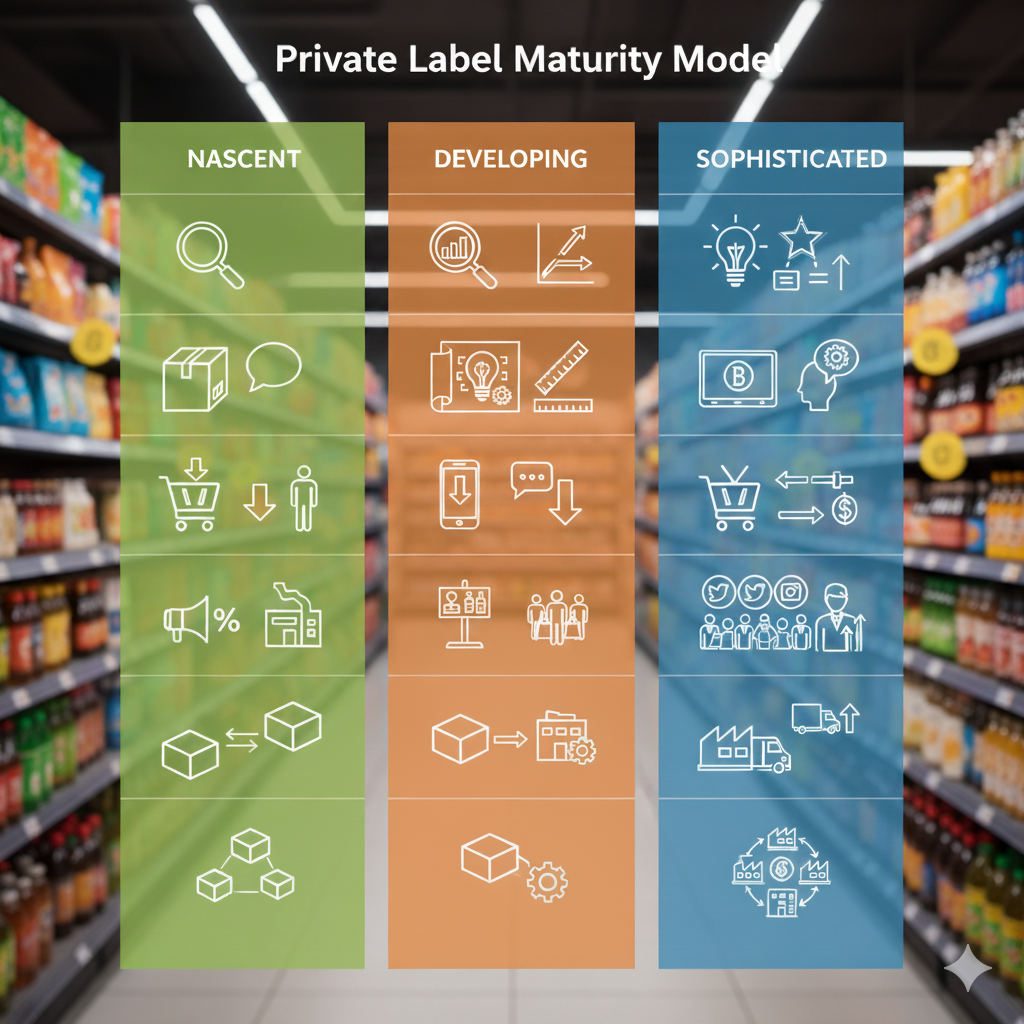
Third Eyesight has evolved a Private Label Maturity Model (see the accompanying graphic) that can help retailers think through their approach to private label, whether their product offering is dominated by private label, or whether they have only just begun considering the possibility of including private label in their product range. The model sketches out a maturity path on five parameters that are affected by or influence the strength of a retailer’s private label offering:
In some cases, retailers may have multiple labels, some of which may be quite nascent while others might be highly evolved, clear and comparable to a national brand. This could be by default, because the labels have been launched at different times and have had more or less time to evolve. However, this can also be used as a conscious strategy to target various segments and competitive brands differently, depending on the strength of the competition and their relationship with the consumer.
The interesting thing is that size and scale do not offer any specific advantage to becoming a more sophisticated private label player. Some extremely large retailers continue to follow a discounted-price “me-too” private label strategy where even the packaging and colours of the product are copied from national brands, while much smaller players demonstrate capabilities to understand their specific consumers’ needs to design, source and promote proprietary products that compare with the best brands in the market.
For a moment, let’s also look at private labels from the suppliers’ point of view. As far as we can see, private label seems to be here to stay and grow. Suppliers can treat private labels as a threat, and figure out how to ensure that they retain a certain visibility and relationship with the consumer. On the other hand, interestingly, some suppliers are also looking at private label as an opportunity. They see the growth of private label as inevitable, and would much rather collaborate in the retailer’s private label development efforts. This way they can maintain some kind of influence on the product development, possibly avoid direct head-on conflict with their own star branded products and, if everything else fails, at least grab a share of the market that would have otherwise gone over to generic suppliers.
If you are retailer, I would suggest using the Private Label Maturity Model to clarify where you want to position yourself, and continue to use it as a guide as you develop and deliver your private label offering.
If you are a supplier concerned about private label, my suggestion would be to gauge how developed your customer is and is likely to become, and ensure that you are at least in step, if not a step ahead.
Of course, if you need support, we’ll only be too happy to help! (Contact Third Eyesight to discuss your private label needs.)
Devangshu Dutta
October 23, 2009
Trade, of course, has been global for millennia, so it seemed hardly unusual for retailers in the US, and in Europe to begin sourcing from distant countries in Asia where certain items were more readily available or significantly cheaper. Imports have also been encouraged as a political and developmental vehicle to aid friendly countries.
So, on the sourcing-end, large retailers have been comfortably operating beyond international borders for several decades even while the stores-end of their business was entirely domestic.
For most large modern retailers however, after the post-Second World War economic boom their core markets have grown relatively slowly (and rather predictably). While the sheer size of the US market kept American retailers busy domestically, planning and legal restrictions in terms of store size, locations, market share etc. limited manoeuvrability for retailers in Europe.
Among the current major retailers, the early retail explorer, Carrefour set out into neighbouring Spain in 1973 and then into distant Brazil in 1975. Soon after, Dutch retailer Ahold landed in the USA in 1977.
However, it took the opening up of East European economies in the 1990s to really prime the pump for growth of international retail. Suddenly, many more millions of consumers became available to European retailers close to their existing markets – both geographically and culturally – and western European retailers jumped at the opportunity.
At the same time, China seemed to have become steadily more open over the previous decade and in the early-1990s India looked accessible again. Some of the Latin American markets were also steaming up.
And, obviously, the prospect of 3-4 billion new consumers in emerging or developing markets was clearly not going to be ignored. In 2001, post dot-com, another inspiring idea hit the business world that was desperately looking for hope – the golden BRICs – the four countries focussed upon by Goldman Sachs as the biggest economies of the future: Brazil, Russia, India and China.
As incomes grew in these “developing” or “emerging markets”, the hypothesis was that consumer would want products and services similar to those in the more developed markets, creating the opportunity for retailers to cross borders. In the last 15 years or so, retail internationalization (and gradually “globalization”) has become an increasingly acceptable theme – in conceptual thinking, in retail boardrooms, in white papers, and finally in trade and mainstream media. The world has witnessed a network of retail subsidiaries, joint-ventures, franchise and other relationships spreading across continents.
Certainly, through the 1990s and 2000s, growing tele-connectivity, fashion, portable TV programming concepts, movies and print media seemed to give the impression that consumers around the world are becoming more similar, and can be reached by common formats and brands. Led by the FMCG companies on the one hand and fashion brands on the other, insights, concepts, products, formats, advertising campaigns are routinely extended across countries. (Unilever’s TV commercial for Close-Up in West Asia is a great example of this – an Anglo-Dutch company’s international brand of toothpaste, Indian models in Thailand, an Arabic voiceover and a Hindi song (“Paas Aao” – “Come Closer”) by Sona Mohapatra – surely you don’t get more global than that?)
But wait! Is the picture really as clear as that?
In 2006 Wal-Mart pulled the plug on its €2 billion German business that was a combination of German chains that it had acquired. In Russia it still has only a development presence since 2005, though it is reported to be looking at opening 10-15 stores in the following three years. According to Newsweek, Wal-Mart’s 13 year old Chinese business – even after an acquisition that is still to be approved – will have fewer stores than it would have opened in the US just in 2009. In the past it has struggled in Japan and Brazil.
In June 2009, Carrefour opened its first 86,000 sq. ft. hypermarket in Moscow, and a second one soon after that. In September, the company affirmed that the BRIC markets were its highest priority for international growth. However, in October it announced that it was pulling out of Russia. Within 4 months of the first store, Russia has gone from a market with “outstanding long term potential” to being a market to exit. In previous years the company has moved out of Japan, South Korea and Mexico. The Economist reports that significant Carrefour’s shareholders are forcing it to look at selling its Chinese business as well – obviously a move that would be politically very sensitive in China. The same shareholders are also reported to be urging a sale of its Latin American business. For now, the official statement from the company maintains an ongoing interest in all these markets.
Ikea has decided to freeze further investments in Russia, and has decided not to enter India until the Indian government allows 100 per cent foreign ownership of retail operations. It entered China in 1998, and has only 7 stores so far.
Even as Carrefour and Ikea announce plans to pull out of Russia, Russian retailers have pulled out from Ukraine, while Metro is cautious in its outlook about that country. French retailer Auchan has opened three stores in Ukraine since 2007, while the German retailer Rewe has opened all of nine since 2000.
Could the juggernaut of global retail be slowing, stopping or even – shock! – reversing? Are the BRICs and emerging markets falling out of favour?
Before we jump to conclusions, as they say in the television world: please don’t adjust your sets. As the French author Karr wrote: “plus ça change, plus c’est la même chose” (the more things change, the more they are the same).
It is a fact that, no matter how international or global a company becomes, when it gets to the business of retail, it needs to be intensely local. While elements of the business – concepts, products, people, money – can travel across borders, it is extremely difficult to take across an intact retail mix and expect to address a significant portion of the population in the new country. And given how important scale is to mass retailers, lack of localization would be a significant hurdle.
A company sourcing products from a developing country can fully expect his suppliers to adapt to his practices and customs. On the other hand, the same company entering that country as a retailer needs to do exactly that – adapt to the customers – rather than expecting them to fall in line because the “best practice” manual dictates certain processes or because central merchandising found some deals that were great for the home market which are totally irrelevant in the new market.
However, there are encouraging signs that retailers looking to grow internationally understand this more and more. Tesco, for one, has been following a localized approach in Thailand and South Korea, while Carrefour, Ikea, Wal-Mart have all steadily modified their approach in China and other markets. Wal-Mart’s cautious steps in India, including the stores opened by its joint-venture partner Bharti, are a complete contrast to the aggressive “plans” that were being reported in the press 2006-onwards. Recently Wal-Mart’s international chief C. Douglas McMillon was quoted by BusinessWeek as saying “we know you can’t run the world from one place”.
For the larger international retailers this means that, the benefits from international scale would be limited by the amount of localization that they carry out in their operations. For smaller and local competitors that are based in an emerging market this means a fighting chance to remain in business and even remain market leaders.
Lastly, as far as all the dark clouds gathered over international retailing and all the retreats being announced – stay tuned – this weather will change, too.

