
admin
March 25, 2020

T. Surendar, The Morning Context
25 March 2020
Standing on the porch of the Grand Hyatt Hotel in Mumbai suburbs, Diwakar Vaish, co-founder of Noida-based AgVa Healthcare, was trying to catch the attention of software industry executives. This is at the annual conference hosted by IT trade body Nasscom. Vaish’s stall was a side-show for startups to exhibit digital technologies in the healthcare sector.
On a cool, breezy February day, the atmosphere was nothing as grim you would expect in a hospital emergency ward. Vaish’s rig, comprising an iPad-like device on a short steel column mounted on wheels with dangling wires, was a cost-effective version of a ventilator used in critical care. There wasn’t much excitement about his solution, as few executives really understood the medical problem he aimed to solve.
Today, a robotic engineer by training, Vaish is super busy.
It is not easy to get him on the phone, as AgVa’s ventilator is suddenly in demand from all parts of the country. The company is running three shifts fulfilling orders, which have been pouring in since it became apparent that Indian hospitals did not have enough ventilators for patients rendered ill by the novel coronavirus.
Unwittingly, the need for ventilators has once again drawn attention to India’s medical devices industry or the lack of it. So much so that Anand Mahindra, chairman of the $17 billion Mahindra group, which has interests in automobiles, software and resorts, said that he was finding ways to manufacture ventilators in his factories. It isn’t easy putting together a ventilator, not when you are racing against time, but Mahindra is a hardy businessman with deep pockets, and maybe, just maybe, he will succeed.
In many ways, the Indian medical devices industry is an anomaly. India has a space programme, a nuclear programme, it is among the few countries that has developed patented medicines and a low cost version of anything from power turbines to trucks but when it comes to medical equipment, it fares poorly.
India is also the biggest supplier of FDA-approved drugs to the US, the biggest pharmaceutical market in the world. Even as the Indian market for medical equipment has grown at double-digit rates in the last five years to Rs 1 lakh crore, two-thirds of its needs are met by foreign companies such as Philips, GE Healthcare, Siemens and Abbott.
Import domination is all pervasive extending to even non-critical but common equipment like sonography machines, dentistry chairs and diagnostic equipment. Less than five Indian companies had revenue of more than Rs 500 crore a year and 90% were classified as small scale, with annual revenue less than Rs 10 crore. The biggest player in the domestic market is the Rs 1,300 crore Mumbai-based Transasia Bio-Medicals, which makes in vitro diagnostic solutions that are exported to Western markets too.
“For a long time, the government was the biggest buyer of medical equipment and they always preferred imported equipment. That meant that it was not lucrative for local entrepreneurs to invest their capital in the sector,” says G.S.K. Velu, managing director of Trivitron Healthcare, which makes and exports imaging equipment.
The proliferation of private hospitals in the last two decades also did not change things much. With well-entrenched foreign players and a liberal import duty structure to make available the best facilities in India, there were few local companies of scale who could invest big money to fend off competition. AgVa’s ventilators were priced at a fifth of the ones sold by the foreign competitors, yet it couldn’t make inroads into big hospitals. “It’s almost as if our cost was our barrier to sell. Being critical equipment, customers had a lot of inertia to even place test orders,” says Vaish.
Thanks to meagre domestic manufacturing. India also could not set standards of equipment specifications to suit the local needs. It had to tweak its own equipment standards to fall in line with those of foreign manufacturers. For example, in the US, defibrillators used to restore heartbeats by giving shock to patients had to last at least two shock cycles. But, in India, since access to hospitals and medical care was not as easy. patients arrive long after they have suffered heart attacks and Indian doctors use defibrillators for even 10 cycles at a time.
The local standards did not specify this need and as a result many imported defibrillators were not of much use in Indian conditions. “We still don’t have an act to regulate medical devices and it falls under the drugs category. Everything is still borrowed from the West,” says Aniruddha Atre, co-founder and director of Pune-based Jeevtronics Pvt. Ltd, which makes the world’s first hand-cranked defibrillator.
Trivitron’s Velu says that the share of locally produced medical equipment will increase within the next decade. This will be a combination of help from the government which will enforce more domestic manufacturing by overseas firms and increased entrepreneurship.
There is also a view that more global manufacturing will come to India, as firms de-risk their strategy of manufacturing everything in China. “In the past, when labour costs went up in the Chinese west coast, Indian garment companies were beneficiaries of increased orders even though other countries like Bangladesh and Vietnam too got a big share of it. The availability of labour and ability to scale up operations is something global players look for and to that extent India will always be an important outsourcing destination,” said Devangshu Dutta, managing partner at consultancy firm Third Eyesight.
The trend started even before the COVID-19 pandemic as companies in the US began to brace themselves for a trade war with China. For example, a US-based company has started sourcing Indian tyres at a 10-15% premium as it wants to diversify its risk from China. “India has witnessed a surge in mobile phone manufacturing. This is bound to increase the ecosystem in electronic manufacturing which in turn create ecosystems for industries like medical equipment,” says Sharad Verma, senior partner who oversees industrials at Boston Consulting Group.
The timing is also right for increase in local manufacturing, argues Verma. One of the important criteria for that is viable domestic consumption. It’s happened time and again in sectors like automobiles, mobile phones and more recently in manufacture of metro bogies after domestic consumption has reached a scale where it makes sense for companies to set up manufacturing facilities. “The industry is no longer small and the incidence of medical technology will only go up from here making it viable for even foreign companies to look at a manufacturing set up in India,” says Verma.
It will be interesting to see how it all plays out. The sector, so far, hasn’t seen much by way of private equity or venture investment. The most prominent one was an investment by a Morgan Stanley fund and Samara Capital in Surat-based Sahajanand Medical Technologies and Fidelity Growth Partners’s investment in Trivitron. But starting 2014, a government fund run by the Biotechnology Industry Research Assistance Council-incubated several companies who are slowly bringing their products to market. As some of these products hit home, especially in the wake of COVID-19, the action is definitely bound to pick up.
(published in The Morning Context)
admin
October 7, 2019
Indian tea brands want a piece of this steaming hot business.
Written By Devika Singh

The company now plans to expand to the North Indian cities of Gurugram, Chandigarh, Amritsar and Lucknow, among others.
Homegrown tea makers are foraying into quick-service restaurants (QSRs) to tap into the ‘eating out’ culture in India and grow the business. But competition is aplenty — global brands have a formidable presence in India’s QSR scene, even as start-up brands such as Chai Point and Chaayos are gaining traction. According to a report by CARE Ratings, the total market size of QSRs in India is approximately Rs 25,900 crore. The overall restaurant and food service industry is expected to grow at a CAGR of 10.4% between 2018 and 2020.
Indian tea brands want a piece of this steaming hot business. Society Tea, a brand predominantly present in Maharashtra, recently opened its first tea café in Mumbai. Goodricke Group has tied up with the Tea Board of India to launch tea lounges in Mumbai and Kolkata on the latter’s premises. Gujarat-based Wagh Bakri, which was among the first movers, plans to expand its tea lounge presence to 50 large and small format outlets, from the current 13, over the next four years.
What’s brewing?
When Wagh Bakri opened its first tea lounge in Ahmedabad in 2007, the company saw it only as another experiential marketing tool. “Initially, it was a place where people could explore different kinds of tea. But, over the years, we saw a demand for these lounges,” says Parag Desai, executive director, Wagh Bakri Tea Group. The company claims to receive a footfall of 300-400 people per day on an average in stores present in high-street locations.
“We have deliberately stepped out of food courts to keep our offering premium,” Desai adds. A Wagh Bakri tea lounge could entail an investment of Rs 50-75 lakh. The company now plans to expand to the North Indian cities of Gurugram, Chandigarh, Amritsar and Lucknow, among others.
Society Tea, meanwhile, plans to open 10 more stores — mid-size stores around corporate offices — in Maharashtra. Pricing will be its key differentiator. “We are not pricing the product at Rs 300 like other players, but offering a full glass of chai at Rs 50,” says Karan Shah, director, Society Tea.
Goodricke Group has five operational tea lounges in the country, with plans to open one more, its second, in Darjeeling by the year end. The aim is to first foster brand awareness via its presence in locations of high tourist interest.
Blending in
Is a QSR foray really their cup of tea?
According to Devangshu Dutta, chief executive, Third Eyesight, each player could be backed by a different motivation to enter this space. Some may want to use it purely as a marketing tool, while some others may look at it as an alternative source of revenue.
QSRs can be an effective marketing tool especially for brands that have limited access to customers through retail. “Such stores help increase visibility and offer insights about their customers, their spending patterns, etc,” says Pinakiranjan Mishra, partner and leader, consumer products and retail, EY India.
However, expanding footprint in the market and eyeing revenue from the QSR chain could entail substantial investments for tea brands. “If tea companies look at QSRs as an additional business stream, then besides tea, there are food items and cold beverages to be served, which cannot be sourced just from the gardens,” says Dutta.
Furthermore, it will be an uphill task in the presence of biggies Starbucks, Café Coffee Day and Costa Coffee, that are established names in the market, in addition to other upstarts like Chaayos, which has over 50 cafés across Delhi-NCR, Mumbai and Chandigarh, and Chai Point which has 100 cafés in eight cities.
To get an edge, Harsha Razdan, partner and head – life sciences and consumer markets, KPMG India, says that new entrants would have to go beyond metros “and should ensure competitive pricing as the market is price sensitive”.
Source: financialexpress
Devangshu Dutta
October 29, 2014
(The Hindu Businessline – cat.a.lyst got marketing experts from diverse industries to analyse consumer behaviour during the last one month and pick out valuable nuggets on how this could impact marketing and brands in the years to come. This piece was a contribution to this Deepavali special supplement.)

Two trends that stand out in my mind, having examined over two-and-a-half decades in the Indian consumer market, are the stretching or flattening out of the demand curve, or the emergence of multiple demand peaks during the year, and discount-led buying.
Secular demand
Once, sales of some products in 3-6 weeks of the year could exceed the demand for the rest of the year. However, as the number of higher income consumers has grown since the 1990s, consumers have started buying more round the year. While wardrobes may have been refreshed once a year around a significant festival earlier, now the consumer buys new clothing any time he or she feels the specific need for an upcoming social or professional occasion. Eating out or ordering in has a far greater share of meals than ever before. Gadgets are being launched and lapped up throughout the year. Alongside, expanding retail businesses are creating demand at off-peak times, whether it is by inventing new shopping occasions such as Republic Day and Independence Day sales, or by creating promotions linked to entertainment events such as movie launches.
While demand is being created more “secularly” through the year, over the last few years intensified competition has also led to discounting emerging as a primary competitive strategy. The Indian consumer is understood by marketers to be a “value seeker”, and the lazy ones translate this into a strategy to deliver the “lowest price”. This has been stretched to the extent that, for some brands, merchandise sold under discount one way or the other can account for as much as 70-80 per cent of their annual sales.
Hyper-opportunity
This Diwali has brought the fusion of these two trends. Traditional retailers on one side, venture-steroid funded e-tailers on the other, brands looking at maximising the sales opportunity in an otherwise slow market, and in the centre stands created the new consumer who is driven by hyper-opportunism rather than by need or by festive spirit. A consumer who is learning that there is always a better deal available, whether you need to negotiate or simply wait awhile.
This Diwali, this hyper-opportunistic customer did not just walk into the neighbourhood durables store to haggle and buy the flat-screen TV, but compared costs with the online marketplaces that were splashing zillions worth of advertising everywhere. And then bought the TV from the “lowest bidder”. Or didn’t – and is still waiting for a better offer. The hyper-opportunistic customer was not shy in negotiating discounts with the retailer when buying fashion – so what if the store had “fixed” prices displayed!
This Diwali’s hyper-opportunism may well have scarred the Indian consumer market now for the near future. A discount-driven race to the bottom in which there is no winner, eventually not even the consumer. It is driven only by one factor – who has the most money to sacrifice on discounts. It is destroys choice – true choice – that should be based on product and service attributes that offer a variety of customers an even larger variety of benefits. It remains to be seen whether there will be marketers who can take the less trodden, less opportunistic path. I hope there will be marketers who will dare to look beyond discounts, and help to create a truly vibrant marketplace that is not defined by opportunistic deals alone.
Devangshu Dutta
October 12, 2013

Much has been written about the various relationship break-downs that have happened in the Indian retail sector in recent years. The biggest, most recent high profile ones are between Bharti and Wal-Mart and the three-way conflict playing out at McDonald’s. Other visible ones include Aigner, Armani, Jimmy Choo, and Etam, while Woolworth’s faded away more quietly because, rather than being present as a retail brand, it was mainly involved in back-end operations with the Tata Group.
I think it’s important to frame the larger context for these relationship upsets. Most international companies, non-Indian observers as well as many Indian professionals are quick to blame the investment regulations as being too restrictive, and being the main reason for non-viability of participation of international brands in the Indian consumer sector.
However, India with its retail FDI regulations is not the only environment where companies form partnerships, nor is it the only one where partnerships break up. Regulations are only one part of the story, although they may play a very large role in specific instances. In most cases, FDI regulations are like the mother-in-law in a fraying marriage: a quick, convenient scapegoat on which to pin blame.
Many of the reasons for breaking up of partnerships can be found in the reasons for which they were set up the first place. The main thing to keep in mind is that the break-down is inevitably due to the changes that have happened between the conception of the partnership to the time of the split. The changes can fall into the following categories, and in most cases the reasons behind the break are a combination of these:
According to Third Eyesight’s estimates, more than 300 international brands are currently operating in the Indian retail sector across product categories, if we just count those that have branded stores, shop-in-shop or a distinct brand presence in some form, not the ones that merely have availability through agents or distributors.
Of these, about 20 per cent operate alone, while other others work with Indian partners, either in a joint-venture or through a licensing or franchise arrangement. The relationships that have broken up in the last decade are only about 5 per cent of the total brands that have come in, and in many cases the international brand has stayed in the market by finding a new partner.
So there’s life after death, after all. And my advice to those who’re feeling particularly defensive or pessimistic because of a few corporate break-ups: take time for a song break. Fleetwood Mac (“Don’t Stop”, “Go your own way”) or Bob Dylan (“Don’t Think Twice, It’s All Right”) are good choices!
admin
January 21, 2013
By Tarang Gautam Saxena & Devangshu Dutta
Since the onset of reopening of India’s economy in the late 1980s, fashion is one consumer sector that has drawn the largest number of global brands and retailers. Notwithstanding the country’s own rich heritage in textiles the market has looked up to the West for inspiration. This may be partly attributable to colonial linkages from earlier times, as well as to the pre-liberalisation years when it was fashionable to have friends and relatives overseas bring back desirable international brands when there were no equivalent Indian counterparts. Even today international fashion brands, particularly those from the USA, Europe or another Western economy, are perceived to be superior in terms of design, product quality and variety.
International brands that have been drawn to India by its large “willing and able to spend” consumer base and the rapidly growing economy have benefitted in attaining quick acceptance in the Indian market and given their high desirability meter, most international brands have positioned themselves at the premium-end of the market, even if that is not the case in the home markets. In addition, Indian companies – manufacturers or retailers – have been more than ready to act as platforms for launching these brands in the market and today there are over 200 international fashion brands in the Indian market for clothing, footwear and accessories alone, and their numbers are still growing.
Global Fashion Brands – Destination India
Europe’s luxury brands have had a long history with India’s princely past, but modern India tickled the interest of international fashion brands in the 1980s when it set on the path of liberalisation. The pioneering companies during this stage were Coats Viyella, Benetton and VF Corporation. At the time the Indian apparel market was still fragmented, with multiple local and regional labels and very few national brands. Ready-to-wear apparel was prevalent primarily for the menswear segment and was the logical target for many international fashion brands (such as Louis Philippe, Arrow, Allen Solly, Lacoste, Adidas and Nike). (Addendum: The rights to Louis Philippe, Van Heusen and Allen Solly in India and a few other markets were sold after several years to the Indian conglomerate, Aditya Birla Group, as part of the Madura Garments business.)
The rapidly growing media sector also helped the international brands in gaining visibility and establishing brand equity in the Indian market more quickly. However, this period did not see a huge rush of international brands into India. West Asia and East Asia (countries such as Japan, South Korea, Taiwan and even Thailand) were seen as more attractive due to higher incomes and better infrastructure. In the mid-1990s there was a brief upward bump in international fashion brands entering the Indian market, but by and large it was a slow and steady upward trend.
The late-1990s marked a significant milestone in the growth of modern retail in India. Higher disposable incomes and the availability of credit significantly enhanced the consumers’ buying power. Growth in good-quality retail real estate and large format department stores also allowed companies to create a more complete brand experience through exclusive brand stores in shopping centres and shop-in-shops in department stores.
By the mid-2000s, however, a very distinct shift became visible. By this time India had demonstrated itself to be an economy that showed a very large, long-term potential and, at least for some brands, the short to mid-term prospects had also begun to look good.
While India was a promising market to many international brands, it was not completely immune to the global economic flu. More than its primary impact on the economy, it sobered the mood in the consumer market. Even the core target group for international brands tightened the purse strings and either down-traded or postponed their purchases.
In 2008, in the midst of economic downturn, scepticism and uncertainty, international fashion brands continued to enter India at nearly the same momentum as the previous year. Many international brands such as Cartier, Giorgio Armani, Kenzo and Prada entered India in 2008, targeting the luxury or premium segment. However, given the high import duties and high real estate costs, the products ended up being priced significantly higher than in other markets. Many brands ended up discounting the goods heavily to promote sales, while a few gave up and closed shop.
The year 2009 saw the true impact of the slowdown as fewer international brands were launched during the year. The brands that launched in 2009 included Beverly Hills Polo Club, Fruit of the Loom, Izod, Polo U.S., Mustang, Tie Rack, Donna Karan/DKNY and Timberland amongst others. Some of these had already been in the pipeline for quite some time and had invested considerable time and effort in understanding the dynamics of the Indian retail market, scouting for appropriate partners, building distribution relationships and tying up for retail space, setting up the supply chain and, most importantly, getting their operational team in place.
2010 was better in comparison: although initially slow, the growth of new international brands entering the Indian market in 2010 bounced back later during the year, and some brands that had exited the Indian market earlier also made a comeback. Amongst the new launches, a highlight of the year was the launch of the most awaited and discussed-about Spanish brand Zara. The first store was launched in Delhi to an absolutely phenomenal response, followed by a store in Mumbai, and a third again in Delhi. The Italian value fashion brand, OVS Industry, was launched in 2010 by Oviesse through a joint-venture with Brandhouse Retail from the SKNL group. While in its first year products were imported from Italy, the company had mentioned that it intended to bring in the merchandise directly from the supply source for speed and cost effectiveness, to achieve aggressive growth over the following five years.
2010 indicated a fresh round of optimism as the pace of new brands entering the market picked up, and those already present in the market showing signs that they were adapting their strategies to grow their India business, including lowering prices and entering new segments.
Though the number of new brands entering the Indian shores in 2011 and 2012 may not have matched the numbers in the peak years, both years have been healthy and the list of new brands ready to enter in 2013 already seems promising.
Amongst others, 2011 saw the entry of Australian brands such as Roxy and Quiksilver having tied up with Reliance Brands for distribution. The largest British football club and lifestyle brand Manchester United, signed up with Indus-League Clothing Ltd. to bring the fashion products to India, after having launched café bars in India in 2010 through a franchisee.
2012 brought in luxury brands such as Christian Louboutin, Roberto Cavalli and Thomas Pink, womenswear brands such as Elle, Monsoon and fashion accessories brands such as Claire’s.
Routes to Market – The Evolution
The choice for entry strategy for the fashion brands has evolved over the years. During the initial years licensing was the preferable route for international brands that were testing the market. This shifted to franchising as import duties dropped and brands looked at exerting more control on the product and the supply chain. More recently, brands seem to be opting for some degree of ownership, as they begin to take a long-term view of the market.
In the 1980s and the early 1990s, licensing was a popular entry strategy amongst the global fashion brands, with minimal involvement in the Indian business.

In the mid-1990s a few companies such as Levi Strauss set up wholly owned subsidiaries while others such as Adidas and Reebok entered into majority-owned joint ventures. This helped them to gain a greater control over their Indian operations, sourcing and supply chain, and brand. In the subsequent years import duties for fashion products successively came down making imports a less expensive sourcing option and the realty boom brought in many investors in retail real estate who became franchisees for the international brands. By 2003, franchising became the preferred launch vehicle for an increasing number of international companies, while only a few chose to enter through licensing.
In 2006 the Government of India reopened retail to foreign investment (allowing up to 51 per cent foreign direct investment in single-brand retail). Using this route, many brands have entered India by setting up majority-owned joint ventures, or moving their existing franchise relationships into a joint venture structure. By the end of 2008, more than 40 per cent of the international brands were present through a franchise or distribution relationship, while more than 25 per cent had either a wholly-owned or majority-owned subsidiary. All these structures allowed the brands to have greater control of operations, particularly of the product.
Amongst the international brands that entered the Indian market, a few were on their second or even third attempt at the market. For instance, Diesel BV initially signed a joint venture agreement in 2007 with Arvind Mills. However, by the middle of 2008, the relationship ended with mutual consent, as Arvind reduced its emphasis at the time on retailing international brands within the country. Within a few months of ending this relationship, Diesel signed a joint venture with Reliance Brands as the iconic denim brand wanted to take on the Indian market full throttle and the Indian counterpart had indicated that it wanted to rapidly build its portfolio of Indian and foreign brands in the premium to luxury segments across apparel, footwear and lifestyle segments.
Similarly, Miss Sixty entered India in 2007 through a franchisee agreement with Indus Clothing. It switched to a joint venture with Reliance Brands in the same year but the partnership was called off in 2008. Miss Sixty finally entered India through a franchisee agreement with a manufacturer of women’s footwear and accessories.
During the turbulence of 2008 and 2009, a few brands also moved out of the market. Some of them were possibly due to misplaced expectations initially about the size of the market or about the pace of change in consumer buying habits. Others were due to a failure either on the part of the brand or its Indian partners (or both), to fully understand what needed to be done to be successful in the Indian market. Whatever the reason, the principals or their partners in the country decided that the business was under-performing against expectations for the amount of effort and money being invested, and that it was better to pull the plug. Amongst the brands that exited the market during 2008 and 2009 were Gas, Springfield and VNC (Vincci).
In the last few years as the foreign direct investment rules are being softened in particular with regard to the more flexibility in the 30% domestic sourcing and clarification on brand ownership norm there is an increasing preference for international companies to enter the India market with some form of ownership while those that are already in the market are looking to increase their stakes in the business.
Several brands have taken the plunge into investing in the Indian operations and moved more aggressively into the market. Since the year 2009, international brands increasingly opted for joint-ventures as the choice for entry into the market. Even the brands already present started looking to modify the nature of their presence in India in order to exert more control over the retail operations, products, supply chain and marketing. Brands that changed their operating structures and, in some cases partners, include VF (Wrangler, Lee etc.), Lee Cooper, Lee, Louis Vuitton, Gucci, Burberry amongst others. Mothercare, the baby product retailer, which was initially present through a franchise agreement with Shoppers Stop, formed a joint venture with DLF Brands Ltd to enable the expansion through stand-alone stores.
During 2011, Promod changed its franchise arrangement with Major Brands into a joint-venture that is majority-owned by Promod. From its launch in 2005, the brand has opened 9 stores so far. However with the new joint venture in place, the international brand is reported to be looking at opening 40 stores in the next four years with the hope of increasing the contribution of India business to its global revenue to the extent of 15-20% from a mere 3% at present.
After its partnership with Raymond fell through in 2007 and all of its standalone stores were shut down, Gas (Grotto SpA) scouted around for an appropriate partner for India business. Eventually, the brand set up a wholly owned subsidiary in 2010 for wholesale operation while retail stores were franchised. In 2012 the company formed an equal joint venture partnership with Reliance Brands with plans to ramp up India retail presence.
2012 was a defining year marking the government’s decision to allow 100% foreign direct investment in single brand retail business and permitting multi-brand retail in India. Not only has this encouraged new brands to consider the Indian market but many existing brands have started reviewing their existing operating structures and alliances, and have initiated moves towards greater ownership and a stronger foothold in the Indian market. Some of the brands have taken the decision to step into an ownership position in India as they felt that India was too strategic a market to be “delegated” entirely to a partner (whether licensee or franchisee), or that an Indian partner alone might not be able to do justice to the brand in terms of management effort and financial capital.
S. Oliver restructured its India operations in 2012 by exiting its prior relationship with the apparel exporter Orient Craft and tied up with a new partner through a majority joint venture. To gain a larger share in the Indian market the company has repositioning the brand, changed its sourcing strategy, reduced the entry-level prices by 40% while reducing the store size (from 5,000 sq. ft. to 1,200-2,400 sq. ft.). It has also put in place an aggressive expansion strategy for tier II towns. The change in FDI norms towards the end of last year may cause it to review its position further.
Canali has entered into a majority-owned joint-venture with its existing partner Genesis Luxury. The brand had entered in India in 2004 through a distribution agreement. Through this change the international brand plans to grow its presence in India multi-fold by opening 10-15 stores over the next three-four years.
Pavers England is the first international brand to have applied for and been granted the permission to own and operate its retail business in India through a 100 per cent subsidiary owned by a UK based company. Newcomers such as H&M and Loro Piana are reportedly considering the joint venture route.
As we have already mentioned in one of our earlier papers (“Tapping into the India Gold Rush”) we do not expect a dramatic short-term growth in the number of international brands following the retail FDI relaxation in September 2012. However, at that time we did foresee some changes in the operating structures for the single brand ventures already active in the market, as well as entry of new brands that have been holding back so far as they wanted greater control in their India retail business and this seems to be happening already.
In the luxury sector, 51 percent FDI and distribution relationships are likely to continue to be a norm, since it is virtually impossible for most luxury companies to meet the 30 percent domestic sourcing requirement in its true spirit. In many cases, the local partner in a joint venture is a mere placeholder until FDI rules are liberalised further and, unless the business grows significantly, most brands will be content to keep the existing structures in place.
In the other segments some more relationships could be reconstituted during 2013, taking the international brand at least a step closer to gaining greater control, even if their partners remain the same.
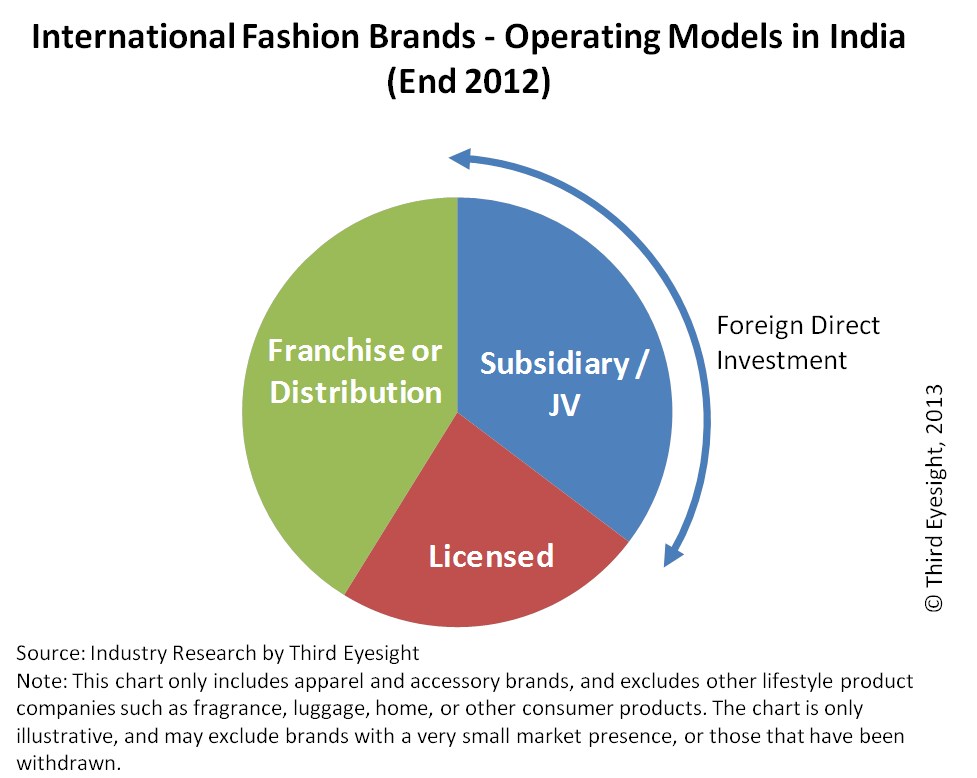
Franchising is still the more common form of route to market for most single brand retail companies although for many international companies an eventual ownership in India business may be desirable. However, licensing should not be excluded from the choice set, especially for companies that are multi-brand retail concepts such as Sephora or those that manage to find a suitable Indian partner that can provide end-to-end support from product sourcing to distribution and retail (for example, the relationship between Elle and Arvind).
Today two thirds of the international fashion brands come from three countries the U.S.A., Italy and the U.K. with nearly 30 per cent originating from the U.S.A. alone.

Is This A Lucky 13?
The theme for the year 2013 is positive for most brands, although still cautious.
Amongst the international brands that one can look forward to shopping in 2013 are “Uniqlo” of Fast Retailing, Japan’s largest apparel retailer, Sweden’s H&M, Emilio Pucci and Billabong. But India is not merely a destination anymore for the international brands to grow their business. The country is also increasingly becoming the innovation-platform or testing ground for new concepts and trends. World Co. a Japanese retailer with more than 3,000 stores in Japan and 200 stores in other parts of Asia is also test-marketing women’s apparel and accessories brands such as Couture Brooch, Opaque.clip, zoc, Tk Mixpie and Hot Beat to gain insights into consumers’ psyche. Italian brand United Colors of Benetton has recently introduced a global retail interior design concept which is present in major European cities but is the first-of-its-kind store in Asia and may well set the trend for the rest of Asia.
Gucci recently opened its largest store in India recently Delhi-NCR after two failed joint ventures. All of its five stores are now run directly by the company and the Indian business also reported to have turned profitable this year.
Brands such as Mango who have chosen the franchise route are tying up with additional partners (e.g. DLF) in the hope of making the Indian business contribute significantly to the overall revenue of the company.
UK-based apparel chain Marks & Spencer is accelerating its expansion in India with plans to add ten stores in the next six to eight months in the country. The company has identified India as one of the key markets to become the world’s most sustainable retailer by 2015. It plans to increase the number of stores in India from 24 currently to over 30 through the 51:49 joint venture with Reliance Retail.
Puma SE, the global sports lifestyle company for athletic shoes, footwear, and other sports-wear aggressively set out to gain 30 per cent of the Indian organised retail sportswear market within a year, from a share of 18-20 per cent in the top four branded sportswear segments in 2011. To this end the company targeted opening nearly 100 more stores during 2012. While the actual numbers are reportedly short of target, the brand has been opening amongst the largest stores during the year.
The confidence in the India opportunity is rising again, with existing global brands expecting the contribution from India business to grow multi-fold in a few years. However, the approach is of careful consideration and brands realise that India is a unique market, different not only from the West but also from other Asian economies such as China. Rather than adopting a “cut-and-paste” approach one needs to seriously consider the appropriate business model for India. Many of the global players have had to create a different positioning from their home markets. Some have significantly corrected pricing and fine-tuned the product offering since they first launched; these include The Body Shop and Marks & Spencer. Others are unearthing new segments to grow into; for instance, Puma and Lacoste are now seriously targeting womenswear as a growth market.
It is not only international brands that are more optimistic. Indian partners are also reviewing their approach. For instance, the Arvind Group that had looked at reducing its emphasis on international fashion brands in 2007-08 has recently acquired the business operations of Planet Retail which operated the franchises of British fashion retailers Debenhams and Next, and American lifestyle brand Nautica in India. The company termed Debenhams’ franchise as a significant acquisition as it provided an entry into the department store segment. Arvind plans to increase the India presence of Debenhams from 2 stores to 8 over the next three years. It also plants to grow the network of Next, the large-format speciality stores, from 3 to 12 in the same period.
As customer footfall and conversions pick up, international brands are also shoring up their foundations for future expansion in terms of better processes and systems, closer understanding of the market, and nurturing talent within their team. Third Eyesight’s study of the market highlights international brands’ concerns with ensuring a consistent brand message, improved organisational capabilities right down to front-line staff, and focussing on unit productivity (per store and per employee).
India shows signs of a healthier business outlook for International brands but the game has just begun and with competition getting tougher, we can expect interesting times ahead.
