
admin
September 1, 2026
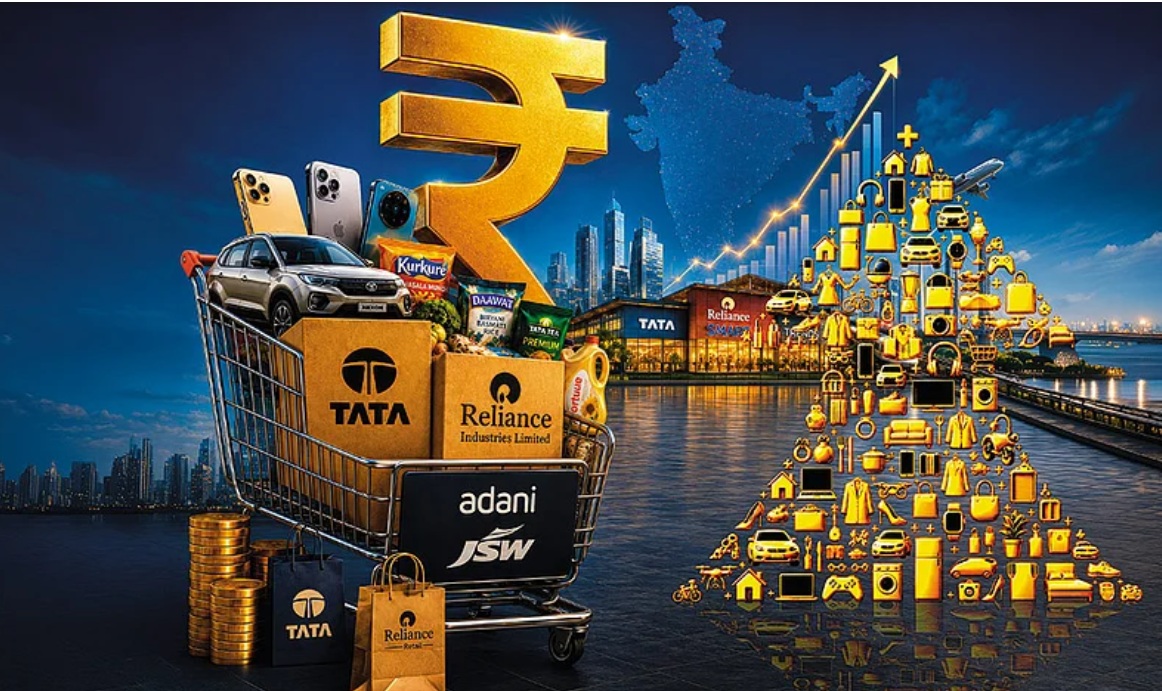
Vikash Tripathi, Outlook Business
1 September 2026
Eight decades ago, the ‘nationalist businessman’ GD Birla helped prepare the ‘Bombay Plan’, which asked the state to pro-vide for the bare minimum needs of its people. His plan asked for 2,800 calories of well-balanced food per day, 30 yards of clothing per year and 100sq ft of housing per person.
Today, seventh-generation Aryaman Vikram Birla is betting on an entirely different opportunity: premium dining. “We continue to believe in the remarkable potential of the premium casual dining space, spurred by rising disposable income and evolving lifestyles,” the 29-year-old said after Aditya Birla New Age Hospitality acquired KA Hospitality in 2023.
The Birlas are not alone in trying to cash-in on rising prosperity in India. In the past five years alone, India’s top 10 industrial groups have announced new ventures in consumer-facing sectors or doubled down on existing ones. A rough tally of these investments crosses ₹4.8 lakh crore.
For decades, these same business houses built their dominance in core sectors like steel, power, aluminium, cement and chemicals, laying the industrial backbone of the economy. This helped the nation become a large producer of such goods and, in some cases, an exporter as well.
But as India’s economic conditions changed, so has the focus of its largest conglomerates.
For the likes of Tata, Aditya Birla, Bajaj and Bharti, that journey started way back. “What has changed in recent years is the speed and openness of the amount of capital being invested,” says Jitender Kumar, associate professor and programme chairperson, retail management programme at Birla Institute of Management Technology.
“It is not ‘opportunistic’ reasons, it’s structural reasons.”
Two factors seem to be driving the shift: the first is the arrival of an affluent consuming class that can buy branded and premium goods, and the second is the attraction of consumer businesses as a way to diversify revenue and, in some cases, improve the quality of earnings.
The Rise of Affluence
A couple of decades ago, if an Indian household had some extra cash, it often meant buying more of the same. Today, it increasingly means buying better. Even salt is being upgraded, from iodised to Himalayan pink or rock salt. The same shift is visible in bigger purchases: sports utility vehicles (SUVs) over hatchbacks, and ₹1cr-plus homes over budget flats.
But India isn’t simply consuming more. It is moving from basic consumption towards discretionary, branded and premium consumption. This boom is most clearly seen in the rapid expansion of the financial infrastructure that enables consumption. Formal retail credit penetration has more than doubled over the past decade, according to a TransUnion Cibil report, driven largely by personal loans, credit cards and consumer durable loans. Meanwhile, the government-backed Unified Payments Interface has untethered spending from the cash in a buyer’s wallet.
The signs show up across the broader consumption economy. Homes priced above ₹1cr accounted for 54% of total sales in 2025, up from just 30% in 2023—the market that decorative paints and home solutions are chasing.
Out of 4.7mn cars sold in the financial year 2025–26, SUVs accounted for more than half.
“The consumer market has grown substantially—not only through rising incomes but also the dramatic expansion of branded consumption across product verticals,” says Devangshu Dutta, founder of management-consulting firm Third Eyesight.
The bets are also getting more varied, from Reliance Retail tying up with global brands like Fenty and Skims to the Bharti Group bringing Olive Garden to India.
The Lure of Returns
For a passenger walking through an airport, the flight is only one part of the journey. There is coffee before boarding, food between flights, a lounge, retail outlets, parking and a host of other things to spend money on. For Adani Airports, those non-aero businesses are increasingly becoming the more lucrative part.
Its non-aero operations already generate about ₹2,500cr, with returns in the high-20% range, against roughly 12% from regulated aeronautical operations.
Jeet Adani, director of Adani Airport Holdings, expects the share of aeronautical revenue to fall to around 10% of total revenue, with non-aero becoming the bigger growth driver. The motivation can be seen as an escape from a return ceiling as much as a bet on rising affluence.
As Kumar puts it, consumer businesses help the conglomerates in two major ways. First, they help insulate them from volatile and often punishing commodity cycles, and second, they often offer far better returns with lower capital intensity and faster cash conversion.
Reliance Industries (RIL) shows how significant that shift can become. By 2025–26, its consumer-facing arms, Jio Platforms, Reliance Retail Ventures and Reliance Consumer Products, together contributed over 40% of group revenue and nearly 60% of operating profit.
And there is another advantage. “A small business, when it wants to build a new venture, faces constant margin pressure and often has to build its supply chain from scratch. A large conglomerate can leverage its existing scale, infrastructure and supply chain to enter a new business far more efficiently,” explains Kranthi Bathini, equity strategist at WealthMills Securities.
Different Strokes
In chasing consumers, some conglomerates are following the fastest-growing categories, while others are using their existing industrial capabilities to enter consumer-facing businesses. One is trying to build an entire ecosystem around it. But the lines between these approaches are not always clean.
Tatas is doing both: building entirely new consumer brands while also using the industrial ecosystem it has built over decades.
For Tatas, the consumer opportunity has largely been about following where spending is moving. Their consumer ventures have followed this arc longest. It began decades ago with Lakmé (1952), Tata Tea (1962) and Titan (1984). Tanishq and the expansion of Trent under brands such as Zudio are only the latest examples.
At Tata Consumer Products, once largely a staples business built around salt, tea and pulses, the focus has been shifting towards value-added foods and beverages, with ₹7,000cr spent on the acquisitions of Capital Foods and Organic India in 2024. Across companies such as Tata Digital, Indian Hotels, Air India and Tata Motors Passenger Vehicles, the group has announced close to ₹93,180cr in investment over the past five years.
Aditya Birla’s jewellery chain Indriya and its move into premium hospitality belong to the same category of ‘pull-based’ diversification.
JSW is taking a different route. It is taking its existing industrial strengths one step closer to the buyer. The group, which has traditionally been focused on areas such as steel, energy and cement, has expanded into consumer-facing areas such as auto, paints and home solutions.
It launched JSW Paints in 2019, and acquired a controlling stake in paintmaker AkzoNobel India for ₹8,986cr last year. Its strategy is to leverage an established network of contractors, dealers, architects and builders to reach consumers.
The same strategy can be seen in its push into autos, acquiring a 35% stake in the Indian unit of China’s MG Motor in 2024, leveraging synergies with its established steel business.
At Tatas, too, group companies like Tata Steel, Tata Power, Tata AutoComp, Tata Technologies and TCS are doing significant businesses with Tata Motors.
Adani is also using an asset it already controls to move further into the consumer’s wallet. Adani Airports announced a ₹20,000cr investment in June to develop hotels, retail, entertainment and commercial infrastructure around its eight airports, and has signed hotel management agreements with IHG Hotels & Resorts for five hotels. City-side developments could contribute 30–40% of Adani Airport Holdings’ non-aero revenue.
Yet another example of the extension strategy is Aditya Birla Group’s attempt to diversify from cement, metals and textiles into decorative paints with Birla Opus.
RIL took a different approach: trying to connect multiple consumer businesses into one ecosystem. It expanded its retail network through new formats and acquisitions, added brands and partnerships, and then built a consumer-goods business around acquisitions such as Campa Cola and Lotus Chocolate.
That expansion was helped by billions of dollars raised by both Jio Infocomm and Retail Ventures from foreign investors in 2020. The group now plans to spend another ₹8,000cr expanding consumer goods manufacturing. The advantage of having that kind of scale is clear. If RIL has Ajio at a mall and, next to it, GAP and Herschel, it can negotiate better rental terms.
For conglomerates, Kumar points out, the next level of competition will not be based on investment, “but on the ability to create different consumer experiences, foster innovation and create lasting brand loyalty through the integration of these capabilities”.
Can Scale Win?
When Reliance Fresh opened its first stores in 2006, it was part of a rush by some of India’s biggest business groups to crack organised retail. Aditya Birla Group, RP-Sanjiv Goenka Group’s Spencer’s and Kishore Biyani’s Future Group were all betting that organised retail could transform the way Indians shopped. What followed was years of experimentation, losses and, for some, eventual retreat.
Birlas essentially gave up on grocery retail after a decade of heavy losses and exited entirely.
Future was pushed into insolvency after a controversial ₹24,713cr deal with RIL. Spencer’s is still trying to find its footing, with ₹249.33cr in net losses in 2025–26.
Conglomerates may have deeper pockets, but that does not automatically make them better at selling to consumers. India has seen some of those bets fail or take years to work. And even among today’s biggest players, the results are still mixed.
Tata Sons has been in this segment longer than the Ambanis, yet its consumer businesses still make up less than 40% of its total revenue —a share that has not changed since 2020.
These groups have what most standalone consumer companies don’t: capital, distribution, infrastructure, brands, scale.
But winning consumers takes something else entirely—reading what people want, building brands, innovating fast and earning loyalty.
“In B2B [business to business], it’s about manufacturing at scale, getting your costs down. Then you can compete. In B2C [business to consumer], it’s all about the product. With the right product at the right price, you have a chance to win in the market,” Parth Jindal, managing director of JSW Cement and JSW Paints, told Outlook Business in 2025.
Tata Sons’ chairman N Chandrasekaran hit the same wall while revamping the group’s consumer unit. “I have the money. But I don’t have the team to run it,” he had told Sunil D’Souza while hiring him to lead Tata Consumer Products in 2020.
Reliance and Tatas have had the longest head start, but even their journeys show how difficult it is to turn scale and capital into consumer businesses. Birla, JSW and Adani are now trying to make that transition in their own ways.
A longer tail—Bajaj in hospitals, L&T in retail finance and education, Mahindra in insurance and hospitality, Murugappa in electric mobility—is playing it safer, going deeper into what it already owns rather than chasing new categories.
What ties them together is a bet on consumers buying not just more but better, and on those consumers being worth more per rupee of capital than the industrial customers who built these houses.
The prize is growing, but so is the competition. Capital and scale may get these conglomerates through the door. They won’t guarantee a seat at the table.
(Published in Outlook Business)
Devangshu Dutta
January 24, 2014

[This article appeared in the February 2014 print issue of Retailer, under the headline “Implications of the Tata-Tesco JV“]
India is a civilisation that has borne fruit from thousands of year of international cultural exchange, commerce and investment flowing both inwards and out. It is also one that has suffered from military and as well as economic colonisation over the millennia.
For those reasons, foreign investment into the country is bound to have both vociferous opponents as well as staunch supporters, and this debate is possibly most polarised in the retail sector that touches every Indian’s life daily. Over the last few decades, foreign investment into the retail sector has seen flip-flops from successive governments and political parties across the spectrum, being allowed until the late 1990s, then blocked (by Congress-led UPA), then selectively allowed (by BJP-led NDA, and later by Congress-led UPA). And more recently, with pressures, protests and influences from all sides 2011, 2012 and 2013 have certainly been on/off years during the UPA’s second successive term.
In this time Zara’s joint-venture, set up in 2010, has turned out be one of the most successful and profitable in India. More recently, Ikea announced a €1.5 billion plan for the country, followed by H&M’s US$ 115 million proposal, while Marks & Spencer identified India as its second largest potential market outside the UK. However in October 2013, the world’s largest retailer Wal-Mart decided to call off its joint venture amid investigations of its executives having supported or indulged in corruption and accusations that it had violated foreign investment norms. It decided to acquire Bharti’s stake in the cash-and-carry JV and announced that it would not invest in Bharti’s retail business.
It was soon after, as if to compensate for Wal-Mart’s blow, that India’s Tata Group and British retailer Tesco announced that they would be creating a formal joint venture in India, with Tesco investing US$ 110 million. The Congress-led government went on to quickly approve the proposal, as if to visibly shake off accusations of “policy paralysis”.
Tesco’s investment doesn’t look like much for a country the size of India, especially in the context of Ikea’s ambitious proposal or H&M’s fashion retail business that is possibly less complex than Tesco’s multi-product multi-brand format. However, let’s keep in mind that Tesco is facing tough trading conditions in Europe, took a global write-down of US$3.5 billion last year including its exit from the US market, and merged its Chinese business with retail giant China Resources Enterprise to become a minority partner. In view of all that and the unpredictability of Indian politics, US$ 110 million looks like a reasonable if not disruptive commitment. It also does somewhat limit the downside risk for Tesco if the environment turns FDI-unfriendly after the general elections.
Whenever Tesco expanded into new markets, it has tried to adopt a localised or partner-led approach. In India, since 2007, Tesco has had an arrangement to provide support to Tata’s food and general merchandise retail business. The intent underlying the partnership was clearly to look at a joint retail business when allowed by regulations and not just at back-end operations. The existing structure has provided Tesco with an opportunity to learn about the Indian market and operating environment first-hand while working closely with Tata’s retail team. Tata, in turn, has drawn upon Tesco considerable expertise of operating retail businesses in both developed and emerging markets. At the very least, the FDI inflow from Tesco will deepen this arrangement further, benefiting both partners further.
But there are the inevitable twists in the tale. While the Tesco proposal was in the works, the new Aam Aadmi Party formed a government in surprise victory in Delhi state and announced that it would not allow foreign owned retail businesses in the state of Delhi. This strikes off one of the most lucrative metropolitan markets from the geographic target list at least in the short term. (The central government has pushed back saying that while retail is a state-subject, the decision to allow FDI by the previous Congress government cannot be reversed at will by the current AAP government, but the debate goes on.) BJP-led and BJP ally-led state governments have also indicated their unwillingness to allow foreign retailers into their markets.
So should we even attempt to forecast what Tesco and Tata could do in this environment? I would rather not pre-empt and second-guess the future plans of business executives who are trying to read the intent of politicians who are focussed on elections 4 months in the future! However, whatever the plans, the retailers must comply with the regulations such as they are now and utilise the opportunities that exist. So it is likely that the following scenario will play out.
Tata and Tesco have said that the proposed joint-venture looks at “building on the existing portfolio of Star Bazaar stores in Maharashtra and Karnataka”. These are both states where Trent has multiple locations, so a certain critical mass is available. Since current government policy requires the investment to be directed at creating fresh capacity, new stores would also be opened in these states, though the expansion plans look modest, with 3-5 new stores every financial year.
But with the 50 percent investment in back-end also being a regulatory requirement, new procurement, processing and logistics infrastructure which could service stores within these states as well as in other states are is likely to be built. Tesco’s wholesale subsidiary currently supplies merchandise to Star Bazaar stores across states – this relationship is likely to continue as some of Tata’s stores are in states that are not within the FDI ambit. The product mix proposed includes vegetables, fruits, meat, fish, dairy products, tea, coffee, liquor, textiles, footwear, furniture, electronics, jewellery and books.
The norms earlier required FDI proposals to ensure that 30 per cent of product sourcing would be domestic, from small-midsized enterprises. However, in August 2013, the government relaxed this requirement to be applied only at the beginning of the joint-venture operations, and that this requirement would not include fruits and vegetables, an area where Tesco has focussed significant energy. So the immediate focus would be on meeting the domestic sourcing requirements in other categories, and creating a viable business model and scale through an appropriate product mix.
The partners are likely to continue working on improving the performance of the existing Star Bazaar stores which are 40,000-80,000 sq ft in size. However, Tata has also launched a new convenience store format, Star Daily sized at about 2,000 sq ft focussed on fresh foods, groceries and essential items. Retailers with foreign investment are now also permitted to open stores in cities with populations under one million from which they had been prohibited previously, so the new small format can provide significant expansion opportunities and more volume for the back-end operations to reach critical mass quicker.
Would there be a change of name on the store fascia? Unlikely, since Tesco has been operating stores under other brands as well in markets outside the UK and a “Tesco” name appearing on the fascia may not significantly change the consumer’s perception of the store. Other than in lifestyle categories or overtly brand-driven products (such as fashion), most Indian consumers focus on utility, quality, local relevance and price as significantly more important purchase drivers than an international name. In fact, a trusted Indian name like Tata carries as much weight or more weight in many categories than an international brand would. So the stores may carry a joint by-line, but the focus is likely to remain on the existing brand names.
And what of several other retailers who are interested in the Indian market? Will they draw inspiration from Tesco and take their plunge into the market, urged on by the outgoing government eager to demonstrate results during its final months?
Wal-Mart, for one, seems to have returned to the table, having set up a new subsidiary, perhaps preparing the ground for a retail launch with another partner. A European retailer, remaining nameless for now, is being mentioned as being the next proposal in the FDI pipeline.
However, it is likely that most will remain in the wait-and-watch mode until the outcome of the national elections is clear. The real issue is not the regulations themselves as much as the unpredictability of the regulatory environment. Policies are being made, turned around, and twisted over in the name of politics, without a clear thought given to the real impact on the country, the economy and the industry of either the original policy formulation or its reversal.
Until that dust settles down, we should expect no dramatic changes in the near term, no sudden rushes into the market. But then, we could be wrong – policy and politics have taken unexpected twists earlier, and could do so again!
Devangshu Dutta
October 12, 2013

Much has been written about the various relationship break-downs that have happened in the Indian retail sector in recent years. The biggest, most recent high profile ones are between Bharti and Wal-Mart and the three-way conflict playing out at McDonald’s. Other visible ones include Aigner, Armani, Jimmy Choo, and Etam, while Woolworth’s faded away more quietly because, rather than being present as a retail brand, it was mainly involved in back-end operations with the Tata Group.
I think it’s important to frame the larger context for these relationship upsets. Most international companies, non-Indian observers as well as many Indian professionals are quick to blame the investment regulations as being too restrictive, and being the main reason for non-viability of participation of international brands in the Indian consumer sector.
However, India with its retail FDI regulations is not the only environment where companies form partnerships, nor is it the only one where partnerships break up. Regulations are only one part of the story, although they may play a very large role in specific instances. In most cases, FDI regulations are like the mother-in-law in a fraying marriage: a quick, convenient scapegoat on which to pin blame.
Many of the reasons for breaking up of partnerships can be found in the reasons for which they were set up the first place. The main thing to keep in mind is that the break-down is inevitably due to the changes that have happened between the conception of the partnership to the time of the split. The changes can fall into the following categories, and in most cases the reasons behind the break are a combination of these:
According to Third Eyesight’s estimates, more than 300 international brands are currently operating in the Indian retail sector across product categories, if we just count those that have branded stores, shop-in-shop or a distinct brand presence in some form, not the ones that merely have availability through agents or distributors.
Of these, about 20 per cent operate alone, while other others work with Indian partners, either in a joint-venture or through a licensing or franchise arrangement. The relationships that have broken up in the last decade are only about 5 per cent of the total brands that have come in, and in many cases the international brand has stayed in the market by finding a new partner.
So there’s life after death, after all. And my advice to those who’re feeling particularly defensive or pessimistic because of a few corporate break-ups: take time for a song break. Fleetwood Mac (“Don’t Stop”, “Go your own way”) or Bob Dylan (“Don’t Think Twice, It’s All Right”) are good choices!
Devangshu Dutta
October 9, 2013

[This article appeared in Daily News & Analysis (DNA) on 10 October 2013, under the headline “Without Wal-Mart, can Bharti play it alone?”]
A year ago, Wal-Mart had called Bharti its natural retail partner in India. But today the companies have jointly and publicly changed their relationship statuses to “single”, calling off the 6-year old marriage. Bharti will buy out or retire Wal-Mart’s debentures in the 200+ store Easyday retail business, while Wal-Mart in turn will acquire Bharti’s stake in the 20-outlet Bestprice cash-and-carry business.
By some estimates, the split was imminent for perhaps a year or longer, as the pressure rose for the two companies due to multiple factors. Several regulatory changes governing foreign investment in the Indian retail sector made it difficult for Wal-Mart to acquire a stake in the existing retail business that the two partners had set up. Anti-corruption investigations in Wal-Mart’s India business (in addition to Mexico, China and Brazil), as well as questions around the legality of US$ 100 million worth of quasi-equity compulsorily convertible debentures issued to Wal-Mart at a time FDI was not allowed in multi-brand retail businesses brought down even more external scrutiny upon the joint business. And finally, pressure against foreign investment in multi-brand retail of basic goods such as food and grocery, continued to exist not just amongst opposition parties but also parties within the ruling coalition and individuals in the government.
The split means that Wal-Mart can now overtly take complete ownership of the Bestprice business, and drive it as it sees fit. The fragmented retail market and the myriad small businesses in India do potentially provide a large customer base for the cash-and-carry business if Wal-Mart chooses to be more aggressive. However, that may not happen immediately. The business has been coasting for over a year without new openings that were already planned and significant personnel changes have happened from the seniormost levels down. Wal-Mart’s investigations of corruption allegations continue and before committing more resources it will definitely want to strengthen systems so as to not be in violation of Indian and US laws.
On the other hand, if it wishes to now enter the retail business, Wal-Mart would also have to look for a new Indian partner to set up new retail stores in a separate company. Retail is capital-hungry so Wal-Mart would need a cash-rich partner who can accept a junior position in the venture in which Wal-Mart would clearly be the driver financially, strategically and operationally.
At this time Wal-Mart seems to have decided to take a step back and evaluate what the Indian market means to it right now and in the future, what sort of investment – both in financial and management terms – it demands, and what returns the investment will bring. It remains to be seen whether it will choose to grow aggressively, coast up incrementally or, in fact, take the next exit out of the market as it has done in some other countries earlier.
And what of Bharti? Will it be able sustain the retail play without Wal-Mart’s close operational guidance and financial participation, or will it choose sell the Easyday operation to another domestic investor? On its part Bharti has stated an ongoing commitment to the business, and has also hired the former CEO of the joint venture, Raj Jain, as a Group Advisor. A 200-plus store chain is sizeable and credible in India’s fragmented food and grocery market, and is seen by the group as “a strong platform to significantly grow the business”.
However, Bharti’s core telecom business is also capital-intensive and highly competitive, and it will be difficult at this time to sustain high-paced growth in another cash-hungry, thin-margin business such as grocery retail. For now the Group’s best bet would possibly be to consolidate operations, unearth more margin opportunities and take a call at a more opportune time whether to further invest in growth or to treat retail as a non-core business and exit it.
Creating a substantial, profitable retail business is a long-term play in any part of the world. In India, as retailers are discovering, it takes just that extra dose of patience.
Devangshu Dutta
September 4, 2010
The last three years have been a roller coaster ride for food & grocery modern retail in India.
Progressive Grocer’s India edition was launched in September 2007, during what was an excellent series of years for the modern retail trade in the country.
It was a year after the launch of Reliance Fresh, and a few months after the acquisition of Trinethra’s chain of 170 stores by the traditionally conservative Aditya Birla Group. Spencer’s announced its plans to raise capital for expansion, while Food Bazaar together with its value-format non-food twin Big Bazaar already accounted for more than half the Future Group’s sales.
Other than the established corporate groups, new entrants such as Wadhawan were also well into growth through mergers and acquisitions, including their purchase of Sangam, Hindustan Unilever’s experiment at retailing directly to consumers, Sabka Bazaar and The Home Store.
The four largest foreign retailers were also making their presence felt through Walmart’s announcement of a joint-venture with Bharti in August, Tesco’s and Carrefour’s intensive investigations of the market and negotiations with potential partners, and Metro’s announcement of its planned growth to 100 outlets.
The modern retail engine seemed to be chugging along strongly. But there were also spots of trouble in paradise.
Protests against the opening of corporate chain stores were seen in a few states. In some cases state administrations even formally stepped in to ask for closure of corporate chains to avoid civic trouble, and it looked as if the lights were going out even before the party had really started!
Along with the battle between modern and traditional, both sides of the debate on foreign direct investment (FDI) into the Indian retail sector were also ramping up their arguments. There was vocal opposition from emerging large Indian retailers, as well as the small traders group, while investors and some of the prominent retailers championed the cause of foreign investment.
In both debates, international examples of the damage wrought by large or foreign retailers to local economies were quoted by those opposed to corporate retailers. And in both, the developmental aspects of modern retail were quoted by proponents of modern retail and FDI.
At Third Eyesight, in early 2007 we had carried out a study (“From Ripples to Waves”) on the increasing impact of modern retail on the supply chain. Amongst the study’s respondents, both retailers and suppliers had favourable things to say about the growth of modern retail and its impact on the supply chains for various products. There was not just talk of efficiency with fewer layers of transactions and lower costs, but also of effectiveness, with suppliers reporting 10-25% higher per square foot sales in modern retail stores as compared to their displays in traditional independent stores.
After years of resisting the impending changes to their ordering and servicing structures, major Indian FMCG and food brands became busy setting up or strengthening teams focussed on the modern trade or ‘organised’ corporate customers.
The market was rich with format experimentation for food and general merchandise retail, typically between 1,000 sq ft and 10,000 sq ft, but also with a gradual growing emphasis on 20,000-80,000 sq ft supermarkets and hypermarkets.
Literally hundreds of food brands from other countries actively sought to tap into the growing Indian market, and modern retailers offered them a familiar environment and a well-managed platform for launch.
At the same time, plenty of respondents also said that they had not made any significant changes to their business. Either inertia or fear of channel conflict was preventing them from pushing ahead with newer business models.
In short, there was no dearth of action and contradiction, no matter where you looked.
However, towards the end of 2007 and beginning of 2008, we had a sense of foreboding. With the rush to expand the store network to get first to some yet-invisible finish line, both property acquisition and human resource costs were driven up by a feeling of a shortage in both. I recall writing a column around that time, urging retailers to look at store productivity as their first priority (See: Priority #1: Store Productivity, Same Store Growth).
By the middle of 2008 the crisis was evident. There was a lot of square footage, much of it in the wrong places. There were issues with the supply chain for managing fresh and perishables, those very products that drive frequent footfall into a food store. More importantly, the global financial storm had started gathering strength, reducing liquidity in the market and making investors and lenders look more closely at existing business models.
The spectacular meltdown of Subhiksha in 2008, and the more gradual but equally deep impact on other businesses was visible. And worrying. Players as disparate as Reliance, with its ambitious plans to grow into a Rs. 300 billion retail juggernaut, and the Shopper’s Stop premium format Hypercity seem to take a break to rethink.
2008 and 2009 were years that I am sure many retailers would like to forget, but they were also very valuable. Some people have compared these years to the churning of the ocean (manthan) by the devas and the asuras in Indian mythology, with the deadly poison halahal coming to the surface before the divine nectar amrit could be reached.
In these two years, we have seen stores closed, formats changed, and organisations made slimmer. Store staff have discovered how to live with small changes like higher ambient air-conditioning temperatures, and are learning the more important science of higher transaction values, even with leaner inventories. Management teams are becoming more accustomed to looking at retail metrics other than only sales growth that could be achieved from new square footage. Vendors are finding newer ways to make their brands more relevant to consumers and to the retailers.
More importantly, these years have also underlined the importance of India as a growth market to non-Indian companies.
2010 so far seems a far happier year. Income and GDP growth figures look much healthier. Real estate inventories in malls that were not released in 2007-2009 are coming on the market, many at terms that are more favourable than earlier. Retailers’ financial results look healthier.
There could always be the temptation to rush headlong into growth again. But I don’t think food retailers or their vendors should drop their guard yet.
The coming months and years need significant sharpening up of customer insight, merchandise and inventory planning capabilities and supply chains. Operational assessments, analytics, organisational capability building, are all tools which will need to be looked at closely.
We are at the cusp of the next growth curve, as the population grows and matures, and the market become more sophisticated.
Though the large-small, local-foreign debate isn’t closed yet, the much-awaited approval from the government to allow foreign investment into multi-brand retail businesses may be around the corner.
Even if FDI doesn’t happen immediately, the majors are already in or preparing to enter and ride the consumption growth that will logically happen. In addition to its support to Bharti’s Easyday chain, Walmart has launched its cash and carry operation, Bestprice. Carrefour reportedly is looking to open its first Indian (wholesale) outlet by November in New Delhi on its own, even as rumours of a partnership with the Future Group fly thick and fast. And Tesco is steadily steaming ahead with the Tata group.
And practically every month we are seeing new products and even new brands being launched by Indian and non-Indian companies.
An old saying goes: the journey of a thousand miles begins with a single step.
From the tumultuous events of the last three years, it seems that the Indian food retail sector must have travelled at least a few hundred miles already. In one sense it has. Many of the developments that we’ve seen in three years would have taken at least a couple of decades in the more mature markets.
However, in another sense, the food and grocery modern retail sector in India has only taken the first few steps, with much to be accomplished still. The sector remains fragmented, and wide swathes of the market are yet to be penetrated – not just by modern trade, but even by brands that already supply traditional retail. The blend of players and business models, not to forget the spicy regional mix of different market segments, promises valuable lessons not only for those in India but potentially for other markets in the world.
There are very big questions seeking answers. How to improve agricultural productivity so that food security is ensured. How to save the abundant harvests rather than letting them rot in unprotected storage dumps. How to ensure adequate calories and nutrition get delivered not just to the wealthy and the middle class, but also to the poorest in the country.
On the retail side, the Indian versions of Walmart, Carrefour and Tesco are possibly still in the making, and may yet surprise us with their origins and growth stories. And e-commerce is a work-in-progress that may be the dark horse, or forever the black sheep.
I think the big stories are yet to unfold, and the unfolding will be exciting, whether we are just watching or actively participating in the modernisation of the Indian food retail business.
