
admin
December 4, 2024
Sagar Malviya, Economic Times
4 December 2024
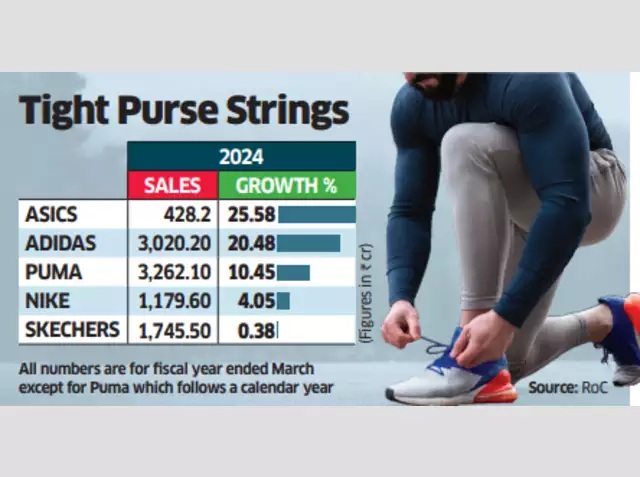
Demand for sportswear from running shoes to joggers and yoga mats slowed down for leading firms such as Puma, Adidas, Nike, Skechers and Asics, halting their sprint since the easing of the Covid-19 pandemic when they doubled their sales in two years.
Sportswear firms have reported 1-25% year-on-year increase for 2023-24, down from 35-85% increase for the previous financial year, according to the latest regulatory filings. While demand for fitness wear and sports equipment for disciplines other than cricket grew as people prioritised health with the onset of Covid-19, consumers cut back on discretionary spends across categories over the past six to eight quarters.
Experts said companies capitalised on the popularity of more casual styles in the wake of the pandemic, a trend that has subsided now although people are more health conscious than ever. A broader slowdown, especially in cities, hurt premium categories including sportswear, which are completely dominated by global players.
“Sportswear or footwear has a slower replacement cycle than apparel and lifestyle products. Also, there is a distinct slowdown as it all comes down to income growth versus inflation. So, a longer term potential still remains for the segment but there is a short-term consumption stress,” said Devangshu Dutta, founder of retail consulting firm Third Eyesight.
With a population of 1.4 billion, India is among the fastest growing and largest international markets for footwear companies and over the years companies such as Under Armour, Asics and Skechers have expanded aggressively in the country.
Puma India managing director Karthik Balagopalan said the category has outpaced market growth with mid to high single digit growth rates even as subdued demand has lagged expectations.
“When it comes to health and fitness, consumers continue to spend on performance products and our sports-first strategy also leans towards that. Our ambition continues to grow at or be above market CAGR (compound annual growth rate) over the mid-term, and we think we are in a good place with our back-end infrastructure, our product portfolio and pipeline, BIS (Bureau of Indian Standards) readiness and our best-in-class team, who will continue to cement and retain our lead on competition,” he said.
In October, Foot Locker entered India through a long-term licensing agreement with Metro Brands, which will own and operate stores, while Nykaa Fashion will be its exclusive e-commerce partner.
However, there are challenges. In August this year, the government made it mandatory for footwear companies to obtain BIS certification for more than a dozen footwear products including sports brands. This impacted sales even last year as BIS had not issued licences to several foreign brands whose products were manufactured outside India, which in turn, forced brands to cut down on supplies.
American footwear firm Skechers said in its last earnings call that it had been growing exceptionally well in India for several years but there was a bit of an anomaly in part because of some of the regulatory changes that it had not yet fully responded to.
“We continue to work closely with both our India team and regulators to further advance our local sourcing strategy. We are seeing positive trends and remain optimistic about the progress in this important market. We see tremendous opportunity, not only in our lifestyle business, but also in performance,” Skechers chief operating officer David Weinberg told analysts.
(Published in Economic Times)
admin
August 19, 2024
Ratna Bhushan, Economic Times
New Delhi, 19 August 2024
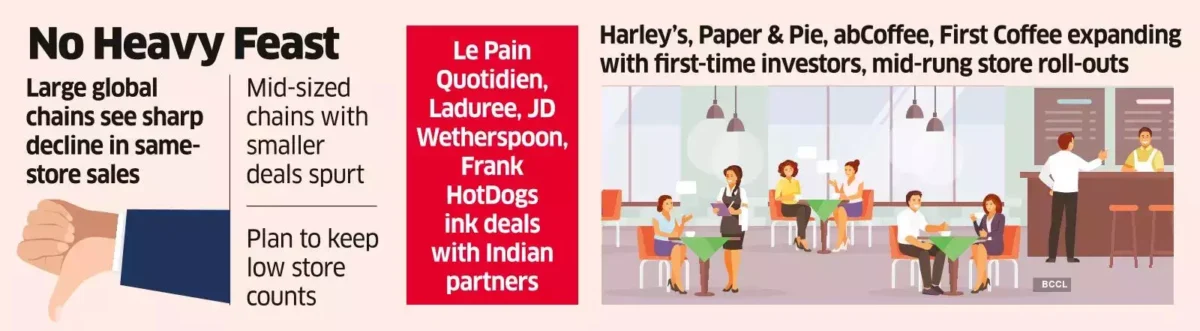
Close to a dozen small to mid-sized global cafes and restaurant brands have either entered India in the past two quarters or are in talks with local players at a time when large global chains are seeing sharp decline in same store sales and growth.
Mid-sized global chains are making investments even in a modest range of Rs. 20-30 crore to tap select cities and intend to keep store counts under about 30 to stay profitable on each store. This is in contrast to earlier times when cafes and chains entered India with mega deals and investment plans, executives said.
Belgian bakery Le Pain Quotidien, French patisserie chain Laduree, UK’s JD Wetherspoon and Frank HotDogs are among those to have inked collaborations with Indian partners, while newer homegrown ones such as Harley’s, Paper & Pie, abCoffee and First Coffee are expanding with first-time investors and mid-rung store rollouts.
“A combination of factors is driving this change of newer, smaller launches,” said Devangshu Dutta, chief executive of retail consultancy Third Eyesight. “There are niches the newer chains are addressing as consumers’ choices evolve and get more specific. Also, there’s a broadening of a wealth base in India leading to mid-sized business houses having capability to invest and willingness to try out newer segments,” he said.
With the big-bang launches in food services drying up, there’s been a mushrooming of small deals that is expected to surge.
Bake & Brew, which has inked a master franchise agreement with Belgian bakery chain Le Pain Quotidien to re-enter India, is investing Rs 35 crore in the first year. “We’ll start in metros and may expand to smaller towns later. We also see potential in travel retail, airports and larger train stations,” Annick Van Overstraeten, chief executive of Le Pain Quotidien, told ET. Bake & Brew is backed by the Nalanda group with core business interests in automotive metal parts.
Earlier this month, the French patisserie chain Laduree said it was launching its cafe at Ritz-Carlton, Pune, in collaboration with CK Israni Group which has business interests in home decor and construction. Its Managing Director Chandni Nath Israni said in a statement that the CK Israni group planned to expand Laduree’s presence across other Indian cities.
Experimenting in newer cuisines is also driving the change. “Our decision to expand in India stems from a deep appreciation for variety and a passion for bold flavours. We see great potential in the Indian market,” said Benjamin Attal, founder of US chain Franks Hot Dog.
Smaller and newer homegrown chains, in contrast, are expanding, backed by mid-ticket investors and business houses, many of whom are foraying into food services for the first time.
Last week Brigade Group, a realtor, announced a partnership with specialty coffee chain abCoffee to set up six outlets within Brigade properties.
“We partnered with abCoffee to enhance the F&B offerings at our office parks. abCoffee is able to retrofit into operational buildings without requiring additional water or gas points,” Arvind Rao, vice president – commercial business, Brigade Group, said.
Specialty coffee startup First Coffee plans to open 35 stores by 2024-end “focused on delivery and minimalist store aesthetic,” according to a company statement, to sell flavoured coffees, cold brews and bubble teas.
(Published in Economic Times)
admin
May 6, 2024
Sesa Sen, NDTV Profit
6 May 2024
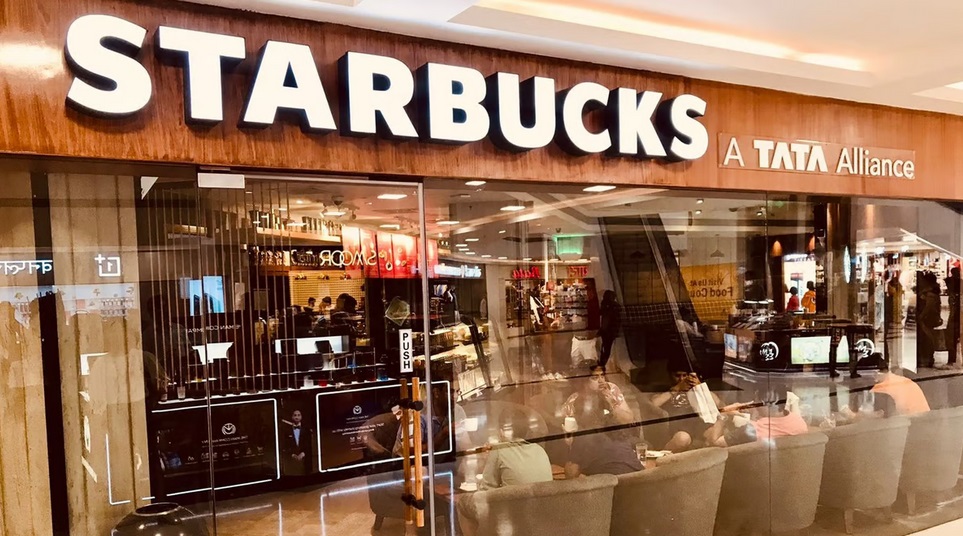
Starbucks Corp., the world’s largest coffee chain, posted its slowest sales growth in India since the pandemic. The coffee giant is struggling to bring in as much business as it has in the past as consumers reduce their visits even as it prepares for ambitious store expansion in a tea-drinking nation.
The India unit formed in partnership with the Tata Group clocked net sales of Rs 1,218 crore, a growth of 12%, during the year ended March 2024, according to Tata Consumer Products Ltd.’s latest investor presentation.
The Seattle-based retailer experienced a compounded annual growth rate of 21.89% between FY17 and FY23 in the world’s most populous nation. The only exception to this trend was in FY21, when sales plunged by 33% as shops were forced to shut down due to the impact of Covid-19.
“Tata Starbucks had a subdued quarter given the overall trends that we’re seeing in the QSR [quick service restaurants] business,” said Sunil D’Souza, managing director and chief executive officer at Tata Consumer Products.
He, however, indicated that March was an improvement over February, and April was even better than March. “So, we see a better trend right now, and we remain focused on the larger India opportunity.”
Tata Starbucks Pvt. Ltd. took 11 years to scale its operations to a revenue of over Rs 1,000 crore. Although the joint venture turned positive at the EBITDA level for the fiscal year 2023, it continues to be loss-making. In the year ending March 2023, Tata Starbucks posted a net loss of Rs 25 crore on a turnover of Rs 1,087 crore, according to filings with the Registrar of Companies. The net profit figures for fiscal 2024 are not available yet.
The coffee chain has seen its popularity take a major hit over the last two quarters, ending in March and December, with a meagre 7% increase in sales during each period. This is a marked shift from its historical track record of double-digit growth, suggesting that consumers are now looking for more budget-friendly cafe experiences.
“Consumers have turned slightly more conservative with their spends, which is affecting both the frequency and of transactions,” according to Devangshu Dutta, head of retail consultancy Third Eyesight.
According to him, new store openings rather than an increase in sales at existing ones could drive growth.
The other reason is that the coffee market is more competitive today, with most local peers selling at price points lower than Starbucks, Dutta said.
Starbucks competes with Bengaluru-based Cafe Coffee Day and foreign entrant Barista, among others, in the country’s $400 million market. It also faces competition from private equity-backed Third Wave and Blue Tokai, which have opened about 200 stores between them in the last three years.
Since opening its first cafe in October 2012, Tata Starbucks’ store count has grown to 421, implying that on average, each outlet generated roughly Rs 3 crore in revenue from coffee, snacks, and merchandise sales in FY24.
The dwindling sales come at a time when the company plans to open 1,000 cafes in India. To meet the target, it seeks to open one new store every three days.
Starbucks added 29 net new stores between January and March, achieving a record of 95 stores opening in a year, according to the presentation.
The coffee chain had earlier said it plans to enter tier-2 and tier-3 cities in the country and increase the number of its drive-through, airport-based and 24-hour cafes. It also aims to double its headcount to 8,600.
To lure consumers back after a rough start to the year, the coffee giant is launching new products like a boba-inspired summer beverage.
“Over the past 11 years, the India market has grown to become one of Starbucks’ fastest-growing markets in the world,” Laxman Narasimhan, chief executive officer, Starbucks, said in a statement during his India visit earlier this year. “With a growing middle class, we are proud to help cultivate the evolving coffee culture while honouring its rich heritage.”
Starbucks faces challenges not only in India but also globally. A disastrous fourth quarter that saw a slowdown in store visits promoted Starbucks Corp. to lower its expectations for its full-year sales and profit. Its revenue for the January–March period dropped 2%, the first since the end of 2020.
admin
February 29, 2024
29 February 2024, Mumbai
Prince M. Thomas, TheMorningContext
Prataap Snacks should have been an easy sell for Peak XV Partners. The venture capital firm, which till recently was known as Sequoia Capital India, is the largest shareholder in the snack maker with a 47.56% stake. It first invested in Indore-based Prataap Snacks in 2011 and has since seen the company become the sixth largest player in the industry. An exit now would give Peak XV returns that would match some of its best exits, like those from Zomato and Go Fashion.
The reality is, finding a buyer for Prataap Snacks isn’t as easy as selling a packet of “chatakedaar” rings bearing its Yellow Diamond brand. In fact, those packets of rings may be one of the reasons why the company seems to have lost some of its spice with suitors. We will come to that in a bit, but first it’s remarkable how many doors Peak XV has knocked on without any luck…
The company’s choice of products, most of them falling under the category of “western snacks”, was prudent. “When it comes to snacks, the Indian market is very diversified. Each region has its own flavour and there are local nuances,” says Devangshu Dutta, founder of consulting firm Third Eyesight. That means a regional snack, like the gathiya that is popular in Gujarat, will have fewer takers in eastern and southern states. Prataap Snacks’s products had no such problem as chips and rings were not region-specific…
Read more at: https://themorningcontext.com/business/sequoia-struggles-to-sell-prataap-snacks
admin
February 23, 2023

India’s economy is in focus globally, and is also at an inflection point.
Join Devangshu Dutta at the Asia-Pacific conference of UFI, The Global Association of the Exhibition Industry. Registration Link: https://lnkd.in/dq89_rY3
See you at UFI Asia-Pacific Conference in Kuala Lumpur!
