
admin
November 18, 2025
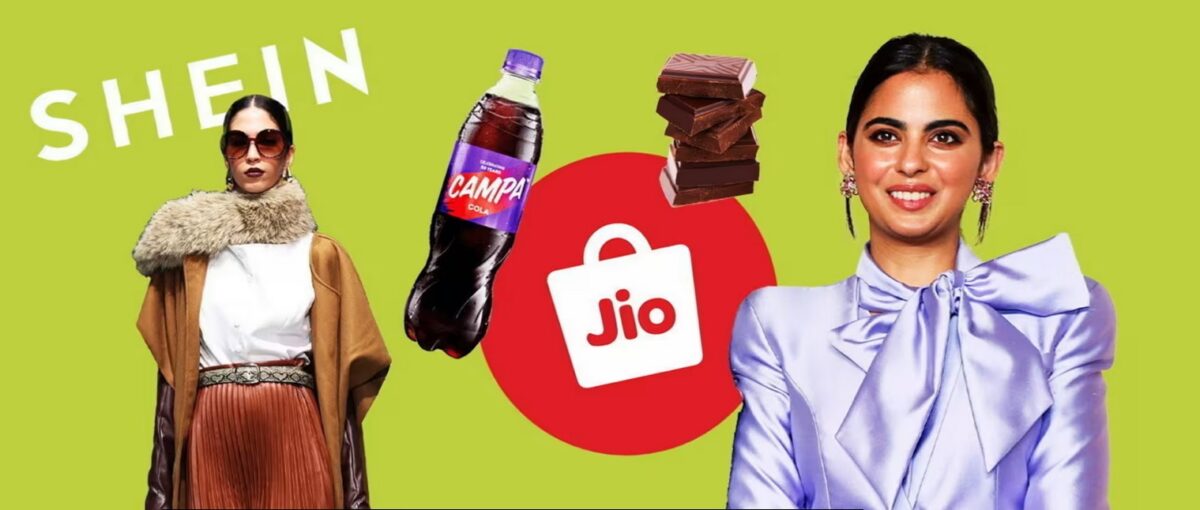
Chris Kay, Krishn Kaushik and Andrea Rodrigues in Mumbai
Nov 18 2025
Just before dawn, Kashif Sameer joins dozens of couriers zipping across Mumbai to deliver items stocked in a basement of a shopping mall run by Reliance Industries.
“I make between 20 and 30 deliveries in a day,” said the 25-year-old, who had just driven a mile across the chaotic roads of the Indian megacity to drop off groceries ordered 15 minutes earlier. “It is very popular with customers.”
The buzzing activity at the so-called dark store, a mini-warehouse operated by Reliance’s ecommerce platform JioMart, is part of a renewed push by the conglomerate’s chair and Asia’s richest man, Mukesh Ambani, to reassert his company’s position in India’s retail market.
It has added hundreds of dark stores to operate a total of nearly 20,000 physical outlets this year — almost double its pre-pandemic size — as it battles for dominance against Blinkit, Swiggy and Zepto in the country’s ballooning quick-commerce market.
“It’s a question of who runs out of money first,” said Arvind Singhal, chair of retail consultancy The Knowledge Company. “We will see some kind of a shakeout.”
Despite its large network of physical stores, Reliance has yet to corner the domestic consumer market like it did with telecoms a decade ago. It faces entrenched competition from established domestic and international rivals, as well as millions of kiranas, family-run convenience stores.
The sprawling Tata Group operates a wide range of consumer businesses, while global multinationals such as Unilever and Nestlé are important players in India’s household goods market.
Reliance Retail, the division that contains all of the conglomerate’s consumer-facing units, had shed tens of thousands of employees and closed underperforming stores following a bloated build-out during the Covid-19 pandemic and slowing middle-class spending.
But India’s most valuable company, which has a market value of more than $225bn and operates across oil refining, telecoms and entertainment, is expanding its retail reach again.
Reliance Retail’s latest results point to a rebound. In the quarter ending September, the unit reported revenue of about $10bn and profit of $390mn, up 18 and 22 per cent respectively from the previous year.
“Reliance’s scale in retail now is unmatched in India,” said Devangshu Dutta, chief executive of consumer advisory company Third Eyesight, in reference to the breadth of the conglomerate’s business. “This scale is unique in India and rare in global retail.”
Ambani’s retail ambitions are being led by his 34-year-old daughter, Isha. In August, she detailed plans for Reliance’s consumer brands subsidiary, which has a portfolio including Lotus Chocolate and the recently revived nostalgic Indian soft drink Campa Cola, to reach $11.7bn in revenue within five years.
Ultimately, the goal was to “become India’s largest FMCG company with a global presence”, said Isha Ambani during Reliance’s annual meeting.
The company told the Financial Times that it continued to “reinforce its position as India’s largest retailer, expanding its nationwide network”.

While Ambani originally indicated that he wanted to list Reliance Jio Infocomm, the telecoms unit, and Reliance Retail by 2024, people familiar with the company said the retail unit was not ready to go public. The billionaire said the Jio listing could happen in the first half of next year.
“Competitive intensity in every category in the discretionary retail side has picked up very sharply,” said Karan Taurani, executive vice-president at Elara Capital, who does not expect Reliance Retail to float for at least two years. “New competitors, new brands have come in and they are challenging the larger incumbents.”
The Ambanis, who operate as gatekeepers for foreign companies seeking access to India’s massive but challenging business landscape, have sought to cement their position through a spate of partnerships with western retail brands.
Foreign brands including West Elm, Pottery Barn and Superdry have stores in Reliance’s shopping malls in upmarket Mumbai. However, those joint ventures have largely struggled to gain traction with shoppers in India, where the per capita income remains less than $3,000.
The conglomerate’s foreign brands business housing these joint ventures lost Rs2.7bn ($30mn) in the financial year through March 2025, according to the latest available accounts. The Knowledge Company’s Singhal called Reliance’s push to bring international names to India “a vanity project”.
Reliance’s high-profile partnership with fast-fashion retailer Shein has also been underwhelming. The company returned to India this year under Reliance’s wing after being booted out in 2020 when relations between New Delhi and Beijing soured following military clashes along their disputed border.
Shein’s app has been downloaded just 11mn times, according to market intelligence firm Sensor Tower. Its discount prices are largely matched, if not undercut, by many Indian ecommerce and fashion retailers, say analysts.
Reliance is investing heavily in quick commerce, where deliveries are promised in 30 minutes or less. Bank of America estimates the market could reach $128bn by 2030.
The field is at present dominated by Blinkit, Swiggy and Zepto, which together control more than 90 per cent of the quick commerce delivery market and compete with Amazon and Walmart-owned Flipkart. None of the companies are profitable.
The Ambanis are eager to catch up. Over the past six months, Reliance has built about 600 dark stores across cities to plug gaps in its vast store network. By contrast, market leader Blinkit operates about 1,800 dark stores.
In quick commerce, “we have to be there because everybody is”, said a person close to the conglomerate. “It is a long-term strategy.”
On a call with analysts last month, Reliance Retail’s finance chief Dinesh Taluja admitted to delays in entering quick commerce. But he insisted that Reliance offered better prices, more variety and wider reach across smaller Indian cities where it is often the only formal retailer.
“The competition today is mainly in the top 10, 20 cities,” Taluja said. “We are present in almost a thousand cities. Competition will take many years to reach where we already have a head start there.”
Still, Reliance was facing an uphill battle, warned Elara’s Taurani. “JioMart is making a late entry,” he said, “it will be very tough to disrupt players here.”
(Published in Financial Times, all copyrights owned by FT)
admin
October 24, 2025

Entrepreneur India
Oct 23, 2025
Indian consumers are increasingly opting for private labels and in-house brands over established ones, and retailers are taking note. According to EY’s ‘Future Consumer Index 2025’, more than half of India’s consumers are now choosing in-house brands over legacy labels.
The report highlights that 52 per cent of Indian consumers have switched to private labels for better value, while 70 per cent believe these in-house brands offer comparable or superior quality. Backed by this shift, retailers from BigBasket to DMart, and quick-commerce players like Zepto and Blinkit, are doubling down on their private label strategies, viewing them as a path to higher margins, stronger brand loyalty, and greater pricing control.
“Indian consumers’ growing preference for private labels reflects both short-term price pressures and a longer-term structural evolution in retail,” said Devangshu Dutta, CEO of Third Eyesight, speaking to Entrepreneur India.
Trending globally
The surge isn’t unique to India. A recent report by the Institute of Grocery Distribution (IGD) notes that globally, private labels now account for over 45 per cent of grocery volume and are expanding faster than legacy brands.
In India, this shift is becoming increasingly visible in-store. The EY report found that 74 per cent of consumers have noticed more private label options where they shop, and 70 per cent say these products are now displayed more prominently, often placed at eye level, signalling a strategic retail push.
Commenting on this trend, Angshuman Bhattacharya, Partner and National Leader, Consumer Products and Retail Sector, EY-Parthenon, said, “Consumer behaviour has traditionally evolved in response to changing economic situations, but the current shifts appear to be more permanent. Retailers are confidently launching private labels and allocating prime shelf space to them, while technology is enhancing the shopping experience by providing consumers with limitless options and the ability to compare products.”
From price-fighters to power brands
According to Dutta, private labels are no longer just “copycat” alternatives meant to undercut national brands.
“For retailers, not just in India but globally, lookalike private labels used to be tools at the opening price point to hook the customer, who saw them as credible, affordable alternatives to national brands,” he explained, adding, “However, as retailers have grown, they have gained both scale and expertise to widen and deepen their supply chains.”
Over time, he said, investments in formulation, packaging, and quality consistency have increased consumer trust.
“Private labels now compete on functional benefits rather than only on price, particularly in food staples and apparel, but also in brown goods and white goods, and increasingly in personal care and other FMCG categories,” he added. [Must read: “Private Label Maturity Model”]
Retailers scale up private labels
As demand for in-house brands grows, retailers are scaling up their strategies across sectors.
BigBasket, one of India’s largest online grocery platforms, reported that 35–40 per cent of its FY24 sales came from private labels like Fresho, BB Royal, and Tasties. The company aims to push this share closer to 45 per cent through expansion in frozen foods and ready-to-eat categories.
DMart’s private label arm, Align Retail, has reportedly more than doubled its sales in two years, touching INR 3,322 crore in FY25. The retailer’s in-house brands in staples, apparel, and home essentials have helped boost margins in a highly competitive retail landscape.
Zepto, the quick-commerce player, is taking private labels into the 10-minute delivery domain. Its brand Relish, focused on meats and eggs, has achieved INR 40 crore in monthly sales.
Meanwhile, Reliance Retail has also expanded its portfolio of private labels, including Good Life, Enzo, and Puric, across groceries, personal care, and household products, strengthening its broader FMCG play. In 2024, Reliance Retail’s Tira Beauty also announced the launch of its latest private label brand, Nails Our Way, signifying a major expansion in its beauty offerings.
Capturing a lion’s share in retail
Dutta noted that in India, private labels will remain a core pillar of modern retail strategy rather than a cyclical response to cost pressures.
“Consumers increasingly view retailers as brand owners rather than intermediaries. As private labels mature in branding and innovation, their growth aligns more and more with brand equity development rather than just opportunistic cost-saving,” he said.
From a retailer’s perspective, private labels deliver higher gross margins and greater strategic control, Dutta said. [Must read: “Private Label Maturity Model”]
Another report by the Private Label Manufacturers Association (PLMA), using Circana data, found that in 2024, private-label sales in food and non-edible categories grew faster than bigger brands globally. While figures vary by region and quarter, the pattern remains consistent: private labels are outpacing traditional FMCG growth.
Collectively, these shifts show that private labels are becoming a major revenue driver for retailers in India, and are fast evolving from value alternatives into brands with genuine consumer pull.
(Published in Entrepreneur India)
admin
July 28, 2025
By Meenakshi Verma Ambwani, Hindu Businessline
New Delhi, July 28, 2025
Nykaa said that Kay Beauty, co-founded with actor Katrina Kaif, has crossed the ₹240 crore mark in terms of Gross Merchandise Value.
Stars from the tinsel town are donning the entrepreneurial hat to venture into the beauty and fashion business space. Some have even succeeded in growing their brands sustainably, earning big bucks.
Take for instance Skincare brand Hyphen, co-founded by actor Kriti Sanon with Pep Brands, which recently touched the ₹400 crore-mark in Annual Recurring Revenues.
Tarun Sharma, CEO and co-founder, Hyphen told businessline: “The brand is witnessing healthy growth rate quarter-on-quarter. In the first year itself, it touched ₹100 crore ARR. We had aimed for ₹500 crore ARR in 3-4 years and, within two years, we are at ₹400crore ARR.” Pep Brands led by Sharma owns mCaffeine and Hyphen.
The model that works
Sharma believes an operator-led, celebrity anchored model works better. ”The operator can bring in the necessary financial and execution muscle. If a celeb partners with an operator that has deep expertise in the space, then there is huge potential for growth,” he added.
“Product launches, marketing and distribution are very data-driven at Pep Brands. It guides us on what to launch, when to launch, and how to launch products. That has helped Hyphen in achieving this kind of growth rate. It is by design that the majority of the business of Hyphen is D2C,” Sharma explained.
In May, Nykaa said that Kay Beauty, co-founded with actor Katrina Kaif, has crossed the ₹240 crore mark in terms of Gross Merchandise Value. On an earnings call for Q4FY25, Adwaita Nayar, Executive Director, Chief Executive Officer, Nykaa Fashion, said: “Kay Beauty is one of the fastest-growing brands on the platform. It’s hit about ₹240 crore of GMV. The innovations have been fantastic this year. So, it is quite a premium brand, and I think the consumers are accepting it even at that price point. It’s got great gross margins.”
Earlier this year, Reliance Retail Ventures announced that it has decided to acquire 51 per cent stake in Ed-a-Mamma , a kid and maternity wear brand founded by actor Alia Bhatt. According to some reports, Hrithik Roshan’s sportswear brand HRX is a ₹1,000 crore brand.
Among the recent entrants are Ranbir Kapoor, who has decided to foray in the apparel and accessories space with ARKS. Launched in February, the brand has also launched its first store in Mumbai, followed by a second store in New Delhi and another with Broadway in Hyderabad.
‘Shift in preferences’
Abhinav Verma, co-founder and CEO, ARKS, told businessline: “We are seeing a shift in consumer preferences towards made-in-India brands. We decided to leverage on the strong manufacturing capability that India has to build a brand that is both aspirational and offers value. We are looking to build a ₹100 crore brand in the next 3-4 years with a strong omni-channel strategy.”
“The success of some of these brands demonstrates that building on consumer relevance and with powerful time-bound execution, celebrity ventures can become significant players in a crowded market. With consumer demand for relatability and digital-first branding on the rise, this segment will definitely grow. However, only brands that offer genuine value to consumers, and not just star appeal, are likely to endure,” said Devangshu Dutta, CEO, Third Eyesight.
(Published in The Hindu-Businessline)
admin
June 1, 2025
Sharleen Dsouza, Business Standard
Mumbai, 1 June 2025
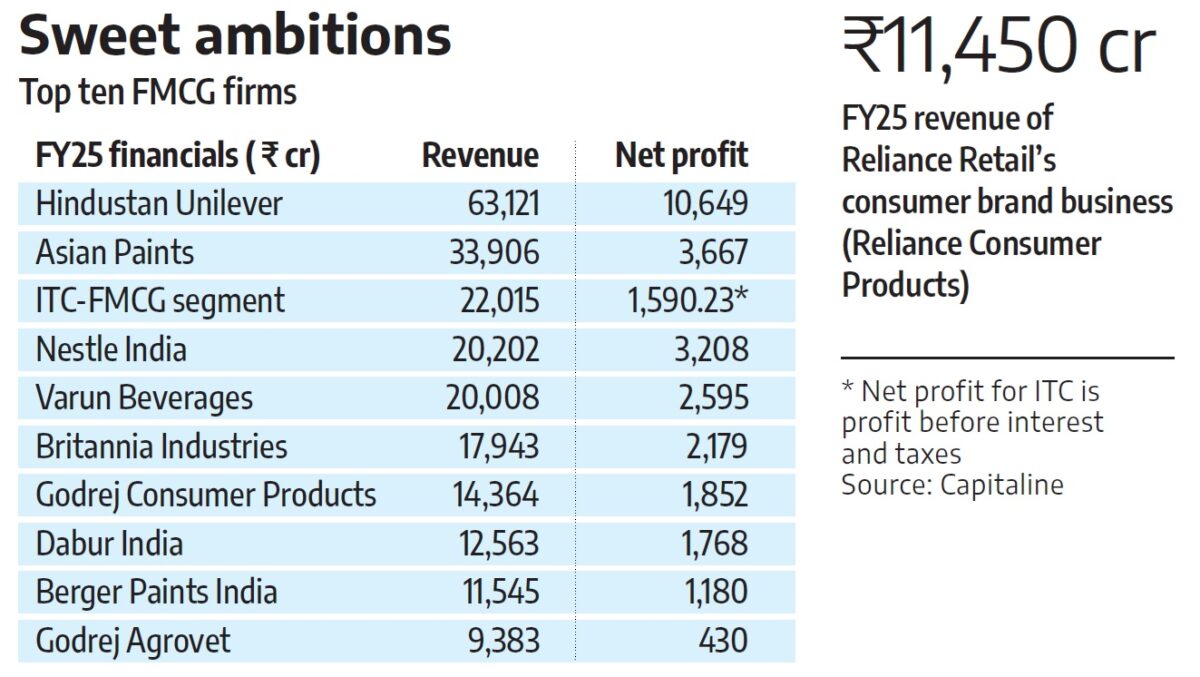
Reliance Consumer Products is in a sweet spot – and it intends to stay there. Launched barely three years ago, the company has already entered the list of India’s top 10 fast-moving consumer goods (FMCG) players by revenue in the 2024-25 financial year (FY25).
After making headlines by acquiring Campa Cola in 2022 — and taking the brand overseas in under two years — Reliance Consumer Products quickly expanded into food and non-food categories under the ‘Independence’ brand. Now, it has trained its sights on a new frontier: Confectionery.
This marks the company’s third major focus area after gaining traction in beverages and staples. Though present in biscuits and namkeens, its immediate priority is grabbing a share of the Indian consumer’s pocket change — via candies, chocolates, and toffees.
Its entry into the confectionery business began quietly in 2022 with a pilot of Joyland candies in Uttar Pradesh. It soon went on an acquisition spree — first picking up the 30-year-old Maharashtra-based Toffeeman brand in 2023, followed by a 51 per cent stake in Lotus Chocolates, and then acquiring the 82-
year-old Ravalgaon, home to nostalgic brands like Pan Pasand, Mango Mood, and Laco. It has been steadily building a formidable candy arsenal.
However, the Mukesh Ambani-led company isn’t limiting itself to Re 1 or Rs 2 price points. According to a source, it is developing an end-to-end confectionery portfolio — across toffees, candies, and chocolate-based products — and plans to enter sub-segments like gums, jellies, and lollipops. It is also betting on old-school favourites, launching chocolate-based confections such as eclairs, Lotus Symphony (toffee with a chocolate centre), and Lotus Zellers (moulded chocolate miniatures).
It is piloting distribution in five states — Maharashtra, Karnataka, Telangana, Andhra Pradesh, and Uttar Pradesh — with plans to go pan-India this fiscal and reach one million outlets, the source added.
Why the big bet? The Indian confectionery market is expected to grow from Rs. 37,900 crore in 2024 to~59,700 crore by 2033, at a compound annual growth rate of 5.2 per cent, according to global consultancy IMARC Group. North India leads the market with a 32.8 per cent share. IMARC adds that modern retail formats, better digital connectivity, and product innovation are driving market penetration in both urban and semi-urban areas.
India’s sweet tooth has deep roots. Parle began selling candies in the 1920s, followed by Ravalgaon —now part of Reliance Consumer Products’ growing portfolio – in the 1940s.
Experts say the company’s strategy from the start was clear: Dominate. And it has the war chest to play the long game.
“Over two decades, Reliance has gained consumer-side experience and enormous momentum through various retail formats, and has figured out vertical integration in procurement,” said Devangshu Dutta, chief executive officer of consultancy Third Eyesight.
“Its experience in staples comes from private labels, and starting with Campa, its acquisitions in food, beverage and FMCG have grown. As a group, it has the muscle and a long-term approach to make a mark in the market.”
Dhanraj Bhagat, partner at Grant Thornton India LLP, pointed out thatthe FMCG market is notoriously tough — especially when scaling regional brands nationally. “But Reliance has deep pockets for brand building,” he said. That’s what sets it apart — it can spend big and be patient, he added.
While the company is making a dent via its distribution penetration strategy, it also needs to spend on publicity, Bhagat added. “Reliance has the money, so it is a different ball game for it as this gives the company the ability to spend and play the long-term game.”
Reliance Consumer Products is also offering higher margins to distributors in categories like Campa and confectionery, giving it a competitive edge. Its aggressive incentives have forced rivals to raise their own distributor margins — a sign of how this sweet battle is heating up.
(Published in Business Standard)
admin
October 28, 2024
Nisha Qureshi, Afaqs
28 Oct 2024
Reliance Industries last year made a strategic move into the soft drink sector by acquiring the iconic carbonated beverage brand ‘Campa Cola,’ which gained prominence in the 80s and 90s.
The conglomerate intends to strengthen its brand by employing its classic pricing disruption strategy. Reliance is expanding its presence nationwide by focussing on affluent regions and utilising e-commerce and quick commerce platforms.
Recent reports suggest that Campa Cola is providing retailers with more favourable trade margins than its rivals Coca Cola and Pepsi, aiming to challenge the existing duopoly in India’s soft drink market.
In the Q2FY25 earnings call, Reliance Industries reported that its consumer brands, particularly Campa Cola and Independence, are experiencing robust growth, with general trade increasing by 250% year-on-year.
“We are taking several marketing initiatives to grow consumer brands and will leverage the festive period to drive demand,” the company’s representative said during the call, adding that the company was “very optimistic about the next few quarters”.
Experts now believe that the soft-drink beverage market will witness an increase in advertising initiatives by the competitors to mitigate the disruption.
Saurabh Munjal, co-founder and CEO of Archian Foods, the makers of Lahori Zeera, asserts that Reliance’s entry into this sector will only expand the market for soft-drink beverages.
“The consumption will increase, accompanied by a corresponding rise in marketing efforts,” he adds.
Devangshu Dutta, the founder of Third Eyesight, a management consulting firm engaged with the retail and consumer products ecosystem, asserts that both Coca-Cola and Pepsi will undoubtedly endeavour to safeguard their market share.
He says the emphasis will particularly be on domestic consumption, and we can anticipate an increased investment in share-of-mind campaigns to proactively counter Campa’s expansion.
Business strategist and independent director Lloyd Mathias believes that the current circumstances are conducive to market expansion and disruption. “Other players will likewise increase their visibility through marketing strategies and retail initiatives to counter this. So what we will see in the next year is that the categories of soft drinks will grow quite dramatically,” he adds.
The classic Reliance move
Experts suggest that Reliance’s approach to Campa Cola involves competitive pricing, reflecting a strategy akin to its disruptive tactics in the telecom sector with Jio and JioCinema. For instance, a two-litre bottle of Campa Cola’s lemon flavour is priced at Rs 53 on a quick commerce platform, whereas a leading competitor offers it for Rs 74.
Besides competitive pricing, Reliance also has the significant advantage of owning a large retail and media network to scale Campa Cola.
“Reliance has earlier disrupted markets with the aggressive pricing strategy and it has the resources to follow-through on its pricing strategy for Campa as well. It can build significant volumes across its own stores prior to having to compete for shelf space in the broader distribution channels,” says Dutta.
As per Mathias, in addition to possessing deep pockets, Reliance benefits from its extensive media and entertainment wing that will be leveraged for the promotion of Campa Cola.
“I think the combined strength of Reliance in terms of distribution, media, and retail, alongside its capacity to maintain pricing integrity, are quite formidable. I think they are going to make a significant impact in the market,” says Mathias.
Impact on smaller players
Experts also suggest that the introduction of Campa Cola at its current price point will primarily affect smaller local competitors who function within the same pricing bracket, particularly in tier-2 and tier-3 markets.
Mathias asserts that Campa Cola will initially expand the soft-drink beverage market, while also emphasising that given the price point of the soft drink, the immediate impact will be felt by smaller local players who operate at similar price points. Introduction of numerous Indian innovations within the soft-drink category could significantly impact relatively smaller competitors.
Similarly, Dutta observes that the market for carbonated beverages largely hinges on the intangible qualities associated with the brands. In India, however, brand preferences are not as hard coded as they are in the United States.
“Consumers do switch between brands, and price-sensitive customers can be swayed by visible pricing differences. This gives deep-pocketed Reliance an opportunity to carve out a significant market share.”
However, according to Munjial of Lahori Zeera, there appears to be no direct impact on his brand, given that Campa Cola has thus far only introduced the well-known flavours of carbonated beverages. “As far as Lahori Zeera is concerned, there is no impact because the target consumer, the flavours are all very different.”
“This development will merely add to the market and increase the number of people consuming carbonated beverages,” he says.
(Published in Afaqs)
