
Devangshu Dutta
December 5, 2013
(Published in ETRetail.com on 6 December 2013)
Franchising isn’t rocket science, but advanced space programmes offer at least one parallel which we can learn from – the staging of objectives and planning accordingly.
A franchise development programme can be staged like a space launch, each successive stage being designed and defined for a specific function or role, and sequentially building the needed velocity and direction to successfully create a franchise operation. The stages may be equated to Launch, Booster, Orbiter and Landing stages, and cover the following aspects:

Stage 1: Launch
The first and perhaps the most important stage in launching a franchise programme is to check whether the organisation is really ready to create a franchise network. Sure, inept franchisees can cause damage to the brand, but it is important to first look at the responsibilities that a brand has to making the franchise network a success. Too many brands see franchising as a quick-fix for expansion, as a low-cost source for capital and manpower at the expense of franchisee-investors. It is vital for the franchiser to demonstrate that it has a successful and profitable business model, as well as the ability to provide support to a network of multiple operating locations in diverse geographies. For this, it has to have put in place management resources (people with the appropriate skills, business processes, financial and information systems) as well as budgets to provide the support the franchisee needs to succeed. The failure of many franchise concepts, in fact, lies in weakness within the franchiser’s organisation rather than outside.
Stage 2: Booster
Once the organisation and the brand are assessed to be “franchise-ready”, there is still work to be put into two sets of documents: one related to the brand and the second related to the operations processes and systems. A comprehensive marketing reference manual needs to be in place to be able to convey the “pulling” power that the brand will provide to the franchisee, clearly articulate the tangible and intangible aspects that comprise the brand, and also specify the guidelines for usage of brand materials in various marketing environments. The operations manual aims to document standard operating procedures that provide consistency across the franchise network and are aimed at reducing variability in customer experience and performance. It must be noted that both sets of documents must be seen as evolving with growth of the business and with changes in the external environment – the Marketing Manual is likely to be more stable, while the Operations Manual necessary needs to be as dynamic as the internal and external environment.
Stage 3: Orbiter
Now the brand is ready to reach out to potential franchisees. How wide a brand reaches, across how many potential franchisees, with what sort of terms, all depend on the vision of the brand, its business plan and the practices prevalent in the market. However, in all cases, it is essential to adopt a “parent” framework that defines the essential and desirable characteristics that a franchisee should possess, the relationship structure that needs to be consistent across markets (if that is the case), and any commercial terms about which the franchiser wishes to be rigid. This would allow clearer direction and focussed efforts on the part of the franchiser, and filter out proposals that do not fit the franchiser’s requirements. Franchisees can be connected through a variety of means: some will find you through other franchisees, or through your website or other marketing materials; others you might reach out to yourselves through marketing outreach programmes, trade shows, or through business partners. During all of this it is useful, perhaps essential, to create a single point of responsibility at a senior level in the organisation to be able to maintain both consistency and flexibility during the franchise recruitment and negotiation process, through to the stage where a franchisee is signed-on.
Stage 4: Landing
Congratulations – the destination is in sight. The search might have been hard, the negotiations harder still, but you now – officially – have a partner who has agreed to put in their money and their efforts behind launching YOUR brand in THEIR market, and to even pay you for the period that they would be running the business under your name. That’s a big commitment on the franchisee’s part. The commitment with which the franchiser handles this stage is important, because this is where the foundation will be laid for the success – or failure – of the franchisee’s business. Other than a general orientation that you need to start you franchisee off with, the Marketing Manual and the Operational Manual are essential tools during the training process for the franchisee’s team. Depending on the complexity of the business and the infrastructure available with the franchiser, the franchisee’s team may be first trained at the franchiser’s location, followed by pre-launch training at the franchisee’s own location, and that may be augmented by active operational support for a certain period provided by the franchiser’s staff at the franchisee’s site. The duration and the amount of support are best determined by the nature of the business and the relative maturity of both parties in the relationship. For instance, someone picking up a food service franchise without any prior experience in the industry is certainly likely to need more training and support than a franchisee who is already successfully running other food service locations.
Will going through these steps guarantee that the franchise location or the franchise network succeeds? Perhaps not. But at the very least the framework will provide much more direction and clarity to your business, and will improve the chances of its success. And it’s a whole lot better than flapping around unpredictably during the heat of negotiations with high-energy franchisees in high-potential markets.
Devangshu Dutta
October 9, 2013

[This article appeared in Daily News & Analysis (DNA) on 10 October 2013, under the headline “Without Wal-Mart, can Bharti play it alone?”]
A year ago, Wal-Mart had called Bharti its natural retail partner in India. But today the companies have jointly and publicly changed their relationship statuses to “single”, calling off the 6-year old marriage. Bharti will buy out or retire Wal-Mart’s debentures in the 200+ store Easyday retail business, while Wal-Mart in turn will acquire Bharti’s stake in the 20-outlet Bestprice cash-and-carry business.
By some estimates, the split was imminent for perhaps a year or longer, as the pressure rose for the two companies due to multiple factors. Several regulatory changes governing foreign investment in the Indian retail sector made it difficult for Wal-Mart to acquire a stake in the existing retail business that the two partners had set up. Anti-corruption investigations in Wal-Mart’s India business (in addition to Mexico, China and Brazil), as well as questions around the legality of US$ 100 million worth of quasi-equity compulsorily convertible debentures issued to Wal-Mart at a time FDI was not allowed in multi-brand retail businesses brought down even more external scrutiny upon the joint business. And finally, pressure against foreign investment in multi-brand retail of basic goods such as food and grocery, continued to exist not just amongst opposition parties but also parties within the ruling coalition and individuals in the government.
The split means that Wal-Mart can now overtly take complete ownership of the Bestprice business, and drive it as it sees fit. The fragmented retail market and the myriad small businesses in India do potentially provide a large customer base for the cash-and-carry business if Wal-Mart chooses to be more aggressive. However, that may not happen immediately. The business has been coasting for over a year without new openings that were already planned and significant personnel changes have happened from the seniormost levels down. Wal-Mart’s investigations of corruption allegations continue and before committing more resources it will definitely want to strengthen systems so as to not be in violation of Indian and US laws.
On the other hand, if it wishes to now enter the retail business, Wal-Mart would also have to look for a new Indian partner to set up new retail stores in a separate company. Retail is capital-hungry so Wal-Mart would need a cash-rich partner who can accept a junior position in the venture in which Wal-Mart would clearly be the driver financially, strategically and operationally.
At this time Wal-Mart seems to have decided to take a step back and evaluate what the Indian market means to it right now and in the future, what sort of investment – both in financial and management terms – it demands, and what returns the investment will bring. It remains to be seen whether it will choose to grow aggressively, coast up incrementally or, in fact, take the next exit out of the market as it has done in some other countries earlier.
And what of Bharti? Will it be able sustain the retail play without Wal-Mart’s close operational guidance and financial participation, or will it choose sell the Easyday operation to another domestic investor? On its part Bharti has stated an ongoing commitment to the business, and has also hired the former CEO of the joint venture, Raj Jain, as a Group Advisor. A 200-plus store chain is sizeable and credible in India’s fragmented food and grocery market, and is seen by the group as “a strong platform to significantly grow the business”.
However, Bharti’s core telecom business is also capital-intensive and highly competitive, and it will be difficult at this time to sustain high-paced growth in another cash-hungry, thin-margin business such as grocery retail. For now the Group’s best bet would possibly be to consolidate operations, unearth more margin opportunities and take a call at a more opportune time whether to further invest in growth or to treat retail as a non-core business and exit it.
Creating a substantial, profitable retail business is a long-term play in any part of the world. In India, as retailers are discovering, it takes just that extra dose of patience.
Devangshu Dutta
February 16, 2013

About six years ago, Kishore Biyani of the Future Group and I were discussing a presentation I had delivered at CII’s National Retail Summit, during which I had mentioned “Purushartha”. This millennia-old living philosophy takes a balanced view of life. Aspects related to consumption are two of its major components including Artha (wealth, commerce) and Kama (sensory pleasure). Dharma (righteousness in society and individual life) and Moksha (liberation) are the other two. My point was that most “traditionalists” and certainly policy-makers in the country have tended to view the retail sector negatively or dismissively.
Of course, at that time most businesses themselves hardly demonstrated any sense of balance, let alone any connection with the reality of India, whether in terms of the consumer’s needs, or in terms of the operating environment in the country. By and large the theme was: push explosive growth, margins be damned; promote “westernised” consumption aspirations, regardless of capability to fulfil those aspirations. Conversely, the four years after the global financial crisis in 2008 have been possibly the worst that the retail sector has faced in recent decades, whether in terms of total losses or the quantum of lost growth opportunity, and business sentiment has swung to the other extreme.
On its part the government has not done much to encourage the sector. After several policy flip-flops, approving investment proposals of some high-profile global brands is a positive signal to the outside world, but none of them so far have unlocked or grown the value of Indian retail businesses in any significant way. There is no doubt that foreign brands and retailers can and should be an integral part of India’s developing retail landscape, but they cannot be the prime drivers of the retail business in India or the saviours of its supply chain. That vision and energy needs to come from within, and the resultant growth will benefit all – Indian and international companies, consumers and the government.
From the ancient treatise Arthashastra, Professor Thomas Trautman quotes the concept of concept of “shad-bhaag” (the state having one-sixth share) as “entrepreneurial” because it has a sense of mutual interest, promoting production and the growth of everyone’s share. This spirit of co-ownership and entrepreneurial participation is largely missing in today’s governance. Direct and indirect taxation remains a complex net for all but the savviest evaders, not to mention all the other regulation and approvals that each business – large or small – needs to comply with.
Somehow the mandarins don’t seem to see that the retail business is a platform for the multi-fold growth of new enterprise, that it is a vehicle for urban renewal, and that it can help enormously in channelling the economy into visible taxable revenues. It also seems to escape them that the biggest drivers for this growth and change will typically be small entrepreneurial businesses, who themselves can only thrive in a simpler and non-adversarial regulatory environment.
The wishlist is not large, but needs some bold steps: enact policies that free up unproductive real estate to reduce costs, reduce regulatory hurdles, remove tax traps, reduce import duties. For instance, one estimate for illegal imports in watches is 75 per cent, where the beneficiaries are the smugglers and those who oil the wheels for them, not the consumer, not the brands or retailers, not the revenue department.
It is an important budget year politically due to impending elections but also economically due to the dismal GDP growth. The animal spirits that the Prime Minister has referred to in the recent past are more in the nature of a “bheegi billi” right now rather than a roaring tiger. The caged golden bird will not lay any golden eggs. Will the Finance Minister choose to crack the whip this year, or cut the chains? We watch with bated breath.
(An edited version of this piece was published as in Daily News & Analysis – DNA on 19 February 2012, under the title “Foreign brands can’t be prime drivers of retail”.)
admin
January 21, 2013
By Tarang Gautam Saxena & Devangshu Dutta
Since the onset of reopening of India’s economy in the late 1980s, fashion is one consumer sector that has drawn the largest number of global brands and retailers. Notwithstanding the country’s own rich heritage in textiles the market has looked up to the West for inspiration. This may be partly attributable to colonial linkages from earlier times, as well as to the pre-liberalisation years when it was fashionable to have friends and relatives overseas bring back desirable international brands when there were no equivalent Indian counterparts. Even today international fashion brands, particularly those from the USA, Europe or another Western economy, are perceived to be superior in terms of design, product quality and variety.
International brands that have been drawn to India by its large “willing and able to spend” consumer base and the rapidly growing economy have benefitted in attaining quick acceptance in the Indian market and given their high desirability meter, most international brands have positioned themselves at the premium-end of the market, even if that is not the case in the home markets. In addition, Indian companies – manufacturers or retailers – have been more than ready to act as platforms for launching these brands in the market and today there are over 200 international fashion brands in the Indian market for clothing, footwear and accessories alone, and their numbers are still growing.
Global Fashion Brands – Destination India
Europe’s luxury brands have had a long history with India’s princely past, but modern India tickled the interest of international fashion brands in the 1980s when it set on the path of liberalisation. The pioneering companies during this stage were Coats Viyella, Benetton and VF Corporation. At the time the Indian apparel market was still fragmented, with multiple local and regional labels and very few national brands. Ready-to-wear apparel was prevalent primarily for the menswear segment and was the logical target for many international fashion brands (such as Louis Philippe, Arrow, Allen Solly, Lacoste, Adidas and Nike). (Addendum: The rights to Louis Philippe, Van Heusen and Allen Solly in India and a few other markets were sold after several years to the Indian conglomerate, Aditya Birla Group, as part of the Madura Garments business.)
The rapidly growing media sector also helped the international brands in gaining visibility and establishing brand equity in the Indian market more quickly. However, this period did not see a huge rush of international brands into India. West Asia and East Asia (countries such as Japan, South Korea, Taiwan and even Thailand) were seen as more attractive due to higher incomes and better infrastructure. In the mid-1990s there was a brief upward bump in international fashion brands entering the Indian market, but by and large it was a slow and steady upward trend.
The late-1990s marked a significant milestone in the growth of modern retail in India. Higher disposable incomes and the availability of credit significantly enhanced the consumers’ buying power. Growth in good-quality retail real estate and large format department stores also allowed companies to create a more complete brand experience through exclusive brand stores in shopping centres and shop-in-shops in department stores.
By the mid-2000s, however, a very distinct shift became visible. By this time India had demonstrated itself to be an economy that showed a very large, long-term potential and, at least for some brands, the short to mid-term prospects had also begun to look good.
While India was a promising market to many international brands, it was not completely immune to the global economic flu. More than its primary impact on the economy, it sobered the mood in the consumer market. Even the core target group for international brands tightened the purse strings and either down-traded or postponed their purchases.
In 2008, in the midst of economic downturn, scepticism and uncertainty, international fashion brands continued to enter India at nearly the same momentum as the previous year. Many international brands such as Cartier, Giorgio Armani, Kenzo and Prada entered India in 2008, targeting the luxury or premium segment. However, given the high import duties and high real estate costs, the products ended up being priced significantly higher than in other markets. Many brands ended up discounting the goods heavily to promote sales, while a few gave up and closed shop.
The year 2009 saw the true impact of the slowdown as fewer international brands were launched during the year. The brands that launched in 2009 included Beverly Hills Polo Club, Fruit of the Loom, Izod, Polo U.S., Mustang, Tie Rack, Donna Karan/DKNY and Timberland amongst others. Some of these had already been in the pipeline for quite some time and had invested considerable time and effort in understanding the dynamics of the Indian retail market, scouting for appropriate partners, building distribution relationships and tying up for retail space, setting up the supply chain and, most importantly, getting their operational team in place.
2010 was better in comparison: although initially slow, the growth of new international brands entering the Indian market in 2010 bounced back later during the year, and some brands that had exited the Indian market earlier also made a comeback. Amongst the new launches, a highlight of the year was the launch of the most awaited and discussed-about Spanish brand Zara. The first store was launched in Delhi to an absolutely phenomenal response, followed by a store in Mumbai, and a third again in Delhi. The Italian value fashion brand, OVS Industry, was launched in 2010 by Oviesse through a joint-venture with Brandhouse Retail from the SKNL group. While in its first year products were imported from Italy, the company had mentioned that it intended to bring in the merchandise directly from the supply source for speed and cost effectiveness, to achieve aggressive growth over the following five years.
2010 indicated a fresh round of optimism as the pace of new brands entering the market picked up, and those already present in the market showing signs that they were adapting their strategies to grow their India business, including lowering prices and entering new segments.
Though the number of new brands entering the Indian shores in 2011 and 2012 may not have matched the numbers in the peak years, both years have been healthy and the list of new brands ready to enter in 2013 already seems promising.
Amongst others, 2011 saw the entry of Australian brands such as Roxy and Quiksilver having tied up with Reliance Brands for distribution. The largest British football club and lifestyle brand Manchester United, signed up with Indus-League Clothing Ltd. to bring the fashion products to India, after having launched café bars in India in 2010 through a franchisee.
2012 brought in luxury brands such as Christian Louboutin, Roberto Cavalli and Thomas Pink, womenswear brands such as Elle, Monsoon and fashion accessories brands such as Claire’s.
Routes to Market – The Evolution
The choice for entry strategy for the fashion brands has evolved over the years. During the initial years licensing was the preferable route for international brands that were testing the market. This shifted to franchising as import duties dropped and brands looked at exerting more control on the product and the supply chain. More recently, brands seem to be opting for some degree of ownership, as they begin to take a long-term view of the market.
In the 1980s and the early 1990s, licensing was a popular entry strategy amongst the global fashion brands, with minimal involvement in the Indian business.

In the mid-1990s a few companies such as Levi Strauss set up wholly owned subsidiaries while others such as Adidas and Reebok entered into majority-owned joint ventures. This helped them to gain a greater control over their Indian operations, sourcing and supply chain, and brand. In the subsequent years import duties for fashion products successively came down making imports a less expensive sourcing option and the realty boom brought in many investors in retail real estate who became franchisees for the international brands. By 2003, franchising became the preferred launch vehicle for an increasing number of international companies, while only a few chose to enter through licensing.
In 2006 the Government of India reopened retail to foreign investment (allowing up to 51 per cent foreign direct investment in single-brand retail). Using this route, many brands have entered India by setting up majority-owned joint ventures, or moving their existing franchise relationships into a joint venture structure. By the end of 2008, more than 40 per cent of the international brands were present through a franchise or distribution relationship, while more than 25 per cent had either a wholly-owned or majority-owned subsidiary. All these structures allowed the brands to have greater control of operations, particularly of the product.
Amongst the international brands that entered the Indian market, a few were on their second or even third attempt at the market. For instance, Diesel BV initially signed a joint venture agreement in 2007 with Arvind Mills. However, by the middle of 2008, the relationship ended with mutual consent, as Arvind reduced its emphasis at the time on retailing international brands within the country. Within a few months of ending this relationship, Diesel signed a joint venture with Reliance Brands as the iconic denim brand wanted to take on the Indian market full throttle and the Indian counterpart had indicated that it wanted to rapidly build its portfolio of Indian and foreign brands in the premium to luxury segments across apparel, footwear and lifestyle segments.
Similarly, Miss Sixty entered India in 2007 through a franchisee agreement with Indus Clothing. It switched to a joint venture with Reliance Brands in the same year but the partnership was called off in 2008. Miss Sixty finally entered India through a franchisee agreement with a manufacturer of women’s footwear and accessories.
During the turbulence of 2008 and 2009, a few brands also moved out of the market. Some of them were possibly due to misplaced expectations initially about the size of the market or about the pace of change in consumer buying habits. Others were due to a failure either on the part of the brand or its Indian partners (or both), to fully understand what needed to be done to be successful in the Indian market. Whatever the reason, the principals or their partners in the country decided that the business was under-performing against expectations for the amount of effort and money being invested, and that it was better to pull the plug. Amongst the brands that exited the market during 2008 and 2009 were Gas, Springfield and VNC (Vincci).
In the last few years as the foreign direct investment rules are being softened in particular with regard to the more flexibility in the 30% domestic sourcing and clarification on brand ownership norm there is an increasing preference for international companies to enter the India market with some form of ownership while those that are already in the market are looking to increase their stakes in the business.
Several brands have taken the plunge into investing in the Indian operations and moved more aggressively into the market. Since the year 2009, international brands increasingly opted for joint-ventures as the choice for entry into the market. Even the brands already present started looking to modify the nature of their presence in India in order to exert more control over the retail operations, products, supply chain and marketing. Brands that changed their operating structures and, in some cases partners, include VF (Wrangler, Lee etc.), Lee Cooper, Lee, Louis Vuitton, Gucci, Burberry amongst others. Mothercare, the baby product retailer, which was initially present through a franchise agreement with Shoppers Stop, formed a joint venture with DLF Brands Ltd to enable the expansion through stand-alone stores.
During 2011, Promod changed its franchise arrangement with Major Brands into a joint-venture that is majority-owned by Promod. From its launch in 2005, the brand has opened 9 stores so far. However with the new joint venture in place, the international brand is reported to be looking at opening 40 stores in the next four years with the hope of increasing the contribution of India business to its global revenue to the extent of 15-20% from a mere 3% at present.
After its partnership with Raymond fell through in 2007 and all of its standalone stores were shut down, Gas (Grotto SpA) scouted around for an appropriate partner for India business. Eventually, the brand set up a wholly owned subsidiary in 2010 for wholesale operation while retail stores were franchised. In 2012 the company formed an equal joint venture partnership with Reliance Brands with plans to ramp up India retail presence.
2012 was a defining year marking the government’s decision to allow 100% foreign direct investment in single brand retail business and permitting multi-brand retail in India. Not only has this encouraged new brands to consider the Indian market but many existing brands have started reviewing their existing operating structures and alliances, and have initiated moves towards greater ownership and a stronger foothold in the Indian market. Some of the brands have taken the decision to step into an ownership position in India as they felt that India was too strategic a market to be “delegated” entirely to a partner (whether licensee or franchisee), or that an Indian partner alone might not be able to do justice to the brand in terms of management effort and financial capital.
S. Oliver restructured its India operations in 2012 by exiting its prior relationship with the apparel exporter Orient Craft and tied up with a new partner through a majority joint venture. To gain a larger share in the Indian market the company has repositioning the brand, changed its sourcing strategy, reduced the entry-level prices by 40% while reducing the store size (from 5,000 sq. ft. to 1,200-2,400 sq. ft.). It has also put in place an aggressive expansion strategy for tier II towns. The change in FDI norms towards the end of last year may cause it to review its position further.
Canali has entered into a majority-owned joint-venture with its existing partner Genesis Luxury. The brand had entered in India in 2004 through a distribution agreement. Through this change the international brand plans to grow its presence in India multi-fold by opening 10-15 stores over the next three-four years.
Pavers England is the first international brand to have applied for and been granted the permission to own and operate its retail business in India through a 100 per cent subsidiary owned by a UK based company. Newcomers such as H&M and Loro Piana are reportedly considering the joint venture route.
As we have already mentioned in one of our earlier papers (“Tapping into the India Gold Rush”) we do not expect a dramatic short-term growth in the number of international brands following the retail FDI relaxation in September 2012. However, at that time we did foresee some changes in the operating structures for the single brand ventures already active in the market, as well as entry of new brands that have been holding back so far as they wanted greater control in their India retail business and this seems to be happening already.
In the luxury sector, 51 percent FDI and distribution relationships are likely to continue to be a norm, since it is virtually impossible for most luxury companies to meet the 30 percent domestic sourcing requirement in its true spirit. In many cases, the local partner in a joint venture is a mere placeholder until FDI rules are liberalised further and, unless the business grows significantly, most brands will be content to keep the existing structures in place.
In the other segments some more relationships could be reconstituted during 2013, taking the international brand at least a step closer to gaining greater control, even if their partners remain the same.
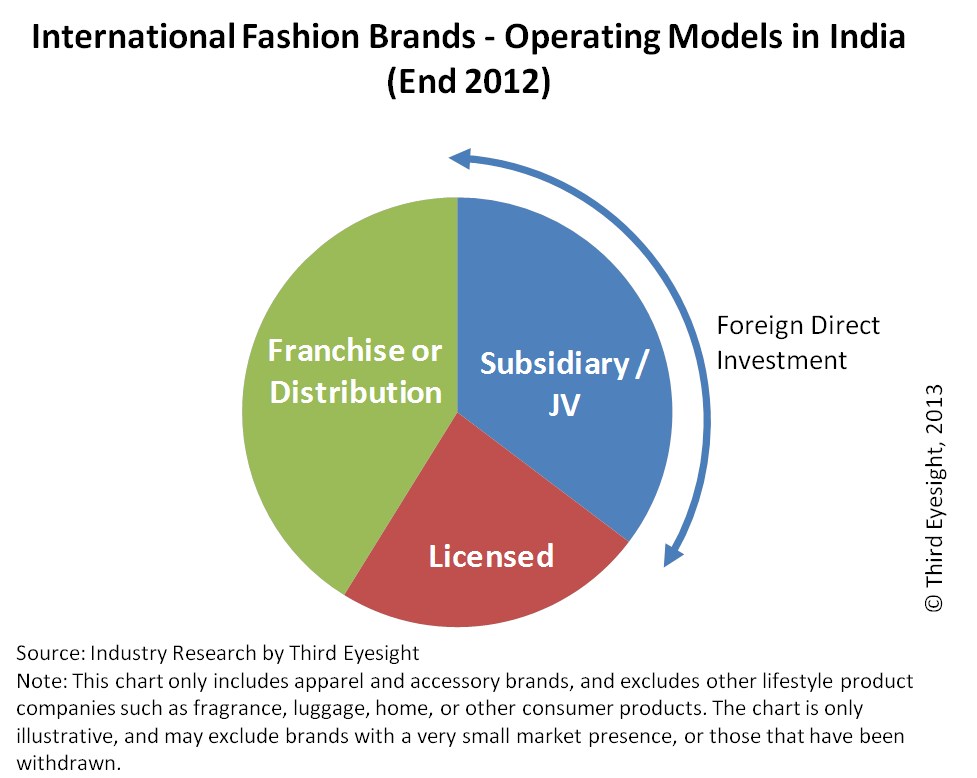
Franchising is still the more common form of route to market for most single brand retail companies although for many international companies an eventual ownership in India business may be desirable. However, licensing should not be excluded from the choice set, especially for companies that are multi-brand retail concepts such as Sephora or those that manage to find a suitable Indian partner that can provide end-to-end support from product sourcing to distribution and retail (for example, the relationship between Elle and Arvind).
Today two thirds of the international fashion brands come from three countries the U.S.A., Italy and the U.K. with nearly 30 per cent originating from the U.S.A. alone.

Is This A Lucky 13?
The theme for the year 2013 is positive for most brands, although still cautious.
Amongst the international brands that one can look forward to shopping in 2013 are “Uniqlo” of Fast Retailing, Japan’s largest apparel retailer, Sweden’s H&M, Emilio Pucci and Billabong. But India is not merely a destination anymore for the international brands to grow their business. The country is also increasingly becoming the innovation-platform or testing ground for new concepts and trends. World Co. a Japanese retailer with more than 3,000 stores in Japan and 200 stores in other parts of Asia is also test-marketing women’s apparel and accessories brands such as Couture Brooch, Opaque.clip, zoc, Tk Mixpie and Hot Beat to gain insights into consumers’ psyche. Italian brand United Colors of Benetton has recently introduced a global retail interior design concept which is present in major European cities but is the first-of-its-kind store in Asia and may well set the trend for the rest of Asia.
Gucci recently opened its largest store in India recently Delhi-NCR after two failed joint ventures. All of its five stores are now run directly by the company and the Indian business also reported to have turned profitable this year.
Brands such as Mango who have chosen the franchise route are tying up with additional partners (e.g. DLF) in the hope of making the Indian business contribute significantly to the overall revenue of the company.
UK-based apparel chain Marks & Spencer is accelerating its expansion in India with plans to add ten stores in the next six to eight months in the country. The company has identified India as one of the key markets to become the world’s most sustainable retailer by 2015. It plans to increase the number of stores in India from 24 currently to over 30 through the 51:49 joint venture with Reliance Retail.
Puma SE, the global sports lifestyle company for athletic shoes, footwear, and other sports-wear aggressively set out to gain 30 per cent of the Indian organised retail sportswear market within a year, from a share of 18-20 per cent in the top four branded sportswear segments in 2011. To this end the company targeted opening nearly 100 more stores during 2012. While the actual numbers are reportedly short of target, the brand has been opening amongst the largest stores during the year.
The confidence in the India opportunity is rising again, with existing global brands expecting the contribution from India business to grow multi-fold in a few years. However, the approach is of careful consideration and brands realise that India is a unique market, different not only from the West but also from other Asian economies such as China. Rather than adopting a “cut-and-paste” approach one needs to seriously consider the appropriate business model for India. Many of the global players have had to create a different positioning from their home markets. Some have significantly corrected pricing and fine-tuned the product offering since they first launched; these include The Body Shop and Marks & Spencer. Others are unearthing new segments to grow into; for instance, Puma and Lacoste are now seriously targeting womenswear as a growth market.
It is not only international brands that are more optimistic. Indian partners are also reviewing their approach. For instance, the Arvind Group that had looked at reducing its emphasis on international fashion brands in 2007-08 has recently acquired the business operations of Planet Retail which operated the franchises of British fashion retailers Debenhams and Next, and American lifestyle brand Nautica in India. The company termed Debenhams’ franchise as a significant acquisition as it provided an entry into the department store segment. Arvind plans to increase the India presence of Debenhams from 2 stores to 8 over the next three years. It also plants to grow the network of Next, the large-format speciality stores, from 3 to 12 in the same period.
As customer footfall and conversions pick up, international brands are also shoring up their foundations for future expansion in terms of better processes and systems, closer understanding of the market, and nurturing talent within their team. Third Eyesight’s study of the market highlights international brands’ concerns with ensuring a consistent brand message, improved organisational capabilities right down to front-line staff, and focussing on unit productivity (per store and per employee).
India shows signs of a healthier business outlook for International brands but the game has just begun and with competition getting tougher, we can expect interesting times ahead.
admin
June 26, 2012
There was time when there were two choices for the middle-class Indian male of all ages—(usually) Bata or (occasionally) the Chinese guy who made shoes to order. Over the years, other brands also entered the market. Things have changed. While it may not reach the scale of an all-consuming obsession, there’s now a strong enough market in India for several upscale overseas and local brands to think it worth their while to vie for custom here, as Paromita Banerjee of Mint discusses in this video.
The article from Mint by Sapna Agarwal & Byravee Iyer is available here.
